
14 Aug How to Calculate Child Support Payments in Florida
Summary
This article explains how to calculate child support in Florida under Fla. Stat. § 61.30. It walks through the statutory formula used by Florida courts, including how gross income and net income are determined, how the child support guidelines table is applied, and how each parent’s percentage share is calculated. The article also explains substantial time-sharing adjustments, health insurance and daycare allocations, retroactive child support, and when courts may deviate from the guideline amount. It includes controlling Florida case law such as Finney v. Finney, Wilcox v. Munoz, M.M. v. J.H., and Marquez v. Lopez, with Miami-specific considerations for cases in the Eleventh Judicial Circuit. The guide is designed to help parents understand how child support is calculated and what factors may affect their financial obligation.
How to Calculate Child Support Payments in Florida? They are governed by a detailed statutory formula set forth in Fla. Stat. § 61.30. In Miami-Dade County and throughout Florida, courts are required to apply the statutory child support guidelines, make specific written findings, and ensure that all calculations are supported by competent substantial evidence. Understanding how to calculate child support payments in Florida is essential for parents navigating divorce, paternity, or modification proceedings in the Eleventh Judicial Circuit and across the state.
This article examines the statutory framework, relevant appellate case law, time-sharing adjustments, retroactive support, deviations, and Miami-specific procedural considerations. It is designed to provide a legally grounded explanation of how to calculate child support payments in Florida under controlling authority.
Statutory Framework for How to Calculate Child Support Payments in Florida
The primary statutory authority governing how to calculate child support payments in Florida is Fla. Stat. § 61.30. The statute establishes a presumptive guideline amount based on the combined net monthly income of both parents and the number of minor children. The guideline amount is rebuttably presumed to be the correct child support obligation. Courts must either apply the guideline amount or make written findings justifying any deviation greater than five percent pursuant to Fla. Stat. § 61.30.
Child support determinations frequently arise in dissolution proceedings under Fla. Stat. § 61.13, which governs parenting plans and time-sharing, and in Title IV-D proceedings under Fla. Stat. § 409.2563. In Miami-Dade County, these cases are adjudicated within the Family Division of the Eleventh Judicial Circuit.
Step One in How to Calculate Child Support Payments in Florida: Determining Gross Monthly Income
The first step in how to calculate child support payments in Florida is identifying each parent’s gross monthly income. Fla. Stat. § 61.30 defines gross income broadly to include wages, salary, commissions, bonuses, business income, disability benefits, workers compensation, unemployment compensation, pension income, Social Security benefits, and spousal support received from a previous marriage.
In Finney v. Finney, 995 So. 2d 579 (Fla. 2d DCA 2008), the appellate court emphasized that trial courts must make explicit findings as to each party’s income and must rely on evidence in the record. Failure to include specific income findings renders a child support order facially erroneous and subject to reversal. Miami courts routinely require submission of financial affidavits pursuant to the Florida Family Law Rules of Procedure, and accurate income documentation is critical.
Step Two in How to Calculate Child Support Payments in Florida: Net Monthly Income
After determining gross income, allowable deductions are subtracted to arrive at net monthly income. Under Fla. Stat. § 61.30, deductions include federal, state, and local income taxes, self employment taxes, mandatory union dues, mandatory retirement payments, health insurance payments excluding coverage for the minor child, and court ordered alimony actually paid.
The holding in Finney v. Finney, 995 So. 2d 579 (Fla. 2d DCA 2008), underscores that deductions must be supported by competent evidence. Courts in Miami-Dade require clarity in the calculation worksheet and frequently attach a child support guidelines worksheet to the final judgment.
Combined Net Income and the Statutory Guidelines Table
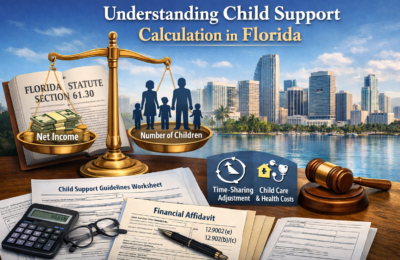
Once net income for both parents is established, the amounts are combined. The combined net monthly income is then applied to the child support guidelines schedule contained in Fla. Stat. § 61.30. The guidelines table establishes a presumptive child support need based on income and number of children.
In Wilcox v. Munoz, 35 So. 3d 136 (Fla. 2d DCA 2010), the court reiterated that the statutory formula must be followed precisely. Courts may not approximate or estimate guideline obligations without explicit findings. Miami trial judges are required to ensure that the worksheet calculations match the evidence and statutory table.
Percentage Share Calculation in How to Calculate Child Support Payments in Florida
Each parent’s percentage share of the child support obligation is determined by dividing that parent’s net income by the combined net income. That percentage is then applied to the total guideline need. This allocation ensures proportional responsibility consistent with Fla. Stat. § 61.30.
Both Finney v. Finney, 995 So. 2d 579 (Fla. 2d DCA 2008), and Wilcox v. Munoz, 35 So. 3d 136 (Fla. 2d DCA 2010), require detailed findings demonstrating how each percentage was calculated. Failure to document the calculation process may result in remand.
Time Sharing Adjustments Under Fla. Stat. § 61.30
How to calculate child support payments in Florida becomes more complex when substantial time-sharing applies. If a parent exercises at least twenty percent of the overnights, defined as seventy three or more overnights annually, the court must apply the statutory substantial time-sharing formula under Fla. Stat. § 61.30.
The formula involves multiplying the basic child support obligation by 1.5, allocating responsibility based on percentage shares, and adjusting based on the number of overnights each parent exercises. The parent with the greater obligation pays the net difference.
Time-sharing determinations are governed by Fla. Stat. § 61.13. Courts must ensure that the parenting plan and the child support worksheet are internally consistent. In Miami, discrepancies between the parenting plan and worksheet frequently lead to post judgment motions.
Additional Child Related Expenses
Fla. Stat. § 61.30 requires inclusion of health insurance costs for the child and reasonable child care expenses. These costs are added to the basic obligation and allocated according to each parent’s percentage share. Fla. Stat. § 61.13 also authorizes courts to address health insurance and uncovered medical expenses.
Miami courts carefully scrutinize child care documentation, particularly in cases involving fluctuating employment or self employment income. The expenses must be reasonable and necessary.
Retroactive Child Support in Florida
In initial proceedings, courts may award retroactive child support for up to twenty four months preceding the filing date pursuant to Fla. Stat. § 61.30. Retroactive support must be calculated using the guidelines in effect at the time of the hearing, while considering actual income during the retroactive period.
Title IV-D cases under Fla. Stat. § 409.2563 also authorize retroactive support. Administrative procedures in certain circuits, including administrative orders such as Fla. 9th Jud. Cir. AO 2010-27, provide procedural guidance, although the controlling authority remains statutory.
Deviations from the Child Support Guidelines
Fla. Stat. § 61.30 permits deviation from the guideline amount by more than five percent if the court makes written findings explaining why the guideline amount would be unjust or inappropriate. Factors include extraordinary medical needs, independent income of the child, seasonal variations in income, and equitable considerations.
In Wilcox v. Munoz, 35 So. 3d 136 (Fla. 2d DCA 2010), the court emphasized the necessity of detailed findings supporting deviation. In M.M. v. J.H., 251 So. 3d 970 (Fla. 2d DCA 2018), the Third District, which governs Miami-Dade County, reiterated that conclusory deviation findings are insufficient. In Marquez v. Lopez, 187 So. 3d 335 (Fla. 3d DCA 2016), the court reversed a support award lacking adequate findings.
Appellate Requirements and Facial Error
Appellate courts consistently hold that failure to include income findings, worksheet calculations, and statutory references constitutes reversible error. Finney v. Finney, 995 So. 2d 579 (Fla. 2d DCA 2008), M.M. v. J.H., 251 So. 3d 970 (Fla. 2d DCA 2018), and Marquez v. Lopez, 187 So. 3d 335 (Fla. 3d DCA 2016), collectively underscore that strict adherence to Fla. Stat. § 61.30 is mandatory.
In Miami family law litigation, practitioners must ensure that proposed final judgments include a completed guidelines worksheet and detailed findings to avoid remand.
Miami Specific Considerations
In Miami-Dade County, child support cases are adjudicated in the Eleventh Judicial Circuit. High cost of living, self employment income, international income sources, and complex compensation structures are common. Accurate tracing of income and careful application of Fla. Stat. § 61.30 are essential.
Local practice often requires submission of updated financial affidavits shortly before trial. Courts expect clarity in income documentation, particularly in business ownership cases.
Conclusion: How to Calculate Child Support Payments in Florida
How to calculate child support payments in Florida requires strict compliance with Fla. Stat. § 61.30, careful determination of gross and net income, proportional allocation, proper time-sharing adjustments, inclusion of health insurance and child care expenses, and, where applicable, retroactive calculations. Deviations must be supported by written findings consistent with Wilcox v. Munoz, 35 So. 3d 136 (Fla. 2d DCA 2010), M.M. v. J.H., 251 So. 3d 970 (Fla. 2d DCA 2018), and Marquez v. Lopez, 187 So. 3d 335 (Fla. 3d DCA 2016).
Parents navigating divorce or paternity proceedings in Miami should ensure that child support calculations are transparent, evidence based, and compliant with controlling authority. Because errors frequently result in appeals and remands, strategic legal guidance is critical.
TLDR: To calculate child support payments in Florida under Fla. Stat. § 61.30, courts determine each parent’s gross monthly income, subtract allowable deductions to reach net income, combine both net incomes, apply the statutory guidelines table, allocate responsibility based on percentage share, adjust for substantial time-sharing, and include child health insurance and child care costs. Deviations greater than five percent require written findings supported by evidence.
Frequently Asked Questions
What statute governs how to calculate child support payments in Florida?
Fla. Stat. § 61.30 governs the calculation of child support payments in Florida.
Can a Miami court deviate from the guideline amount?
Yes. Under Fla. Stat. § 61.30, deviation greater than five percent requires written findings explaining why the guideline amount is unjust or inappropriate.
How does time-sharing affect child support?
If a parent exercises at least twenty percent of overnights, the substantial time-sharing formula under Fla. Stat. § 61.30 applies.
Can retroactive child support be ordered?
Yes. Courts may award retroactive support for up to twenty four months preceding the filing date under Fla. Stat. § 61.30 and Fla. Stat. § 409.2563.
What happens if the court fails to make findings?
Appellate courts may reverse or remand, as demonstrated in Finney v. Finney, 995 So. 2d 579 (Fla. 2d DCA 2008), M.M. v. J.H., 251 So. 3d 970 (Fla. 2d DCA 2018), and Marquez v. Lopez, 187 So. 3d 335 (Fla. 3d DCA 2016).
Need Help Calculating Child Support in Miami?
If you are facing a divorce, paternity action, or modification proceeding in Miami-Dade County, accurate calculation of child support is essential. Ensuring compliance with Fla. Stat. § 61.30 and binding appellate authority protects your financial interests and your child’s wellbeing. Contact an experienced Miami family law attorney to review your income documentation, time-sharing schedule, and child support worksheet before your final hearing.