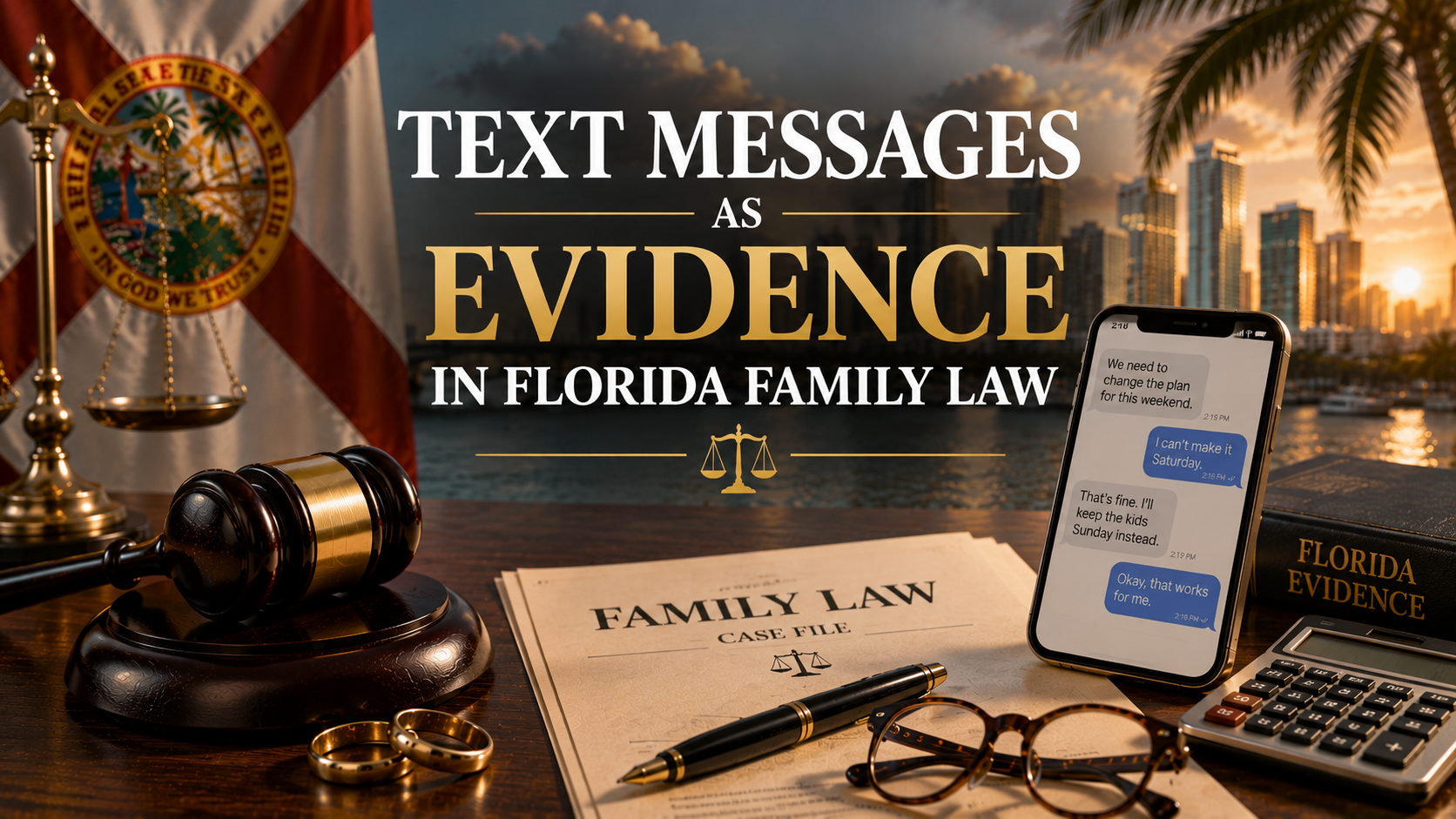
14 May Text Messages as Evidence in Florida Family Law
Summary
This article explains how Florida courts evaluate text messages in divorce, paternity, timesharing, child support, and domestic violence cases. It covers authentication, screenshots as originals, hearsay objections, excited utterances, and practical steps for presenting digital evidence in Miami-Dade and Broward family courts.
Few categories of proof have become as central to modern divorce, paternity, timesharing, and domestic violence cases as text messages, yet the rules governing text messages as evidence in Florida family law remain widely misunderstood by litigants who assume that anything stored on a smartphone is automatically admissible in court. In reality, the Florida Evidence Code imposes specific, sequenced requirements before a judge in the Eleventh Judicial Circuit in Miami-Dade County or the Seventeenth Judicial Circuit in Broward County may consider an SMS thread, an iMessage exchange, or a screenshot of a WhatsApp conversation. Authentication, the best evidence rule, hearsay, and the procedural mechanics of preliminary facts each play a distinct role, and a failure on any one front can result in exclusion of the most damaging communications in the file.
This article walks through the legal framework that governs text messages as evidence in Florida family law, the principal methods Florida courts have approved for authenticating electronic communications, the hearsay considerations that often determine whether a message comes in for its truth, and the practical strategies an experienced Miami family law attorney uses to package text message evidence for trial. The discussion draws on the Florida Statutes governing evidence, including section 90.901, section 90.951, section 90.105, section 90.801, and section 90.803(2), as well as the Florida appellate authority that has shaped how trial courts evaluate digital communications, including D.W. v. State, 388 So. 3d 1161 (Fla. 2d DCA 2024), Gilbert v. State, 324 So. 3d 598 (Fla. 2d DCA 2021), Walker v. Harley-Anderson, 301 So. 3d 299 (Fla. 4th DCA 2020), and Johnson v. State, 969 So. 2d 938 (Fla. 2007).
Why Text Messages as Evidence in Florida Family Law Cases Have Become So Important
In a typical Miami dissolution case, communications between spouses, between a parent and a co-parent, or between a parent and a child have migrated almost entirely to text-based platforms. Parties exchange schedule changes by SMS, debate financial matters through iMessage, document concerns about substance abuse or violence in screenshots saved to camera rolls, and route routine updates through co-parenting apps. Consequently, when a contested timesharing hearing or a hearing on a motion for temporary relief arrives at the courthouse on Northwest Twelfth Avenue, the most probative evidence is often a string of messages exchanged weeks or months earlier.
Furthermore, because text messages are written contemporaneously and are usually preserved on at least one device, they tend to be more reliable than after-the-fact recollections from witnesses who have a strong incentive to shade their version of events. As a result, both petitioners and respondents in family law proceedings throughout South Florida increasingly rely on text messages as evidence in Florida family law disputes. Notably, a single message acknowledging an extramarital affair, threatening a child, agreeing to a parenting schedule, or admitting to undisclosed income can change the trajectory of a case. For that reason, understanding how to introduce text messages as evidence in Florida family law proceedings is no longer a niche evidentiary skill; it is foundational practice for any litigant serious about presenting a complete record to the court.
Authentication: The First Hurdle Under Section 90.901
Authentication is the gateway requirement for all evidence in Florida, and texts are no exception. Specifically, section 90.901, Florida Statutes, provides that authentication or identification of evidence is a condition precedent to admissibility, satisfied by evidence sufficient to support a finding that the matter in question is what its proponent claims. Fla. Stat. § 90.901. In other words, before the trial judge will consider the substance of any text message, the party offering the message must lay a foundation tying that message to a specific author, recipient, or event in a manner that a reasonable fact-finder could accept.
Significantly, Florida appellate courts have characterized authentication as a “relatively low threshold,” meaning that the proponent need not prove authorship beyond doubt or eliminate every conceivable possibility of fabrication. Instead, the standard is a prima facie showing of authenticity, after which the fact-finder ultimately determines whether the exhibit is genuine and what weight to give it. D.W. v. State, 388 So. 3d 1161 (Fla. 2d DCA 2024). For litigants in Miami-Dade and Broward divorce proceedings, this is encouraging news because it means that a perfect chain of forensic custody is rarely required to admit text messages as evidence in Florida family law cases. At the same time, the threshold is not zero, and a party who shows up to a temporary relief hearing with a stack of unexplained screenshots and no foundation testimony is likely to face an objection that the trial court will sustain.
What Counts as a Prima Facie Showing
A prima facie showing of authenticity for a text message ordinarily consists of testimony, an exhibit, or a combination of both that connects the messages to an identified speaker and to the events at issue. Under section 90.901, the proponent may rely on direct or circumstantial proof, including appearance, contents, substance, internal patterns, or other distinctive characteristics taken in conjunction with the circumstances. Fla. Stat. § 90.901; Gilbert v. State, 324 So. 3d 598 (Fla. 2d DCA 2021). Consequently, a party who can testify that a particular phone number belongs to the opposing party, that the messages reflect the parties’ ongoing conversation about a specific child or financial issue, and that the screenshots accurately depict what appeared on the witness’s screen has typically met the threshold.
Methods of Authenticating Text Messages as Evidence in Florida Family Law
Because section 90.901 does not prescribe a single method, Florida courts evaluate authentication of electronic communications case by case. D.W. v. State, 388 So. 3d 1161 (Fla. 2d DCA 2024). For text messages in particular, two pathways recur in Florida appellate decisions: direct testimony from a witness with personal knowledge, and circumstantial authentication based on distinctive characteristics and surrounding circumstances. Both pathways are available to litigants in family law cases, and seasoned trial counsel often combines them to build redundancy into the foundation.
Direct Testimony From a Witness With Knowledge
The most straightforward method involves placing a witness on the stand who personally received or sent the messages. For instance, in a dissolution of marriage proceeding, the wife may testify that she received the messages on her own iPhone from a number she has identified as belonging to her husband, that she has communicated with that number for years, and that the screenshots accurately depict the conversation. Likewise, in a paternity action under Chapter 742, a mother may testify that the messages came from a number saved in her contacts as the father and reflect their ongoing exchanges about the child’s medical appointments, school schedule, or timesharing pickups. Florida courts have repeatedly accepted this kind of direct, percipient testimony as sufficient to establish a prima facie foundation under section 90.901. Gilbert v. State, 324 So. 3d 598 (Fla. 2d DCA 2021).
Circumstantial Authentication Through Distinctive Characteristics
In contrast, when a witness cannot identify the sender by direct observation, Florida law permits circumstantial authentication grounded in the content and context of the messages themselves. Section 90.901 contemplates this approach by referencing appearance, contents, substance, internal patterns, or other distinctive characteristics taken in conjunction with the circumstances. Fla. Stat. § 90.901. As applied to text messages, distinctive characteristics may include references to facts known only to the parties, the use of nicknames, the discussion of events that match independently verifiable timelines, and the presence of reply patterns indicating that the messages are part of a coherent dialogue rather than fabricated standalone fragments. Gilbert v. State, 324 So. 3d 598 (Fla. 2d DCA 2021). Notably, Florida appellate authority recognizes that authentication of electronic communications is often circumstantial and that the law in this area continues to evolve as new platforms emerge. Gilbert v. State, 324 So. 3d 598 (Fla. 2d DCA 2021).
Moreover, while Florida cases also discuss specialized foundations for audio recordings, including device operation, accuracy, and voice identification, those recording-specific factors are not the typical framework for text messages. Instead, text messages are most commonly authenticated through the section 90.901 distinctive characteristics approach, supplemented by witness testimony establishing receipt and surrounding context. Gilbert v. State, 324 So. 3d 598 (Fla. 2d DCA 2021). For a Miami family law litigant, this means that a careful narrative laying out the relationship between the parties, the device used, the contact name, and the content of the conversation will usually carry the day.
When Authentication Fails: The Cautionary Lesson of Walker v. Harley-Anderson
Florida appellate courts have made clear that even though the authentication bar is low, it is real, and proponents who skip the foundational steps risk exclusion of their most powerful proof. Walker v. Harley-Anderson, 301 So. 3d 299 (Fla. 4th DCA 2020), reflects exactly that danger. In that decision, the proponent failed to authenticate text messages, and the appellate court confirmed that a failure of authentication can result in exclusion. Accordingly, even though the threshold under section 90.901 is described as “relatively low,” it still requires some competent evidence connecting the messages to what the proponent claims they are. D.W. v. State, 388 So. 3d 1161 (Fla. 2d DCA 2024).
For a Miami divorce or paternity litigant, the practical implication is straightforward: do not assume that handing the bailiff a stack of screenshots, or holding up a phone in front of the bench, will satisfy the rules of evidence. Instead, prepare an authenticating witness, prepare clean exhibits, and prepare a brief but thorough foundation that addresses the device, the contact information, the dates of the messages, and the accuracy of the screenshots. Indeed, in many family law trials in the Eleventh Judicial Circuit, the difference between a hearing that goes well and one that goes poorly is whether counsel laid the section 90.901 foundation properly before moving the texts into evidence.
Best Evidence and “Originals” Under Section 90.951
A second evidentiary doctrine that often arises with text messages as evidence in Florida family law is the best evidence rule, codified principally in section 90.951, Florida Statutes. Florida defines “writings” and “recordings” broadly to include data compilations and electronic recordings, and significantly, the statute provides that if data are stored in a computer or similar device, any printout or other output readable by sight and shown to reflect the data accurately is an “original.” Fla. Stat. § 90.951. As a result, screenshots and printouts of text messages are not automatically excluded as mere “copies” simply because they are not the digital file stored on the underlying server.
That said, the original concept does not eliminate the separate authentication requirement. Even if a screenshot or printout qualifies as an original, the proponent must still satisfy section 90.901 by showing that the exhibit is what it is claimed to be, including a true and accurate depiction of the messages sent and received in a particular conversation. Fla. Stat. § 90.901. Practically, the testifying witness should describe the device on which the messages appeared, confirm that the screenshots were taken without alteration, and confirm that the printed pages accurately reflect what the witness saw on the screen. With that foundation, screenshots are routinely received as originals in Miami-Dade and Broward family law trials.
Furthermore, parties should remember that section 90.951’s broad definition of writings and recordings extends to a variety of platforms beyond traditional SMS, including iMessage, WhatsApp, Facebook Messenger, Instagram direct messages, and text fields within co-parenting apps such as Our Family Wizard and TalkingParents. So long as the data are stored electronically and the proponent can show that the printout or screenshot accurately reflects that data, the output qualifies as an original under section 90.951.
The Hearsay Hurdle: Are Text Messages Offered for Their Truth?
Even after a party clears authentication and best evidence, a third doctrine often determines whether text messages as evidence in Florida family law come in for a particular purpose. That doctrine is hearsay, defined by section 90.801, Florida Statutes, as an out-of-court statement offered to prove the truth of the matter asserted. Fla. Stat. § 90.801. Because text messages are, by definition, out-of-court statements, the hearsay analysis turns almost entirely on the purpose for which the messages are offered.
Hearsay Versus Non-Hearsay Purposes
When offering texts in Miami family court, the proponent should be prepared to articulate whether the texts are offered for their truth, in which case the hearsay analysis applies, or for a non-hearsay purpose such as effect on the recipient, notice, state of mind, or context, in which case the hearsay rule may not apply at all. Fla. Stat. § 90.801. Notably, even when the messages are offered for a non-hearsay purpose, authentication and relevance still apply, and the proponent should be ready to explain the non-hearsay theory clearly so that the trial court can rule on the objection without confusion.
For example, in a domestic violence injunction hearing in Miami-Dade County, a text from the respondent saying “I will be at your house in five minutes” may be offered not to prove that the respondent actually arrived in five minutes, but to show that the petitioner reasonably feared imminent harm. Used that way, the message is offered for its effect on the listener, not for the truth of the matter asserted, and the hearsay rule does not bar admission. Similarly, in a parenting plan modification case, a text expressing a co-parent’s intent to relocate may be offered to demonstrate the existence of a substantial change in circumstances, rather than to prove the truth of any underlying fact about the destination.
The Excited Utterance Exception Under Section 90.803(2)
If text messages are offered for their truth, the proponent must identify a hearsay exception or exclusion. One commonly litigated exception in Florida family law is the excited utterance exception under section 90.803(2). Specifically, an excited utterance is a statement relating to a startling event made while the declarant was under the stress of excitement caused by the event. Johnson v. State, 969 So. 2d 938 (Fla. 2007). Florida courts apply a three-part test that examines whether there was a startling event, whether the statement was made before there was time to contrive or misrepresent, and whether the statement was made while the declarant was still under the stress of excitement. Johnson v. State, 969 So. 2d 938 (Fla. 2007).
In appropriate circumstances, a text message can qualify as an excited utterance if the proponent can establish those elements. Johnson v. State, 969 So. 2d 938 (Fla. 2007). For instance, a text sent moments after a violent incident describing what just happened, sent while the declarant was still in the stress of the event, may qualify under section 90.803(2). On the other hand, a message composed days later, after time for reflection, would generally not qualify because the stress of the event has dissipated and the declarant has had time to contrive. Whether a particular text qualifies will depend heavily on timing, content, and surrounding circumstances, all of which must be established through testimony or other admissible evidence. Johnson v. State, 969 So. 2d 938 (Fla. 2007).
Preliminary Facts and Conditional Admission Under Section 90.105
Florida family law trials rarely proceed in a perfectly linear fashion, and questions about the admissibility of text messages often hinge on preliminary facts that themselves require some evidence. Recognizing that practical reality, section 90.105, Florida Statutes, addresses the trial court’s role when relevancy or admissibility depends on a preliminary fact. The court admits the evidence when there is prima facie evidence sufficient to support a finding of that preliminary fact, and the court may admit the evidence subject to later proof. Fla. Stat. § 90.105. Consequently, when admissibility depends on whether the messages are connected to a particular sender or whether a foundational circumstance exists, Florida law permits admission upon prima facie proof of the preliminary fact, and also permits conditional admission subject to later introduction of additional prima facie evidence. Fla. Stat. § 90.105.
Strategically, this provision supports an orderly presentation in which the authenticating witness and foundational testimony are presented before, or promptly after, the texts are moved into evidence. In practice, an experienced Miami family law trial attorney typically structures the direct examination so that the predicate questions about the device, the contact, and the content come immediately before the request to publish the exhibit. If circumstances require introducing the messages before all foundational facts are in place, counsel may request conditional admission under section 90.105 with the express commitment to complete the foundation later in the trial.
Practical Strategies for Using Text Messages as Evidence in Florida Family Law Hearings
Beyond the doctrinal framework, certain practical habits separate effective use of text messages as evidence in Florida family law from ineffective use. First, preserve the messages early and in multiple formats. As soon as a dispute is reasonably anticipated, parties should back up the relevant device, export the conversations using built-in tools where available, and capture screenshots of each message in context. Second, organize the messages chronologically, with date and time stamps visible, so that the trial judge can follow the narrative without effort. Third, keep the screenshots clean by avoiding crops or annotations that could trigger an authentication objection grounded in alteration concerns.
Furthermore, prepare the authenticating witness in advance. The witness should be able to identify the device on which the messages appeared, the contact information associated with the sender, the approximate date range, the platform used, and any reasons for confidence that the messages have not been altered. In addition, the witness should be ready to explain whether the messages are offered for their truth or for a non-hearsay purpose so that counsel can respond efficiently to objections under section 90.801. With this groundwork, text messages as evidence in Florida family law cases can be admitted promptly without consuming valuable hearing time on foundational disputes.
Moreover, consider the role of forensic preservation in higher-stakes matters. Although the section 90.901 threshold is low, certain disputes involving allegations of fabrication, altered timestamps, or deleted messages benefit from a formal forensic image of the device. A qualified examiner can preserve metadata, recover deleted messages, and provide expert testimony about authenticity that strengthens the section 90.901 foundation and, in some cases, supports the admission of additional categories of digital evidence.
Common Mistakes Miami Litigants Make With Text Message Evidence
Despite the relatively forgiving framework Florida law provides for text messages as evidence in Florida family law, certain mistakes recur across Miami-Dade and Broward family courtrooms. The first mistake is delay. When parties wait to preserve their messages, they risk losing them to phone replacement, factory resets, accidental deletion, or platform retention policies. By the time the case reaches a temporary relief hearing or trial, the most probative messages may simply no longer exist on the witness’s device.
The second mistake is selective production. A party who produces only the messages that favor their position invites cross-examination about omitted context and may face an instruction or argument that the exhibit is misleading. Florida judges in the Eleventh Judicial Circuit are sophisticated readers of digital communications and routinely notice when a thread appears to begin in the middle of a conversation. Producing the full thread, even when parts of it are unhelpful, generally enhances credibility under section 90.901’s distinctive characteristics analysis. Gilbert v. State, 324 So. 3d 598 (Fla. 2d DCA 2021).
A third mistake is conflating authentication with admission for the truth. Some litigants assume that once the trial court finds the messages authentic under section 90.901, the messages are automatically admissible for every purpose. In reality, hearsay analysis under section 90.801 still applies independently, and the proponent must address the purpose of the offer separately. D.W. v. State, 388 So. 3d 1161 (Fla. 2d DCA 2024). For that reason, careful counsel maintains a checklist that distinguishes authentication, best evidence, hearsay, and relevance, and addresses each in turn.
Finally, some parties undermine their text message evidence through improper conduct in obtaining the messages. Florida law generally allows a party to use messages on devices the party owns or that the party may legitimately access, but unauthorized access to a spouse’s accounts or devices can give rise to separate legal exposure and may complicate the evidentiary analysis. Therefore, parties who suspect they have access concerns should consult an attorney before extracting messages from any device that is not exclusively their own.
How a Miami Family Law Attorney Strengthens Text Message Evidence
Working with experienced counsel meaningfully changes how text messages as evidence in Florida family law cases are received by the trial court. The Law Firm of Jeffrey Alan Aenlle, PLLC, serving Miami-Dade and Broward Counties, regularly assists clients with the preservation, organization, and presentation of digital communications in dissolution, paternity, timesharing, child support, alimony, and domestic violence injunction proceedings. Counsel can identify the relevant message threads early, coordinate with forensic professionals when needed, prepare the authenticating witness, draft motions in limine to address anticipated objections, and structure the direct examination so that section 90.901 and section 90.951 foundations are laid efficiently before the texts are moved into evidence.
If you are involved in a Florida family law case in Miami or Fort Lauderdale and the outcome may turn on text messages between you and the other party, do not wait until the eve of a hearing to think about admissibility. Instead, contact the Law Firm of Jeffrey Alan Aenlle, PLLC, at +1.786.309.8588 to discuss your case. The firm will help you preserve the messages, evaluate their evidentiary value under the Florida Evidence Code, and develop a clear plan to present them to the trial court in a manner that complies with section 90.901, section 90.951, section 90.105, section 90.801, and any applicable hearsay exception under section 90.803.
Furthermore, because every family law case has unique facts, the firm tailors its approach to the specific dynamics of your dispute. Whether the issue involves co-parenting communications, financial admissions, threats, or admissions concerning hidden assets, the firm has experience preparing text message exhibits for hearings before the family division of the Eleventh Judicial Circuit and the Seventeenth Judicial Circuit. Calling early matters because preservation steps are most effective when taken promptly, before messages are lost or altered.
Conclusion
In Florida family law proceedings, text messages are admissible only if the proponent satisfies the Florida Evidence Code at each stage of the analysis. The proponent must make a prima facie showing of authenticity under section 90.901, which may be established through direct testimony or through circumstantial evidence based on distinctive characteristics and surrounding circumstances. Fla. Stat. § 90.901; Gilbert v. State, 324 So. 3d 598 (Fla. 2d DCA 2021). Screenshots and printouts can qualify as originals under section 90.951 if shown to accurately reflect the electronically stored data, but that does not replace the need for authentication. Fla. Stat. § 90.951. If the texts are offered for their truth, the proponent must also address hearsay under section 90.801 and, where applicable, establish an exception such as excited utterance under section 90.803(2). Fla. Stat. § 90.801; Johnson v. State, 969 So. 2d 938 (Fla. 2007). Section 90.105 provides flexibility through prima facie and conditional admission when admissibility depends on preliminary facts. Fla. Stat. § 90.105. Authentication is described as a relatively low threshold, but it is not zero, and a careful approach to text messages as evidence in Florida family law remains essential, as Walker v. Harley-Anderson, 301 So. 3d 299 (Fla. 4th DCA 2020), and D.W. v. State, 388 So. 3d 1161 (Fla. 2d DCA 2024), confirm.
TLDR: Text messages as evidence in Florida family law are admissible only after the proponent establishes a prima facie foundation under section 90.901, addresses the best evidence rule under section 90.951, and resolves any hearsay objection under section 90.801, including by relying on exceptions such as excited utterance under section 90.803(2) when applicable. Screenshots are usually treated as originals if shown to accurately reflect the underlying data, but a careful authentication record remains essential in Miami-Dade and Broward family courtrooms.
Are text messages automatically admissible in Florida family law cases? No. Text messages are not automatically admissible simply because they appear on a phone or have been printed. Under section 90.901, Florida Statutes, the proponent must make a prima facie showing of authenticity, and if the messages are offered for their truth, the proponent must also overcome any hearsay objection under section 90.801. D.W. v. State, 388 So. 3d 1161 (Fla. 2d DCA 2024); Fla. Stat. § 90.901; Fla. Stat. § 90.801.
How do I authenticate text messages for a Miami divorce hearing? Florida law allows authentication through direct testimony from a witness with knowledge or through circumstantial evidence based on appearance, contents, substance, internal patterns, or other distinctive characteristics taken in conjunction with the circumstances. Fla. Stat. § 90.901; Gilbert v. State, 324 So. 3d 598 (Fla. 2d DCA 2021). In practice, a witness who can identify the device, the contact, and the content of the messages, and who can confirm that the screenshots accurately reflect the original conversation, will usually satisfy the section 90.901 threshold.
Are screenshots of text messages considered originals under Florida law? Yes, under section 90.951, Florida Statutes, when data are stored in a computer or similar device, any printout or other output readable by sight that is shown to reflect the data accurately is an original. Fla. Stat. § 90.951. Therefore, screenshots and printouts of text messages can qualify as originals if a witness establishes that they accurately reflect the messages stored on the device.
Do I still have to deal with hearsay if my texts are authenticated? Yes. Authentication under section 90.901 and the hearsay analysis under section 90.801 are separate inquiries. Even after the trial court determines that text messages are authentic, the proponent must still address whether the messages are offered for the truth of the matter asserted and, if so, whether a hearsay exception applies. Fla. Stat. § 90.801. Common non-hearsay purposes in Miami family law include effect on the recipient, notice, and state of mind, while exceptions such as excited utterance under section 90.803(2) may apply in appropriate circumstances. Johnson v. State, 969 So. 2d 938 (Fla. 2007).
Can a text message qualify as an excited utterance in Florida? Yes, if the proponent can establish a startling event, that the statement was made before there was time to contrive or misrepresent, and that the statement was made while the declarant was still under the stress of excitement caused by the event. Johnson v. State, 969 So. 2d 938 (Fla. 2007). A text sent in the immediate aftermath of a violent or otherwise startling incident may qualify, while a message composed hours or days later generally will not.
What happens if my text messages are not properly authenticated? They may be excluded. Florida appellate authority confirms that the failure to authenticate text messages can result in exclusion under section 90.901. Walker v. Harley-Anderson, 301 So. 3d 299 (Fla. 4th DCA 2020); Fla. Stat. § 90.901. For that reason, parties should not assume that simply showing a phone to the court will satisfy the rules of evidence. Instead, they should prepare an authenticating witness and clean exhibits before the hearing.
Can the trial court admit text messages before the foundation is fully laid? Yes, in appropriate circumstances. Section 90.105, Florida Statutes, permits the trial court to admit evidence on a prima facie showing of a preliminary fact, and to admit evidence conditionally subject to later proof. Fla. Stat. § 90.105. As a result, when the foundation requires testimony from another witness later in the hearing, the trial court may receive the messages conditionally and revisit admissibility once the additional testimony is presented.
Should I hire a Miami family law attorney to help with text message evidence? Yes, especially when the case involves contested allegations, significant assets, or sensitive issues such as parenting and domestic violence. The Law Firm of Jeffrey Alan Aenlle, PLLC, serves Miami-Dade and Broward Counties and regularly handles the preservation, organization, and admission of text messages as evidence in Florida family law cases. To discuss your situation, call the firm at +1.786.309.8588.