
21 Aug Changing a Child’s School After Divorce in Florida
Summary
This article explains how Florida law governs changing a child’s school after divorce, including parental responsibility, relocation rules, and the best interests standard. It also explains how Miami family courts resolve educational disputes when parents disagree.
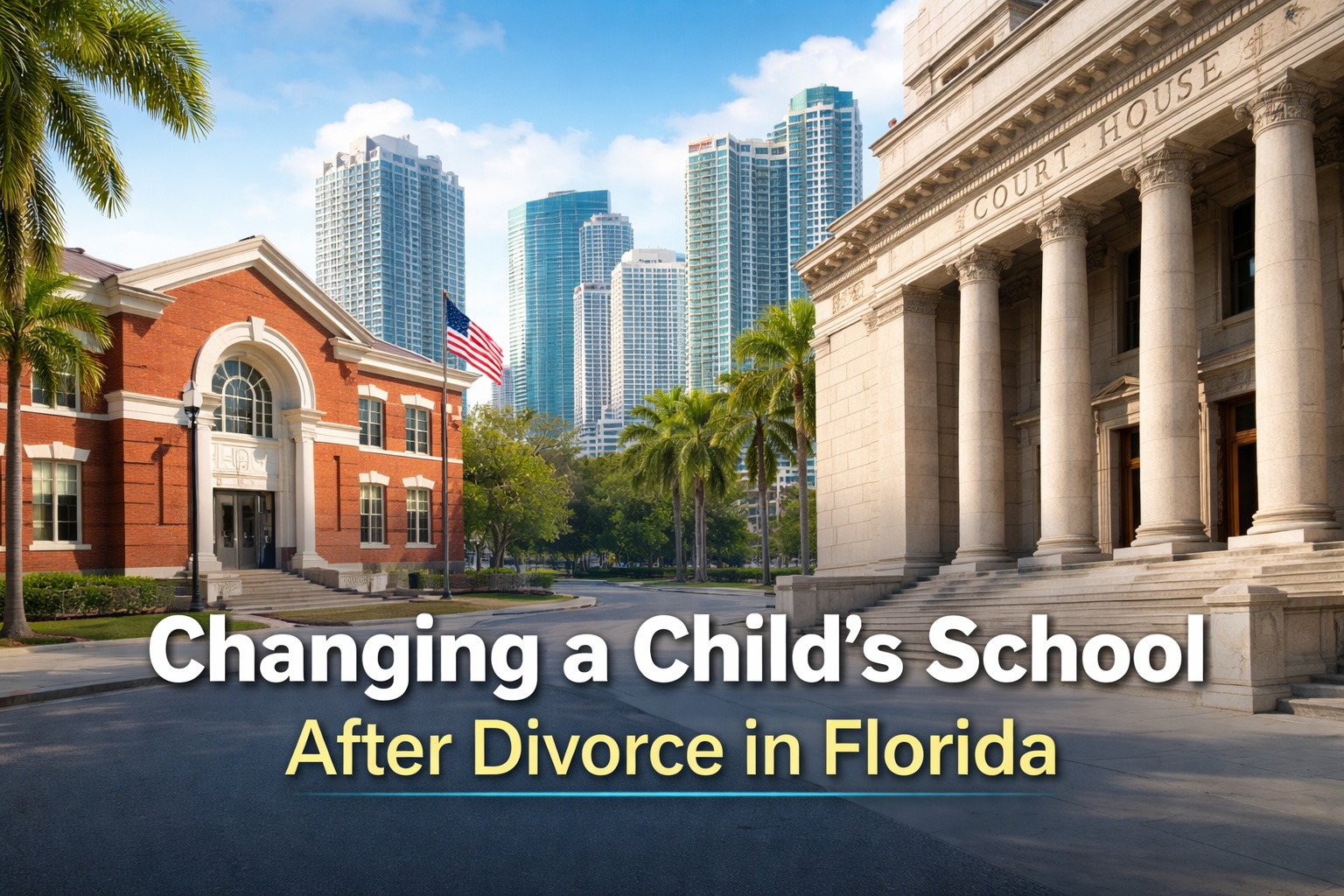
Parents frequently ask whether they can change their child’s school after divorce in Florida. The answer depends on several legal factors including the parenting plan, the allocation of parental responsibility, and the child’s best interests under Florida law. In Miami and throughout Florida, courts emphasize that major decisions affecting a child’s education typically require cooperation between parents when they share parental responsibility. When parents disagree about schooling decisions after divorce, the dispute may ultimately require judicial intervention in family court. Understanding how Florida law governs educational decision making can help parents avoid litigation and protect the stability of their child’s academic environment.
Parental Responsibility and Educational Decisions Under Florida Law
Florida family law begins with the presumption that both parents should remain actively involved in their child’s life after divorce. The governing statute is Fla. Stat. § 61.13, which establishes the framework for parental responsibility and time sharing in dissolution of marriage cases. Under this statute, Florida courts generally order shared parental responsibility unless the court finds that such an arrangement would be detrimental to the child.
Shared parental responsibility means that both parents must confer with one another when making major decisions affecting the welfare of the child. Educational decisions such as selecting or changing a school are considered significant decisions within the meaning of the statute. Because of this requirement, one parent usually cannot unilaterally change a child’s school without consulting the other parent when the parenting plan provides for shared parental responsibility.
Florida appellate courts have repeatedly affirmed this principle. In Martinez v. Martinez, 573 So. 2d 37 (Fla. 3d DCA 1990), the court addressed a dispute involving parental decision making authority regarding a child’s education. The decision clarified that when parents share parental responsibility but cannot agree on educational decisions, the court must determine which option better serves the child’s best interests and may grant ultimate decision making authority to one parent in that specific area.
The Martinez decision remains influential in family courts across Florida, including the Eleventh Judicial Circuit in Miami Dade County. Judges frequently rely on its reasoning when resolving disputes about school selection, extracurricular activities, and other educational matters.
Parenting Plans and Educational Authority
Most divorce judgments in Florida include a parenting plan that governs parental responsibility and time sharing. Parenting plans are required under Fla. Stat. § 61.13. These plans often contain provisions addressing how parents must handle decisions involving education, healthcare, religion, and extracurricular activities.
In some cases, the parenting plan explicitly states which parent has ultimate decision making authority over education. When such authority is granted, the designated parent may make the final decision if the parents cannot agree after good faith consultation.
However, many parenting plans in Miami family law cases simply state that parents must jointly decide educational issues. When the parenting plan contains no tie breaking provision, disagreements may require court intervention. In those situations, the court must analyze the circumstances and determine which educational option serves the child’s best interests.
Sole Parental Responsibility and School Decisions
Although shared parental responsibility is the norm in Florida, there are situations where the court awards sole parental responsibility to one parent. When sole parental responsibility exists, the designated parent generally has the authority to make major decisions affecting the child, including educational choices.
This principle was addressed in Healy v. Healy, 409 So. 3d 128 (Fla. 4th DCA 2025). In that case, the court recognized that when one parent is granted sole parental responsibility, that parent has the authority to make decisions regarding the child’s schooling without obtaining the other parent’s consent. However, the court also emphasized that even when one parent holds sole authority, the decision must still align with the child’s best interests if challenged.
Family courts in Miami and throughout Florida continue to treat the best interests standard as the central guiding principle in all custody and educational disputes.
The Best Interests of the Child Standard
The concept of the child’s best interests is the cornerstone of Florida family law. Section 61.13 of the Florida Statutes provides a comprehensive list of factors that courts must consider when evaluating parenting decisions. These factors include the child’s developmental needs, the capacity of each parent to encourage a close relationship with the other parent, the stability of the child’s environment, and the moral fitness and mental health of the parents.
When parents dispute a proposed school change, the court examines whether the new educational environment benefits the child academically, socially, and emotionally. Stability is often a major consideration. Courts are cautious about disrupting a child’s educational continuity unless there is a compelling reason to do so.
Florida appellate courts have reinforced the importance of the best interests standard in multiple decisions. In Gutierrez v. Medina, 613 So. 2d 528 (Fla. 3d DCA 1993), the court explained that parental disagreements regarding child related decisions must ultimately yield to the child’s welfare. Similarly, in Hassenplug v. Hassenplug, 346 So. 3d 149 (Fla. 2d DCA 2022), the court reiterated that family courts must focus on the child’s stability and developmental needs when resolving parental disputes.
Relocation and School Changes in Florida
In some situations, changing a child’s school may be connected to a relocation by one parent. Florida law addresses relocation in Fla. Stat. § 61.13001. This statute governs any relocation of a child’s principal residence by more than fifty miles for at least sixty consecutive days.
If a parent intends to relocate and enroll the child in a new school located more than fifty miles away, the relocating parent must either obtain written consent from the other parent or file a petition to relocate with the court. The petition must include detailed information about the proposed move and its anticipated effect on the child.
Courts evaluate relocation petitions by examining several statutory factors. These include the child’s relationship with both parents, the feasibility of preserving the relationship with the non relocating parent, the educational opportunities available in the new location, and the child’s overall quality of life.
Failure to comply with the relocation statute can have serious consequences. Courts may deny the relocation request or even modify the parenting plan if a parent relocates without authorization.
School Changes Without Relocation
Not every school change involves relocation. A parent may wish to transfer a child from one school to another within the same metropolitan area. Miami Dade County, for example, contains hundreds of public, charter, and private schools. A parent might wish to change schools for academic reasons, transportation convenience, or specialized educational programs.
Even when the new school is located less than fifty miles away, shared parental responsibility may still require agreement between both parents. The appellate court addressed this scenario in Dickson v. Dickson, 169 So. 3d 287 (Fla. 2d DCA 2015). The court held that although the relocation statute did not apply because the move was less than fifty miles, the parent still needed court approval to change the child’s school due to shared parental responsibility.
This decision highlights an important point. The absence of relocation does not automatically allow a parent to change schools unilaterally when the parenting plan requires joint decision making.
Procedural Requirements When Parents Disagree
When parents cannot agree on a school change, the dispute may be resolved through negotiation, mediation, or court proceedings. Florida family courts strongly encourage parents to resolve disputes through mediation before requesting judicial intervention.
In Miami Dade County, family division judges frequently require mediation before scheduling evidentiary hearings on parenting disputes. During mediation, parents can discuss educational options, transportation issues, and the child’s academic needs with the assistance of a neutral mediator.
If mediation fails, a parent may file a motion seeking court determination regarding the educational decision. The court will then evaluate evidence such as school performance records, expert testimony, and the child’s unique educational needs.
Parents involved in contested custody disputes may also be required to complete a parenting course under Fla. Stat. § 61.21. The purpose of this course is to educate parents about the psychological impact of divorce and parental conflict on children.
Educational Stability and Miami Family Courts
Miami Dade family courts place strong emphasis on maintaining educational stability whenever possible. Judges recognize that frequent school changes can disrupt a child’s academic development and social relationships.
As a result, courts often examine whether the child has established friendships, extracurricular activities, or specialized academic programs at the current school. Judges may also consider commute times, transportation logistics, and each parent’s involvement in the child’s education.
Miami’s diverse educational landscape adds additional complexity to these decisions. Parents may choose between public magnet programs, charter schools, private institutions, and specialized academic academies. Courts must therefore evaluate not only parental preferences but also the objective educational benefits available at each school.
Practical Considerations for Parents
Parents considering a school change after divorce should carefully review their parenting plan and consult with legal counsel before making decisions. Acting unilaterally in violation of the parenting plan can lead to court sanctions or modification of the parenting arrangement.
Effective communication between parents often prevents litigation. When parents share information about academic performance, transportation challenges, and the child’s social needs, they may reach mutually beneficial agreements that prioritize the child’s well being.
In situations where agreement is not possible, parents should be prepared to demonstrate why the proposed school change promotes the child’s best interests.
Conclusion
Changing a child’s school after divorce in Florida is rarely a simple decision. The legal framework governing these disputes involves parental responsibility, parenting plan provisions, and the best interests of the child. When parents share parental responsibility, major educational decisions usually require joint agreement. If the parents cannot agree, the court may intervene and determine which educational option best serves the child.
Relocation issues may add additional complexity when the proposed school change involves moving more than fifty miles from the child’s current residence. In such cases, the relocation statute requires court approval or written consent from the other parent.
Because school decisions can significantly affect a child’s stability and development, Florida family courts approach these disputes with careful consideration of the child’s welfare. Parents navigating these issues should seek informed legal guidance to ensure compliance with Florida law and to protect their child’s educational future.
If you are dealing with a dispute regarding your child’s school after divorce in Miami or elsewhere in Florida, consulting an experienced family law attorney can help you understand your rights and options under Florida law.
TLDR: Changing a child’s school after divorce in Florida depends on parental responsibility, the parenting plan, and the child’s best interests. When parents share parental responsibility, both must agree on major educational decisions unless the court grants one parent ultimate authority. If the parents cannot agree, the court will evaluate statutory best interest factors under Florida law and may determine whether the school change is appropriate.
Can one parent change a child’s school after divorce in Florida?
Generally no when parents share parental responsibility. Major educational decisions must be made jointly unless the parenting plan grants one parent ultimate decision making authority.
What happens if parents disagree about a child’s school?
The dispute may be resolved through mediation or by the family court, which will determine which educational option best serves the child’s best interests.
Does changing schools count as relocation in Florida?
It may if the move changes the child’s principal residence by more than fifty miles. In that case the relocation statute requires court approval.
Can a court modify a parenting plan because of a school dispute?
Yes. Courts may modify decision making authority or time sharing arrangements if necessary to protect the child’s welfare.