
26 Aug Divorce While Pregnant Florida: Legal Rights, Court Procedures, and Miami Family Law Considerations
Summary
This article explains the legal rules governing divorce while pregnant in Florida, including why simplified dissolution is not permitted and how courts address issues involving unborn children. It also discusses Miami specific court practices, paternity presumptions, and financial considerations during pregnancy related divorce cases.
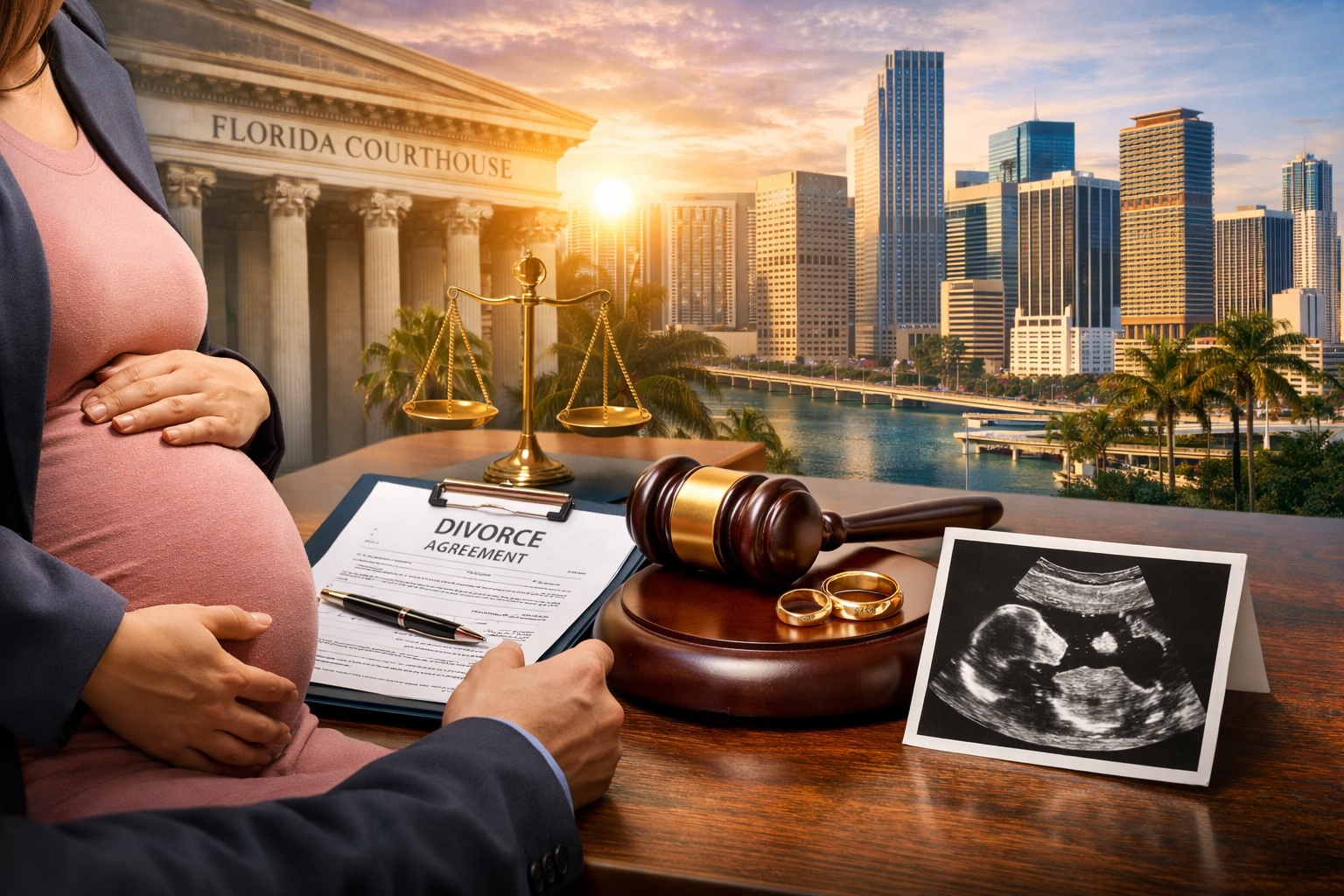
Divorce while pregnant in Florida presents unique legal questions that many spouses do not anticipate when beginning the dissolution process. Pregnancy introduces additional procedural requirements, limitations on simplified divorce options, and special considerations related to the unborn child. Individuals seeking a pregnant divorce in Miami or elsewhere in Florida often want to know whether the law allows a divorce during pregnancy, how the court handles issues involving the unborn child, and what rights each spouse has during the proceedings.
Florida family law does allow spouses to file for divorce during pregnancy, but the process differs from other divorce cases in important ways. Courts must ensure that the legal interests of the unborn child are protected and that issues such as paternity, parental responsibility, and child support are addressed appropriately once the child is born. Understanding the legal framework governing pregnancy divorce rights in Florida is essential for anyone navigating divorce during pregnancy in Miami or throughout the state.
Understanding Divorce While Pregnant in Florida
The question most people ask is simple: can you get divorced while pregnant in Florida. The answer is yes. Florida law permits the filing of a petition for dissolution of marriage regardless of whether the wife is pregnant at the time the case begins. However, pregnancy affects the type of dissolution available and may influence how the court manages the case timeline and issues involving the child.
Under Florida law, a dissolution of marriage action begins with the filing of a petition in circuit court and proper service of that petition on the other spouse. The statute governing this process is Florida Statute § 61.043, which outlines the procedural requirements for initiating a divorce case. The statute also requires that at least one spouse must have lived in Florida for at least six months prior to filing the petition. This residency requirement applies equally to divorce while pregnant Florida cases and to all other dissolutions of marriage.
Although the legal right to file for divorce during pregnancy exists, courts must address several additional issues that arise because a child is expected. These include determining parental rights, preparing for custody arrangements, and ensuring that financial support obligations can be established once the child is born.
Why Simplified Dissolution Is Not Available During Pregnancy
One of the most significant procedural limitations in a divorce while pregnant Florida case involves the inability to use the simplified dissolution process. Florida offers a streamlined divorce procedure for couples who meet specific criteria, including agreement on property division and the absence of minor children. However, pregnancy automatically disqualifies spouses from using simplified dissolution.
The Florida Family Law Rules of Procedure require both parties in a simplified dissolution to certify under oath that the wife is not pregnant. This requirement appears in Florida Family Law Rule of Procedure 12.105 and in the approved simplified dissolution form used by Florida courts. The Florida Supreme Court reaffirmed this limitation when it approved amendments to the simplified dissolution form in In re: Amendments to the Florida Family Law Rules of Procedure – Form 12.901(a), 235 So. 3d 800 (Fla. 2018).
Because of this rule, couples seeking a pregnant divorce Miami residents must proceed through the standard dissolution process rather than the simplified option. This means that additional filings, court supervision, and potentially hearings will occur before the marriage can be legally dissolved.
Court Authority Over Issues Involving the Unborn Child
When divorce during pregnancy Miami cases arise, courts must carefully balance the procedural aspects of the divorce with the future needs of the child. Florida courts have broad authority to issue orders concerning children in dissolution cases, and this authority extends to children conceived during the marriage but not yet born.
The statutory foundation for these decisions is found in Florida Statute § 61.052, which governs dissolution of marriage proceedings and authorizes courts to issue temporary orders involving minor children. Although the unborn child cannot yet be the subject of a finalized custody order, the court may structure the divorce proceedings in a way that allows those issues to be addressed once the child is born.
Florida courts often delay the finalization of certain aspects of a divorce while pregnant Florida case until after birth so that paternity, parental responsibility, time sharing, and child support can be properly determined. This ensures that the child’s legal rights and welfare remain protected within the dissolution process.
Presumption of Paternity in Florida Marriage
Another critical component of pregnancy divorce rights Florida residents should understand is the legal presumption of paternity. Florida law recognizes a longstanding presumption that a child conceived during a valid marriage is the legal child of the husband. This presumption exists to protect the stability of family relationships and the rights of the child.
The Florida appellate decision in Lopez v. Lopez, 627 So. 2d 108 (Fla. 1st DCA 1993), emphasized that issues relating to children conceived during a marriage are properly handled within the dissolution proceeding itself. The court recognized that family courts possess the authority and responsibility to resolve questions about custody, support, and parental rights during divorce cases involving children.
This presumption of legitimacy can be rebutted, but doing so typically requires strong evidence such as genetic testing or other proof demonstrating that the husband is not the biological father. In most divorce while pregnant Florida cases, however, the presumption remains intact and the husband is treated as the legal father for purposes of the divorce and future child support obligations.
How Miami Family Courts Handle Divorce During Pregnancy
Family courts in Miami and throughout South Florida regularly handle cases involving divorce during pregnancy. Because Miami is one of the largest family law jurisdictions in the state, judges in the Eleventh Judicial Circuit are well accustomed to addressing the unique procedural issues that arise when a spouse files for divorce while expecting a child.
In many cases, the court will allow the divorce proceedings to move forward but will delay final decisions concerning parental responsibility or time sharing until after the child is born. This approach allows the court to ensure that any parenting plan reflects the actual circumstances of the child rather than speculative arrangements.
Miami family courts also frequently address temporary financial issues during pregnancy, including spousal support and preparation for future child related expenses. These temporary orders can help ensure that the pregnant spouse receives necessary financial assistance while the divorce case is pending.
Constructive Service and Its Limitations in Pregnancy Divorce Cases
In some divorce cases the filing spouse cannot locate the other spouse for personal service of the divorce petition. Florida law allows constructive service in such circumstances, meaning that notice of the case can be provided through publication rather than personal delivery. However, constructive service significantly limits the court’s authority.
Instructions associated with Florida Family Law Form 12.913 explain that when a divorce proceeds by constructive service, the court cannot grant certain forms of relief such as child support or alimony. The Florida Supreme Court addressed these limitations in In re Amendments to the Florida Supreme Court Approved Family Law Forms, 96 So. 3d 217 (Fla. 2012).
In a divorce while pregnant Florida case, these limitations become particularly important. Because the court must address issues related to the unborn child, constructive service may complicate or delay the resolution of child related matters until the other spouse can be properly brought before the court.
Financial and Parenting Considerations During Pregnancy Divorce
Divorce during pregnancy Miami residents face often involves complex financial planning. Pregnancy itself involves medical expenses, prenatal care, and preparation for the child’s arrival. When a divorce occurs simultaneously, the court may need to determine how these expenses will be handled during the pendency of the case.
Temporary relief orders may address issues such as payment of medical insurance, prenatal medical bills, and living expenses for the pregnant spouse. Courts have broad discretion to ensure fairness between spouses while also protecting the welfare of the expected child.
Once the child is born, the court will typically address parenting plans, time sharing arrangements, and child support calculations based on Florida’s statutory child support guidelines. These decisions become part of the final judgment of dissolution of marriage.
Emotional and Legal Complexity of Divorce While Pregnant
Beyond the legal framework, divorce while pregnant Florida cases can be emotionally complex. Pregnancy often heightens stress and uncertainty for both spouses. Legal guidance becomes especially important during this period to ensure that the rights of both parents and the unborn child are protected.
Miami family law attorneys frequently advise clients to consider the long term parenting relationship that will exist after the divorce is finalized. Even though the marriage may end, both parents will likely remain involved in the child’s life for many years. Courts therefore encourage cooperation and planning when resolving parenting issues connected to pregnancy divorce rights Florida cases.
Why Legal Guidance Matters in Pregnancy Divorce Cases
Because divorce during pregnancy involves overlapping issues of marital dissolution, parental rights, and child welfare, legal guidance is often essential. The procedural rules governing divorce while pregnant Florida cases differ from standard divorces and require careful attention to statutory requirements, court rules, and case law.
For example, spouses must ensure that their dissolution petition complies with the filing requirements of Florida law and that all issues concerning the unborn child are properly addressed. Courts must also consider the presumption of legitimacy and determine whether additional proceedings will be necessary after the child’s birth.
Conclusion
Divorce while pregnant Florida cases present unique legal challenges that distinguish them from ordinary dissolution proceedings. Although Florida law allows a spouse to file for divorce during pregnancy, the simplified dissolution process is unavailable and the court must carefully consider issues involving the unborn child. Courts retain jurisdiction to address parental responsibility, child support, and parenting plans once the child is born, while also applying the legal presumption that a child conceived during the marriage is the husband’s child.
For individuals facing a pregnant divorce in Miami or elsewhere in Florida, understanding the statutory framework and procedural limitations is essential. With proper legal guidance, spouses can navigate the divorce process while ensuring that the rights of both parents and the child are fully protected under Florida law.
TLDR: Florida law allows spouses to file for divorce while pregnant, but the process must proceed through a regular dissolution rather than simplified divorce. Courts in Miami and throughout Florida ensure that issues involving the unborn child, including parental responsibility and support, are addressed appropriately once the child is born while applying the presumption that a child conceived during marriage is legally the husband’s child.
Can you get divorced while pregnant in Florida? Yes. Florida law allows spouses to file for dissolution of marriage during pregnancy as long as the residency requirement and procedural filing requirements are satisfied. However, the simplified dissolution process cannot be used when the wife is pregnant, so the case must proceed through the regular divorce process.
Why is simplified divorce not allowed during pregnancy in Florida? Florida Family Law Rules require both spouses to certify that the wife is not pregnant in order to qualify for simplified dissolution. Because a child is expected, the court must retain jurisdiction to address issues such as parental responsibility and child support once the child is born.
How do Miami courts handle divorce during pregnancy? Miami family courts generally allow the divorce case to proceed but may delay final decisions about parenting plans and child support until the child is born so that the court can issue orders based on the child’s actual circumstances.
Does the husband automatically become the legal father in a pregnancy divorce case? Florida law presumes that a child conceived during a marriage is the legal child of the husband. This presumption can be challenged with strong evidence such as genetic testing, but it usually applies in divorce while pregnant Florida cases.
Can child support be ordered before the baby is born? Courts typically wait until the child is born to enter final child support orders. However, judges may issue temporary financial orders during the pregnancy to help cover medical expenses and living costs.