
13 Jul What is Florida’s “Baker Act”?
Summary
This article explains the Florida Baker Act, the state law that governs involuntary mental health examination and short term commitment. It analyzes the statutory criteria, patient rights, court oversight, and how Baker Act procedures are commonly applied in Miami and throughout Florida.
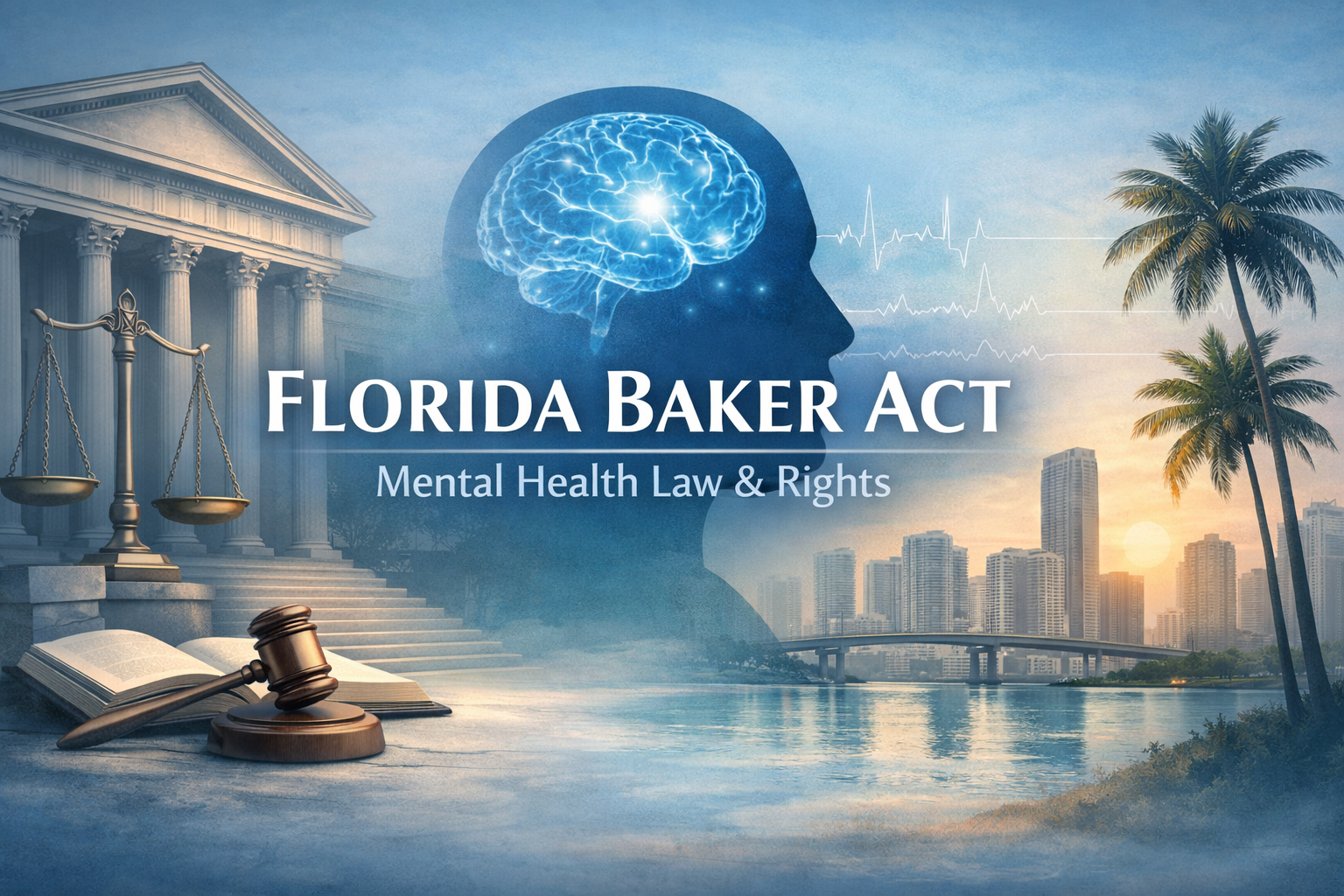
The Florida Baker Act is the common name for the Florida Mental Health Act, codified in Chapter 394 of the Florida Statutes. The statute establishes the legal framework for involuntary mental health examination and short term treatment of individuals who may pose a danger to themselves or others due to mental illness. The Florida Baker Act is widely used across the state, including in Miami and throughout Miami-Dade County, and it creates a balance between public safety and individual constitutional rights. Understanding how the Florida Baker Act works is critical for families, attorneys, medical professionals, and individuals who may become subject to involuntary mental health examination under Florida law.
The Florida Legislature enacted the Baker Act to address situations where a person’s mental illness creates an immediate risk of harm or severe neglect. The statute attempts to ensure that individuals receive prompt mental health evaluation while protecting their civil liberties. The law contains strict procedures governing involuntary examination, transportation to receiving facilities, patient rights, confidentiality of records, and court oversight. These protections reflect Florida’s policy that involuntary commitment should be limited to circumstances where intervention is necessary and justified by clear statutory criteria.
Florida’s statutory framework begins with the legislative findings set forth in Fla. Stat. § 394.451, which declares that mental health services should be designed to enable individuals with mental illnesses to return to the community as quickly as possible. The law recognizes that involuntary examination is an extraordinary measure and must only be used when less restrictive alternatives are not appropriate. Courts interpreting the statute have repeatedly emphasized the importance of protecting the dignity and due process rights of individuals who are subjected to involuntary mental health examination.
Understanding the Florida Baker Act Legal Framework
The Florida Baker Act operates as a civil commitment statute that authorizes temporary detention and evaluation of individuals suffering from mental illness. Unlike criminal incarceration, Baker Act detention is not punitive. Instead, it is designed to provide emergency mental health assessment and stabilization.
The Florida Supreme Court has recognized the constitutional implications of involuntary civil commitment. In Westerheide v. State, 831 So. 2d 93 (Fla. 2002), the court discussed the state’s authority to confine individuals for treatment while also recognizing the importance of procedural safeguards. Civil commitment statutes must balance the government’s responsibility to protect the public with the individual’s liberty interest under the United States and Florida Constitutions.
Florida courts have further clarified the statutory requirements for involuntary mental health examination. In K.M. v. State, 359 So. 3d 414 (Fla. 1st DCA 2023), the court examined the evidentiary requirements necessary to justify involuntary commitment proceedings. The decision underscores the principle that Baker Act detention must be supported by competent evidence demonstrating the statutory criteria.
The statutory scheme recognizes that mental illness alone is not sufficient to justify involuntary detention. Instead, the individual’s behavior and the risk of harm must satisfy the specific statutory standard.
Criteria for Involuntary Examination Under the Florida Baker Act
The central legal authority governing involuntary mental health examination appears in Fla. Stat. § 394.463. Under this provision, a person may be taken to a receiving facility for involuntary examination if there is reason to believe that the person has a mental illness and meets additional statutory criteria.
The statute requires a finding that the person has refused voluntary examination or is unable to determine whether examination is necessary. In addition, there must be evidence that without treatment the individual is likely to suffer serious neglect or poses a substantial likelihood of causing serious bodily harm to themselves or others in the near future.
Florida courts have interpreted these statutory requirements strictly. In Lukehart v. State, 70 So. 3d 503 (Fla. 2011), the Florida Supreme Court emphasized that involuntary commitment procedures must comply with constitutional due process protections. Evidence must demonstrate a clear and present risk, not merely speculation about potential future behavior.
These statutory safeguards are critical in preventing the misuse of involuntary mental health detention. The Baker Act is intended to address genuine mental health crises rather than to serve as a tool for resolving family disputes or behavioral conflicts that do not involve mental illness.
How the Florida Baker Act Is Initiated
The Florida Baker Act provides three primary methods through which involuntary examination may be initiated. Each method involves a different legal authority but ultimately leads to transportation to a designated receiving facility for evaluation.
First, a court may enter an ex parte order requiring an individual to undergo involuntary examination. This typically occurs when a sworn petition provides sufficient factual evidence that the statutory criteria are satisfied.
Second, law enforcement officers may take a person into custody when the officer has reason to believe the statutory criteria for involuntary examination are met. This authority is commonly exercised during emergency situations where immediate intervention is necessary to prevent harm.
Third, certain licensed professionals may initiate involuntary examination. These professionals include physicians, clinical psychologists, psychiatric nurses, clinical social workers, and licensed mental health counselors who have examined the individual within the preceding forty eight hours.
Section 394.463(2)(a), Florida Statutes, sets out who may initiate an involuntary examination and on what showing, and compliance with those statutory requirements is what courts examine when an initiation is challenged.
Transportation and Receiving Facilities in Florida Baker Act Cases
Once the Florida Baker Act is initiated, the individual must be transported to a designated receiving facility for examination. Law enforcement officers typically perform transportation duties unless alternative arrangements are authorized.
Receiving facilities must meet strict regulatory standards established under Florida law. These facilities are licensed by the Department of Children and Families and must comply with administrative rules governing mental health services.
The Florida Administrative Code establishes operational standards for Baker Act funded services. Administrative Rule 65E-5.400 sets forth requirements related to patient care, staffing qualifications, and facility operations. These rules are designed to ensure that individuals subject to involuntary examination receive appropriate clinical evaluation and treatment.
Additional regulatory provisions appear in Rule 65E-5.280 of the Florida Administrative Code, which addresses involuntary examination procedures and reporting requirements. These rules require facilities to collect and submit data concerning Baker Act cases, allowing the state to monitor trends and evaluate the effectiveness of mental health services.
Local administrative orders may also apply to Baker Act procedures. For example, Florida’s Eighth Judicial Circuit Administrative Order 7.16 addresses operational and confidentiality requirements applicable to Baker Act receiving facilities.
Rights of Individuals Subject to the Florida Baker Act
One of the most important aspects of the Florida Baker Act is the extensive set of rights afforded to individuals who are involuntarily examined. These rights are codified in Fla. Stat. § 394.459.
The statute provides that individuals receiving mental health services retain fundamental civil rights unless specifically limited by law or clinical necessity. These protections include the right to communicate with persons outside the facility, the right to participate in treatment planning, and the right to challenge the legality of detention.
Patients also have the right to petition the court for a writ of habeas corpus if they believe their detention is unlawful. This important procedural safeguard allows individuals to seek judicial review of the circumstances surrounding their involuntary examination.
Another significant statutory protection involves voting rights. Even individuals who are subject to involuntary examination retain the right to vote in public elections. Facilities must provide reasonable assistance to ensure that patients can register and obtain ballots.
These rights reflect Florida’s recognition that involuntary examination should not strip individuals of their civil liberties beyond what is strictly necessary to address the mental health crisis.
Confidentiality of Baker Act Records
Confidentiality is another core component of the Florida Baker Act framework. Mental health records created during involuntary examination are protected from public disclosure under Florida law.
Receiving facilities must maintain strict confidentiality regarding clinical records and treatment information. Disclosure is generally permitted only in limited circumstances authorized by statute or court order.
Administrative Order 7.16 within Florida’s Eighth Judicial Circuit further reinforces confidentiality protections by outlining procedures governing the handling and release of Baker Act related records.
These confidentiality provisions are particularly important in protecting individuals from stigma and ensuring that mental health treatment remains private.
The Florida Baker Act in Miami and Miami-Dade County
The Florida Baker Act is frequently utilized in Miami and throughout Miami-Dade County due to the region’s large population and extensive healthcare infrastructure. Local hospitals such as Jackson Memorial Hospital and other designated receiving facilities routinely conduct Baker Act examinations.
Miami law enforcement agencies, including the Miami Police Department and the Miami-Dade Police Department, regularly respond to mental health crisis calls that may result in Baker Act detention. Officers receive training regarding the legal standards required for involuntary examination.
Miami attorneys often encounter Baker Act issues in family law cases, guardianship proceedings, and criminal matters where mental health concerns intersect with legal disputes. Understanding the statutory framework can help families respond effectively when a loved one experiences a mental health crisis.
The Miami legal community also recognizes the importance of protecting individual rights during Baker Act proceedings. Attorneys frequently assist clients with habeas corpus petitions, discharge hearings, and related mental health litigation.
Distinction Between the Florida Baker Act and Other Commitment Laws
The Florida Baker Act differs from other civil commitment statutes that address long term confinement of dangerous individuals. For example, the Jimmy Ryce Act governs the civil commitment of sexually violent predators after completion of criminal sentences.
Courts have recognized the distinct legal purposes of these statutes. In Westerheide v. State, 831 So. 2d 93 (Fla. 2002), the Florida Supreme Court analyzed constitutional challenges related to the Jimmy Ryce Act while also discussing the broader context of civil commitment laws.
Unlike the Jimmy Ryce Act, the Florida Baker Act focuses on short term crisis intervention rather than indefinite confinement. Most Baker Act examinations last no longer than seventy two hours unless further court proceedings authorize continued treatment.
This limited timeframe reflects the statute’s goal of stabilizing individuals and returning them to the community whenever possible.
Legal Challenges and Litigation Involving the Florida Baker Act
Florida courts regularly address legal disputes arising under the Baker Act. These cases often involve questions regarding whether the statutory criteria were satisfied or whether procedural safeguards were properly followed.
Appellate decisions emphasize that involuntary commitment involves a significant deprivation of liberty and therefore must be supported by competent substantial evidence. Courts also scrutinize whether professionals initiating involuntary examination complied with statutory documentation requirements.
In J.W. v. State, 313 So. 3d 909 (Fla. 1st DCA 2021), the court examined issues involving civil commitment procedures and evidentiary standards. The decision reinforces the principle that involuntary detention must be justified by legally sufficient evidence demonstrating mental illness and risk of harm.
Litigation involving Baker Act procedures continues to shape the interpretation of Florida’s mental health statutes.
Why Understanding the Florida Baker Act Matters
The Florida Baker Act plays a crucial role in addressing mental health crises while safeguarding civil liberties. Families, healthcare professionals, and legal practitioners must understand the statute’s requirements in order to ensure that the law is applied correctly.
Improper use of the Baker Act can lead to significant legal consequences, including civil rights claims and challenges to unlawful detention. Conversely, failure to intervene when statutory criteria are satisfied may result in serious harm to individuals experiencing mental health crises.
The statute’s detailed procedures reflect the Legislature’s attempt to balance compassion, safety, and constitutional protections.
Conclusion
The Florida Baker Act represents a comprehensive legal framework governing involuntary mental health examination and treatment. Codified in Chapter 394 of the Florida Statutes, the law establishes strict criteria and procedures designed to protect both public safety and individual rights.
Through statutory safeguards, judicial oversight, and administrative regulation, Florida law ensures that involuntary mental health intervention occurs only when necessary and in a manner consistent with constitutional principles. The statute provides critical protections for individuals experiencing mental health crises while maintaining accountability for law enforcement officers, healthcare professionals, and receiving facilities.
For residents of Miami and throughout Florida, understanding the Florida Baker Act is essential. Whether responding to a mental health emergency or navigating legal issues arising from involuntary examination, knowledge of the statutory framework allows individuals and families to protect their rights and seek appropriate care.
TLDR: The Florida Baker Act allows involuntary mental health examination when a person with mental illness poses a danger to themselves or others or risks serious neglect. Codified in Chapter 394 of the Florida Statutes, the law authorizes courts, law enforcement, and certain mental health professionals to initiate emergency evaluation while protecting patient rights, confidentiality, and due process.
What is the Florida Baker Act?
The Florida Baker Act is the Florida Mental Health Act, a state law that allows involuntary mental health examination and short term detention of individuals who may pose a danger to themselves or others due to mental illness.
How long can someone be held under the Florida Baker Act?
In most cases a person may be held for up to seventy two hours for evaluation unless a court authorizes further involuntary treatment proceedings.
Who can initiate a Florida Baker Act examination?
A Baker Act examination may be initiated by a court order, a law enforcement officer, or a qualified mental health professional who has examined the individual within the previous forty eight hours.
Can a person challenge a Baker Act detention?
Yes. Individuals have the right to file a petition for writ of habeas corpus to challenge the legality of their detention and seek judicial review.
Are Baker Act records public?
No. Clinical records created during Baker Act examinations are confidential and protected from public disclosure under Florida law.
Is the Baker Act used in Miami?
Yes. The Florida Baker Act is regularly used in Miami and throughout Miami-Dade County when individuals experience mental health crises that meet statutory criteria.