

10 Mar How Is Child Support Calculated in Florida? 2026 Guide
Summary
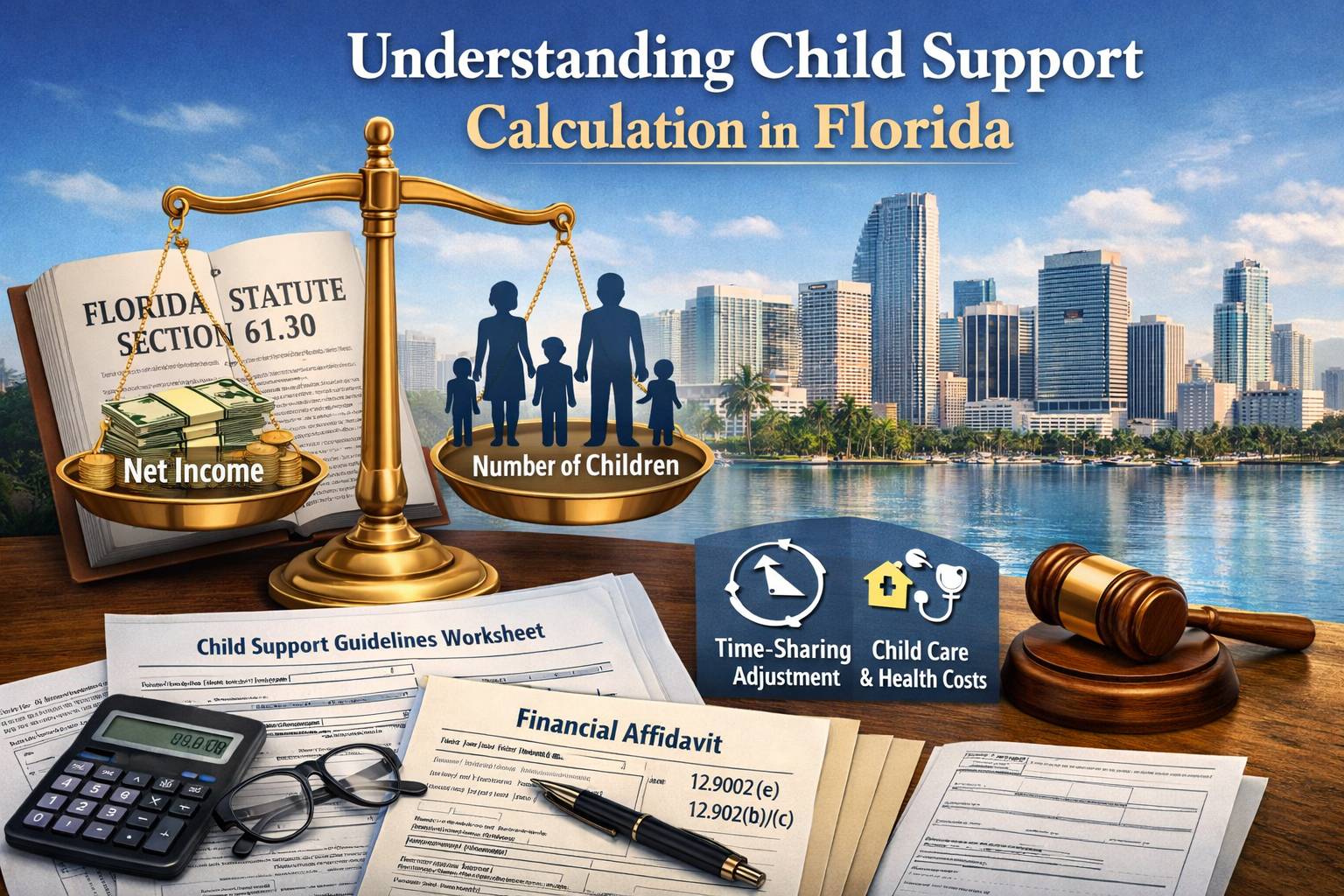
This article explains how Florida courts calculate child support under Section 61.30, Florida Statutes, covering net income determination, the guideline schedule, child care cost add-ons, substantial time-sharing adjustments, and the written findings required for deviations. Miami-area families and practitioners will find a step-by-step breakdown of the statutory formula, mandatory procedural requirements under Florida Family Law Rule 12.285, and the appellate standards governing income findings and guideline compliance.
Understanding how child support is calculated in Florida is one of the most pressing concerns for parents navigating separation, divorce, or paternity proceedings in Miami-Dade County and throughout the state. Florida’s child support framework is governed primarily by Section 61.30, Florida Statutes, which establishes a presumptive guideline amount based on both parents’ net monthly incomes, the number of children, and several other critical variables. Whether you are a parent seeking to establish support for the first time, attempting to modify an existing order, or facing enforcement proceedings in Miami, a clear understanding of how Florida courts perform these calculations is essential to protecting your rights and your children’s financial security.
Florida’s child support system reflects the Legislature’s recognition that children are entitled to share in the economic circumstances of both parents, regardless of whether those parents were ever married. The statutory scheme under Section 61.30, Florida Statutes, is designed to achieve consistency, predictability, and fairness across the state, while at the same time granting courts sufficient flexibility to account for the realities of individual family situations. From Brickell to Coral Gables, from Doral to Miami Beach, Miami-Dade County courts apply the same statutory formula, though the facts of each case can produce dramatically different outcomes. This article examines each component of that formula in detail, drawing on the controlling statute and authoritative Florida appellate decisions.
This guide is intended for educational purposes and reflects the law as of 2026. It does not constitute legal advice. Families in Miami and throughout South Florida who have questions about child support calculation, modification, or enforcement should consult with a qualified Florida family law attorney. The stakes in child support proceedings are significant, and proper legal representation can make a material difference in the outcome for both parents and children.
The Statutory Foundation: Section 61.30, Florida Statutes
Florida’s child support calculation process begins and ends with Section 61.30, Florida Statutes. This statute establishes the guideline framework, defines the presumptive amount, sets out the categories of income that must be considered, prescribes the method for calculating each parent’s net income, and specifies how the court must handle substantial time-sharing, child care costs, health insurance, and deviations. It is, in every meaningful sense, the cornerstone of child support law in Florida. Any parent, attorney, or judge addressing child support in a Florida court must work within the structure that Section 61.30 provides.
The guideline amount produced by Section 61.30 is presumptive, meaning that courts are required to begin their analysis at that figure. A trial court may vary the guideline amount by plus or minus five percent after considering all relevant factors. However, if the court orders child support that varies by more than five percent from the guideline amount, it must make a specific written finding explaining why the guideline amount would be unjust or inappropriate in the particular case. This requirement ensures both accountability and transparency in child support determinations, and it provides a meaningful basis for appellate review.
Florida’s appellate courts have consistently reinforced the mandatory nature of the guideline calculation. In M.M. v. J.H., 251 So. 3d 970 (Fla. 2018), the court made clear that Section 61.30 establishes a presumptive guideline amount and that written findings are required for any deviation exceeding the five percent threshold. This decision reflects the judiciary’s commitment to ensuring that departures from the statutory formula do not occur arbitrarily or without explanation. Furthermore, the case reinforces that it is legal error for a trial court to fail to make adequate findings of fact regarding the parties’ incomes when determining or modifying child support. Consequently, the written record of any child support proceeding in Miami-Dade or elsewhere in Florida must clearly reflect how the guideline calculation was performed.
Step One: Determining Gross Income in Child Support Cases
What Counts as Gross Income Under Florida Child Support Law
The first step in calculating child support in Florida is identifying each parent’s gross income. Section 61.30, Florida Statutes, defines gross income broadly and includes virtually every source of economic benefit that a parent receives. The statute specifically enumerates wages, salaries, bonuses, commissions, allowances, overtime pay, tips, and other similar payments. Beyond traditional employment income, gross income also includes business income, disability benefits, workers’ compensation payments, unemployment compensation, retirement and pension distributions, social security benefits, interest and dividends, rental income, and certain in-kind payments or reimbursed expenses that effectively reduce a parent’s personal living costs.
This expansive definition of gross income reflects the Legislature’s intent to capture the true economic capacity of each parent, not merely the income reported on a W-2 or tax return. Courts in Miami-Dade have applied this definition consistently, recognizing that a parent who receives a company car, housing allowance, or other fringe benefits has greater economic capacity than one who does not, and that such benefits should be factored into the support calculation. The goal is to ensure that children benefit from all of the resources available to each parent, not just those reflected in a base salary.
Business Income and Self-Employment: Special Rules Under Section 61.30
One of the most frequently litigated issues in child support cases involving Miami entrepreneurs, business owners, and self-employed professionals concerns the treatment of business income. Section 61.30, Florida Statutes, specifically addresses this situation by defining business income as gross receipts minus ordinary and necessary business expenses required to produce that income. This definition is narrower than what might be claimed on a business tax return, as the statute does not permit deductions for expenses that are personal in nature, excessive, or not genuinely required for the production of income.
In practice, this means that a Miami-based contractor, real estate agent, physician, or other self-employed professional cannot simply deduct all business-related expenses from gross receipts before arriving at an income figure for child support purposes. Courts scrutinize business deductions carefully, and expenses that effectively constitute personal consumption or that are inflated beyond what is reasonably necessary will be disallowed. This approach protects children from parents who might otherwise manipulate their apparent income by routing personal expenses through a business entity. The proper determination of business income often requires forensic accounting analysis, and in complex cases, financial experts are frequently retained to assist the court.
Step Two: Converting Gross Income to Net Income
After identifying each parent’s gross income, the next and equally critical step is converting that gross income into net income. This distinction is not a technicality but rather a fundamental aspect of Florida’s child support methodology. The guideline schedule set forth in Section 61.30, Florida Statutes, is based on combined net monthly income, not gross income. As a result, using gross income to calculate child support would produce an incorrect result and would constitute reversible error on appeal.
The Florida Supreme Court’s decision in Moody v. Moody, 315 So. 3d 799 (Fla. 2021), underscores the critical importance of this distinction. In that case, the appellate court found it to be error for a trial court to calculate child support using the parties’ gross incomes without subtracting allowable deductions. The ruling makes clear that the net-income requirement is not merely procedural guidance but a binding legal standard. Trial courts that bypass the net income calculation expose their judgments to reversal on appeal, and parties who accept or propose gross-income calculations do their clients a disservice.
The allowable deductions that must be subtracted from gross income to arrive at net income include federal income tax obligations, as well as other deductions specifically authorized by Section 61.30. The statute’s method ensures that the child support obligation is calculated in a manner that reflects each parent’s actual take-home capacity, which is ultimately the money available to meet the family’s financial needs. In Miami-Dade County, where the cost of living is substantial and federal tax obligations can be significant depending on income level, the difference between gross and net income can be considerable, making precise calculation essential.
Additionally, the Florida appellate decision in Addie v. Coale, 120 So. 3d 44 (Fla. 2013), firmly established that child support awards must be supported by competent substantial evidence and that the trial court must determine each parent’s net income and include adequate findings in the final judgment. This case reinforces the obligation of trial courts to make specific, documented income determinations rather than relying on stipulations or general estimates. It also provides a clear basis for appellate challenge when income findings are absent or inadequate. Miami family law practitioners must therefore ensure that every child support final judgment contains sufficient factual findings to satisfy this standard.
Step Three: Calculating the Combined Net Monthly Income and Each Parent’s Share
Once each parent’s net monthly income has been properly determined, the next step is to combine those figures to produce a single combined net monthly income figure. This combined figure is then used to determine the minimum child support need for the children at issue by reference to the guideline schedule set forth in Section 61.30, Florida Statutes. The guideline schedule provides a table that shows the presumptive minimum child support obligation based on the combined net monthly income and the number of children. This schedule represents the Legislature’s determination of what portion of the parents’ combined resources should be devoted to the support of their children.
After the minimum child support need is identified from the schedule, the statute directs the court to determine each parent’s percentage share of the combined net monthly income. This percentage reflects each parent’s proportional financial contribution to the total combined resources. Each parent’s actual dollar share of the minimum child support need is then calculated by multiplying the total minimum child support need by each parent’s percentage share of the combined monthly net income. This proportional allocation system ensures that each parent contributes to the support of the children in proportion to their financial capacity, consistent with the equitable principles underlying Florida’s family law statutes.
In practice, this calculation process involves precise arithmetic, and errors can have significant financial consequences. For families in high-income brackets in Miami’s Brickell, Coconut Grove, or Key Biscayne neighborhoods, small percentage differences in income determination can translate into meaningful differences in monthly support obligations. Conversely, for families with more modest incomes, incorrect income determinations can place a financial burden on a parent that exceeds their actual capacity to pay, potentially leading to default, arrears, and enforcement proceedings. Careful attention to the accuracy of each calculation step is therefore essential in every case.
Child Care Costs: How Day Care and Work-Related Expenses Affect Child Support in Florida
Beyond the basic guideline obligation derived from the income schedule, Section 61.30, Florida Statutes, requires the court to add qualifying child care costs to the basic obligation. Specifically, child care costs that are incurred due to employment, job search, or qualifying education or job training that is reasonably necessary to obtain employment or to improve earning capacity shall be added to the basic obligation determined from the guideline schedule. This provision reflects the recognition that child care is a real and often substantial expense that directly enables parents to work and thereby support their children.
In Miami, where child care costs can be exceptionally high due to the region’s elevated cost of living, this statutory add-on can have a significant effect on the total child support obligation. Quality licensed child care in Miami-Dade County often commands substantial monthly fees, and these costs are properly included in the child support calculation when they are genuinely incurred for work-related purposes. However, the statute also provides an important limitation: child care costs may not exceed the level required to provide quality care from a licensed source. This ceiling prevents either parent from artificially inflating child care expenses beyond what is reasonable and necessary.
The statute also addresses the situation in which a parent has prepaid child care costs for the child or children involved in the case. In that circumstance, the amounts already prepaid by that parent are deducted from that parent’s share of the child support obligation. This credit mechanism prevents a parent who has already contributed to child care expenses from being required to pay for the same expenses a second time through the support transfer. Miami family law attorneys should carefully document any prepaid child care costs and ensure that appropriate credits are claimed in the child support worksheet and reflected in any final judgment or order.
Substantial Time-Sharing: How Overnight Parenting Time Affects Child Support in Florida
The 20 Percent Overnight Threshold Under Section 61.30
One of the most significant variables in Florida’s child support calculation framework is the time-sharing arrangement between the parents. When a parenting plan or time-sharing arrangement provides that each child spends a substantial amount of time with each parent, Section 61.30, Florida Statutes, mandates a specific adjustment to the basic guideline amount. The statute defines substantial time-sharing as the arrangement in which each child spends at least twenty percent of the overnights with each parent over the course of the year. Twenty percent of 365 overnights equals approximately 73 overnights per year, which in practical terms amounts to somewhat less than every other weekend plus additional time.
When this threshold is met, the court must apply a multi-step statutory adjustment method designed to account for the fact that both parents are incurring direct expenses for the children during their respective periods of custody. The adjustment recognizes that a parent who has the children for more overnights is directly spending more money on housing, food, clothing, and other necessities, and that a simple percentage-of-income transfer payment would fail to reflect this economic reality. Florida’s substantial time-sharing formula attempts to allocate financial responsibility more accurately between parents who share significant parenting time.
How the Substantial Time-Sharing Adjustment Is Calculated
The statutory adjustment method for substantial time-sharing is detailed and sequential, and it must be applied precisely. First, the court calculates each parent’s support obligation without including day care and health insurance costs, and multiplies that figure by 1.5. This multiplication factor is prescribed by Section 61.30, Florida Statutes, and reflects the Legislature’s recognition that households with substantial time-sharing incur greater combined total expenses because each parent must maintain a residence suitable for the children during their respective parenting time. Second, the court applies the other parent’s overnight percentage to each parent’s multiplied obligation. Third, the court determines a transfer amount by comparing the results. Fourth, and only after these steps are completed, the court adjusts the transfer amount to account for day care and health insurance expenses.
This sequential method is not optional or merely advisory. When the twenty percent threshold is met, the court is required to apply the statutory adjustment. Failure to do so constitutes legal error. Moreover, even after applying the time-sharing formula, Section 61.30 permits the court to deviate from the adjusted amount based on the statutory deviation factors and additional considerations specifically enumerated in the time-sharing subsection. This layered framework gives courts sufficient flexibility to achieve a just result while maintaining the structural integrity of the guideline system. Attorneys practicing family law in Miami must be thoroughly familiar with this calculation method, as time-sharing arrangements are routinely contested and the financial stakes can be substantial.
It bears emphasis that the time-sharing percentage used in the calculation must be based on the actual parenting plan or court-ordered time-sharing schedule. Parents cannot simply assert a higher overnight percentage to reduce their support obligation without having a corresponding enforceable parenting plan or court order in place. Miami-Dade courts apply the statutory formula based on the actual, enforceable arrangement, and attempts to manipulate the calculation through unverified time-sharing claims are unlikely to succeed. This principle protects children and the integrity of the child support system.
Deviations from the Guideline Amount: When and How Courts Adjust Child Support
As discussed above, Section 61.30, Florida Statutes, establishes the guideline amount as the presumptive starting point for child support in every Florida case. The statute provides that the court may vary the guideline amount by plus or minus five percent after considering relevant factors without providing written findings. However, any deviation greater than five percent from the guideline requires the court to make a specific written finding in the record explaining why the guideline amount would be unjust or inappropriate under the circumstances of the case. This written-findings requirement applies whether the court is ordering an amount above or below the guideline.
The Florida appellate decision in M.M. v. J.H., 251 So. 3d 970 (Fla. 2018), provides authoritative guidance on this issue. In that case, the appellate court reiterated that section 61.30 requires written findings for deviations beyond five percent and that failure to make adequate findings of fact regarding the parties’ incomes when determining child support constitutes reversible error. This decision highlights the practical consequences of procedural noncompliance in child support proceedings and underscores the importance of thorough, documented analysis in every case. A child support judgment that orders an amount materially different from the guideline without adequate written findings is vulnerable to reversal on appeal.
The statute enumerates various factors that a court may consider when evaluating whether a deviation is appropriate. These factors include, among others, the extraordinary medical, psychological, educational, or dental needs of the child beyond what is covered by insurance, the income available to either party through investment of assets, the total assets available to either party, the impact of the Internal Revenue Service dependency exemption and child tax credit, and any other adjustment that is needed to achieve an equitable result. Miami family law courts apply these factors on a case-by-case basis, and the outcome of any deviation request is highly dependent on the specific facts presented and the quality of the supporting evidence.
Required Filings: The Child Support Guidelines Worksheet and Financial Affidavit
Florida’s child support calculation process is not only governed by substantive statutory rules but also by mandatory procedural requirements. Rule 12.285 of the Florida Family Law Rules of Procedure establishes that in any proceeding to establish or modify child support, the parties must file a Child Support Guidelines Worksheet using Florida Family Law Form 12.902(e) at or before any hearing to establish or modify child support. Critically, this filing requirement cannot be waived by agreement of the parties or by order of the court. The worksheet is the formal, standardized document on which the statutory calculation is performed and presented to the court, and its absence from the record is a procedural deficiency that courts take seriously.
In addition to the guidelines worksheet, Rule 12.285 of the Florida Family Law Rules of Procedure also requires the parties to file a financial affidavit. Depending on the income level of the party, this will be either Form 12.902(b) or Form 12.902(c). The financial affidavit is a sworn statement in which each party discloses their income, expenses, assets, and liabilities. Like the guidelines worksheet requirement, the financial affidavit requirement cannot be waived. The financial affidavit serves multiple important functions: it provides the factual foundation for the income determinations that drive the guideline calculation, it promotes transparency and honesty in financial disclosure, and it creates a sworn record that can be used to challenge inconsistent representations made elsewhere in the proceeding.
For Miami-area litigants, the obligation to complete these forms accurately and completely is both a legal requirement and a practical necessity. Incomplete or inaccurate financial affidavits can result in adverse credibility findings, discovery sanctions, or the exclusion of income figures favorable to the filing party. Moreover, the financial affidavit serves as the basis for the guidelines worksheet, meaning that errors in one document propagate through the entire calculation. Experienced Miami family law attorneys devote considerable attention to the preparation and review of these required filings, understanding that their accuracy is foundational to a correct and sustainable child support determination.
Income Findings and Competent Substantial Evidence: Appellate Standards in Florida
Florida appellate courts exercise meaningful oversight over child support determinations, and the standard of review they apply has real consequences for litigants in Miami-Dade and throughout the state. The Florida appellate decision in Addie v. Coale, 120 So. 3d 44 (Fla. 2013), established that child support awards must be supported by competent substantial evidence and that the trial court must determine each parent’s net income and include adequate findings in the final judgment. This standard means that a child support order that is not anchored in documented, credible evidence of each parent’s actual financial circumstances is susceptible to reversal on appeal.
The requirement for competent substantial evidence has practical implications at every stage of the trial court proceeding. Evidence of income must be introduced through proper channels, such as tax returns, pay stubs, bank statements, business records, or testimony from accountants and financial experts. Courts cannot simply accept a party’s unverified assertion about their own income without corroborating documentation, particularly in cases where income is disputed or where one party suspects the other of concealing or underreporting earnings. Miami family law litigants who fail to introduce adequate income evidence risk having the court impute income to them based on the available record, which may or may not reflect their actual circumstances.
Furthermore, M.M. v. J.H., 251 So. 3d 970 (Fla. 2018), reinforces that it is reversible error for a trial court to fail to make findings of fact regarding the parties’ incomes when determining child support. This means that the final judgment or order must contain specific, explicit income findings for each parent, not merely a recitation of the support amount that was ordered. When adequate findings are present, the appellate court applies a deferential standard of review and will affirm the trial court’s income determinations if they are supported by competent substantial evidence. When findings are absent or inadequate, reversal and remand are the likely consequence, resulting in delay, additional expense, and ongoing uncertainty for both parents and children.
Modification of Child Support Orders in Florida
Child support obligations in Florida are not necessarily permanent. Section 61.30, Florida Statutes, and the related procedural framework provide mechanisms for modifying child support when there has been a substantial change in circumstances. A modification requires a showing that the circumstances of the parties have changed in a material and unanticipated way since the entry of the existing order, and that the modification is in the best interests of the child. Common grounds for modification include a significant change in either parent’s income, a change in the child’s needs, a change in the time-sharing arrangement, or the termination of child care expenses.
In Miami, where economic conditions can be volatile and careers can change rapidly, income-based modifications are frequently sought. A parent who loses a job, experiences a significant pay cut, or transitions from employment to self-employment may have a legitimate basis to seek a downward modification of their child support obligation. Conversely, a parent who discovers that the other parent’s income has substantially increased may petition for an upward modification to ensure that the children benefit from improved financial circumstances. In either case, the same statutory framework that governs initial child support determinations, including the requirements for net income calculation, guidelines worksheet filing, financial affidavit submission, and adequate court findings, applies with equal force in modification proceedings.
The rules governing modification proceedings also require compliance with Rule 12.285 of the Florida Family Law Rules of Procedure, including the mandatory filing of the Child Support Guidelines Worksheet and financial affidavits. These procedural requirements apply at the modification stage just as they apply at the initial establishment stage, and they cannot be waived. Failure to comply with these requirements can result in procedural deficiencies that undermine the modification request or provide a basis for appeal. Accordingly, parents in Miami and throughout South Florida who wish to modify an existing child support order should seek legal counsel to ensure that their petition is properly prepared and supported by adequate evidence.
Income Imputation: What Happens When a Parent Is Voluntarily Underemployed
Florida law recognizes that some parents may attempt to reduce their apparent income by voluntarily leaving employment, accepting lower-paying positions, or otherwise reducing their earning capacity in order to diminish their child support obligation. Section 61.30, Florida Statutes, addresses this problem by authorizing courts to impute income to a parent based on their demonstrated earning capacity when the court finds that the parent is voluntarily unemployed or underemployed. Imputed income represents what the court determines the parent is capable of earning if they made reasonable efforts to use their education, skills, and work history to their full capacity.
The imputation of income is a fact-intensive inquiry that requires the court to consider the parent’s employment history, educational background, occupational qualifications, and the prevailing wages for similar positions in the local job market. In Miami’s diverse and dynamic economy, courts have access to wage data across a wide range of industries, from hospitality and real estate to healthcare, law, and technology. A parent who holds a professional degree or who has a history of high earnings cannot simply quit their job or take a minimum wage position and expect a corresponding reduction in their child support obligation. The court will look beyond the nominal income to the actual earning capacity and impute income accordingly.
It is important to note that income imputation is not automatic. The party seeking to have income imputed to the other parent bears the burden of presenting evidence sufficient to support the court’s finding of voluntary underemployment and the appropriate level of imputed income. This typically requires evidence of the other parent’s work history, qualifications, and the availability of suitable employment in the relevant market. Miami family law attorneys who handle child support cases involving self-employed, intermittently employed, or recently transitioned clients must be prepared to address income imputation arguments both offensively and defensively, as the outcome can significantly affect the final support obligation.
Health Insurance and Other Add-Ons to the Basic Child Support Obligation
In addition to child care costs, Section 61.30, Florida Statutes, requires the court to address health insurance coverage for the children when calculating child support. The cost of health insurance for the children is generally added to the basic support obligation and allocated between the parents in proportion to their respective incomes. When one parent provides health insurance coverage for the children through their employer or other source, the cost of that coverage attributable to the children is factored into the child support calculation. Courts in Miami-Dade County frequently encounter situations in which one parent has access to employer-sponsored health insurance for the children and the other does not, making the allocation of this cost a significant issue in the overall calculation.
The interaction between health insurance costs and the substantial time-sharing adjustment is noteworthy. As described earlier, the multi-step substantial time-sharing formula under Section 61.30 first calculates the adjusted support obligation without including day care and health insurance, then applies the statutory multiplier and overnight percentages, and finally adjusts the resulting transfer amount for day care and health insurance expenses. This sequential approach ensures that add-on expenses are layered onto the adjusted obligation in a manner consistent with the legislative design. Attorneys and self-represented litigants who attempt to apply the substantial time-sharing formula without following this prescribed sequence will produce an incorrect result.
Practical Implications for Miami-Dade County Families
For families navigating child support proceedings in Miami, Miami Beach, Coral Gables, Hialeah, Homestead, and the surrounding communities of South Florida, the statutory framework described in this article has immediate practical significance. Miami-Dade County’s Eleventh Judicial Circuit handles a substantial volume of family law cases each year, and child support disputes are among the most common. The economic diversity of Miami-Dade, which encompasses some of the wealthiest zip codes in Florida as well as communities with significant economic challenges, means that child support calculations must be adapted to a wide range of financial circumstances.
Miami’s large population of entrepreneurs, real estate professionals, hospitality industry workers, international business professionals, and commission-based sales employees presents particular challenges in the income determination context. Business income, commission income, and tip income are all forms of compensation that require careful analysis under Section 61.30, Florida Statutes, and that may vary significantly from year to year. Parents whose income is irregular or whose business expenses are substantial often find themselves in disputes about the appropriate income figure to use in the guidelines calculation. Resolving these disputes requires a combination of legal knowledge, financial expertise, and persuasive advocacy.
Furthermore, Miami’s significant bilingual and multilingual population means that child support proceedings frequently involve families in which language barriers may complicate the understanding of complex legal and financial concepts. Florida courts provide interpreter services in appropriate cases, and experienced Miami family law attorneys routinely work with clients whose primary language is Spanish, Haitian Creole, Portuguese, or other languages. Ensuring that all parties fully understand the child support calculation process and their rights and obligations under Florida law is an essential aspect of providing effective family law representation in Miami-Dade County.
Conclusion
Understanding how child support is calculated in Florida requires a comprehensive grasp of Section 61.30, Florida Statutes, and the appellate decisions that interpret and apply it. The calculation process begins with a thorough determination of each parent’s gross income, encompassing all statutory categories including wages, bonuses, business income defined as gross receipts minus ordinary and necessary expenses, and all other specified sources. Gross income is then converted to net income through the subtraction of allowable deductions, a step that is mandatory and non-waivable under Florida law as confirmed by Moody v. Moody, 315 So. 3d 799 (Fla. 2021). The combined net monthly incomes are applied to the statutory guideline schedule to determine the minimum child support need, and each parent’s share is allocated proportionally based on their percentage of the combined net income.
When qualifying child care costs are present, they must be added to the basic obligation, with credits for amounts already prepaid by either parent, and the total may not exceed the cost of quality care from a licensed source. When each child spends at least twenty percent of overnights with each parent, the mandatory substantial time-sharing adjustment formula must be applied, incorporating the statutory 1.5 multiplier, overnight percentages, and final add-on adjustments for day care and health insurance. Deviations beyond five percent from the presumptive guideline amount require specific written findings as mandated by M.M. v. J.H., 251 So. 3d 970 (Fla. 2018), and all child support awards must be supported by competent substantial evidence with adequate income findings as required by Addie v. Coale, 120 So. 3d 44 (Fla. 2013). Finally, compliance with Rule 12.285 of the Florida Family Law Rules of Procedure, including mandatory filing of the Child Support Guidelines Worksheet (Form 12.902(e)) and the required financial affidavit (Form 12.902(b) or (c)), is a non-waivable procedural prerequisite in every child support proceeding.
For parents in Miami and throughout South Florida, these legal principles translate into real financial consequences for their families and their children. The complexity of Florida’s child support framework makes professional legal guidance not merely helpful but often essential to achieving a correct and sustainable outcome. Whether you are establishing child support for the first time, seeking a modification based on changed circumstances, or facing an enforcement action, a knowledgeable Miami family law attorney can help you navigate the statutory requirements, protect your interests, and advocate effectively for the best interests of your children.
Speak with a Miami Child Support Attorney Today
If you have questions about how child support is calculated in Florida, or if you need assistance establishing, modifying, or enforcing a child support order in Miami-Dade County or the surrounding South Florida area, we are here to help. Attorney Jeffrey Alan Aenlle is a Florida family law practitioner based in Brickell, Miami, with extensive experience handling child support matters for clients throughout Florida.
Whether your situation involves complex business income, disputed time-sharing arrangements, income imputation, or the need to modify an existing order based on changed circumstances, our office brings a thorough understanding of Section 61.30, Florida Statutes, and the related procedural requirements to every client engagement. We are committed to providing clear, practical legal guidance that helps families in Miami navigate Florida’s child support system with confidence. We serve clients in Brickell, Downtown Miami, Coral Gables, Coconut Grove, Miami Beach, Doral, Hialeah, Homestead, and throughout Miami-Dade County. The consultation you schedule today may be the most important step you take toward protecting your rights and your children’s financial future.
TLDR: Child support in Florida is calculated under Section 61.30, Florida Statutes, using each parent’s net monthly income (not gross income) combined with the number of children to determine a presumptive guideline amount. Each parent’s share is allocated proportionally. Qualifying child care costs are added to the basic obligation. When each child spends at least 20 percent of overnights with each parent, a mandatory substantial time-sharing adjustment applies using a 1.5 multiplier and each parent’s overnight percentage. Courts may deviate from the guideline by up to 5 percent without written findings, but any greater deviation requires a specific written finding that the guideline amount would be unjust or inappropriate. All proceedings require a Child Support Guidelines Worksheet (Form 12.902(e)) and a financial affidavit (Form 12.902(b) or (c)) under Rule 12.285 of the Florida Family Law Rules of Procedure, and both requirements are non-waivable.
How is child support calculated in Florida?
Florida courts calculate child support under Section 61.30, Florida Statutes, by determining each parent’s gross income, converting it to net income by subtracting allowable deductions, combining both parents’ net monthly incomes, and applying the statutory guideline schedule. Each parent’s proportional share of the combined income determines their share of the minimum child support need. Qualifying child care costs, health insurance, and time-sharing adjustments are then applied.
Does Florida child support use gross income or net income?
Florida child support calculations are based on net income, not gross income. This is a binding legal requirement under Section 61.30, Florida Statutes, and has been confirmed by Florida appellate courts including in Moody v. Moody, 315 So. 3d 799 (Fla. 2021). Courts that calculate support using gross income commit reversible error.
What is the substantial time-sharing adjustment in Florida child support?
When each child spends at least 20 percent of overnights (approximately 73 overnights per year) with each parent, Section 61.30, Florida Statutes, requires the court to apply a mandatory adjustment formula. The formula multiplies each parent’s basic obligation by 1.5, applies the other parent’s overnight percentage, determines a transfer amount, and then adds adjustments for child care and health insurance. This adjustment recognizes that both parents incur direct expenses during their parenting time.
Can a Florida court deviate from the child support guidelines?
Yes. Under Section 61.30, Florida Statutes, a court may deviate from the presumptive guideline amount by up to five percent without written findings. For any deviation greater than five percent, the court must make a specific written finding that the guideline amount would be unjust or inappropriate. This requirement was reinforced by the Florida appellate decision in M.M. v. J.H., 251 So. 3d 970 (Fla. 2018).
What documents are required in a Florida child support proceeding?
Rule 12.285 of the Florida Family Law Rules of Procedure requires all parties in a child support proceeding to file a Child Support Guidelines Worksheet using Form 12.902(e) and a financial affidavit using Form 12.902(b) or (c) depending on income level. Both requirements are mandatory and cannot be waived by agreement of the parties or order of the court.
How is business income treated in Florida child support calculations?
For self-employed parents and business owners, Section 61.30, Florida Statutes, defines business income as gross receipts minus ordinary and necessary expenses required to produce that income. Personal expenses routed through a business, excessive deductions, or expenses not genuinely required for income production are not deductible. Courts scrutinize business income carefully, and forensic accounting analysis is sometimes necessary in complex cases involving Miami entrepreneurs and professionals.
What happens if a Florida court fails to make income findings in a child support case?
Under Addie v. Coale, 120 So. 3d 44 (Fla. 2013), child support awards must be supported by competent substantial evidence, and the trial court must determine each parent’s net income and include adequate findings in the final judgment. Failure to include these findings is reversible error, meaning the appellate court can reverse the judgment and remand the case to the trial court for additional proceedings.
Can Florida child support be modified after it is ordered?
Yes. Child support orders in Florida may be modified upon a showing of a substantial, material, and unanticipated change in circumstances since the entry of the existing order. Common grounds include a significant change in either parent’s income, a change in the child’s needs, or a change in the time-sharing arrangement. Modification proceedings require the same mandatory filings as initial support proceedings under Rule 12.285 of the Florida Family Law Rules of Procedure.