
19 Feb Illegal Clause in my Prenup – Is the Prenup Enforceable?
Summary
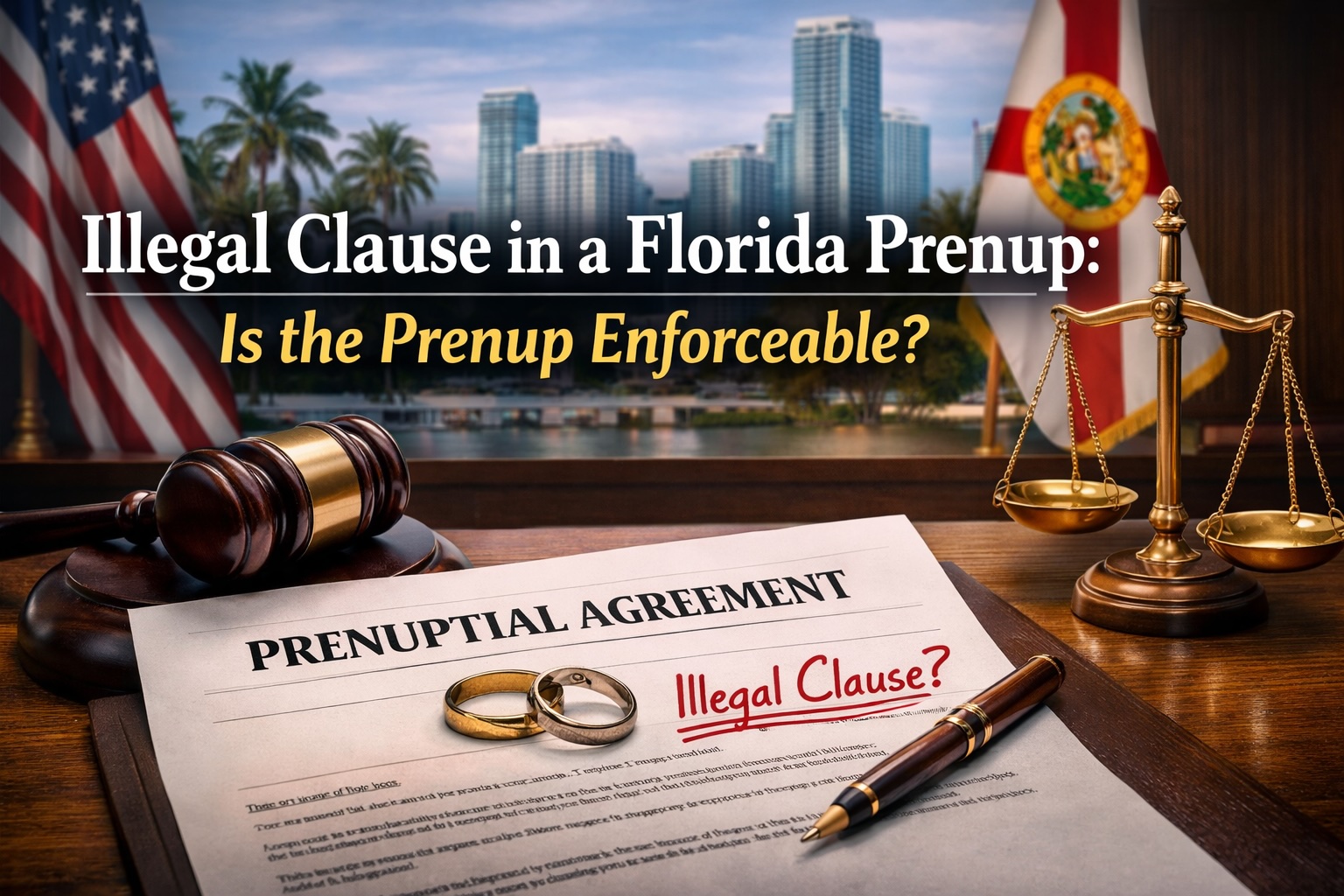
This article explains whether a prenuptial agreement remains enforceable in Florida when it contains an illegal clause. It analyzes Florida Statute 61.079 and leading case law to show that courts often sever unlawful provisions while enforcing the remainder of the agreement.
Prenuptial agreements are widely used in Florida to clarify financial expectations before marriage and to reduce the likelihood of contentious litigation if the relationship later ends in divorce. Couples throughout Miami and South Florida often rely on these agreements to determine how property, debts, and support obligations will be handled in the future. However, a common concern arises when a prenuptial agreement contains a clause that appears to violate Florida law or public policy. Many individuals assume that the presence of an illegal provision automatically voids the entire contract. Under Florida law, that assumption is often incorrect.
The key legal question is whether an illegal clause in a prenuptial agreement renders the entire agreement unenforceable. Florida courts typically analyze this issue through principles of contract severability and statutory requirements governing premarital agreements. In many circumstances, the court will simply remove the offending provision while enforcing the remainder of the agreement. This approach reflects the judiciary’s goal of preserving the lawful intentions of the parties whenever possible.
Florida Law Governing Prenuptial Agreements
Florida prenuptial agreements are primarily governed by the Florida Uniform Premarital Agreement Act, codified in Fla. Stat. § 61.079. This statute establishes the foundational rules that determine whether a premarital agreement is enforceable. Under Florida law, a valid prenuptial agreement must be in writing and signed by both parties before the marriage takes place. Unlike many other contracts, consideration beyond the marriage itself is not required for enforceability.
The statute also requires that the agreement be entered into voluntarily. Courts evaluating enforceability frequently examine whether either party signed the agreement under duress, coercion, or undue pressure. In addition, financial disclosure plays a central role. The law generally requires fair and reasonable disclosure of each party’s financial circumstances, unless that disclosure is expressly waived in writing. These requirements reflect the public policy interest in ensuring that both spouses understand the economic implications of the agreement before entering into marriage.
Florida law also sets limits on the types of provisions that may appear in a prenuptial agreement. While parties have broad authority to determine how property and financial matters will be handled, certain provisions are unenforceable as a matter of law. For example, an agreement cannot adversely affect a child’s right to support. Similarly, provisions that violate public policy may be invalidated by the court.
What Happens When a Prenuptial Agreement Contains an Illegal Clause
When an illegal clause appears in a prenuptial agreement, the central legal question becomes whether the unlawful provision invalidates the entire contract or whether the offending clause can be severed while leaving the rest intact. Florida courts generally favor severability. This means that if the illegal provision can be removed without undermining the overall purpose of the agreement, the remaining provisions may still be enforced.
This principle reflects a broader doctrine in Florida contract law. Courts attempt to preserve lawful agreements whenever possible rather than voiding them entirely. If the illegal clause is merely incidental and does not go to the essence of the agreement, the court will often strike that provision and enforce the remainder.
For individuals in Miami and throughout Florida who have discovered a problematic clause in their prenuptial agreement, this doctrine can be critically important. The existence of one unlawful provision does not necessarily eliminate the protections or obligations contained in the rest of the agreement.
Severability of Illegal Contract Provisions Under Florida Law
The concept of severability has been consistently recognized by Florida courts. The leading principle is that contracts may be partially enforced when the unlawful portion can be separated from the lawful terms. Courts examine whether the illegal provision was central to the agreement or whether the contract can still function effectively without it.
The Florida appellate decision in Vanacore Construction, Inc. v. Osborn, 260 So. 3d 527 (Fla. 2d DCA 2018), illustrates this doctrine. In that case, the court emphasized that a contract remains enforceable when the illegal portion does not go to the essence of the agreement. The decision confirmed that courts may excise the unlawful language while preserving the remaining valid contractual obligations.
This reasoning applies equally to prenuptial agreements. Because premarital agreements are contracts governed by established legal principles, the severability doctrine frequently determines whether an agreement survives judicial scrutiny after an illegal clause is identified.
Examples of Unenforceable Prenuptial Provisions
Although prenuptial agreements rights and responsibilities, certain types of clauses are frequently invalidated by Florida courts. One common example involves provisions attempting to waive child support obligations. Because child support belongs to the child rather than the parents, courts will not enforce agreements that limit or eliminate that right.
Another problematic category involves provisions that violate public policy. Courts may strike clauses that encourage divorce, impose punitive financial consequences for marital behavior, or interfere with statutory rights established under Florida law. In some cases, prenuptial agreements attempt to waive spousal support in circumstances where doing so would leave one spouse dependent on public assistance. Florida courts retain authority to override such provisions to prevent unjust outcomes.
Despite these limitations, the presence of an unenforceable clause does not necessarily destroy the entire agreement. Instead, courts focus on whether the remaining provisions still reflect the lawful intentions of the parties.
Florida Case Law Addressing Prenuptial Agreement Enforcement
Florida appellate courts have repeatedly addressed disputes involving prenuptial agreements. These cases demonstrate a consistent judicial effort to enforce agreements that were voluntarily entered into and that comply with statutory requirements.
In Lashkajani v. Lashkajani, 911 So. 2d 1154 (Fla. 2005), the Florida Supreme Court addressed a prevailing party attorney’s fee provision contained within a prenuptial agreement. The Court upheld the enforceability of the provision, recognizing that parties have significant freedom to allocate financial responsibility through premarital agreements. The decision reinforced the principle that valid contractual provisions will generally be enforced even in the family law context.
Another important case is Lord v. Lord, 993 So. 2d 562 (Fla. 4th DCA 2008). In that case, the court addressed issues related to spousal support provisions within a premarital agreement. The decision clarified that courts may decline to enforce provisions that violate public policy or conflict with statutory protections. At the same time, the court recognized that other portions of the agreement may remain enforceable.
Taken together, these cases demonstrate that Florida courts do not automatically invalidate prenuptial agreements simply because one clause is problematic. Instead, judges engage in a careful legal analysis to determine whether the remaining provisions can stand independently.
Unconscionability and Fairness in Prenuptial Agreements
Another factor that may affect enforceability is unconscionability. A prenuptial agreement may be challenged if it was unconscionable at the time it was executed. Courts evaluating unconscionability examine several factors, including the financial circumstances of the parties, the adequacy of disclosure, and the voluntariness of the agreement.
If a spouse can demonstrate that they lacked meaningful knowledge of the other party’s financial condition and did not voluntarily waive disclosure, the court may decline to enforce certain provisions. However, even when unconscionability is established, the court may still enforce portions of the agreement that remain fair and legally valid.
Florida courts therefore balance two competing principles. On one hand, the law respects the contractual autonomy of individuals entering marriage. On the other hand, courts retain authority to prevent agreements that would produce unjust or inequitable results.
Public Policy Considerations in Florida Family Law
Family law in Florida places significant emphasis on public policy. Courts are particularly concerned with protecting vulnerable spouses and children from financial harm. As a result, certain provisions within prenuptial agreements are subject to closer scrutiny than those found in ordinary commercial contracts.
For example, a clause that attempts to eliminate spousal support entirely may be overridden if enforcement would cause one spouse to become dependent on public assistance. In such situations, the court may modify or disregard the offending provision while leaving the remainder of the agreement intact.
This approach reflects the broader equitable powers of Florida family courts. Judges are tasked not only with enforcing contracts but also with ensuring that the outcomes of divorce proceedings remain consistent with fairness and public policy.
Why Severability Matters in Miami Divorce Cases
In Miami and throughout South Florida, prenuptial agreements frequently involve substantial assets, complex property interests, and international financial holdings. When disputes arise during divorce proceedings, the enforceability of these agreements can significantly affect the financial outcome for both spouses.
If an illegal clause automatically invalidated the entire agreement, many contracts would become vulnerable to challenge. Instead, the severability doctrine allows courts to preserve the lawful intentions of the parties while removing problematic provisions. This approach promotes stability in marital agreements and reduces the likelihood that minor drafting errors will undermine otherwise valid contracts.
For individuals who signed prenuptial agreements before marrying in Miami, understanding this doctrine can be essential when evaluating their legal rights during divorce.
Practical Implications for Couples With Prenuptial Agreements
The presence of an illegal clause does not necessarily mean a prenuptial agreement is worthless. Courts will analyze the structure of the agreement, the intent of the parties, and the significance of the unlawful provision. If the clause is minor or unrelated to the core purpose of the contract, the court will often remove it and enforce the remaining provisions.
However, if the illegal clause goes to the essence of the agreement or fundamentally alters the parties’ financial expectations, the court may determine that the entire agreement cannot be enforced. Each case depends on its specific facts and the overall structure of the contract.
Because of these complexities, individuals facing divorce in Florida should carefully review their prenuptial agreements with a qualified attorney. A detailed legal analysis is often necessary to determine which provisions remain enforceable and which may be vulnerable to challenge.
Conclusion
An illegal clause in a prenuptial agreement does not automatically invalidate the entire contract under Florida law. Courts generally apply the doctrine of severability, allowing them to remove unlawful provisions while enforcing the remainder of the agreement. As long as the illegal clause does not go to the essence of the contract and the remaining provisions comply with statutory requirements, the prenuptial agreement may still be enforceable.
Florida statutes, including Fla. Stat. § 61.079, along with case law such as Vanacore Construction, Inc. v. Osborn, Lashkajani v. Lashkajani, and Lord v. Lord, demonstrate the courts’ commitment to preserving valid agreements whenever possible. For couples in Miami and across Florida, this means that discovering an unlawful clause does not necessarily eliminate the legal protections established by a prenuptial agreement.
TLDR: Under Florida law, the presence of an illegal clause in a prenuptial agreement does not automatically invalidate the entire contract. Courts may sever the unlawful provision and enforce the remaining terms if they are lawful and consistent with the parties’ original intent.
Can a prenup still be valid if one clause is illegal? Yes. Florida courts may remove the illegal provision and enforce the rest of the agreement if the remaining terms are valid and the unlawful clause does not undermine the contract’s core purpose.
What law governs prenuptial agreements in Florida? Prenuptial agreements in Florida are governed primarily by Fla. Stat. § 61.079, which establishes requirements for enforceability such as written form, voluntary execution, and financial disclosure.
What types of clauses are unenforceable in a Florida prenup? Clauses affecting a child’s right to support, provisions that violate public policy, or terms that would leave a spouse dependent on public assistance may be declared unenforceable.
Can a court modify a prenuptial agreement during divorce? Courts generally enforce valid agreements but may refuse to enforce specific provisions that violate statutory requirements, public policy, or equitable principles.
Does Miami law treat prenups differently from the rest of Florida? No. Miami courts apply the same Florida statutes and appellate case law governing prenuptial agreements as courts throughout the state.