
20 May Unequal Distribution in Florida Divorce
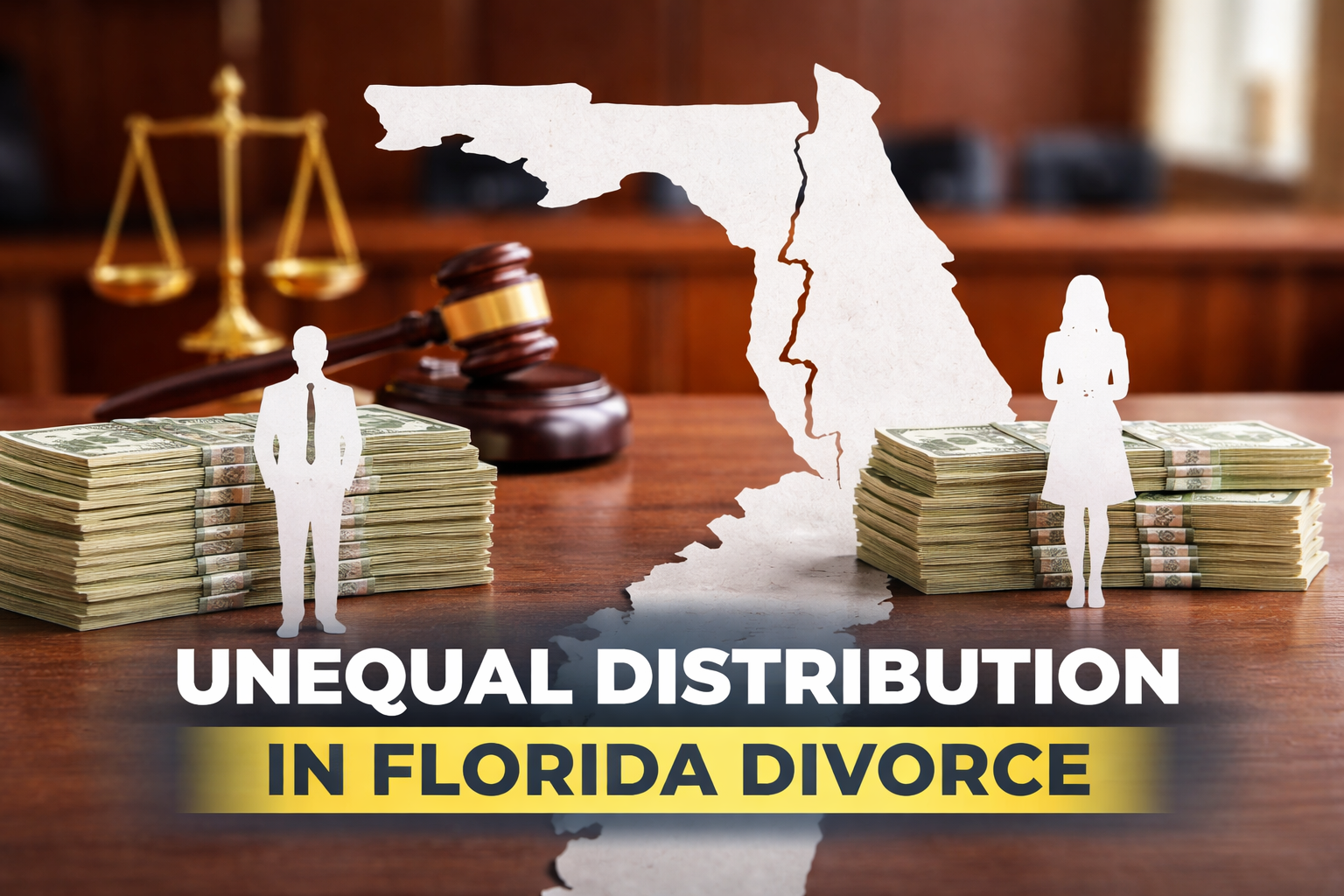
Unequal distribution in Florida divorce is one of the most misunderstood areas of equitable distribution litigation. Florida law begins with a strong presumption that marital assets and liabilities will be divided equally. However, section 61.075, Florida Statutes, expressly permits a trial court to award an unequal distribution when justified by competent substantial evidence and supported by specific written findings. In Miami-Dade County dissolution cases, judges strictly enforce these statutory requirements, and failure to comply often results in reversal on appeal.
This academic analysis examines the statutory framework governing unequal distribution in Florida divorce, recent appellate guidance, procedural requirements, and strategic considerations for litigants in Miami family courts.
Statutory Framework for Unequal Distribution in Florida Divorce
Presumption of Equal Distribution Under Section 61.075
Section 61.075(1), Florida Statutes, establishes the foundational principle that marital assets and liabilities must be distributed equally unless there is a justification for an unequal distribution based on all relevant factors. Florida appellate courts consistently reaffirm that equal division is the starting point.
In McGowan v. McGowan, 344 So. 3d 607 (Fla. 1st DCA 2022), the Second District reiterated that a trial court must begin with the premise of equal distribution before deviating. Similarly, in Rojas v. ADA Isis Pelaez Otero, 399 So. 3d 1160 (Fla. 3d DCA 2024), the Third District emphasized that deviation requires articulated reasoning grounded in statutory factors.
Statutory Factors Justifying Unequal Distribution
Section 61.075(1) lists nonexclusive factors that may justify unequal distribution in Florida divorce, including but not limited to:
The contribution of each spouse to the marriage, including homemaking and child care services; the economic circumstances of the parties; the duration of the marriage; interruption of personal careers or educational opportunities; the contribution of one spouse to the career or education of the other; the desirability of retaining an asset intact; intentional dissipation or waste of marital assets; and any other factor necessary to do equity and justice between the parties.
These factors must be applied to the specific evidentiary record. A generalized statement that an unequal division is fair is legally insufficient.
Required Written Findings in Unequal Distribution Cases
Section 61.075(3) Mandatory Findings
Section 61.075(3), Florida Statutes, mandates specific written findings in contested dissolution cases where no filed stipulation exists. The court must identify:
The classification of assets as marital or nonmarital; the ownership interest in nonmarital assets; the valuation of significant marital assets; the allocation of marital assets and liabilities; and the factual basis supporting any unequal distribution.
In Aponte v. Wood, 308 So. 3d 1043 (Fla. 4th DCA 2020), the Fourth District reversed an equitable distribution scheme because the trial court failed to include sufficient findings to permit meaningful appellate review. The appellate court emphasized that statutory compliance is not discretionary.
Competent Substantial Evidence Standard
Any unequal distribution in Florida divorce must be supported by competent substantial evidence. Trial courts may not rely on speculation or conclusory assertions. Appellate courts regularly reverse unequal awards when evidentiary support is lacking.
In Vanetten v. Vanetten, 92 So. 3d 235 (Fla. 2d DCA 2012), the Second District held that deviation from equal distribution requires record evidence specifically tied to statutory factors. Absent such linkage, reversal is required.
Dissipation and Intentional Misconduct
Intentional Waste of Marital Assets
One of the most litigated grounds for unequal distribution in Florida divorce is intentional dissipation under section 61.075(1)(i). Dissipation involves the intentional waste, depletion, or destruction of marital assets for a purpose unrelated to the marriage and occurring during the breakdown of the marital relationship.
Florida courts require clear evidence connecting the dissipation to the marital breakdown. Spending that occurred during intact marital harmony generally does not qualify.
Adultery and Financial Impact
Although adultery alone does not justify unequal distribution, if marital funds were expended in furtherance of an extramarital relationship, courts may consider the financial impact as dissipation. The analysis focuses on economic loss rather than moral wrongdoing.
Economic Circumstances and Long-Term Marriages
In long-term marriages exceeding seventeen years under section 61.08 definitions, economic disparity may influence distribution decisions. While alimony addresses support, equitable distribution focuses on property allocation. Courts must avoid using unequal distribution as disguised alimony.
In Parker v. Parker, 2024 WL 171898 (Fla. 2d DCA 2024), the Second District reinforced that financial calculations must be grounded in proper methodology, reversing an alimony calculation based on gross rather than net income. Although primarily an alimony case, its reasoning underscores the necessity of financial precision in all dissolution determinations.
Procedural Requirements in Miami-Dade County
In the Eleventh Judicial Circuit serving Miami-Dade County, family divisions require strict adherence to Florida Family Law Rule of Procedure 12.285 regarding mandatory disclosure. Accurate financial affidavits are critical when litigating unequal distribution in Florida divorce.
Failure to provide complete disclosure may result in sanctions or adverse inferences. Courts rely heavily on forensic accounting testimony in high net worth Miami cases involving business valuations, investment portfolios, cryptocurrency holdings, and international assets.
Appellate Consequences of Insufficient Findings
Florida district courts of appeal consistently reverse unequal distribution awards lacking adequate findings. The absence of statutory compliance creates reversible error per se.
In Merlihan v. Skinner, 382 So. 3d 735 (Fla. 4th DCA 2024), although addressing delegation of timesharing decisions, the Fourth District reiterated the broader principle that trial courts may not abdicate statutory responsibilities. This reasoning applies equally to equitable distribution analysis.
Guardian ad Litem and Property Issues
While guardians ad litem primarily address timesharing under section 61.13, courts may not delegate property determinations to third parties. As clarified in Bahl v. Bahl, 220 So. 3d 1214 (Fla. 2d DCA 2016), reliance on unsworn reports without evidentiary foundation constitutes reversible error. Property decisions must rest on sworn testimony and admissible evidence.
Miami-Specific Considerations in Unequal Distribution
Miami divorce litigation frequently involves closely held corporations, professional practices, real estate development ventures, and foreign investment accounts. Courts in Miami-Dade County often confront complex tracing issues when determining whether assets are marital or nonmarital.
International marriages involving assets in Latin America, Europe, or the Caribbean require careful jurisdictional analysis. While Florida courts may equitably distribute property subject to in personam jurisdiction, enforcement abroad may present practical challenges.
Common Litigation Mistakes
Parties frequently fail to present expert valuation testimony, neglect to trace nonmarital claims with documentary precision, or rely on generalized allegations of unfairness. Without clear statutory analysis and evidentiary linkage, courts default to equal distribution.
Another common error involves conflating emotional grievances with economic harm. Florida courts do not punish marital misconduct absent financial consequences.
Strategic Considerations for Counsel
Successful litigation of unequal distribution in Florida divorce requires early financial investigation, forensic analysis, and structured presentation of statutory factors. Counsel must build a record anticipating appellate scrutiny.
Detailed proposed final judgments assist trial courts in making statutorily compliant findings. Given the frequency of appellate reversals, precision in drafting is essential.
Conclusion
Unequal distribution in Florida divorce is permitted but carefully circumscribed. Section 61.075 creates a presumption of equality that may be overcome only through competent substantial evidence tied to enumerated statutory factors and accompanied by specific written findings. Miami-Dade courts strictly enforce these requirements, and appellate courts routinely reverse deficient orders. Parties seeking deviation must present clear, persuasive, and legally grounded evidence.
If you are facing a complex equitable distribution dispute in Miami, strategic preparation and experienced representation are essential. Contact our Miami family law team to schedule a confidential consultation and protect your financial future.
TLDR: Unequal distribution in Florida divorce occurs when a court awards marital assets and liabilities disproportionately instead of equally under section 61.075, Florida Statutes, based on specific statutory factors and written findings supported by competent substantial evidence.
Frequently Asked Questions About Unequal Distribution in Florida Divorce
What is unequal distribution in Florida divorce?
Unequal distribution occurs when a court divides marital assets and liabilities disproportionately rather than equally under section 61.075, Florida Statutes, based on statutory factors and written findings.
Can a judge award more than fifty percent of marital assets to one spouse?
Yes, but only if justified by statutory factors and supported by competent substantial evidence with detailed written findings.
Is adultery grounds for unequal distribution?
Adultery alone is insufficient. However, if marital funds were spent in furtherance of an extramarital relationship, the financial dissipation may justify deviation.
What happens if the judge fails to make written findings?
Failure to comply with section 61.075(3) generally results in reversal and remand by the appellate court.
How does Miami-Dade County handle high asset divorce cases?
Miami courts frequently rely on forensic accountants and expert testimony to value complex assets and ensure statutory compliance in equitable distribution orders.