
02 Aug Can Parents Waive Child Support in a Florida Divorce?
Summary
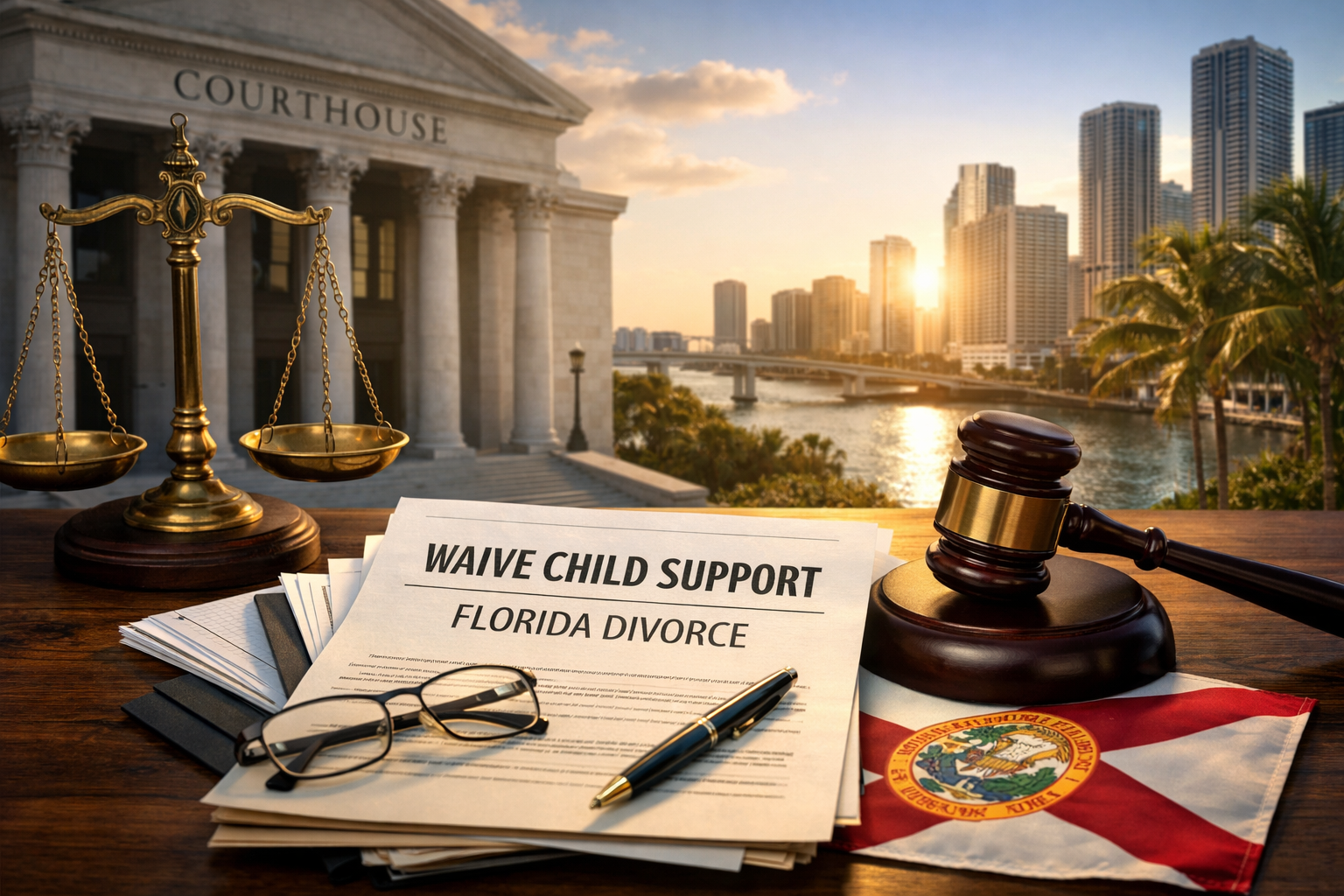
Parents generally cannot waive child support in a Florida divorce because the legal right to financial support belongs to the child, not the parents. Florida courts, including those in Miami-Dade County, must review any support agreement and will reject arrangements that fail to comply with Florida Child Support Guidelines or the child’s best interests.
The question of whether parents can waive child support in a Florida divorce arises frequently in family law proceedings throughout Miami and the Eleventh Judicial Circuit. Many separating couples believe they can mutually agree that no child support will be paid. However, Florida law imposes strict limitations on such agreements because the legal right to support belongs to the child rather than the parents. Under Florida law, parents generally cannot waive child support in a Florida divorce because child support is considered a fundamental right of the child. Courts in Miami-Dade County and across Florida consistently hold that parents cannot contract away a child’s right to financial support.
This legal principle reflects the public policy of the State of Florida that children must receive adequate financial support from both parents regardless of the parents’ personal agreements. Florida courts routinely review any agreements concerning child support to ensure compliance with statutory requirements and to protect the best interests of the child.
Understanding whether parents may waive child support in a Florida divorce requires careful examination of Florida statutes, appellate court decisions, and the role of the trial court in approving or rejecting parental agreements. This article explains the governing law, the limited circumstances in which agreements may affect support obligations, and how Miami family courts approach child support issues in divorce proceedings.
Child Support in Florida Is a Right of the Child
Florida law clearly establishes that child support is a right belonging to the child rather than to either parent. Because the right belongs to the child, parents cannot waive child support in a Florida divorce simply by agreement. Courts treat the obligation as a matter of public policy designed to protect children from financial hardship.
Florida appellate courts have repeatedly emphasized this principle. In Fox v. Haislett, 388 So.2d 1261 (Fla. 2d DCA 1980), the court explained that parents may not contract away a child’s right to support. The court held that agreements purporting to eliminate support obligations are void when they conflict with the child’s welfare. Similarly, the Florida courts recognized that the obligation to support minor children exists independently of any contractual arrangement between the parents.
Another significant decision reinforcing this rule is Armour v. Allen, 377 So.2d 798 (Fla. 1st DCA 1979), which held that parents cannot permanently relieve a parent of support obligations through private agreement. The court explained that such agreements violate public policy because they attempt to deprive children of financial resources that the law guarantees.
More recently, the Florida courts have reaffirmed this doctrine in cases such as Quinn v. Quinn, 169 So.3d 268 (Fla. 2d DCA 2015), which emphasized that child support obligations exist for the benefit of the child and cannot be waived by the parents.
These cases demonstrate a consistent judicial approach in Florida family law. Regardless of parental agreement, courts must ensure that children receive adequate support consistent with statutory guidelines.
Florida Statutory Framework Governing Child Support
The statutory framework governing child support in Florida is primarily contained in Chapter 61 of the Florida Statutes. Section 61.30 establishes the Florida Child Support Guidelines, which provide a presumptive calculation for determining the appropriate amount of support based on parental income, childcare costs, health insurance expenses, and the number of overnight visits each parent has with the child.
Under section 61.30, Florida courts must calculate the presumptive guideline amount of support in every case involving minor children. The guideline calculation creates a rebuttable presumption that the calculated amount is the appropriate level of support. Courts may deviate from the guideline amount only if they make written findings explaining why the deviation is justified.
The Florida appellate court in Finch v. Finch, 640 So.2d 1243 (Fla. 1st DCA 1994), confirmed that trial courts must follow the statutory guidelines and provide written justification for any deviation. This requirement ensures consistency and transparency in child support determinations across Florida courts.
Section 61.14 of the Florida Statutes further governs modification and enforcement of support obligations. This statute recognizes that child support obligations may change over time due to substantial changes in circumstances, but it does not allow parents to permanently waive the obligation.
Additionally, section 61.13 addresses parental responsibility and time sharing, emphasizing that all decisions affecting children must serve the best interests of the child. Courts reviewing child support agreements must therefore consider whether the agreement adequately protects the child’s welfare.
Why Courts Do Not Allow Parents to Waive Child Support
Florida courts refuse to allow parents to waive child support because doing so could jeopardize the financial security of the child. Children have independent rights under Florida law, and courts must ensure those rights are protected regardless of parental agreements.
The policy rationale behind this rule is straightforward. Parents may attempt to waive child support for many reasons including convenience, financial bargaining during divorce negotiations, or attempts to avoid ongoing financial obligations. However, circumstances change. A child who appears financially secure at the time of divorce may later require additional resources for healthcare, education, or basic living expenses.
Because of these uncertainties, Florida courts maintain continuing jurisdiction over child support matters. Judges must review any agreement affecting support to ensure that the child’s financial needs are adequately addressed.
Courts also recognize that unequal bargaining power between parents could lead to unfair agreements. One parent may feel pressured to accept a waiver in order to finalize a divorce or avoid litigation. Judicial oversight prevents such agreements from harming the child.
Agreements Concerning Child Support in Florida Divorce
Although parents generally cannot waive child support in a Florida divorce, they may enter into agreements concerning how support will be structured. These agreements must still comply with statutory requirements and must be approved by the court.
The Florida appellate decision in Lester v. Lester, 736 So.2d 1257 (Fla. 2d DCA 1999), addressed this issue directly. The court held that parents may make agreements relating to child support as long as the agreement serves the best interests of the child. However, the court emphasized that agreements attempting to permanently eliminate support obligations are unenforceable.
Courts may approve agreements that deviate from the guideline amount when the deviation is justified by the child’s needs and the parents’ financial circumstances. For example, parents may agree that one parent will directly pay certain expenses such as private school tuition, medical costs, or extracurricular activities.
Even in such cases, the court must verify that the agreement provides adequate financial support for the child and that the deviation from the guidelines is supported by written findings.
The Role of the Court in Reviewing Child Support Agreements
Florida family courts play a central role in reviewing and approving child support agreements. Judges must ensure that any agreement complies with statutory guidelines and protects the best interests of the child.
The case of Gentry v. Morgan, 83 So.3d 924 (Fla. 1st DCA 2012), illustrates the importance of judicial oversight. In that case, the court emphasized that trial courts have the authority to reject parental agreements that fail to adequately provide for the child’s financial needs.
This authority reflects the broader principle that child support is not purely a private matter between parents. Once incorporated into a final judgment of dissolution of marriage, the parenting plan and child support provisions become enforceable court orders.
In Miami-Dade County, child support orders are typically entered by judges sitting in the family division of the Eleventh Judicial Circuit Court. These judges must review financial affidavits, guideline worksheets, and other evidence before approving any support arrangement.
Modification of Child Support in Florida
Child support obligations in Florida may be modified when there is a substantial change in circumstances. Section 61.14 of the Florida Statutes allows courts to modify support orders when changes in income, parenting time, or the needs of the child justify adjustment.
Courts require the party seeking modification to demonstrate a substantial, material, and unanticipated change in circumstances. The burden of proof generally rests on the party requesting the modification.
Florida courts have recognized that parties seeking to reduce support obligations after agreeing to a specific amount may face a higher burden of proof. The decision in Lester v. Lester highlighted the importance of stability in child support arrangements while still allowing modification when circumstances warrant it.
Child Support Proceedings in Miami Family Court
Child support issues arising from divorce proceedings in Miami are handled by the Eleventh Judicial Circuit Court located in Miami-Dade County. The court applies the same statutory framework governing child support throughout Florida.
However, Miami family courts frequently address complex financial situations due to the city’s diverse economy and high cost of living. Judges must carefully evaluate financial disclosures and evidence to ensure that support orders reflect the child’s needs and the parents’ ability to pay.
Because child support cannot be waived in a Florida divorce, Miami family law attorneys often advise clients that attempts to eliminate support obligations will likely be rejected by the court.
Conclusion
Florida law makes clear that parents cannot waive child support in a Florida divorce because the right to support belongs to the child. Courts consistently enforce this principle through statutes and appellate case law, including Fox v. Haislett, Armour v. Allen, and Lester v. Lester. While parents may enter into agreements concerning the structure of support, such agreements must comply with statutory guidelines and receive judicial approval.
Miami family courts remain vigilant in protecting children’s financial interests. Judges carefully review all support agreements and retain the authority to reject arrangements that fail to adequately provide for the child’s needs. As a result, parents navigating divorce proceedings in Florida should understand that child support obligations cannot be permanently waived.
Speak With a Miami Child Support Attorney
Parents involved in divorce or parenting plan disputes in Miami often have questions about whether child support can be waived or modified. Because Florida law strictly protects the financial rights of children, it is critical to obtain legal guidance before entering any agreement affecting support obligations.
An experienced Miami family law attorney can analyze financial circumstances, calculate guideline support, and ensure that any proposed agreement complies with Florida statutes and court requirements. Proper legal advice can help parents avoid agreements that courts may later reject.
TLDR: Can child support be waived in a Florida divorce? No. Under Florida law, child support cannot be waived because the right to support belongs to the child rather than the parents. Courts may approve agreements affecting the structure or amount of support, but they must ensure that the agreement complies with Florida Child Support Guidelines and serves the best interests of the child.
Frequently Asked Questions
Can parents agree to no child support in Florida?
Parents may propose agreements concerning child support, but courts must review and approve those agreements. If the agreement eliminates support or fails to meet guideline requirements, the court will likely reject it.
Why does Florida not allow child support waivers?
Florida law treats child support as a right belonging to the child. Because children cannot waive their own rights, parents cannot waive support on their behalf.
Can a child support agreement deviate from Florida guidelines?
Yes. Courts may approve deviations from the statutory guidelines if the judge makes written findings explaining why the deviation is appropriate and consistent with the child’s best interests.
Can child support be modified after divorce?
Yes. Child support orders may be modified when there is a substantial change in circumstances under section 61.14 of the Florida Statutes.