
10 Mar Changing a Child’s Last Name in Florida Divorce Proceedings
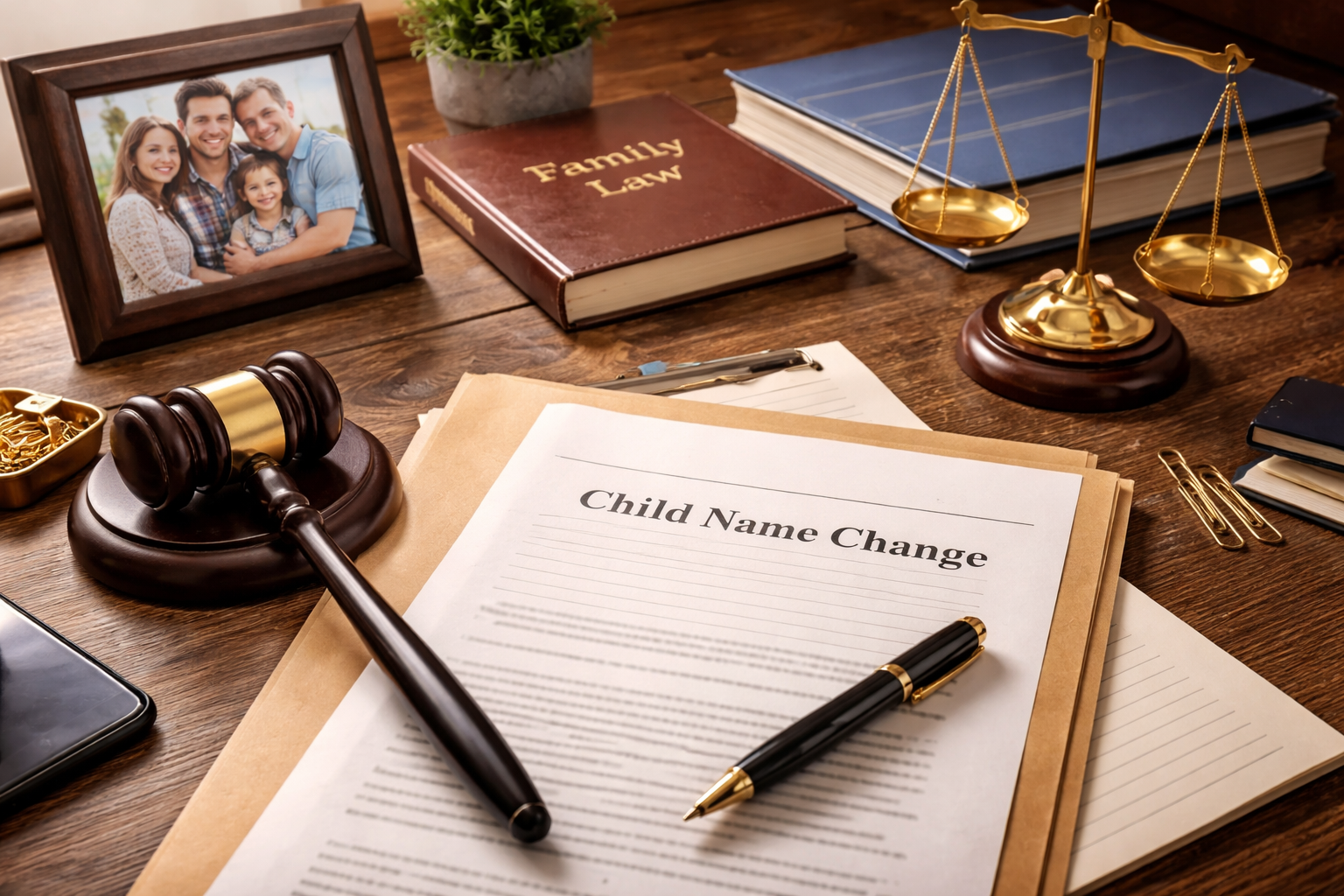
A child’s last name change in Florida divorce proceedings is permitted only if the requesting parent proves that the change is in the child’s best interests under section 61.13, Florida Statutes. The burden of proof rests on the parent seeking the modification, and courts require competent substantial evidence demonstrating that the change is necessary for the child’s welfare.
A child’s last name change in Florida divorce litigation is governed by a strict best interests of the child standard under section 61.13, Florida Statutes. Florida courts do not permit a child’s surname to be modified based on parental preference, remarriage, or convenience. Instead, a child’s last name change in Florida divorce proceedings requires competent substantial evidence demonstrating that the requested modification is necessary for the child’s welfare. Appellate courts have consistently reversed trial court orders where the legal standard was misapplied or where findings were unsupported by the record.
Legal Standards Governing a Child’s Last Name Change in Florida Divorce
The controlling principle in any child’s last name change in Florida divorce case is the best interests of the child. Section 61.13(3), Florida Statutes, requires courts to evaluate all factors affecting the welfare and interests of the minor child. Although the statute does not expressly reference surname disputes, appellate courts uniformly apply its framework to determine whether a child’s identity should be altered through judicial intervention.
Florida public policy favors frequent and continuing contact with both parents after dissolution. A child’s surname implicates identity, familial association, and parental bonds. For that reason, courts approach a child’s last name change in Florida divorce cases with caution and insist on substantial justification.
Statutory Authority
Chapter 61 provides the circuit court with jurisdiction to resolve parental responsibility and time-sharing matters during dissolution. When a child’s last name change in Florida divorce litigation is requested within an active dissolution case, the court may adjudicate the issue as part of its authority over matters affecting the child.
Section 68.07, Florida Statutes, governs general name change petitions. However, when the issue arises between divorcing parents in Miami-Dade County, the family division may resolve the dispute within the dissolution proceeding without requiring a separate civil action.
Burden of Proof
The parent requesting a child’s last name change in Florida divorce litigation bears the burden of proof. In Levine v. Best, 595 So. 2d 278 (Fla. 3d DCA 1992), the Third District held that a minor’s name may be changed only where the record affirmatively demonstrates that such a change is required for the minor’s welfare. Parental preference is insufficient.
Similarly, in McKay v. Haikey, 860 So. 2d 1046 (Fla. 5th DCA 2003), the court emphasized that in the absence of sufficient evidence, the issue must be resolved against the proponent of the name change. The jurisprudence surrounding a child’s last name change in Florida divorce cases reflects a consistent reluctance to disturb a child’s established surname absent compelling evidence.
Appellate Case Law on Child’s Last Name Change in Florida Divorce
Florida appellate courts have repeatedly reversed orders granting a child’s last name change in Florida divorce proceedings where trial courts relied on speculative concerns.
In Girten v. Andreu, 698 So. 2d 886 (Fla. 3d DCA 1997), the Third District rejected generalized assertions of potential embarrassment. In Chamberlin v. Miller, 47 So. 3d 381 (Fla. 5th DCA 2010), reversal was required because the record lacked competent substantial evidence demonstrating necessity for the child’s welfare. In Airsman v. Airsman, 179 So. 3d 342 (Fla. 2d DCA 2015), the court reiterated that uniformity with a parent’s surname does not justify modification.
These decisions confirm that a child’s last name change in Florida divorce proceedings demands detailed factual findings supported by substantial evidence.
Best Interests Analysis
When evaluating a child’s last name change in Florida divorce litigation, courts consider factors derived from section 61.13(3), including stability, parental involvement, the child’s developmental needs, and the demonstrated capacity of each parent to foster a close relationship with the other parent.
Courts reviewing a child’s last name change in Florida divorce proceedings must begin with the presumption that continuity of identity promotes stability for the minor child. The length of time the child has used the existing surname and the child’s identification within school and community settings are significant considerations.
The child’s preference may be considered if the child demonstrates sufficient maturity. However, the preference is not controlling. The trial court must independently determine whether the requested change advances the child’s welfare.
Procedural Requirements
A request for a child’s last name change in Florida divorce proceedings must be specifically pleaded in the petition or counterpetition. Due process requires notice and an opportunity to be heard. A trial court cannot order a surname modification sua sponte.
Specific written findings are mandatory. Failure to articulate factual findings demonstrating why the child’s last name change in Florida divorce is in the child’s best interests constitutes reversible error.
The requesting parent must present competent substantial evidence. Speculative testimony is insufficient. The court may not delegate its decision-making authority to a guardian ad litem or other expert without conducting an independent analysis.
Miami-Dade Considerations
In Miami-Dade County, surname disputes frequently arise in multicultural families where compound surnames or dual surnames reflect cultural traditions. While cultural considerations may inform the analysis, they do not replace the statutory best interests standard. Immigration documentation, passports, school enrollment, and international travel logistics are commonly raised in Miami cases involving a child’s last name change in Florida divorce proceedings. These practical concerns must be supported by competent evidence demonstrating actual impact on the child.
Modification of a Child’s Last Name After Florida Divorce
If a child’s last name change in Florida divorce is sought after entry of a final judgment, the moving party must demonstrate a substantial, material, and unanticipated change in circumstances in addition to proving that the modification serves the child’s best interests under section 61.13.
Where a child’s last name change in Florida divorce is requested post-judgment, courts apply the same evidentiary rigor required at the initial determination stage.
Conclusion
A child’s last name change in Florida divorce litigation is an extraordinary judicial remedy. Florida courts consistently protect the stability of a child’s identity and require compelling, competent substantial evidence before altering a surname. Parental preference, remarriage, or desire for uniformity does not satisfy the legal standard. In Miami-Dade County, where cultural naming practices often intersect with family law disputes, courts remain anchored to the statutory best interests framework. Parents considering a child’s last name change in Florida divorce proceedings should seek experienced legal counsel to ensure compliance with Florida law and to protect both parental rights and the child’s long-term welfare.
Frequently Asked Questions
Can a mother automatically obtain a child’s last name change in Florida divorce?
No. A child’s last name change in Florida divorce requires proof that the modification is in the child’s best interests under section 61.13, Florida Statutes.
Who bears the burden of proof in a child’s last name change in Florida divorce?
The parent requesting the child’s last name change in Florida divorce proceedings bears the burden of presenting competent substantial evidence.
Does remarriage justify a child’s last name change in Florida divorce?
Remarriage alone does not justify a child’s last name change in Florida divorce litigation. Courts require evidence demonstrating necessity for the child’s welfare.
Can a child’s last name change in Florida divorce be requested after final judgment?
Yes. However, the requesting parent must prove a substantial, material, and unanticipated change in circumstances in addition to the best interests standard.
How do Miami courts decide a child’s last name change in Florida divorce disputes?
Miami-Dade family courts apply section 61.13, Florida Statutes, require specific written findings, and demand competent substantial evidence supporting the requested modification.