
17 Mar Violating Time-Sharing Agreements in Florida Parenting Plans
Summary
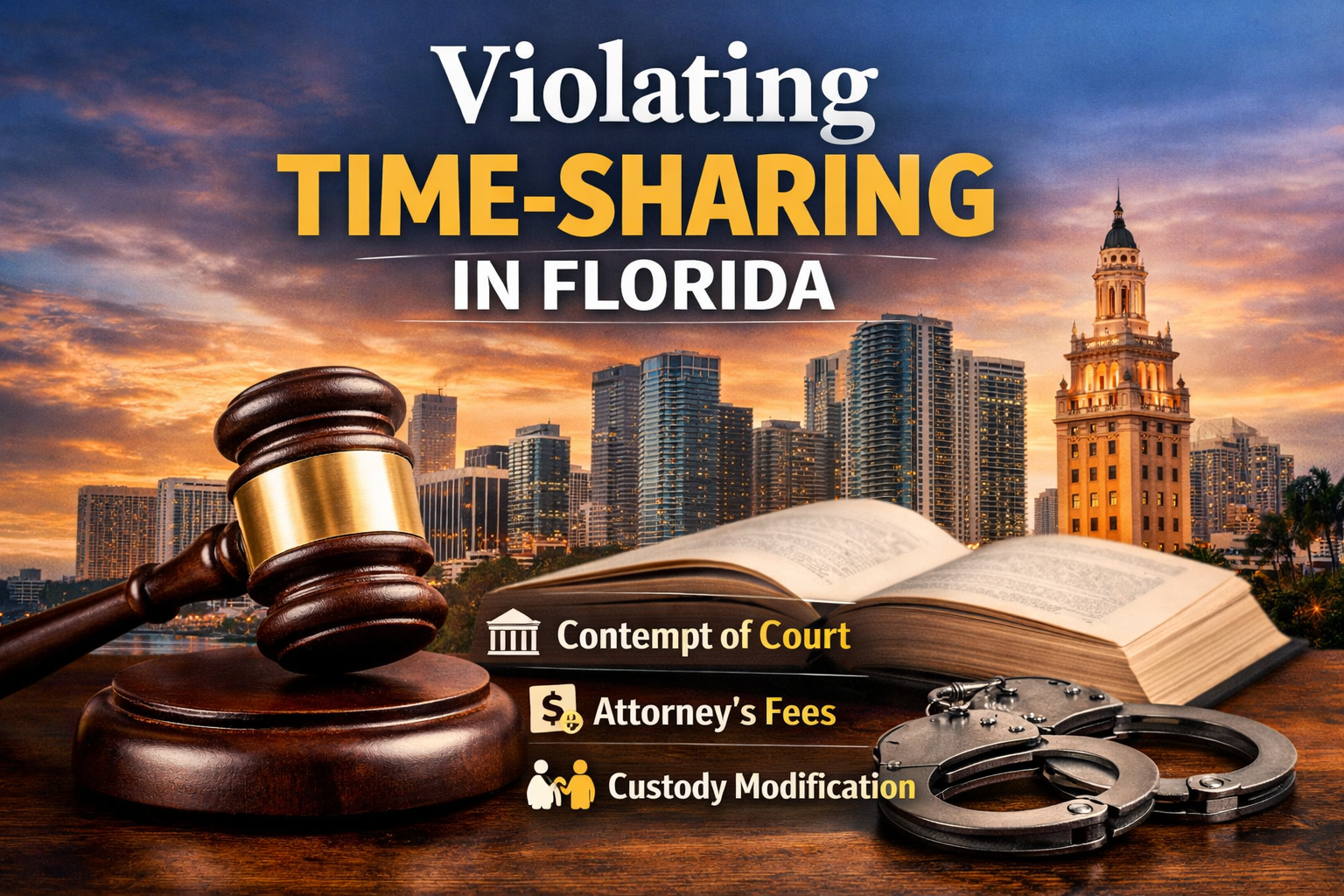
Violating time-sharing in Florida can result in contempt, attorney’s fees, make-up parenting time, and possible modification of the parenting plan under §61.13(4). Courts strictly enforce compliance to protect the child’s best interests and uphold judicial authority.
Violating time-sharing in Florida exposes a parent to contempt proceedings, financial sanctions, attorney’s fees, make-up parenting time, and possible modification of parental responsibility. Section 61.13(4), Florida Statutes, provides that when a parent refuses to honor the time-sharing schedule in a court-approved parenting plan without proper cause, the court may impose statutory remedies, including contempt of court or other relief the court deems appropriate. In Miami-Dade County and throughout the State of Florida, trial courts treat interference with time-sharing as a direct violation of judicial authority and a threat to the child’s best interests.
This article provides an analysis of enforcement remedies under section 61.13(4), Florida Statutes; civil contempt procedures under Florida Family Law Rule of Procedure 12.615; the independence of child support obligations; attorney’s fee provisions; modification standards; limitations on judicial delegation; and relevant Florida appellate decisions including Wolf v. Wolf, 296 So. 3d 479 (Fla. 5th DCA 2020); Lett v. Lett, 408 So. 3d 167 (Fla. 5th DCA 2025); Hoffman v. Foley, 541 So. 2d 145 (Fla. 3d DCA 1989); Merlihan v. Skinner, 382 So. 3d 735 (Fla. 4th DCA 2024); and Bahl v. Bahl, 220 So. 3d 1214 (Fla. 2d DCA 2016). Particular attention is given to enforcement practice in the Eleventh Judicial Circuit in and for Miami-Dade County.
Florida Public Policy and the Statutory Foundation of Time-Sharing
Florida family law reflects a strong public policy favoring frequent and continuing contact between minor children and both parents following separation or dissolution of marriage. Section 61.13(2)(c)1., Florida Statutes, expressly states this legislative intent. Section 61.046(23), Florida Statutes, defines a parenting plan as a document governing the relationship between the parents relating to decisions that must be made regarding the child and that must contain a time-sharing schedule.
Section 61.13(2)(c) establishes a rebuttable presumption that equal time-sharing is in the best interests of a minor child unless otherwise agreed by the parties or rebutted by a preponderance of the evidence. When establishing or modifying a parenting plan, the court must consider all best interest factors enumerated in section 61.13(3), Florida Statutes, and must make specific written findings regarding time-sharing. The failure to make required findings has repeatedly resulted in appellate reversal.
Because the parenting plan is incorporated into a final judgment of dissolution or paternity, interference with court-ordered time-sharing constitutes a violation of a court order subject to enforcement under section 61.13(4).
Statutory Remedies Under Section 61.13(4), Florida Statutes
Section 61.13(4)(a), Florida Statutes, provides that when a parent refuses to honor the time-sharing schedule without proper cause, the court shall, after calculating the amount of time-sharing improperly denied, award the parent denied time-sharing a sufficient amount of extra time-sharing to compensate for the time-sharing missed. Section 61.13(4)(c) authorizes additional remedies, including ordering the violating parent to pay reasonable court costs and attorney’s fees incurred by the nonviolating parent, ordering the violating parent to attend a parenting course, ordering community service, modifying the parenting plan if modification is in the best interests of the child, or imposing any other reasonable sanction.
The statute concludes that a person who violates this subsection may be punished by contempt of court or other remedies as the court deems appropriate. The statutory language is mandatory regarding make-up time-sharing and permissive regarding additional sanctions.
In Wolf v. Wolf, 296 So. 3d 479 (Fla. 5th DCA 2020), the Fifth District Court of Appeal confirmed that a violation of section 61.13(4) may be punished by contempt or other remedies as deemed appropriate. The appellate court emphasized the trial court’s broad enforcement authority while reinforcing the necessity of adherence to statutory procedures.
Civil Contempt Proceedings Under Florida Family Law Rule 12.615
Enforcement of time-sharing violations commonly proceeds through civil contempt under Florida Family Law Rule of Procedure 12.615. To establish civil contempt, the movant must demonstrate the existence of a prior valid court order, knowledge of that order by the alleged contemnor, and a willful failure to comply despite the present ability to do so. The burden then shifts to the alleged contemnor to demonstrate inability to comply.
Contempt proceedings must comply with constitutional due process requirements, including adequate notice and opportunity to be heard. Orders of contempt must include findings regarding the contemnor’s present ability to comply if coercive incarceration is imposed.
In Miami-Dade County, Unified Family Court judges regularly evaluate documentary evidence, communications between parents, and testimony regarding alleged denials of visitation. The court’s authority to impose sanctions flows both from section 61.13(4) and from its inherent contempt powers.
Attorney’s Fees for Improper Denial of Time-Sharing
Section 61.13(4)(c)2., Florida Statutes, expressly authorizes an award of attorney’s fees and court costs when a parent refuses to honor the time-sharing schedule without proper cause. This statutory basis differs from need-based fee awards under section 61.16, Florida Statutes, because it focuses on enforcement and deterrence rather than financial disparity.
In Lett v. Lett, 408 So. 3d 167 (Fla. 5th DCA 2025), the Second District Court of Appeal recognized that section 61.13(4)(c)2. authorizes attorney’s fees when a parent’s refusal to comply with the parenting plan lacks proper cause. The decision underscores the Legislature’s intent to deter noncompliance and to compensate the aggrieved parent for enforcement expenses.
Miami trial courts routinely apply section 61.13(4)(c)2. when evidence demonstrates unjustified interference with time-sharing.
Independence of Child Support Obligations
Florida law unequivocally provides that child support obligations are independent of time-sharing compliance. Section 61.13 states that when a parent refuses to honor the other parent’s time-sharing rights, the parent whose time-sharing rights were violated shall continue to pay any ordered child support or alimony.
In Hoffman v. Foley, 541 So. 2d 145 (Fla. 3d DCA 1989), the Third District Court of Appeal held that the duty of the noncustodial parent to support a child is independent of the custodial parent’s duty to permit visitation. Self-help remedies such as withholding child support are impermissible under Florida law.
This principle remains particularly relevant in Miami-Dade County, where high-conflict disputes often involve both support and time-sharing issues.
Modification as a Consequence of Repeated Violations
Persistent and willful interference with time-sharing may rise to the level of a substantial, material, and unanticipated change in circumstances warranting modification of the parenting plan under section 61.13. The moving party must demonstrate both the substantial change and that modification serves the best interests of the child as defined in section 61.13(3).
Courts must independently evaluate statutory factors and may not delegate their decision-making authority. In Merlihan v. Skinner, 382 So. 3d 735 (Fla. 4th DCA 2024), the Fourth District Court of Appeal held that a trial court may not delegate its statutory responsibility to determine time-sharing issues to a guardian ad litem or adopt a proposed parenting plan wholesale without independent analysis.
The appellate court’s reasoning reinforces that enforcement and modification remain judicial functions governed by statutory mandates.
Due Process Constraints and Evidentiary Requirements
Enforcement proceedings must respect due process protections. Emergency modifications based solely on unsworn reports or without proper notice are subject to reversal. In Bahl v. Bahl, 220 So. 3d 1214 (Fla. 2d DCA 2016), the Second District Court of Appeal reversed an emergency time-sharing change that relied on an unsworn guardian ad litem report and lacked adequate notice to the father.
Miami-Dade judges routinely require sworn testimony, authenticated documentation, and compliance with evidentiary standards before imposing sanctions or modifying parenting plans.
Miami-Dade County Enforcement Practice
In the Eleventh Judicial Circuit in and for Miami-Dade County, enforcement motions are filed pursuant to Florida Family Law Rule of Procedure 12.615 and section 61.13(4), Florida Statutes. Unified Family Court divisions address parenting disputes within a coordinated framework designed to promote judicial consistency and child-focused outcomes.
Judges consider statutory mandates, appellate precedent, and the factual record presented at hearing. The court’s objective is to restore compliance while safeguarding the best interests of the child.
What Happens If a Parent Violates Time-Sharing in Florida
If a parent violates time-sharing in Florida, the court may award make-up parenting time under section 61.13(4)(a), order attorney’s fees under section 61.13(4)(c)2., impose contempt sanctions pursuant to Florida Family Law Rule 12.615, and modify the parenting plan if repeated violations constitute a substantial change in circumstances. Child support obligations continue despite denied visitation, as confirmed in Hoffman v. Foley, 541 So. 2d 145 (Fla. 3d DCA 1989).
Conclusion
Violating time-sharing in Florida constitutes a statutory violation subject to enforcement under section 61.13(4), Florida Statutes. Courts may award compensatory time-sharing, impose attorney’s fees, hold a parent in contempt, and modify parenting plans where appropriate. Appellate decisions including Wolf v. Wolf, Lett v. Lett, Hoffman v. Foley, Merlihan v. Skinner, and Bahl v. Bahl provide clear guidance regarding judicial authority, due process, and enforcement boundaries.
In Miami-Dade County, strict compliance with court-ordered parenting plans remains essential. Early legal intervention preserves parental rights, strengthens evidentiary presentation, and promotes stability for children.
If your co-parent is denying court-ordered time-sharing in Miami, do not wait. Florida courts take violations seriously. Speak with an experienced Miami family law attorney today to protect your parental rights and your child’s stability.
Frequently Asked Questions
What remedies are available if a parent violates time-sharing in Florida?
Section 61.13(4), Florida Statutes, authorizes make-up time-sharing, attorney’s fees, contempt sanctions, community service, parenting courses, and possible modification of the parenting plan.
Can child support be withheld if visitation is denied?
No. Under section 61.13 and Hoffman v. Foley, 541 So. 2d 145 (Fla. 3d DCA 1989), child support obligations are independent of time-sharing compliance.
Can repeated violations result in custody modification?
Yes. If interference constitutes a substantial, material, and unanticipated change in circumstances and modification serves the child’s best interests under section 61.13(3), the court may modify the parenting plan.
Are attorney’s fees mandatory for time-sharing violations?
Section 61.13(4)(c)2. authorizes attorney’s fees when refusal lacks proper cause, as recognized in Lett v. Lett, 408 So. 3d 167 (Fla. 5th DCA 2025).
How are enforcement actions filed in Miami-Dade County?
Enforcement proceedings are filed in the Eleventh Judicial Circuit pursuant to Florida Family Law Rule of Procedure 12.615 and section 61.13(4), Florida Statutes.