
13 May Stop Paying Child Support in Florida? The Consequences.
Summary
This article explains why Florida parents cannot stop paying child support without first obtaining a court-ordered modification. It covers vested arrears, income deduction orders, contempt risks, enforcement tools, and the proper legal path for seeking child support modification.
When financial pressure mounts, frustrated parents in Miami sometimes consider whether they can simply stop paying child support in Florida and deal with the consequences later. The short answer, under well-settled Florida law, is that this approach almost always backfires. If you stop paying child support in Florida without first obtaining a court-ordered modification, the unpaid installments vest as enforceable arrears that the courts of the Eleventh Judicial Circuit and every other Florida circuit will collect through aggressive enforcement mechanisms, including mandatory income deduction orders, contempt proceedings, license suspensions, and even incarceration in extreme cases.
This article explains, in detail, what really happens when a parent decides to stop paying child support in Florida. It walks through the controlling statutes, the appellate decisions that bind Miami-Dade and Broward County family courts, the limited defenses available once enforcement begins, and the safer legal pathways that exist for parents who genuinely cannot afford their current support obligation. The goal is to help South Florida parents make informed decisions before they act in a way that could create thousands of dollars in arrears and trigger years of collection activity.
Why You Cannot Simply Stop Paying Child Support in Florida
Florida courts have long recognized that each installment of child support, once due, becomes a vested property right in the receiving parent and the child. As the Fourth District Court of Appeal held in Teta v. Teta, 297 So. 2d 642 (Fla. 1st DCA 1974), past-due child support installments are treated as enforceable obligations that survive even years of nonpayment. This vesting rule is the single most important legal principle to understand if you are considering whether to stop paying child support in Florida.
The vesting doctrine has a simple consequence. Once a payment is due under a Florida child support order and is not paid, the unpaid amount becomes a fixed debt. It does not disappear because the obligor lost a job, took a pay cut, started supporting a new family, or believed the receiving parent was misusing the funds. Furthermore, it does not disappear because the parties verbally agreed to a different arrangement, swapped extra time-sharing for reduced payments, or operated under an informal understanding for years. Under Florida law, only the court can change the support obligation, and the court can only do so prospectively in most situations.
The Second District Court of Appeal reaffirmed this principle in Kutz v. Fankhanel, 608 So. 2d 873 (Fla. 5th DCA 1992), describing the rule that past-due and unpaid child support becomes vested and is not modifiable retroactively as a “long accepted general rule.” The decision reflects the strong public policy against allowing obligor parents to unilaterally rewrite their support obligations after the fact. Consequently, if you stop paying child support in Florida, every missed installment from that point forward becomes a separate enforceable judgment that accrues statutory interest until paid.
For parents contemplating self-help, the practical math is sobering. A monthly child support obligation of $1,500 turns into $18,000 in arrears in just twelve months, plus interest at the statutory rate. Two years of nonpayment generates $36,000 in arrears. By the time the receiving parent or the Florida Department of Revenue initiates enforcement, an obligor who chose to stop paying child support in Florida is often facing a substantial judgment with no realistic way to negotiate it down.
Florida Courts Reject Self-Help and the “Take Matters Into Your Own Hands” Approach
Florida appellate courts have been emphatic that obligor parents cannot decide for themselves when to reduce or terminate support. In Bingemann v. Bingemann, 551 So. 2d 1228 (Fla. 1st DCA 1989), the court stated plainly that an obligor “may not take matters into his own hands” and confirmed that a trial court has “no authority to cancel or reduce a past due installment of child support.” This holding has been cited repeatedly by Florida family courts, including those in Miami-Dade and Broward, when obligor parents try to argue that their unilateral decision to stop paying child support in Florida should be excused by some equitable consideration.
The Bingemann rule operates as a hard ceiling on judicial discretion. Even if a Miami-Dade family judge believes the obligor had a sympathetic reason for stopping payments, the judge lacks authority to wipe out the accrued arrears. The most the judge can typically do is set a payment plan on the existing arrears, decline to hold the obligor in contempt, or fashion a forward-looking modification that takes effect from the date the modification petition was filed. Accordingly, the longer a parent waits to file a modification petition after circumstances change, the more arrears accrue under the original order, and the larger the eventual judgment becomes.
Notably, this is not a procedural technicality. The Florida Supreme Court and every district court of appeal have consistently treated the no-self-help rule as a foundational principle of family law. The reason is straightforward. Children are entitled to consistent, court-ordered financial support, and allowing obligor parents to unilaterally adjust payments would undermine the predictability that supports child welfare. As a result, when an obligor parent decides to stop paying child support in Florida, the legal system treats that decision not as a defensive measure but as a violation of an active court order.
Income Deduction Orders: Florida’s Primary Enforcement Mechanism
The most powerful tool Florida uses to enforce child support is the income deduction order. Under Fla. Stat. § 61.1301, the Florida Legislature has built a comprehensive wage withholding framework that operates almost automatically once a support order is entered. This statute governs how income deduction orders are issued, served on employers, contested, and enforced. It is the single most important enforcement provision for any parent who is considering whether to stop paying child support in Florida.
Mandatory Income Deduction Upon Entry of a Support Order
Under section 61.1301, “upon entry of an order establishing, enforcing, or modifying support” other than a temporary order, “the court shall enter a separate order for income deduction if one has not been entered.” This statutory command is mandatory, not discretionary. The Fifth District Court of Appeal confirmed in Robinson v. Robinson, 657 So. 2d 958 (Fla. 1st DCA 1995), that an income deduction order must be entered when support is established or modified, and the order is effective immediately unless the court finds good cause to delay activation until a delinquency equal to one month’s support occurs.
For Miami-Dade and Broward parents, this means that an income deduction order is almost certainly already in place if a support order has been entered, even if it is currently dormant pending an arrearage trigger. The moment a parent decides to stop paying child support in Florida and a delinquency develops, the dormant income deduction order can be activated simply by serving a notice to payor on the obligor’s employer. No additional court hearing is required to start the wage garnishment.
Federal Caps and the Consumer Credit Protection Act
Section 61.1301 also incorporates the federal cap on wage garnishment found in the Consumer Credit Protection Act, codified at 15 U.S.C. § 1673(b). The amount withheld from disposable earnings cannot exceed the federal limit, which currently allows up to fifty percent of disposable earnings if the obligor is supporting another spouse or child, or up to sixty percent if the obligor is not, with an additional five percent in either case for arrears more than twelve weeks old. For many South Florida obligors, this means that more than half of their take-home pay can be garnished once they stop paying child support in Florida and arrears accumulate.
Narrow Defenses to Income Deduction in Florida
Once income deduction is initiated, the statute sharply limits the defenses available to the obligor. Section 61.1301 provides that enforcement of an income deduction order “may only be contested on the ground of mistake of fact” regarding the amount owed, the existence of arrearages, or the identity of the parties or payor. This narrow defense window is the single most underestimated feature of Florida’s enforcement framework. Many obligor parents assume that they can challenge withholding by arguing fairness, hardship, informal agreements, or an inability to pay. Under section 61.1301, however, those arguments are not legally cognizable defenses to wage withholding itself.
The practical effect is that once a parent decides to stop paying child support in Florida and the obligee or the Florida Department of Revenue serves a notice to payor, the obligor’s options are extremely limited. The obligor can only challenge withholding by proving a factual mistake, such as that the wrong person is being garnished, that the calculation is mathematically wrong, or that an arrearage figure is inaccurate. None of the equitable arguments that obligors typically want to raise are available to stop the garnishment from proceeding.
Employer Obligations and Penalties Under Section 61.1301
Florida law also creates strong incentives for employers to comply with income deduction orders. Section 61.1301 requires that a notice to payor instruct the employer to implement withholding timely and to forward the withheld sums promptly to the State Disbursement Unit. If the employer fails to deduct the proper amount, the statute imposes liability on the employer for the amount that should have been deducted, plus costs, interest, and reasonable attorney’s fees. This liability structure essentially turns the employer into an unwilling enforcement partner of the family courts.
In addition, Florida statutes prohibit an employer from discharging or disciplining an employee because of the enforcement of an income deduction order. Civil penalties apply to employers who violate this rule. As a result, an obligor parent in Miami-Dade or Broward County who tries to stop paying child support in Florida cannot reasonably expect an employer to ignore the notice or look the other way. The employer has direct financial liability for noncompliance and faces legal exposure for retaliating against the employee.
For self-employed obligors, the analysis is different but no more favorable. Florida courts can enter orders directing customers, clients, or business entities to remit payments directly to the State Disbursement Unit. Furthermore, the court can rely on imputed income calculations under Fla. Stat. § 61.30 if the obligor attempts to obscure earnings, and it can use contempt powers to coerce compliance. Self-employment, in other words, offers no real shelter from Florida’s enforcement framework.
Limited Retroactive Modification: The Time-Sharing Exception
Florida law contains one notable exception to the general rule against retroactive modification of child support, and it is worth understanding because it is often misread by obligor parents as permission to stop paying child support in Florida. Under Fla. Stat. § 61.30, a parent’s failure to regularly exercise time-sharing, when that failure resulted in an adjustment of child support, “shall be deemed a substantial change of circumstances” for modification purposes. The statute further provides that such a modification is “retroactive to the date the noncustodial parent first failed to regularly exercise” the time-sharing schedule.
On its face, this provision seems to allow retroactive relief for the receiving parent when the paying parent’s reduced support was based on time-sharing assumptions that turned out to be false. However, reported case law makes clear that this provision is not a self-help mechanism. In Migliore v. Harris, 848 So. 2d 1250 (Fla. 4th DCA 2003), the court warned that applying a remedy before an adjustment is made is “placing the cart before the horse.” This means that even where retroactive modification might ultimately be available under section 61.30, the affected parent must first obtain an actual order of modification. Until that order is entered, the existing support order controls, and unilateral nonpayment violates that order.
The Migliore court’s reasoning underscores a broader theme in Florida family law. Even in narrow contexts where retroactive relief is available, the legal system requires the parent to file a petition, present evidence, and obtain a court order. Self-help is not authorized. If you are considering whether to stop paying child support in Florida based on a perceived change in circumstances, the only legally sound course is to file a petition for modification immediately and continue paying under the current order until the court rules.
When Child Support Terminates: Section 61.13 and the Age 18 Step-Down
Another common scenario in which parents wonder whether they can stop paying child support in Florida arises when a child approaches or reaches the age of majority. Under Fla. Stat. § 61.13, child support orders and income deduction orders entered on or after October 1, 2010 must include three specific provisions: a termination date corresponding to the child’s eighteenth birthday, subject to specified exceptions, a schedule stating the amount owed as each child ages out, and the effective date of any reduction or termination.
If your support order falls within this statutory framework and clearly identifies the termination date and step-down schedule, your obligation will reduce or end automatically on the dates specified in the order itself. You should not need to file anything to stop the support obligation, although you may need to coordinate with your employer’s payroll department or the State Disbursement Unit to ensure the income deduction stops at the correct time. This is the only situation in which a Florida parent can legitimately stop paying child support without first obtaining a separate court order.
However, several exceptions complicate this rule. Under Fla. Stat. § 743.07, a Florida court may order continued support beyond age 18 in two principal scenarios. First, support may continue indefinitely where the child is mentally or physically incapacitated and that incapacity began before the child reached majority. Second, support may continue between ages 18 and 19 where the child is dependent in fact, is still in high school, and has a reasonable expectation of graduating before turning 19. These exceptions apply by operation of law when the underlying conditions exist, and they can extend an obligation that the obligor parent assumed had ended.
Furthermore, support orders entered before October 1, 2010 may not contain a clear termination date or step-down schedule. In those older orders, the obligation may technically continue until the court enters an order terminating it. Consequently, an obligor parent who simply assumes the obligation has ended and decides to stop paying child support in Florida based on the child’s age can find themselves accruing arrears even when the child has already reached 18. The safer course in any older case is to file a motion to terminate support, obtain a written order, and only then stop paying.
Practical Consequences When You Stop Paying Child Support in Miami-Dade and Broward
In addition to the statutory enforcement framework, parents who stop paying child support in Florida face a range of practical consequences in the local family courts that handle these cases day in and day out. The Eleventh Judicial Circuit in Miami-Dade County and the Seventeenth Judicial Circuit in Broward County both maintain robust child support enforcement dockets, and the Florida Department of Revenue Child Support Program operates aggressive collection programs throughout South Florida.
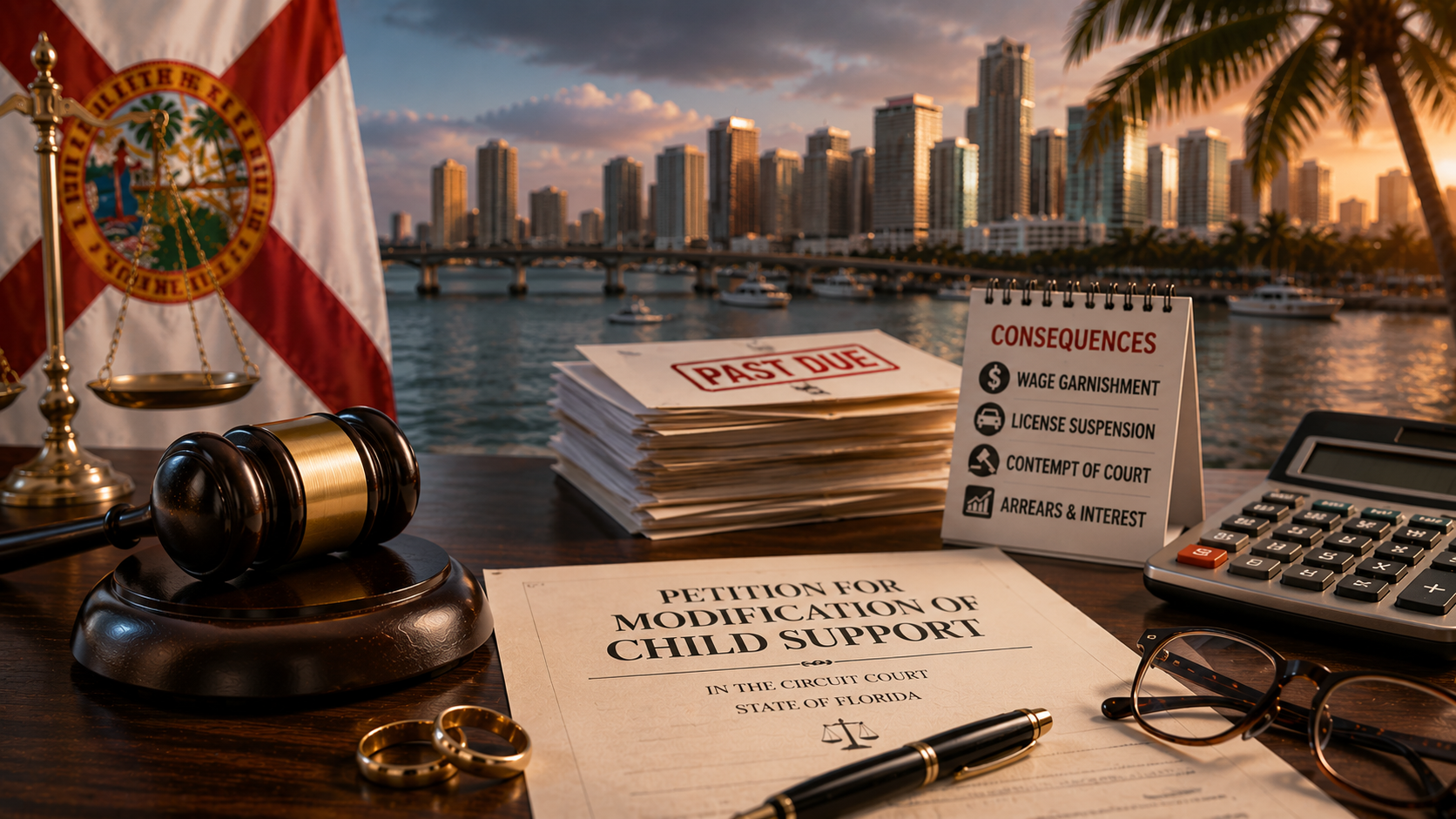
The collection tools available to the courts and the Department of Revenue include driver’s license suspension, professional license suspension, passport denial, federal and state tax refund interception, lottery winnings interception, credit bureau reporting, liens on real and personal property, levies on bank accounts, and contempt of court proceedings that can result in incarceration. For an obligor parent in Miami-Dade or Broward, the cumulative effect of these tools makes long-term avoidance of a Florida child support obligation extremely difficult. Furthermore, federal law allows interstate enforcement, so relocating outside of Florida does not break the obligation or shield the obligor from collection.
Contempt proceedings deserve special attention. Under longstanding Florida law, a court can hold an obligor parent in civil contempt for willful failure to pay court-ordered child support. The remedy can include incarceration until the obligor purges the contempt by paying a specified amount. While Florida courts are required to find a present ability to pay before incarcerating an obligor for contempt, the burden of proof on inability to pay typically shifts to the obligor once the obligee establishes the existence of an order and nonpayment. This procedural posture means that an obligor parent who decides to stop paying child support in Florida bears the affirmative burden of proving inability to pay, often without the benefit of counsel.
The Right Way to Reduce Your Obligation: Petition the Court for Modification
If your circumstances have genuinely changed and you cannot afford your current child support obligation, the legally correct response is to file a Supplemental Petition for Modification of Child Support under Fla. Stat. § 61.30. To prevail on a modification, you must show a substantial, material, involuntary, and permanent change in circumstances that was not contemplated when the original order was entered. Examples include involuntary job loss, a documented and lasting reduction in income, a serious medical condition that prevents work, or substantial changes in the child’s needs or in the time-sharing arrangement.
Critically, modification under section 61.30 is generally retroactive only to the date the petition was filed, not to the date the change in circumstances occurred. This means that every day you wait to file is a day of arrears that cannot be recovered later. The strongest practical reason not to stop paying child support in Florida without filing a modification petition is that doing so destroys the only meaningful retroactivity protection available under Florida law.
In addition, while a modification petition is pending, you remain obligated to pay under the existing order. Filing the petition does not pause the obligation, and continuing to pay during the pendency demonstrates good faith to the court. Conversely, an obligor who files a petition and simultaneously stops paying signals to the judge that the petition is a litigation tactic rather than a genuine request for relief, which can significantly hurt the obligor’s credibility at the modification hearing.
Speak With an Experienced Miami Family Law Attorney Today
If you are weighing whether to stop paying child support in Florida or facing an enforcement action that has already begun, the most important step you can take right now is to consult with an experienced South Florida family law attorney. The Law Firm of Jeffrey Alan Aenlle, PLLC represents parents throughout Miami-Dade and Broward Counties in child support modification, enforcement defense, contempt proceedings, and income deduction disputes. We help clients navigate the complex interplay between the vesting rule, section 61.1301 income deduction, section 61.30 modification standards, and the district court of appeal precedents that bind the family courts of the Eleventh and Seventeenth Judicial Circuits.
Moreover, we understand that financial circumstances can change quickly, and that the legal system does not always feel responsive to those changes in real time. Our role is to help you take the right legal steps before the problem grows, whether that means filing a modification petition, negotiating a payment plan on existing arrears, or defending against enforcement that may rest on inaccurate calculations. Acting early almost always produces a better outcome than acting after a wage garnishment, license suspension, or contempt motion has already been filed.
To discuss your child support situation in confidence with a Miami family law attorney, call the Law Firm of Jeffrey Alan Aenlle, PLLC at +1.786.309.8588. We serve clients throughout Miami-Dade County, Broward County, and the surrounding South Florida communities, and we will help you understand your options under Florida law before you make a decision that could create years of avoidable arrears.
Conclusion
Florida law treats child support as a vested obligation that cannot be unilaterally adjusted by the obligor parent. When you stop paying child support in Florida without first obtaining a court-ordered modification, the unpaid installments become enforceable arrears under decisions like Teta v. Teta, 297 So. 2d 642 (Fla. 1st DCA 1974), Kutz v. Fankhanel, 608 So. 2d 873 (Fla. 5th DCA 1992), and Bingemann v. Bingemann, 551 So. 2d 1228 (Fla. 1st DCA 1989). Furthermore, Florida’s income deduction framework under Fla. Stat. § 61.1301, confirmed in Robinson v. Robinson, 657 So. 2d 958 (Fla. 1st DCA 1995), makes wage withholding nearly automatic, while limiting the obligor’s defenses to narrow mistake-of-fact issues. While Fla. Stat. § 61.30 and Migliore v. Harris, 848 So. 2d 1250 (Fla. 4th DCA 2003) recognize narrow retroactive modification in time-sharing scenarios, those provisions do not authorize self-help. The safer and legally sound course in every case is to file a modification petition promptly under Fla. Stat. § 61.13 and § 61.30 and continue paying under the existing order until the court enters relief.
TLDR: If you stop paying child support in Florida, the unpaid installments vest as enforceable arrears under Teta v. Teta, Kutz v. Fankhanel, and Bingemann v. Bingemann, and Florida’s mandatory income deduction framework under Fla. Stat. § 61.1301 will collect them through wage withholding with very limited defenses. The correct path is to file a modification petition under Fla. Stat. § 61.30 before reducing or stopping payments.
Can I stop paying child support in Florida if my child lives with me now? No, not without a court order. Even when a child has begun residing primarily with the obligor parent, Florida law requires that you petition the court for modification of the time-sharing schedule and child support before reducing or terminating payments. Until the court enters an order, the existing support obligation continues, and any unpaid installments will vest as enforceable arrears that cannot later be reduced retroactively under the rule reaffirmed in Bingemann v. Bingemann.
What happens if I lost my job and cannot pay child support in Florida? Job loss alone does not pause your child support obligation. To obtain relief, you must file a Supplemental Petition for Modification of Child Support under Fla. Stat. § 61.30 and demonstrate a substantial, material, involuntary, and permanent change in circumstances. Modification is generally retroactive only to the date the petition is filed, so you should file immediately and continue paying as much as you can to preserve your credibility with the Miami-Dade or Broward family court hearing your case.
Can the court send me to jail for not paying child support in Miami-Dade or Broward? Yes, in certain circumstances. A Florida family court can hold an obligor parent in civil contempt for willful failure to pay child support, and the remedy can include incarceration until the obligor purges the contempt by paying a specified amount. The court must find a present ability to pay before incarcerating, but the burden of proving inability to pay generally shifts to the obligor once the obligee shows the existence of the order and nonpayment.
Does my child support automatically end when my child turns 18 in Florida? Generally yes, if your support order was entered on or after October 1, 2010 and complies with Fla. Stat. § 61.13. Such orders must include a termination date and step-down schedule. However, exceptions under Fla. Stat. § 743.07 allow continued support where the child is incapacitated due to a condition arising before majority, or where the child is between 18 and 19, still in high school, and reasonably expected to graduate before turning 19.
Can my employer fire me for child support wage garnishment in Florida? No. Fla. Stat. § 61.1301 prohibits employers from discharging or disciplining an employee because of an income deduction order, and civil penalties apply to violations. The employer is also liable for the amount that should have been withheld if it fails to comply with a notice to payor, which gives South Florida employers a strong incentive to follow the law rather than retaliate against the employee.
Can I make a private agreement with my ex to lower child support in Florida? No, private agreements between parents do not override a court-ordered child support obligation. Even if both parents sincerely agree to a reduced amount, the receiving parent can still enforce the original order at any time, and the arrears will vest under Bingemann v. Bingemann and Kutz v. Fankhanel. To make any reduction enforceable, you must obtain a court order modifying the original support obligation.
How long do I have to pay child support arrears in Florida? Florida child support arrears do not expire and remain collectible until paid in full, with statutory interest. Unlike many ordinary debts, child support arrears are generally not subject to a standard statute of limitations and survive bankruptcy. Furthermore, the Florida Department of Revenue Child Support Program can pursue collection for decades, so arrears accumulated during a period when a parent decided to stop paying child support in Florida continue to follow the obligor indefinitely.