
16 Oct Can a Court Restrict Social Media Posts About a Divorce in Florida?
Summary
This article explains whether courts can restrict social media posts about a divorce in Florida and the constitutional standards that apply. It analyzes Florida appellate case law governing gag orders, free speech, and the requirement that any restriction be supported by evidence and narrowly tailored.
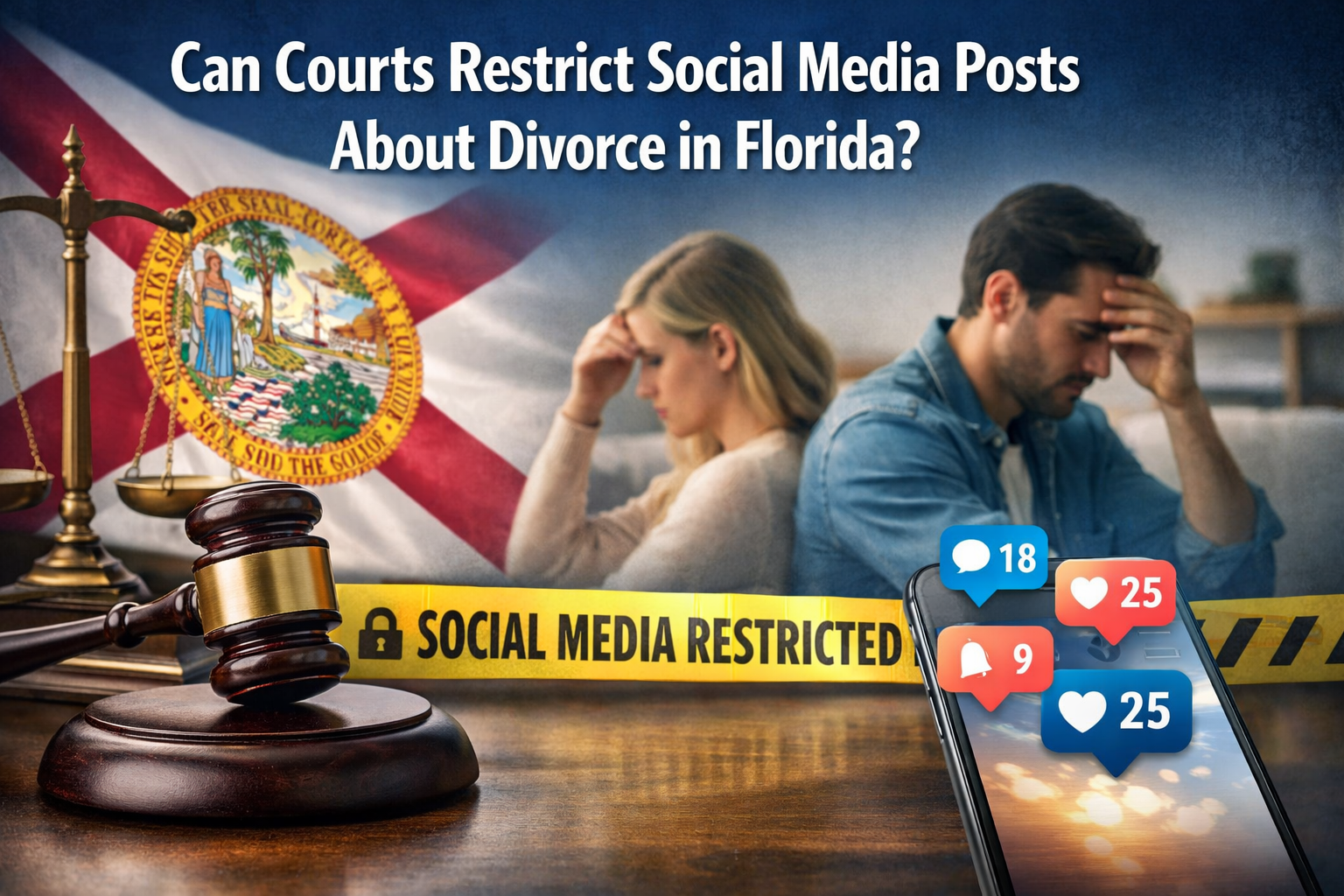
In modern family law litigation, social media posts about a divorce in Florida increasingly raise complex constitutional and procedural questions. While litigants often feel compelled to discuss their experiences online, courts must balance the First Amendment rights of the parties and attorneys against the judiciary’s obligation to ensure fair and impartial proceedings. Consequently, the question arises whether a Florida court has the authority to restrict social media posts about a pending divorce case. Florida law confirms that courts may impose such restrictions only in limited circumstances, and any restriction must satisfy strict constitutional and procedural safeguards.
In particular, courts must demonstrate good cause supported by evidence, must show that the speech at issue poses a substantial likelihood of material prejudice to the proceeding, and must narrowly tailor the restriction to address the specific harm identified. These principles arise from both Florida appellate precedent and constitutional doctrine governing speech restrictions in pending litigation. As divorce litigation increasingly intersects with digital communication platforms such as Instagram, Facebook, TikTok, and X, courts and practitioners must carefully navigate these competing interests.
Understanding Social Media Posts About a Divorce in Florida
Social media has fundamentally changed the way individuals communicate about personal matters, including marital disputes. Parties involved in divorce proceedings often share opinions, accusations, emotional reactions, or personal details online. While these posts may feel cathartic to the person making them, they can also influence witnesses, affect jurors in jury trials, and undermine the integrity of judicial proceedings.
Divorce litigation in Florida frequently involves sensitive allegations relating to finances, parenting, property division, or personal conduct. When parties publicly discuss these issues online, the posts can create publicity that may interfere with the court’s ability to administer justice. Consequently, trial courts sometimes consider whether restrictions on speech are necessary.
Nevertheless, any judicial restriction on speech raises serious constitutional concerns. The First Amendment to the United States Constitution protects the right to speak freely, including the right to discuss matters of personal importance and ongoing litigation. Therefore, courts must proceed cautiously when considering any order that limits social media activity related to a pending divorce case.
The Constitutional Framework Governing Speech Restrictions
Florida courts have repeatedly recognized that judicial orders restricting speech by litigants or attorneys constitute prior restraints. Prior restraints are generally disfavored under constitutional law because they prevent speech before it occurs rather than punishing unlawful speech after the fact.
The Florida courts have emphasized that limitations imposed on communications between litigants, attorneys, and the media must be supported by good cause and must be designed to ensure a fair trial. In E.I. DuPont de Nemours & Co. v. Aquamar, S.A., 33 So. 3d 839 (Fla. 3d DCA 2010), the court explained that restrictions on communications in pending litigation must be justified by a demonstrated need to protect the fairness of the proceedings.
Importantly, the court in that decision noted that such restrictions cannot be based on speculation or generalized concerns about publicity. Instead, a trial court must rely on evidence and must make specific findings demonstrating that extrajudicial statements pose a substantial or imminent threat to the fairness of the trial.
This principle reflects a broader constitutional balancing test that weighs the First Amendment rights of litigants and attorneys against the judiciary’s responsibility to safeguard the administration of justice.
The Requirement of Good Cause and Evidentiary Findings
A Florida court cannot simply prohibit parties from discussing their divorce online because the court believes such posts are inappropriate or embarrassing. Instead, the court must identify a concrete threat to the fairness of the judicial process.
The Florida appellate courts require trial judges to make explicit factual findings demonstrating good cause for any speech restriction. Without such findings, an order restricting social media posts is vulnerable to reversal on appeal.
The decision in E.I. DuPont de Nemours & Co. v. Aquamar, S.A., 33 So. 3d 839 (Fla. 3d DCA 2010), illustrates this principle clearly. In that case, the appellate court held that limitations on communications between the media and lawyers or litigants must be supported by evidence and findings establishing that the speech poses a substantial or imminent threat to a fair trial.
Therefore, if a family court judge in Miami or elsewhere in Florida were to consider restricting social media posts about a divorce case, the judge would first need to conduct an evidentiary analysis demonstrating that the posts are likely to materially prejudice the proceeding.
Narrow Tailoring of Any Restriction
Even when a court identifies good cause to limit speech, the restriction must be narrowly tailored. This means that the order may prohibit only those statements that create a substantial likelihood of material prejudice to the proceeding.
Florida courts emphasize that speech restrictions cannot be overly broad. A blanket prohibition on discussing the divorce case publicly would typically violate constitutional principles because it suppresses more speech than necessary.
The Fourth District Court of Appeal addressed this requirement in Delgado v. Miller, 314 So. 3d 515 (Fla. 4th DCA 2020). In that case, the court held that when a trial court restricts free speech rights, the restriction must be narrowly tailored to prevent only those extrajudicial statements that are substantially likely to materially prejudice the litigation.
This principle ensures that courts protect the fairness of the proceedings while preserving as much freedom of expression as possible.
Regulation of Attorney Speech in Divorce Cases
Speech restrictions involving attorneys raise additional considerations. Lawyers have ethical duties that sometimes justify greater regulation of their speech during pending litigation.
The United States Supreme Court has recognized that attorney speech in ongoing cases may be regulated under a somewhat less demanding standard than speech by the press. This distinction reflects the lawyer’s role as an officer of the court and the lawyer’s professional obligation to avoid prejudicing judicial proceedings.
Florida courts have adopted the “substantial likelihood of material prejudice” standard as the appropriate balance between attorney free speech rights and the state’s interest in ensuring fair trials. This principle was recognized in Rodriguez by & Through Posso-Rodriguez v. Feinstein, 734 So. 2d 1162 (Fla. 3d DCA 1999).
Under this standard, a court may regulate attorney statements that create a substantial likelihood of materially prejudicing the proceeding. Nevertheless, the court must still ensure that any restriction is carefully limited and supported by specific findings.
Florida courts have also acknowledged the constitutional implications of restricting lawyer speech in pending cases. In Dippolito v. State, 225 So. 3d 233 (Fla. 4th DCA 2017), the court discussed the delicate balance between protecting the First Amendment rights of attorneys and preserving the fairness of criminal proceedings.
Although that case involved criminal litigation, the principles apply broadly to judicial restrictions on attorney speech in other contexts, including divorce litigation.
Application in Florida Divorce Cases
Divorce proceedings often involve intense emotional disputes that sometimes spill into public discourse. Parties may post allegations about infidelity, financial misconduct, or parenting behavior on social media platforms. These posts may influence witnesses, create reputational harm, or escalate conflict between the parties.
Nevertheless, courts cannot restrict such speech simply to promote civility or privacy. Instead, the restriction must be tied directly to protecting the fairness of the judicial process.
For example, if a party repeatedly posts allegations that could influence potential witnesses or intimidate participants in the litigation, a court might determine that limited restrictions are justified. Similarly, if attorneys use social media to comment publicly on contested facts in the case, the court may conclude that the comments threaten the integrity of the proceedings.
However, even in these circumstances, the restriction must address only the specific speech that poses a risk of material prejudice.
Social Media and Divorce Litigation in Miami
In Miami and throughout South Florida, family courts regularly encounter cases in which social media activity becomes evidence in divorce proceedings. Screenshots of Instagram posts, Facebook messages, and TikTok videos frequently appear in litigation involving parenting disputes, allegations of misconduct, or claims relating to financial behavior.
Because Miami is a major metropolitan area with extensive media coverage and high social media usage, the potential impact of online statements may be particularly significant. As a result, judges in the Eleventh Judicial Circuit sometimes confront requests to restrict public commentary about pending divorce cases.
Yet Miami family courts remain bound by the same constitutional standards that apply statewide. Any restriction must be supported by evidence and must be carefully crafted to address only the specific speech that threatens the fairness of the proceedings.
Practical Considerations for Divorce Litigants
Although courts rarely impose formal gag orders in divorce cases, litigants should exercise caution when posting about ongoing litigation online. Social media statements can become evidence and may affect credibility in court.
In many cases, attorneys advise clients to refrain from discussing the case publicly even if no court order requires such restraint. This approach reduces the risk of escalating conflict and helps preserve the integrity of the litigation process.
Moreover, courts may consider online conduct when evaluating issues such as parental responsibility or credibility. Therefore, responsible social media use is often an important strategic consideration in divorce litigation.
Conclusion
A Florida court may restrict social media posts about a divorce only under limited circumstances consistent with constitutional principles. Any restriction must be supported by good cause, must rely on evidence demonstrating a substantial likelihood of material prejudice to the proceeding, and must be narrowly tailored to address the specific speech at issue.
Florida appellate decisions including E.I. DuPont de Nemours & Co. v. Aquamar, S.A., 33 So. 3d 839 (Fla. 3d DCA 2010), Delgado v. Miller, 314 So. 3d 515 (Fla. 4th DCA 2020), Dippolito v. State, 225 So. 3d 233 (Fla. 4th DCA 2017), and Rodriguez by & Through Posso-Rodriguez v. Feinstein, 734 So. 2d 1162 (Fla. 3d DCA 1999) illustrate the careful balance between protecting free speech and ensuring fair trials.
Ultimately, while courts possess limited authority to regulate speech in pending cases, broad prohibitions on discussing a divorce online are unlikely to survive appellate scrutiny unless they satisfy the strict requirements established by Florida law.
If you are involved in a divorce case in Miami or anywhere in Florida and have questions about social media, court orders, or protecting your rights during litigation, obtaining experienced legal guidance is essential. A knowledgeable Florida family law attorney can help you understand your rights and avoid mistakes that could affect the outcome of your case.
TLDR: A Florida court can restrict social media posts about a divorce only if it finds good cause supported by evidence that the speech poses a substantial likelihood of material prejudice to the case, and any restriction must be narrowly tailored to protect the fairness of the proceedings.
Can a Florida judge issue a gag order in a divorce case?
Yes, but only in limited circumstances. The court must show good cause and must find that the speech poses a substantial likelihood of materially prejudicing the proceeding.
Are social media posts used as evidence in Florida divorce cases?
Yes. Courts frequently consider social media posts as evidence relating to credibility, parenting behavior, finances, and other issues.
Can attorneys comment on a pending divorce case publicly?
Attorney speech may be regulated if it creates a substantial likelihood of material prejudice to the proceeding.
Can a court prohibit all discussion of a divorce online?
Generally no. A blanket prohibition on discussing a case publicly is unlikely to be upheld unless it is narrowly tailored and supported by evidence.