
21 Apr Travel Restrictions in Florida Parenting Plans
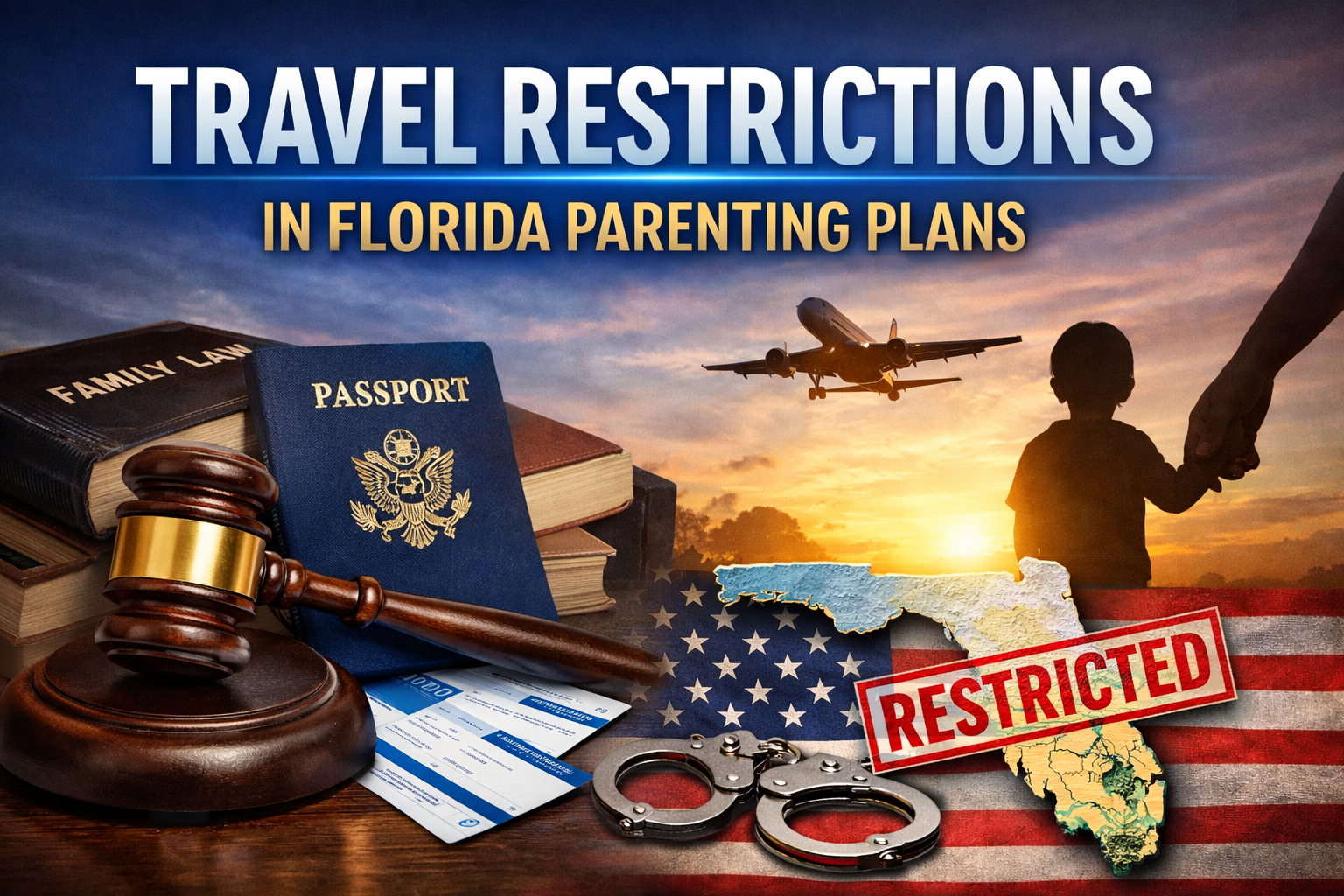
Travel Restrictions in Florida Parenting Plans are a critical component of modern family law litigation and settlement practice in Miami-Dade County and throughout the State of Florida. Florida courts regularly confront disputes involving domestic travel, international vacations, relocation requests, and concerns about potential child abduction. The governing legal framework balances a parent’s right to travel with the child against the court’s paramount obligation to protect the best interests of the child under section 61.13, Florida Statutes.
In Miami family law cases, disputes over travel often arise in high conflict parenting situations, international families, and cases involving dual citizenship. Florida law provides a detailed statutory structure that addresses relocation, international travel objections, and preventive safeguards. The primary statutory authorities include sections 61.13, 61.13001, and 61.45, Florida Statutes, as well as federal passport regulations under 22 C.F.R. section 51.28. Florida appellate courts have further clarified these principles in decisions such as Arthur v. Arthur, 54 So. 3d 454 (Fla. 2010), Ward v. Waters, 389 So. 3d 652 (Fla. 3d DCA 2024), and Castleman v. Bicaldo, 248 So. 3d 1181 (Fla. 4th DCA 2018).
This analysis examines how Travel Restrictions in Florida Parenting Plans operate in practice, what safeguards courts may impose, and how Miami family courts evaluate risk when one parent objects to travel.
Legal Framework Governing Travel Restrictions in Florida Parenting Plans
Travel Restrictions in Florida Parenting Plans are rooted in the statutory requirement that all parenting determinations must serve the best interests of the child under section 61.13, Florida Statutes. Florida maintains a strong public policy favoring frequent and continuing contact with both parents after separation or divorce. However, that policy is balanced against the court’s authority to prevent harm, including the risk of abduction or interference with time-sharing.
Section 61.13001, Florida Statutes, governs parental relocation, while section 61.45, Florida Statutes, specifically addresses measures to prevent the wrongful removal or retention of children. Together, these provisions give trial courts broad discretion to craft travel restrictions tailored to the facts of each case.
The Florida Supreme Court in Arthur v. Arthur, 54 So. 3d 454 (Fla. 2010), emphasized that relocation and travel disputes must be resolved through a fact specific best interests analysis, and no presumption exists for or against relocation. More recently, the Third District in Ward v. Waters, 389 So. 3d 652 (Fla. 3d DCA 2024), reaffirmed the trial court’s broad discretion to adjust parenting plans when travel or relocation issues arise.
Definition of Relocation Under Florida Law
Understanding Travel Restrictions in Florida Parenting Plans requires careful distinction between ordinary travel and statutory relocation. Section 61.13001(1)(e), Florida Statutes, defines relocation as a change in the principal residence of a parent or other person at least fifty miles from the current residence for at least sixty consecutive days, excluding temporary absences for vacation, education, or health care.
This definition is critical in Miami family law practice because many disputes that initially appear to involve simple travel may actually constitute relocation if the statutory thresholds are met. When relocation is triggered, strict procedural requirements apply.
Under section 61.13001(3), Florida Statutes, a parent seeking relocation must either obtain written consent from the other parent or file a petition to relocate. The burden initially rests on the relocating parent to prove by a preponderance of the evidence that the move is in the child’s best interests. If that burden is met, the burden shifts to the objecting parent. This burden shifting framework was confirmed in Arthur v. Arthur, 54 So. 3d 454 (Fla. 2010).
Best Interests Analysis in Travel and Relocation Cases
Florida courts consistently emphasize that the best interests of the child remain the controlling standard in Travel Restrictions in Florida Parenting Plans. Section 61.13001(7), Florida Statutes, sets forth numerous factors courts must evaluate in relocation disputes, many of which also inform travel restriction decisions.
Key considerations include the nature and quality of the child’s relationship with each parent, the child’s developmental needs, the feasibility of preserving the relationship with the non-traveling parent, and the good faith of the relocating parent. Courts also consider financial circumstances and whether the move will enhance the child’s quality of life.
In Ward v. Waters, 389 So. 3d 652 (Fla. 3d DCA 2024), the court reiterated that trial judges possess significant discretion when weighing these factors. Similarly, in Castleman v. Bicaldo, 248 So. 3d 1181 (Fla. 4th DCA 2018), the appellate court confirmed that there is no presumption favoring parental travel and that each case must be decided on its specific facts.
International Travel When One Parent Objects
Travel Restrictions in Florida Parenting Plans most frequently arise when one parent objects to international travel. In cases involving shared parental responsibility, major decisions affecting the child must be made jointly under section 61.13(2)(c), Florida Statutes. International travel is commonly treated as such a major decision.
When parents cannot agree, the traveling parent must seek court authorization. Florida courts evaluate the request using the best interests standard, considering safety, purpose of travel, and the risk that the child may not be returned.
The case of Cancino v. Cancino, 273 So. 3d 122 (Fla. 3d DCA 2019), illustrates that where shared parental responsibility exists, unilateral decision making regarding significant matters may be improper. Trial courts therefore often require either written consent or a court order before international travel occurs.
Federal law also intersects with Florida practice. Under 22 C.F.R. section 51.28, both parents generally must consent to the issuance of a passport for a child under sixteen unless an exception applies. This federal safeguard frequently becomes part of Florida parenting plan litigation.
Protective Measures Available Under Section 61.45
Section 61.45, Florida Statutes, gives courts powerful tools to impose Travel Restrictions in Florida Parenting Plans when there is a risk of wrongful removal. This statute is particularly important in Miami cases involving international families or parents with significant ties outside the United States.
Florida courts may require detailed travel itineraries, including flight information, addresses, and contact numbers. Courts may also prohibit a parent from applying for or using a passport without court approval. These safeguards are routinely used in Miami-Dade family divisions.
In Mizrahi v. Mizrahi, 867 So. 2d 1211 (Fla. 3d DCA 2004), the Third District approved restrictions preventing international travel without mutual consent or court order. Trial courts continue to rely on Mizrahi when crafting protective provisions in parenting plans.
Similarly, in White v. Lee-Yuk, 354 So. 3d 563 (Fla. 3d DCA 2022), the court imposed geographic restrictions to prevent removal of the child without prior authorization. Although trial level, this case reflects the practical approach taken in South Florida courts.
Bond Requirements and Financial Safeguards
One of the most powerful tools within Travel Restrictions in Florida Parenting Plans is the ability to require a bond or other financial security under section 61.45, Florida Statutes. Courts may order a parent to post a monetary bond designed to deter abduction and fund recovery efforts if the child is not returned.
In Miami family law practice, bond requirements are often considered where there is evidence of prior violations, strong foreign ties, or concerning preparatory conduct. Courts evaluate multiple statutory risk factors before imposing such measures.
The statute directs courts to consider family and community ties, financial incentives to leave Florida, and activities such as liquidating assets or applying for foreign travel documents. These factors provide a structured risk assessment framework.
Hague Convention Considerations
Travel Restrictions in Florida Parenting Plans frequently involve analysis of the Hague Convention on the Civil Aspects of International Child Abduction. Section 61.45, Florida Statutes, specifically authorizes courts to consider whether the destination country is a Hague Convention signatory.
If the proposed destination country is not a participant in the Hague Convention or has a poor record of compliance, Miami courts often impose heightened safeguards or deny travel altogether. The risk that a foreign court will not enforce return orders is a major factor.
Florida courts also evaluate whether the destination country presents safety concerns, lacks a United States diplomatic presence, or has laws that could restrict the child’s return. These considerations are particularly relevant in international Miami families.
Modification of Parenting Plans Based on Travel Issues
Travel Restrictions in Florida Parenting Plans may arise in the context of modification proceedings. Under section 61.13, Florida Statutes, a party seeking modification must demonstrate a substantial, material, and unanticipated change in circumstances and that modification serves the child’s best interests.
Recent appellate decisions confirm that relocation alone is not always sufficient. In Lally v. Lally, 426 So. 3d 514 (Fla. 4th DCA 2025), the court addressed the relationship between relocation and modification standards. Similarly, in Puertas v. Ruiz, 425 So. 3d 1131 (Fla. 3d DCA 2025), the appellate court reaffirmed the trial court’s discretion to restructure time-sharing when relocation is approved.
Miami practitioners must therefore carefully analyze whether a proposed travel restriction request is actually a disguised modification claim.
Enforcement and Penalties for Violating Travel Restrictions
Florida courts take violations of Travel Restrictions in Florida Parenting Plans very seriously. Under sections 61.13 and 61.13001, Florida Statutes, courts may impose contempt sanctions, order the immediate return of the child, modify time-sharing, and award attorney’s fees.
In extreme cases, repeated violations may justify a change in parental responsibility. Miami judges routinely warn litigants that unilateral international travel in violation of a court order can have severe consequences.
Section 61.45, Florida Statutes, also authorizes preventive and remedial measures designed to ensure compliance with court orders and protect the child’s welfare.
Miami Specific Considerations in Travel Restriction Cases
Travel Restrictions in Florida Parenting Plans take on unique importance in Miami-Dade County due to the region’s international population. Many Miami families maintain dual citizenship, foreign property, or extended family abroad. These factors often heighten judicial scrutiny.
Miami courts frequently encounter cases involving travel to Latin America, Europe, and the Caribbean. Judges in the Eleventh Judicial Circuit are particularly attentive to Hague Convention participation, prior compliance with court orders, and the logistical feasibility of enforcing return orders.
Local practice also reflects increased use of passport controls and detailed itinerary requirements. Practitioners handling Miami parenting plan disputes should anticipate that courts will expect thorough documentation and advance notice provisions.
Strategic Considerations for Parents and Practitioners
From a litigation strategy perspective, Travel Restrictions in Florida Parenting Plans require careful evidence development. The parent seeking travel must present a clear, good faith purpose and demonstrate a low risk of non-return. The objecting parent must present specific, evidence based concerns rather than speculative fears.
Courts repeatedly emphasize that generalized anxiety is insufficient. Instead, the statutory risk factors in section 61.45, Florida Statutes, provide the roadmap for both sides.
Miami family law attorneys should also consider whether narrowly tailored safeguards may resolve disputes without complete denial of travel. Courts often prefer structured protections over absolute prohibitions when the child’s best interests can be protected.
Conclusion
Travel Restrictions in Florida Parenting Plans represent a sophisticated intersection of parental rights, child safety, and judicial discretion. Florida law provides a comprehensive statutory framework through sections 61.13, 61.13001, and 61.45, Florida Statutes, supported by extensive appellate guidance including Arthur v. Arthur, Ward v. Waters, Mizrahi v. Mizrahi, and Castleman v. Bicaldo.
In Miami family law practice, these issues arise frequently due to the region’s global connections. Courts carefully evaluate each case, focusing on the best interests of the child while balancing legitimate travel needs against the risk of wrongful removal.
Parents involved in travel disputes should act proactively, comply strictly with court orders, and seek legal guidance before making international plans. Early legal intervention often prevents costly emergency litigation and protects both parental rights and the child’s stability.
Speak With a Miami Family Law Attorney
If you are facing a dispute involving Travel Restrictions in Florida Parenting Plans in Miami-Dade County, experienced legal guidance can make a decisive difference. Whether you are seeking permission to travel, opposing international travel, or modifying an existing parenting plan, strategic action under Florida law is essential.
Consulting with a knowledgeable Miami family law attorney can help you protect your parental rights while ensuring full compliance with sections 61.13, 61.13001, and 61.45, Florida Statutes. Prompt legal advice often prevents emergency hearings, contempt exposure, and unnecessary conflict.
TLDR: Travel restrictions in Florida parenting plans are governed primarily by sections 61.13, 61.13001, and 61.45, Florida Statutes. Courts focus on the best interests of the child, require consent or court approval for certain travel, and may impose safeguards such as passport controls, travel itineraries, or bonds to prevent unauthorized removal.
Frequently Asked Questions About Travel Restrictions in Florida Parenting Plans
What are travel restrictions in Florida parenting plans?
Travel restrictions in Florida parenting plans are court ordered conditions that regulate when and how a parent may travel with a child. These restrictions are authorized primarily under sections 61.13, 61.13001, and 61.45, Florida Statutes, and are designed to protect the child’s best interests.
Can a parent take a child out of the country without permission in Florida?
Generally no. When parents share parental responsibility, international travel typically requires either the other parent’s written consent or a court order. Courts frequently rely on section 61.13, Florida Statutes, and the reasoning in Cancino v. Cancino, 273 So. 3d 122 (Fla. 3d DCA 2019).
What safeguards can Florida courts impose to prevent international child abduction?
Courts may require passport controls, detailed itineraries, bonds, enrollment in the Children’s Passport Issuance Alert Program, and other measures authorized under section 61.45, Florida Statutes.
Does relocation count as travel under Florida law?
Relocation is treated differently from temporary travel. Under section 61.13001, Florida Statutes, relocation involves a move of at least fifty miles for sixty consecutive days and requires strict statutory compliance.
What happens if a parent violates travel restrictions in a Florida parenting plan?
Violations can result in contempt, modification of time-sharing, attorney’s fees, and orders compelling the child’s return under sections 61.13 and 61.13001, Florida Statutes.
How do Miami courts evaluate the risk of international abduction?
Miami courts apply the risk factors in section 61.45, Florida Statutes, including foreign ties, prior violations, immigration status, financial incentives, and whether the destination country participates in the Hague Convention.