
20 Nov Child Custody: Do Florida Courts have Jurisdiction over my Child Custody Dispute?
Summary
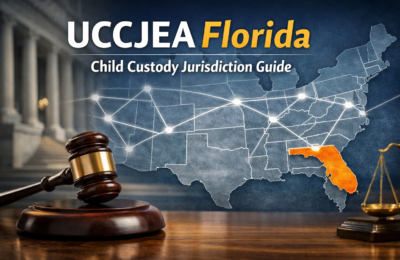
Child custody jurisdiction in Florida is determined under the Uniform Child Custody Jurisdiction and Enforcement Act. Florida courts typically exercise jurisdiction when Florida is the child’s home state or when significant connections exist with the state.
The Legal Framework for Child Custody Jurisdiction in Florida
The statutory structure governing Child Custody Jurisdiction in Florida appears in the Uniform Child Custody Jurisdiction and Enforcement Act. The UCCJEA was adopted to prevent interstate conflict between courts, discourage parental forum shopping, and ensure that custody determinations occur in the state best positioned to evaluate the child’s welfare. The governing provisions appear primarily in Florida Statute §61.503, Florida Statute §61.514, and Florida Statute §61.515. These provisions create a structured hierarchy that determines which state has authority to adjudicate custody disputes.
The UCCJEA was enacted nationwide to resolve problems that historically arose when parents moved children across state lines in search of a favorable custody ruling. Prior to the statute, competing custody orders from different states often created legal chaos. By establishing uniform jurisdictional rules, the Act ensures that courts cooperate rather than compete. Florida courts regularly emphasize that the purpose of the statute is to promote stability and discourage interstate child abduction.
Home State Jurisdiction Under Florida Law
The primary basis for Child Custody Jurisdiction in Florida is the concept of the child’s home state. Under Florida Statute §61.514, Florida courts have jurisdiction to make an initial custody determination if Florida is the child’s home state at the time the custody proceeding is filed. The home state is defined in Florida Statute §61.503 as the state in which the child lived with a parent or person acting as a parent for at least six consecutive months immediately before the commencement of the proceeding.
For children younger than six months of age, the home state is the state in which the child lived from birth. Courts interpret this provision strictly because it creates predictability and discourages strategic relocation during custody disputes.
The Florida Third District Court of Appeal addressed the home state principle in Arjona v. Torres, 941 So. 2d 451 (Fla. 3d DCA 2006). The court explained that home state jurisdiction serves as the primary jurisdictional basis under the UCCJEA and must be analyzed before considering any alternative jurisdictional ground. If Florida qualifies as the home state, the Florida court generally has priority over courts in other jurisdictions.
Another instructive case is N.B. v. Department of Children and Families, 274 So. 3d 1163 (Fla. 1st DCA 2019), which reaffirmed that the child’s home state must be determined by examining where the child actually lived during the six months preceding the custody proceeding. The decision emphasized that physical presence alone does not automatically establish jurisdiction if the statutory criteria are not satisfied.
Significant Connection Jurisdiction
If no state qualifies as the child’s home state, Florida courts may exercise jurisdiction under the significant connection test established in Florida Statute §61.514. This alternative basis applies when the child and at least one parent maintain meaningful connections with Florida and when substantial evidence concerning the child’s care, protection, training, and personal relationships is available in Florida.
The significant connection test functions as a secondary jurisdictional mechanism. Courts rely on this basis only when home state jurisdiction does not exist or when the home state declines to exercise jurisdiction. The requirement that substantial evidence exist in Florida ensures that the state assuming jurisdiction has access to relevant witnesses and information necessary to evaluate the child’s best interests.
In practice, courts evaluate several factors when determining whether a significant connection exists. These factors may include the child’s schooling, healthcare providers, extended family members, and other relationships located in Florida. The analysis focuses on whether Florida possesses meaningful connections that justify exercising jurisdiction.
Default Jurisdiction and More Appropriate Forum
Florida law also recognizes additional jurisdictional bases that apply when neither home state jurisdiction nor significant connection jurisdiction exists. Florida Statute §61.514 allows Florida courts to exercise jurisdiction if all courts with potential jurisdiction decline to exercise their authority because Florida is the more appropriate forum.
This provision reflects the UCCJEA’s goal of judicial cooperation. Courts communicate with each other to determine which jurisdiction should hear the custody dispute. The process avoids conflicting custody determinations and ensures that the case proceeds in the state best positioned to resolve the issues.
Florida courts may also exercise jurisdiction if no other state would have jurisdiction under the statutory criteria. This form of default jurisdiction ensures that custody disputes always have a forum capable of resolving them.
Exclusive Continuing Jurisdiction
Once a Florida court properly exercises Child Custody Jurisdiction in Florida and enters a custody determination, that court generally retains exclusive continuing jurisdiction over the matter. Florida Statute §61.515 establishes this principle. The purpose of continuing jurisdiction is to provide stability and prevent repeated litigation in different states.
Exclusive continuing jurisdiction remains in effect until the Florida court determines that neither the child nor the parents maintain a significant connection with Florida and that substantial evidence concerning the child is no longer available in Florida. The court may also relinquish jurisdiction if all parties have moved out of the state.
The case of Steckler v. Steckler, 921 So. 2d 740 (Fla. 5th DCA 2006), illustrates this principle. The court explained that once a Florida court has entered a custody determination consistent with the UCCJEA, it retains jurisdiction unless statutory conditions for relinquishing jurisdiction are satisfied. This rule prevents competing courts from modifying existing custody orders without proper authority.
Temporary Emergency Jurisdiction
Florida law recognizes that emergencies sometimes require immediate court intervention. Under the UCCJEA, Florida courts may exercise temporary emergency jurisdiction when a child is present in Florida and has been abandoned or requires protection due to abuse or mistreatment.
This jurisdiction is designed to protect children facing urgent threats. However, emergency jurisdiction is temporary and does not replace the authority of the child’s home state. Courts typically coordinate with the home state court to determine whether the emergency order should remain in place or whether the case should be transferred.
Florida courts have repeatedly emphasized that emergency jurisdiction must be used cautiously. The emergency provisions exist to protect children from harm while preserving the jurisdictional structure established by the UCCJEA.
Simultaneous Custody Proceedings
Jurisdictional conflicts occasionally arise when custody proceedings are filed in more than one state. The UCCJEA provides a clear mechanism for resolving these conflicts. When a Florida court learns that another state has already commenced a custody proceeding consistent with the statute, the Florida court must stay its proceedings and communicate with the other court.
The Florida Third District Court of Appeal addressed this requirement in Karam v. Karam, 6 So. 3d 87 (Fla. 3d DCA 2009). The court explained that communication between courts is essential to ensure that only one jurisdiction proceeds with the custody determination. This process prevents conflicting orders and promotes judicial efficiency.
International Custody Jurisdiction Issues
Child custody jurisdiction frequently involves international elements, particularly in cities such as Miami where families often maintain connections with other countries. Under the UCCJEA, foreign countries are treated similarly to U.S. states for jurisdictional purposes. Florida courts therefore analyze international custody disputes using the same home state and significant connection framework.
However, courts must also consider international treaties and comity principles when addressing cross border custody disputes. These cases require careful analysis because jurisdictional determinations may affect the enforcement of custody orders abroad.
Miami Specific Considerations in Custody Jurisdiction Cases
Miami courts frequently address interstate and international custody disputes due to the city’s diverse population and international connections. Families often relocate between Florida and other states or countries, creating complex jurisdictional questions.
Judges in the Eleventh Judicial Circuit regularly apply the UCCJEA to determine whether Miami courts have authority to decide custody disputes. Attorneys practicing family law in Miami must carefully evaluate jurisdiction before filing any custody related pleadings because filing in the wrong jurisdiction may lead to dismissal or transfer of the case.
Miami parents involved in interstate custody disputes should consult experienced family law counsel to determine whether Florida qualifies as the child’s home state and whether jurisdiction exists under Florida law.
Practical Implications for Parents
Understanding Child Custody Jurisdiction in Florida is essential for parents navigating interstate custody disputes. Jurisdiction determines which court has authority to make decisions regarding parental responsibility and time sharing.
Parents sometimes assume that filing a custody case in the state where they currently reside will automatically establish jurisdiction. However, the UCCJEA requires courts to examine where the child lived during the preceding six months and whether another state has continuing jurisdiction.
Parents should also be aware that attempting to move a child across state lines in order to gain a favorable custody ruling may backfire. Courts frequently reject jurisdiction when relocation appears motivated by forum shopping.
Why Jurisdiction Matters in Florida Family Law
Jurisdictional rules protect children by ensuring that custody decisions are made in the forum best equipped to evaluate the child’s circumstances. Courts in the child’s home state typically have access to teachers, healthcare providers, and family members who can provide evidence regarding the child’s well being.
These rules also reduce the likelihood of conflicting custody orders. Without jurisdictional standards, multiple courts could issue competing custody determinations, creating uncertainty for parents and children.
Conclusion
Child Custody Jurisdiction in Florida is governed by the Uniform Child Custody Jurisdiction and Enforcement Act, which establishes a structured framework for determining which court has authority to decide custody disputes. Florida courts analyze jurisdiction using the home state rule, significant connection jurisdiction, and additional statutory provisions designed to prevent jurisdictional conflicts.
The principles of exclusive continuing jurisdiction and temporary emergency jurisdiction ensure both stability and protection in custody matters. Courts coordinate with other jurisdictions when necessary to avoid conflicting orders and to promote cooperation between states.
For parents in Miami and throughout Florida, understanding jurisdictional rules is critical before initiating a custody case. Filing in the wrong jurisdiction can delay proceedings and increase legal costs. Consulting an experienced Florida family law attorney can help ensure that custody proceedings are filed in the proper forum and that parents protect their legal rights.
If you are involved in a custody dispute involving another state or country, obtaining knowledgeable legal guidance is essential. Proper jurisdiction determines whether a Florida court can decide issues of parental responsibility, time sharing, and child welfare.
TLDR: Child Custody Jurisdiction in Florida is determined under the Uniform Child Custody Jurisdiction and Enforcement Act. Florida courts usually have jurisdiction if Florida is the child’s home state or if the child and a parent have significant connections with Florida. Once jurisdiction is established, Florida courts typically retain exclusive authority unless statutory conditions require transfer to another state.
What determines child custody jurisdiction in Florida?
Child custody jurisdiction in Florida is determined primarily by the child’s home state under Florida Statute §61.514. Courts examine where the child lived during the six months preceding the custody filing.
Can Florida modify another state’s custody order?
Florida may modify another state’s custody order only if Florida has jurisdiction under the UCCJEA and the original state has relinquished exclusive continuing jurisdiction.
What is temporary emergency jurisdiction?
Temporary emergency jurisdiction allows Florida courts to issue short term custody orders when a child present in Florida faces abandonment, abuse, or mistreatment.
Does living in Florida automatically create custody jurisdiction?
No. Physical presence alone does not create jurisdiction. Courts must evaluate the statutory factors established in the UCCJEA.
What should Miami parents do before filing a custody case?
Parents should consult a family law attorney to determine whether Florida qualifies as the child’s home state and whether jurisdiction exists before filing any custody pleadings.