18 Mar Child Transportation and Related Child Visitation Issues
Summary
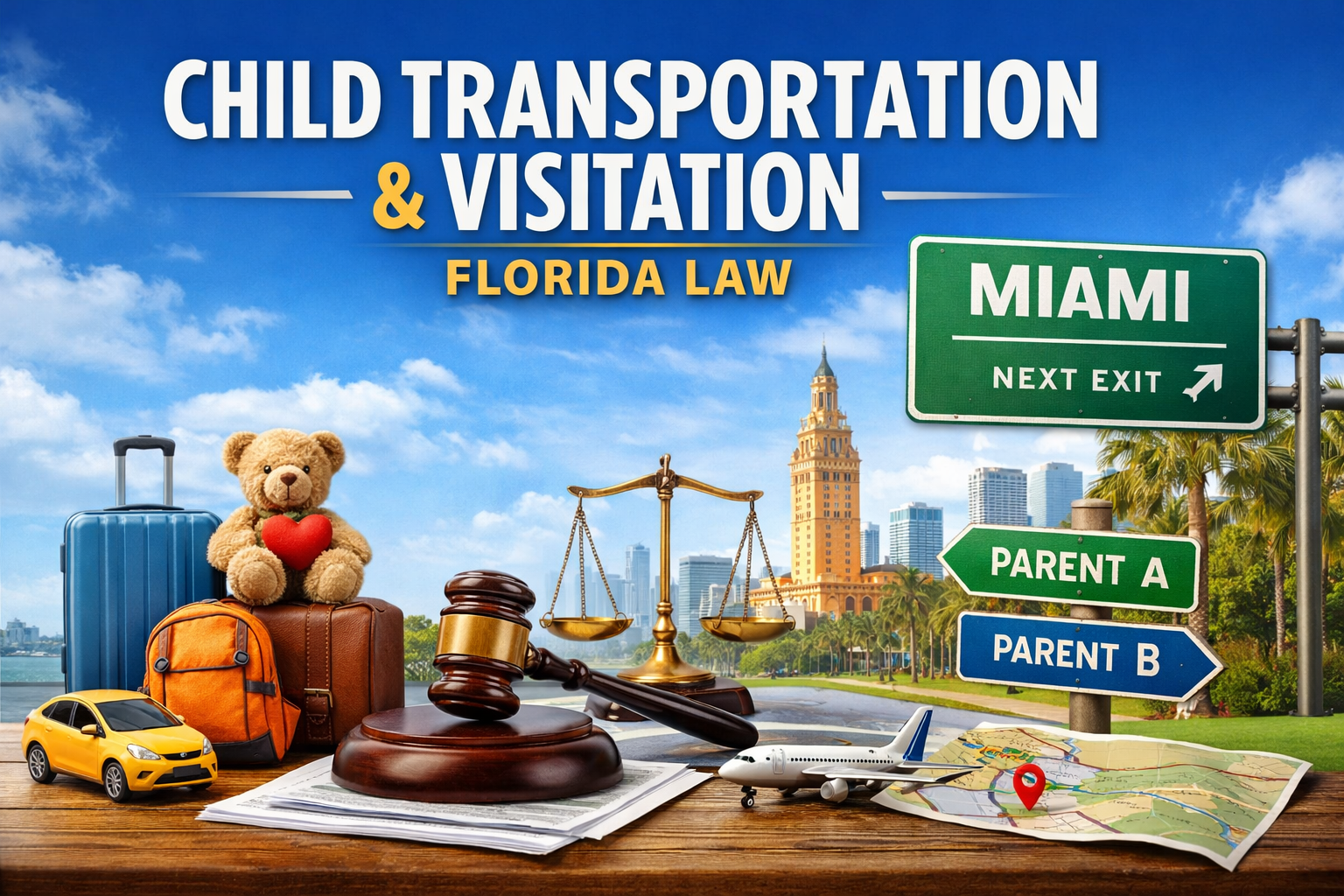
This article explains child transportation and visitation Florida law, including how parenting plans allocate travel responsibilities, exchange logistics, and transportation costs. It analyzes Florida statutes and appellate case law while providing practical guidance for families and courts in Miami-Dade County.
In Florida family law cases, transportation arrangements are typically addressed within the parenting plan and are evaluated under the overarching legal standard of the child’s best interests. Courts in Miami-Dade County and throughout Florida regularly confront disputes about transportation responsibilities, travel costs, and exchange logistics when parents live in different cities or when conflict between parents makes exchanges difficult. Florida statutes and appellate case law establish a structured legal framework that determines how transportation obligations should be assigned and enforced.
Understanding how child transportation and visitation Florida law works is essential for parents navigating divorce, paternity, and post-judgment modification proceedings. Parenting plans must contain clear provisions that identify who is responsible for transporting the child, where exchanges will occur, and how related expenses will be allocated. Courts analyze transportation provisions together with time-sharing schedules, financial circumstances of the parents, and the practical realities of travel distance. The result is a legal system designed to preserve strong parent-child relationships while ensuring that the exchange process remains safe, fair, and practical.
Legal Framework for Child Transportation and Visitation Florida
Florida family law requires parenting plans to address child transportation arrangements with sufficient detail to avoid future disputes. The statutory authority governing these issues appears primarily in Florida Statute § 61.13, which establishes the requirements for parenting plans and time-sharing schedules. The statute provides that parenting plans must describe in adequate detail how parents will share and be responsible for the daily tasks associated with raising their children. Transportation responsibilities for time-sharing exchanges fall squarely within these required provisions.
Courts interpreting child transportation and visitation Florida law consistently emphasize that parenting plans must include specific exchange logistics. The Florida Supreme Court reinforced this requirement in In re Amendments to the Florida Supreme Court Approved Family Law Forms, 173 So. 3d 19 (Fla. 2015), which confirmed that parenting plans must contain clear provisions addressing transportation and exchange arrangements. These provisions may include designated meeting locations, travel schedules, and methods for resolving disputes if transportation problems arise.
In practical terms, transportation provisions help ensure that a time-sharing schedule can actually function in real life. Without clear rules regarding who picks up the child, who drops the child off, and where exchanges occur, even well-intentioned parenting plans can devolve into ongoing conflict. Florida courts therefore require detailed language that reduces ambiguity and protects the child from exposure to parental conflict.
Best Interests Standard in Transportation Decisions
The central legal principle governing child transportation and visitation Florida disputes is the best interests of the child. Under Florida Statute § 61.13, courts must evaluate numerous factors when determining time-sharing arrangements. Transportation logistics are closely connected to these factors because travel distance, parental cooperation, and scheduling feasibility all influence the stability of the child’s routine.
Courts evaluating transportation disputes often consider the geographic viability of the parenting plan. A schedule that requires a child to travel several hours multiple times each week may be impractical, particularly for school-aged children. Judges therefore analyze how travel time affects school attendance, extracurricular activities, and the child’s overall well-being.
In Miami-Dade County, where traffic congestion and travel times can be significant, courts frequently address practical issues such as exchange timing, airport travel for out-of-state parents, and the impact of long-distance commuting on children’s schedules. Judges aim to create arrangements that preserve both parents’ relationships with the child while minimizing unnecessary disruption.
Allocation of Transportation Costs
Transportation costs associated with visitation and time-sharing are generally considered child-rearing expenses under Florida law. Courts must allocate these costs in a manner that is equitable and consistent with the financial circumstances of the parties. The legal authority supporting this principle appears in the appellate decision Drakulich v. Drakulich, 705 So. 2d 665 (Fla. 2d DCA 1998).
In Drakulich, the court recognized that travel expenses incurred for visitation constitute a legitimate child-related cost. The court explained that transportation expenses must be analyzed alongside other financial responsibilities associated with raising a child. Because both parents benefit from maintaining a relationship with the child, courts generally attempt to allocate transportation costs in a fair and balanced manner.
The equitable allocation principle was reaffirmed in Williams v. Williams, 429 So. 3d 594 (Fla. 3d DCA 2026). In that case, the appellate court reversed a trial court decision that required one parent to bear the entirety of transportation expenses without sufficient factual findings. The appellate court emphasized that deviations from equitable cost-sharing must be supported by clear reasoning and evidence.
These decisions demonstrate that Florida courts expect transportation expenses to be distributed in a manner consistent with the financial abilities of each parent. If one parent earns substantially more income or voluntarily relocates far from the child, the court may adjust transportation obligations accordingly.
Relocation and Transportation Obligations
Relocation cases present some of the most complex transportation issues in Florida family law. The governing statute is Florida Statute § 61.13001, which establishes the legal procedure for parental relocation involving a child subject to a time-sharing order.
Under the relocation statute, a parent seeking to move more than fifty miles from the child’s current residence for at least sixty consecutive days must either obtain the other parent’s consent or receive court approval. When relocation is requested, the relocating parent must propose a revised time-sharing schedule that includes detailed transportation arrangements.
Courts reviewing relocation petitions carefully examine the feasibility of the proposed travel schedule. Judges consider factors such as airline travel, driving distance, school calendars, and the financial cost of travel. The relocating parent typically bears the initial burden of demonstrating that the move serves the child’s best interests. If that burden is met, the opposing parent may present evidence that relocation would harm the child’s relationship with the non-relocating parent.
Transportation logistics often become a decisive factor in relocation cases. If travel arrangements are excessively burdensome or financially unrealistic, courts may deny relocation even if other factors support the move.
Neutral Exchange Locations and Safety Considerations
In some family law cases, the relationship between parents is sufficiently contentious that direct exchanges pose safety risks or create emotional stress for the child. Florida courts have authority under Florida Statute § 61.13 to order neutral exchange locations or supervised exchanges when necessary to protect the child’s welfare.
Courts may designate locations such as police stations, supervised visitation centers, or other neutral settings to facilitate safe transfers of the child between parents. These arrangements can reduce opportunities for conflict and provide a structured environment for exchanges.
Financial considerations associated with supervised exchanges may also be addressed by the court. The cost of professional supervision services can be significant, and judges typically evaluate each parent’s financial resources when determining how those expenses should be shared.
Florida law also recognizes that certain circumstances may require additional protective measures. For example, Florida Statute § 61.45 addresses situations involving international travel with children and establishes safeguards intended to prevent international child abduction.
Geographic Viability of Parenting Plans
One of the most important considerations in child transportation and visitation Florida disputes is geographic viability. A parenting plan must account for the distance between the parents’ residences and the time required for transportation. Courts evaluate whether the proposed schedule realistically allows the child to maintain a consistent routine.
When parents live in different counties or states, transportation arrangements must be carefully structured to avoid excessive travel for the child. For example, weekend-only time-sharing schedules are often used when parents live far apart. Courts may also allocate longer holiday and summer visits to compensate for reduced weekday contact.
Judges in Miami-Dade County frequently consider the impact of traffic patterns, school schedules, and airport travel when crafting transportation provisions. The goal is to design a parenting plan that preserves meaningful contact with both parents without imposing unreasonable travel demands.
Drafting Effective Parenting Plan Transportation Provisions
Clear drafting of transportation provisions is essential for reducing post-judgment disputes. Parenting plans should specify the exact exchange location, the parent responsible for transportation, and the timing of exchanges. Detailed language eliminates ambiguity and makes enforcement easier if conflicts arise.
Effective parenting plans may also include contingency provisions addressing situations such as flight delays, illness, or unexpected scheduling conflicts. These provisions allow parents to resolve transportation issues without returning to court.
Courts evaluating parenting plans expect transportation provisions to be realistic and consistent with the parents’ financial and logistical circumstances. Judges often reject vague language that fails to identify specific responsibilities.
Enforcement of Transportation Provisions
When a parent fails to comply with transportation obligations, the other parent may seek enforcement through the court. Under Florida law, violations of a parenting plan can result in various remedies including makeup time-sharing, modification of the parenting plan, or other appropriate sanctions.
Enforcement proceedings frequently arise when one parent repeatedly refuses to transport the child, arrives late for exchanges, or imposes unreasonable conditions on transportation arrangements. Courts evaluate the pattern of behavior and determine whether it interferes with the child’s relationship with the other parent.
Judges emphasize that transportation disputes should not be used as leverage in broader parental conflicts. The focus remains on preserving the child’s right to maintain meaningful relationships with both parents.
Miami-Dade County Considerations
Families in Miami-Dade County face unique logistical challenges when addressing transportation issues. Long travel times across the county, school schedules, and airport travel for international families frequently complicate time-sharing exchanges.
Local judges often encourage parenting plans that minimize weekday travel and concentrate exchanges around predictable schedules. For example, exchanges may occur at school dismissal or during weekend transitions to reduce disruption to the child’s daily routine.
Because Miami is an international hub, courts also address cases involving parents who reside in different countries. These situations require particularly detailed transportation provisions, including flight schedules, passport control arrangements, and cost allocation.
Practical Guidance for Parents
Parents involved in family law disputes should approach transportation issues with careful planning and cooperation. Transportation arrangements that are realistic, predictable, and fair reduce the likelihood of future litigation.
Parents should document travel expenses, maintain clear communication about exchange logistics, and follow the terms of the parenting plan precisely. When disputes arise, seeking legal guidance early can prevent minor disagreements from escalating into costly litigation.
Conclusion
Child transportation and visitation Florida law reflects a balanced legal framework designed to protect the best interests of children while ensuring fairness between parents. Florida statutes, including § 61.13 and § 61.13001, require parenting plans to contain detailed transportation provisions that address logistics, costs, and safety concerns. Appellate decisions such as Drakulich v. Drakulich and Williams v. Williams further clarify that transportation expenses must be allocated equitably based on the parents’ financial circumstances.
For families in Miami and throughout Florida, careful drafting of transportation provisions can prevent unnecessary conflict and support a stable time-sharing arrangement. When transportation disputes arise, experienced legal guidance can help protect both parental rights and the child’s well-being.
If you are facing a dispute involving child transportation, visitation exchanges, or parenting plan enforcement in Miami-Dade County, consulting an experienced Florida family law attorney can provide clarity and strategic guidance. Properly structured transportation provisions can make the difference between a parenting plan that works smoothly and one that generates constant litigation.
TLDR: Child transportation and visitation Florida law requires parenting plans to clearly define who transports the child, where exchanges occur, and how travel costs are shared. Florida courts prioritize the child’s best interests, equitable cost allocation, and practical travel logistics when resolving transportation disputes.
What does Florida law require for child transportation in parenting plans?
Florida law requires parenting plans to specify transportation responsibilities, exchange locations, and related logistics under Florida Statute § 61.13.
Who pays transportation costs for visitation in Florida?
Courts typically allocate transportation costs equitably between parents based on their financial circumstances, as recognized in Drakulich v. Drakulich.
Can courts order neutral exchange locations?
Yes. Courts may require neutral or supervised exchanges if safety concerns exist or if parental conflict makes direct exchanges difficult.
How does relocation affect transportation responsibilities?
Under Florida Statute § 61.13001, a relocating parent must propose a revised time-sharing schedule and transportation plan demonstrating that the move serves the child’s best interests.
What happens if a parent refuses to transport the child?
Failure to comply with transportation provisions may lead to enforcement proceedings, makeup time-sharing, or other court sanctions.