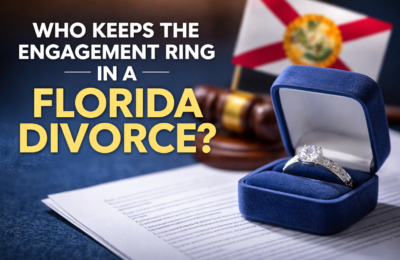


15 Jan Interspousal Gifts in Florida Divorce Law
Summary
Florida law generally treats gifts given by one spouse to the other during marriage as marital property subject to equitable distribution under Florida Statutes section 61.075. However, a spouse may rebut this presumption by presenting clear and convincing evidence that the gift was intended to remain separate property.
Interspousal gifts in Florida divorce proceedings raise important questions regarding marital property, equitable distribution, and the legal presumption that certain transfers between spouses during a marriage become marital assets. Understanding how interspousal gifts Florida divorce courts analyze can significantly affect the outcome of property division in Miami and throughout the State of Florida. Florida courts rely primarily on the equitable distribution framework contained in Florida Statutes section 61.075 when determining whether a gift given by one spouse to the other during the marriage should be treated as marital property subject to division or nonmarital property that remains with the recipient spouse.
The classification of property as marital or nonmarital is often one of the most heavily litigated issues in a divorce case. Jewelry, vehicles, real estate, financial transfers, and even luxury items may be argued to be personal gifts rather than shared marital assets. However, Florida law creates a strong presumption that gifts exchanged between spouses during the marriage belong to the marital estate. This presumption can dramatically impact high asset divorce litigation in Miami where valuable items may have been transferred between spouses throughout the marriage.
Florida courts examine several factors when analyzing whether a gift given by one spouse retains nonmarital status or becomes marital property. These factors include the statutory presumption under Florida Statutes section 61.075, the elements required to prove a gift, the burden of proof necessary to overcome marital asset presumptions, and the doctrines of commingling and equitable distribution. Each of these principles has been developed through extensive appellate case law and statutory interpretation.
Florida Equitable Distribution and Interspousal Gifts
The concept of equitable distribution forms the foundation of Florida property division law in divorce proceedings. Florida Statutes section 61.075 governs the classification, valuation, and distribution of marital assets and liabilities. Under this statute, courts must first determine whether an asset is marital or nonmarital before deciding how it should be distributed between the parties.
Section 61.075(6)(a) specifically addresses property classification and includes interspousal gifts as part of the marital estate. The statute provides that gifts made by one spouse to the other during the marriage are presumed to be marital assets. Because of this statutory presumption, many items that individuals believe to be personal gifts may actually be treated as shared marital property when the marriage dissolves.
The policy rationale behind this rule reflects the partnership theory of marriage that underlies Florida family law. The marital relationship is considered an economic partnership in which both spouses contribute to the accumulation of assets. When one spouse gives property to the other during the marriage, Florida law presumes that the transfer occurred within the context of that partnership and therefore should be considered part of the marital estate.
This principle has been repeatedly reinforced by Florida appellate courts. In Colley v. Colley, 745 So. 2d 1125 (Fla. 5th DCA 1999), the court emphasized that interspousal gifts are presumed to be marital assets subject to equitable distribution unless the party seeking to exclude the property can prove otherwise. The court explained that failing to classify such gifts as marital assets would undermine the equitable distribution scheme established by the legislature.
The rule was further addressed in Maddox v. Maddox, 750 So. 2d 693 (Fla. 4th DCA 2000), where the appellate court reiterated that gifts exchanged between spouses during the marriage typically become marital property unless clear evidence demonstrates a contrary intent. These cases demonstrate that Florida courts consistently apply the statutory presumption that interspousal gifts are marital assets.
Presumption of Marital Property for Gifts Between Spouses
One of the most significant aspects of Florida divorce law is the presumption that gifts exchanged between spouses during the marriage are marital assets. This presumption exists regardless of which spouse originally purchased the item or which spouse used separate funds to acquire it.
Under Florida Statutes section 61.075(6)(a), the law presumes that any property transferred between spouses during the marriage becomes part of the marital estate. This presumption reflects the idea that marital partners typically intend such transfers to benefit the marriage rather than the individual spouse.
Because of this presumption, a spouse who wishes to claim that a gift should remain nonmarital property must overcome a significant evidentiary burden. The spouse asserting that the property is nonmarital must provide clear and convincing evidence demonstrating that the gift was not intended to become marital property.
Florida courts frequently evaluate documentary evidence, witness testimony, and the surrounding circumstances of the transfer when determining whether the presumption has been rebutted. Courts may consider the nature of the property, the language used when the gift was presented, and whether the asset was subsequently treated as part of the marital estate.
The appellate decision in Erdman v. Erdman, 301 So. 3d 316 (Fla. 2d DCA 2019), illustrates the difficulty of overcoming the marital asset presumption. In Erdman, the court explained that simply proving that nonmarital funds were used to purchase property titled jointly between spouses is insufficient to rebut the presumption of a marital gift. The court held that additional evidence must demonstrate that the donor spouse did not intend to make a gift to the marital estate.
The Legal Elements of a Gift in Florida
Florida law requires proof of specific elements before a transfer can be legally recognized as a gift. These elements play a critical role in divorce litigation because they determine whether the transfer actually constituted a gift rather than a loan or conditional transfer.
Florida courts have consistently recognized three elements necessary to establish a valid gift. First, the donor must possess donative intent, meaning that the person giving the property intends to transfer ownership without expecting compensation. Second, there must be delivery of the property or transfer of possession to the recipient. Third, the donor must surrender dominion and control over the property.
These elements were discussed in Mills v. Mills, 845 So. 2d 230 (Fla. 3d DCA 2003), where the court explained that donative intent and delivery are essential components of a legally recognized gift. Without proof of these elements, the transfer may be classified as a loan or temporary use rather than a permanent gift.
More recently, Florida courts reaffirmed these principles in McHugh v. McHugh, 397 So. 3d 1179 (Fla. 2d DCA 2024). In that decision, the court again emphasized the necessity of proving donative intent, delivery, and relinquishment of control when determining whether a transfer constituted a valid gift.
These elements are particularly important in divorce cases involving expensive jewelry, vehicles, or real estate transfers where one spouse later claims that the property was merely loaned or temporarily assigned.
Burden of Proof in Interspousal Gift Disputes
The burden of proof plays a crucial role in disputes involving interspousal gifts. Because Florida law presumes that such gifts are marital assets, the spouse seeking to classify the gift as nonmarital bears the burden of overcoming this presumption.
To rebut the statutory presumption, the challenging spouse must present clear and convincing evidence demonstrating that the gift was intended to remain separate property. This heightened standard of proof reflects the legislature’s intent to treat most property exchanged between spouses as part of the marital estate.
Evidence that may support rebutting the presumption includes written agreements between the parties, testimony regarding the circumstances of the gift, or documentation demonstrating that the donor spouse explicitly intended the property to remain separate.
In many Miami divorce cases, the absence of clear documentation makes it extremely difficult to prove that a gift should remain nonmarital property. Courts frequently rely on the surrounding facts and conduct of the parties when evaluating such claims.
Commingling and Loss of Nonmarital Status
Even when property initially qualifies as nonmarital, it may lose that classification through the process known as commingling. Commingling occurs when separate property becomes so intertwined with marital property that it can no longer be distinguished from the marital estate.
Florida courts have repeatedly held that commingling can convert nonmarital property into marital property subject to equitable distribution. This principle was illustrated in Dravis v. Dravis, 170 So. 3d 849 (Fla. 2d DCA 2015), where the court determined that noninterspousal gifts that were mixed with marital funds became marital assets.
Commingling frequently occurs when separate funds are deposited into joint bank accounts, when property is jointly titled, or when both spouses contribute to the maintenance or improvement of the asset. Once commingling occurs, the original nonmarital character of the property may be permanently lost.
Judicial Discretion in Equitable Distribution
Even when an asset is classified as marital property, Florida courts are not required to divide that property equally between the parties. Instead, courts must distribute marital assets in a manner that is equitable and fair under the circumstances.
Florida Statutes section 61.075(1) establishes that courts should begin with the premise of equal distribution but may order unequal distribution when justified by specific factors. These factors include the economic circumstances of the parties, contributions to the marriage, and any other factor necessary to achieve equity and justice.
The appellate decision in Crossen v. Feeley, 430 So. 3d 100 (Fla. 4th DCA 2026) clarified that the existence of an interspousal gift does not prevent a court from awarding that asset disproportionately if doing so would be equitable under the circumstances.
This principle is particularly important in Miami divorce cases involving significant wealth disparities between spouses or situations in which one spouse contributed substantially more to the acquisition of marital assets.
Written Agreements and Property Classification
Spouses may alter the default property classification rules through written agreements such as prenuptial agreements or postnuptial agreements. Florida Statutes section 61.075(6)(b) provides that property excluded by valid written agreements remains nonmarital.
These agreements can explicitly state that certain gifts exchanged between spouses will remain the separate property of the recipient spouse. When properly drafted and executed, such agreements can override the statutory presumption that interspousal gifts are marital assets.
In high asset marriages in Miami, prenuptial and postnuptial agreements often address the treatment of luxury gifts, jewelry, real estate transfers, and financial accounts. Clear language in these agreements can prevent costly litigation during divorce proceedings.
Miami Divorce Litigation and Interspousal Gifts
In Miami family courts, disputes involving interspousal gifts frequently arise in high net worth divorce cases. Jewelry collections, luxury vehicles, designer items, and real estate transfers often become the subject of contested equitable distribution proceedings.
Judges in the Eleventh Judicial Circuit apply the same statutory framework found in Florida Statutes section 61.075 while also relying heavily on Florida appellate case law. Because Miami is home to many international couples and high asset marriages, these disputes can involve complex financial records and cross border property issues.
Attorneys handling divorce litigation in Miami must carefully analyze the classification of each asset, gather evidence regarding the intent behind the transfer, and evaluate whether commingling has occurred.
Conclusion
Interspousal gifts Florida divorce courts analyze are generally presumed to be marital assets subject to equitable distribution under Florida Statutes section 61.075. This presumption reflects the economic partnership theory of marriage and ensures that assets exchanged during the marriage are fairly considered during property division.
However, the presumption is not absolute. A spouse may rebut the presumption by presenting clear and convincing evidence that the gift was intended to remain separate property. Courts evaluate the elements of a gift, the intent of the parties, and the surrounding circumstances when making this determination.
Florida appellate courts including Colley v. Colley, Maddox v. Maddox, Erdman v. Erdman, Mills v. Mills, McHugh v. McHugh, Dravis v. Dravis, and Crossen v. Feeley provide critical guidance on how these disputes should be resolved.
Because the classification of interspousal gifts can significantly affect property division, individuals facing divorce in Miami should seek experienced legal guidance to protect their financial interests and ensure that all assets are properly analyzed under Florida law.
Speak With a Miami Divorce Attorney
If you are facing divorce in Miami and questions have arisen regarding interspousal gifts Florida divorce law may affect, consulting an experienced Miami family law attorney can help protect your financial interests. Proper classification of assets under Florida Statutes section 61.075 can significantly influence the outcome of equitable distribution and determine whether valuable property remains separate or becomes part of the marital estate.
A knowledgeable divorce lawyer can analyze the facts of your case, review documentation regarding gifts exchanged during the marriage, and develop a strategy to protect your rights in court. Contact a Miami divorce attorney to discuss your situation and ensure that your property is properly evaluated under Florida law.
TLDR: In Florida divorce cases, gifts given by one spouse to the other during the marriage are generally considered marital property subject to equitable distribution under Florida Statutes section 61.075. Courts presume that interspousal gifts belong to the marital estate unless clear and convincing evidence demonstrates that the gift was intended to remain separate property.
Are gifts from one spouse to another considered marital property in Florida?
Yes. Florida Statutes section 61.075 creates a presumption that interspousal gifts made during the marriage are marital assets subject to equitable distribution.
Can a spouse keep a gift after divorce in Florida?
A spouse may keep a gift if they prove with clear and convincing evidence that the donor spouse did not intend the property to become marital property.
What elements must exist to prove a legal gift?
Florida courts require donative intent, delivery of the property, and surrender of control by the donor as explained in Mills v. Mills and McHugh v. McHugh.
Can commingling affect gifts in divorce?
Yes. If a gift becomes commingled with marital assets it may lose its nonmarital status as explained in Dravis v. Dravis.
Do Miami divorce courts divide gifts equally?
Not necessarily. Florida courts may order unequal distribution if equity requires it under Florida Statutes section 61.075.