
11 Jul Mandatory Parenting Classes in Divorces Involving Children
Summary
Mandatory parenting classes are required in Florida divorce cases involving minor children under Florida Statutes section 61.21. The Parent Education and Family Stabilization Course teaches parents about the effects of divorce on children and must be completed before a final judgment can be entered.
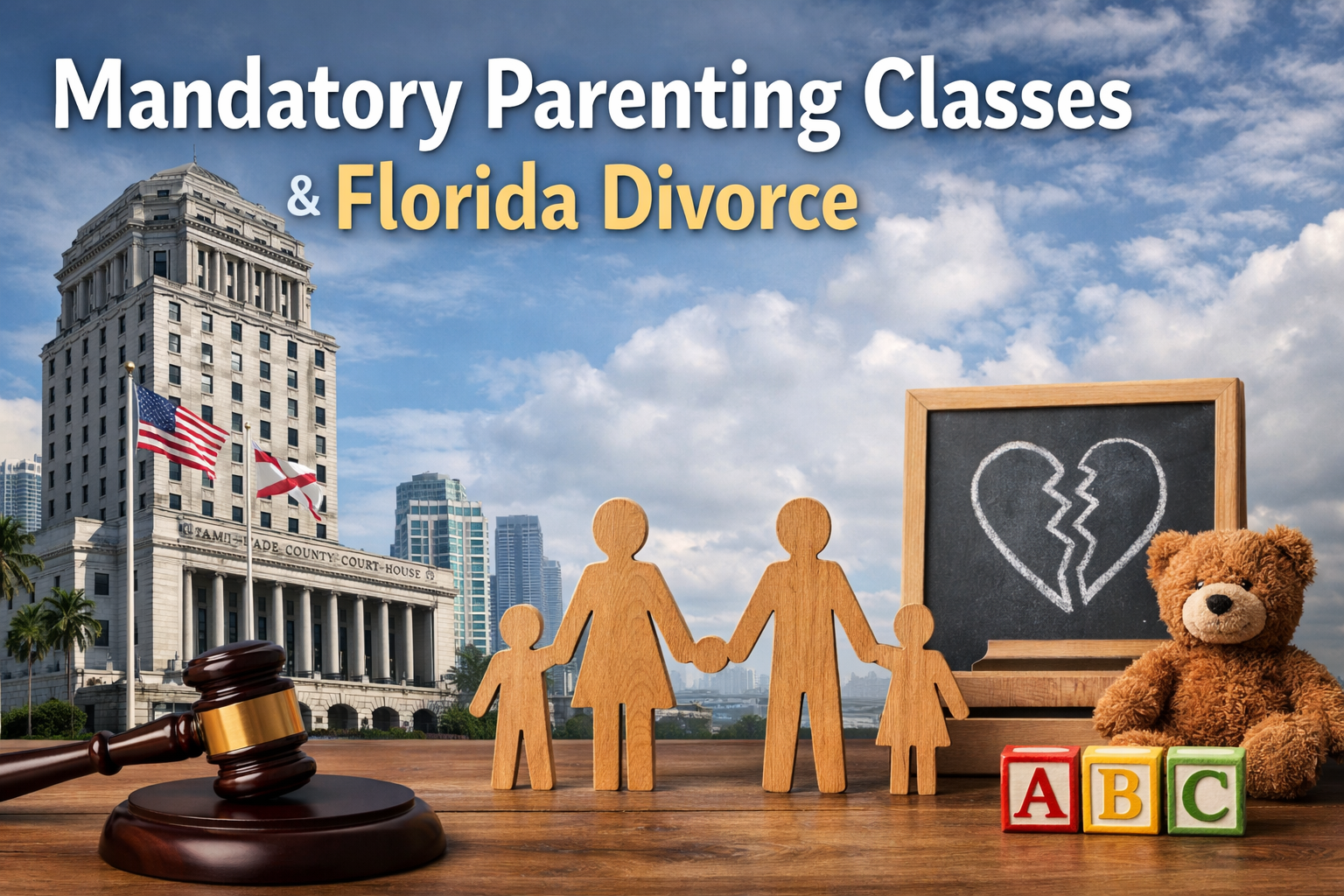
Mandatory parenting classes are a central procedural and educational requirement in family law proceedings involving minor children. In Miami-Dade County and throughout the State of Florida, parents who file for divorce or paternity actions involving parental responsibility must complete a statutorily mandated Parent Education and Family Stabilization Course before a final judgment may be entered. The requirement is codified in Florida Statutes section 61.21 and reinforced by administrative rules and judicial decisions interpreting the statute. The purpose of the course is to educate parents about the impact of separation and divorce on children and to promote parenting practices that protect the best interests of the child during family restructuring.
In the Eleventh Judicial Circuit in Miami-Dade County, compliance with the parenting course requirement is considered a routine yet legally significant component of divorce litigation involving minor children. Courts expect strict adherence to statutory deadlines and procedural requirements. Failure to complete the course may affect the timing of the final judgment and in some circumstances may influence determinations relating to parental responsibility and time sharing. Understanding the legal framework surrounding mandatory parenting classes Florida divorce cases require is therefore essential for litigants and attorneys practicing family law in Miami and throughout Florida.
Statutory Framework Governing Mandatory Parenting Classes Florida Divorce Cases Require
The statutory authority for mandatory parenting classes Florida divorce cases require is found in Florida Statutes section 61.21. The statute mandates that all parties to a dissolution of marriage proceeding involving minor children complete a parenting course approved by the Florida Department of Children and Families prior to the entry of a final judgment. The requirement also applies in paternity actions when issues of parental responsibility or time sharing are involved.
The legislature enacted section 61.21 to address the growing recognition that parental conflict during divorce can have significant psychological and developmental effects on children. By requiring parents to participate in structured education programs, the statute seeks to mitigate these negative effects and encourage cooperative parenting behavior following separation.
The statutory scheme operates as a procedural prerequisite within family law litigation. Courts generally will not enter a final judgment of dissolution involving minor children unless each parent has completed the required course and filed proof of completion with the court. The requirement applies regardless of whether the case is contested or uncontested.
Administrative regulations adopted by the Department of Children and Families further define the content and structure of the required course. Florida Administrative Code rule 65C-32.003 establishes the required components of the Parent Education and Family Stabilization Course and sets standards for program approval and operation.
Purpose and Policy Behind Mandatory Parenting Classes Florida Divorce Proceedings Require
The public policy underlying mandatory parenting classes Florida divorce proceedings require reflects the principle that the best interests of the child are paramount in family law cases. Florida courts consistently emphasize that children should be insulated from parental conflict whenever possible and that parents must learn strategies to minimize emotional harm during the divorce process.
The parenting course requirement is designed to provide parents with information about the psychological effects of divorce, communication techniques that reduce conflict, and strategies for maintaining healthy parent child relationships. Courts view the course as an educational tool that helps parents transition from a marital relationship to a cooperative co parenting relationship.
The program also addresses issues such as financial responsibilities, the impact of litigation on children, and methods of conflict resolution. By exposing parents to these concepts early in the litigation process, the statute seeks to promote settlement and reduce adversarial behavior.
Florida appellate courts have recognized that the statutory requirement serves an important role in promoting child welfare within the judicial system. The legislature has therefore given courts authority to enforce compliance and impose sanctions when parties fail to complete the required course.
Course Content Required by Florida Law
Florida Administrative Code rule 65C-32.003 specifies the educational topics that must be included in the Parent Education and Family Stabilization Course. These requirements ensure that programs offered throughout the state provide consistent and meaningful instruction.
The curriculum must address the emotional and psychological impact of divorce on children. Participants learn about the stages of adjustment children experience following parental separation and the importance of maintaining stability in the child’s life.
The course must also address family dynamics and the changes that occur when parents separate. Instruction includes techniques for reducing conflict, improving communication, and maintaining cooperative parenting relationships.
Another required component involves legal aspects of dissolution and parenting litigation. Parents receive information about parental responsibility, time sharing arrangements, and the role of the court in resolving disputes.
Programs must also address issues related to financial responsibilities, including child support obligations and the economic realities families often face after divorce. Education about domestic violence, abuse, and neglect is also included in the curriculum.
Timing Requirements for Completing the Parenting Course
Florida Statutes section 61.21 establishes specific deadlines for completing mandatory parenting classes Florida divorce cases require. The petitioner in a dissolution of marriage action must complete the course within forty five days of filing the petition. The responding party must complete the course within forty five days after service of the petition.
These deadlines are designed to ensure that parents receive educational guidance early in the litigation process. Early completion of the course encourages parents to approach issues of parental responsibility and time sharing with a greater understanding of the needs of their children.
In paternity proceedings involving minor children, similar deadlines apply. The petitioner must complete the course within forty five days of filing the action, and the other party must complete the course within forty five days after acknowledgment or adjudication of paternity or entry of an order addressing time sharing or support.
Courts expect strict compliance with these deadlines unless good cause exists for an extension or exemption.
Proof of Completion and Court Filing Requirements
Completion of mandatory parenting classes Florida divorce cases require must be documented through a certificate issued by the approved course provider. Each party must file the certificate with the court prior to the entry of final judgment.
The filing of the certificate serves as proof that the statutory requirement has been satisfied. Without this documentation, the court may decline to enter a final judgment or may require additional hearings to address compliance.
The requirement to file proof of completion ensures transparency in the judicial process and allows courts to confirm that both parents have participated in the educational program mandated by Florida law.
Judicial Discretion and Exceptions to Course Requirements
Although the statute establishes a mandatory requirement, Florida Statutes section 61.21 grants courts discretion to excuse a party from completing the course or from meeting the statutory deadline for good cause. Judicial discretion allows courts to account for unique circumstances that may make participation impractical or unnecessary.
Examples of situations in which courts may excuse compliance include cases involving severe medical issues, incarceration, or other circumstances that prevent attendance. Courts also consider safety concerns in cases involving domestic violence.
When domestic violence is alleged or documented, courts may prohibit parents from attending the course together and may require separate participation to ensure safety.
Consequences of Failing to Complete Mandatory Parenting Classes Florida Divorce Cases Require
Failure to complete mandatory parenting classes Florida divorce cases require can result in significant legal consequences. Courts possess authority to enforce compliance through various procedural mechanisms.
One potential consequence is contempt of court. Because completion of the parenting course is a statutory requirement, failure to comply may be treated as disobedience of a court order.
Courts may also impose other sanctions designed to encourage compliance. These sanctions may include delaying entry of the final judgment or scheduling additional hearings.
In some circumstances, noncompliance may influence determinations relating to parental responsibility or time sharing if the court concludes that a parent has demonstrated unwillingness to follow court orders.
Florida Case Law Interpreting Parenting Course Requirements
Florida appellate courts have addressed the consequences of failing to comply with the parenting course requirement. In Southwell v. Southwell, 385 So. 3d 170 (Fla. 2d DCA 2024), the court addressed a situation in which a parent failed to complete the mandatory parenting course required under Florida Statutes section 61.21.
The court upheld the denial of time sharing where the parent had failed to comply with the statutory requirement. The decision emphasized that completion of the course is an important component of the statutory framework designed to protect children involved in divorce proceedings.
The court also noted that the parent retained the ability to seek modification of time sharing after completing the course and demonstrating compliance with statutory requirements.
Administrative Orders Reinforcing Parenting Course Requirements
In addition to statewide statutes and regulations, judicial circuits often issue administrative orders reinforcing compliance with mandatory parenting classes Florida divorce cases require.
For example, administrative orders in several Florida circuits require completion of the parenting course prior to participation in mediation or trial proceedings. These orders are designed to ensure that parents receive educational instruction before litigating parenting issues.
Administrative orders issued in the Seventh Judicial Circuit and Tenth Judicial Circuit emphasize that completion of the parenting course is mandatory in all cases involving minor children regardless of whether the case is contested or uncontested.
Application in Miami Family Law Courts
In Miami-Dade County, family law cases are primarily handled within the Eleventh Judicial Circuit of Florida. Judges routinely enforce the parenting course requirement in dissolution of marriage cases involving minor children.
Local practice reflects strict adherence to Florida Statutes section 61.21. Attorneys practicing family law in Miami regularly advise clients to complete the course as soon as possible after filing or receiving service of a petition for dissolution.
Completing the parenting course early in the litigation process often helps facilitate mediation and settlement discussions by providing parents with tools to communicate more effectively.
Practical Considerations for Parents in Miami Divorce Cases
Parents involved in divorce proceedings in Miami should understand that mandatory parenting classes Florida divorce cases require are not merely procedural formalities. Courts view the requirement as an important educational component of family law litigation.
Timely completion of the course helps avoid delays in obtaining a final judgment and demonstrates a parent’s willingness to comply with court orders. Parents who proactively complete the course often experience smoother litigation processes and fewer procedural obstacles.
Conclusion
Mandatory parenting classes Florida divorce cases require represent a critical component of the state’s family law framework. By requiring parents to participate in educational programs addressing the impact of divorce on children, Florida law seeks to promote healthier family transitions and protect the best interests of children.
Florida Statutes section 61.21, Florida Administrative Code rule 65C-32.003, and appellate decisions such as Southwell v. Southwell collectively establish a comprehensive legal structure governing parenting education in divorce cases. Courts retain discretion to enforce compliance and to impose sanctions when parties fail to complete the required course.
In Miami-Dade County and throughout Florida, parents involved in divorce proceedings should treat the parenting course requirement as an essential step in the legal process. Understanding the statutory framework and complying with course requirements can help avoid delays, reduce conflict, and promote better outcomes for children.
If you are facing a divorce involving minor children in Miami-Dade County, understanding mandatory parenting classes Florida divorce cases require is essential to protecting your parental rights and avoiding unnecessary delays in your case. An experienced Miami family law attorney can guide you through the parenting course requirement, ensure compliance with court rules, and help you pursue a parenting plan that protects your relationship with your children.
TLDR: Mandatory parenting classes Florida divorce cases require are educational programs that parents must complete when a divorce or paternity case involves minor children. Under Florida Statutes section 61.21, both parents must complete a Department of Children and Families approved Parent Education and Family Stabilization Course before a court can enter a final judgment. The course teaches parents about the effects of divorce on children and strategies for cooperative parenting.
Are parenting classes mandatory in Florida divorce cases with children?
Yes. Florida Statutes section 61.21 requires both parents to complete a Department of Children and Families approved Parent Education and Family Stabilization Course before the court enters a final judgment in divorce cases involving minor children.
How long is the Florida parenting course for divorce?
The required parenting course must be at least four hours in length and must include topics specified in Florida Administrative Code rule 65C-32.003.
What happens if a parent does not complete the required parenting course?
Failure to complete the course may result in sanctions such as contempt of court, delay of the final judgment, or restrictions on time sharing. Florida courts addressed these consequences in cases such as Southwell v. Southwell, 385 So. 3d 170 (Fla. 2d DCA 2024).
Can a Florida judge waive the parenting class requirement?
Yes. Florida Statutes section 61.21 allows a court to excuse participation for good cause, although courts exercise this discretion sparingly.