

11 Mar Florida Child Support Deviation Rules: What Judges Must Find in Writing
Summary
Florida child support deviation rules occupy a uniquely critical place in family law litigation throughout Miami-Dade County and across the state. When a trial court elects to order child support in an amount that deviates from the presumptive guideline figure established under Florida Statutes Section 61.30, the law imposes a precise and non-negotiable obligation: the court must make specific written findings explaining why the guideline amount would be unjust or inappropriate. This article examines the statutory framework governing Florida child support guideline deviations, the body of appellate authority interpreting that framework, the mandatory income-finding requirements that undergird any valid deviation order, and the procedural considerations that arise in both initial proceedings and modification actions. Drawing on the leading cases of Pitts v. Pitts, 626 So. 2d 278 (Fla. 3d DCA 1993), Pullis v. Pullis, 118 So. 3d 937 (Fla. 2d DCA 2013), Walsh v. Walsh, 600 So. 2d 1222 (Fla. 4th DCA 1992), J.A.D. v. K.M.A., 264 So. 3d 1080 (Fla. 2d DCA 2019), and Kirchen v. Kirchen, 595 So. 2d 129 (Fla. 4th DCA 1992), this article provides an analysis of what Florida judges must find in writing and why those findings matter both for the integrity of the lower court record and for appellate review.
I. Introduction: Florida Child Support Deviation Rules and Why Written Findings Matter
Florida child support deviation rules represent one of the most consequential procedural requirements in Florida family law practice. Practitioners in Miami and throughout Florida’s family law courts encounter child support disputes in virtually every dissolution of marriage, paternity, and post-judgment modification proceeding. Despite the frequency with which child support is addressed, the statutory framework governing how courts may deviate from the presumptive guideline amount, and particularly what courts must commit to writing when they do so, is frequently misapplied, misunderstood, or simply overlooked. The result is a disproportionately high rate of appellate reversal in cases where trial courts fail to satisfy their written findings obligations.
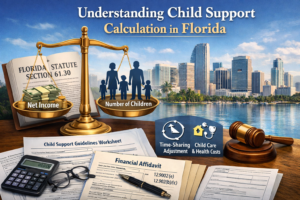
The foundation of Florida’s child support scheme rests on a legislative policy determination that the interests of children are best served by a predictable, calculable support framework. Florida Statutes Section 61.30 establishes that framework, creating a presumptive guideline amount derived from the combined net incomes of both parents and calibrated to reflect the number of children at issue. The presumptive nature of the guideline amount is not merely advisory; rather, it carries legal force that constrains judicial discretion. A court that wishes to order child support in a different amount must do more than exercise its general equitable discretion. It must identify and articulate in writing the specific grounds that justify departure from a figure the legislature has determined to be presumptively appropriate.
Furthermore, Miami-Dade County family law litigants face the added complexity of contested time-sharing arrangements, multi-jurisdictional income sources, self-employment income, and varying degrees of parental financial transparency, each of which can significantly affect both the calculation of the guideline amount and the justification for any deviation. Understanding precisely what the law requires in terms of written findings is therefore not merely an academic exercise; it is a practical imperative for every family law attorney practicing in Miami and across Florida. This article systematically examines those requirements, identifies the doctrinal boundaries established by Florida appellate courts, and provides guidance on how the mandatory written findings framework operates in both initial and modification proceedings.
II. The Statutory Framework: Florida Statutes Section 61.30 and the Presumptive Guideline Amount
A. The Presumptive Nature of the Guideline Amount
Florida Statutes Section 61.30 serves as the primary legislative source for all child support calculations in the state of Florida. The statute establishes what is commonly referred to as the income shares model, which is premised on the principle that children should receive the same proportion of parental income they would have received had the family remained intact. Critically, the amount produced by the statutory guideline calculation is not merely a starting point or a benchmark for judicial consideration; it is presumptively correct. This distinction carries profound legal significance and is central to understanding why Florida child support deviation rules impose such demanding obligations on trial courts that elect to depart from the calculated figure.
As interpreted by Florida’s appellate courts, the presumptive character of the guideline amount means that the amount calculated under the statutory formula is the correct child support award absent a specific factual and legal justification for deviation. Pitts v. Pitts, 626 So. 2d 278 (Fla. 3d DCA 1993), stands as a foundational statement of this principle, establishing that a court may order a different amount only if it makes the required findings. Consequently, a trial court that departs from the guideline amount without satisfying the written findings requirement does not merely commit a procedural irregularity; it orders child support in an amount that lacks a legally sufficient basis and is therefore vulnerable to reversal on appeal.
B. Net Income as the Basis for the Guideline Calculation
Because the statutory guideline amount is derived from the combined net incomes of both parents, an accurate and legally sufficient determination of net income is a prerequisite to any valid child support order, whether the court ultimately adheres to the guideline amount or deviates from it. Florida Statutes Section 61.30 defines net income with specificity, identifying the categories of gross income that must be considered and the allowable deductions that must be subtracted to arrive at the net income figure. Among the allowable deductions enumerated in the statute are federal, state, and local income taxes; Federal Insurance Contributions Act (FICA) deductions or self-employment tax; mandatory union dues; mandatory retirement payments; and certain court-ordered support actually paid to other families.
The appellate courts have consistently and firmly held that trial courts may not take shortcuts in this income-determination process. In J.A.D. v. K.M.A., 264 So. 3d 1080 (Fla. 2d DCA 2019), the Second District Court of Appeal held that a trial court errs by failing to make specific findings concerning each parent’s net monthly income and by relying only on gross income. This holding reflects a straightforward application of the statutory scheme: because the guideline is based on combined net income, a court that anchors its calculation to gross income figures rather than net income figures is calculating the wrong number. The resulting child support order, whether it purports to follow the guidelines or to deviate from them, rests on a factually and legally deficient foundation.
For practitioners in Miami, where income complexity is common and disputes over income characterization arise frequently, the obligation to make specific net income findings has both substantive and strategic dimensions. A party who can demonstrate that the trial court relied on gross rather than net income, or that the court failed to account for specific statutory deductions, has a strong basis for appellate challenge, particularly where the income error results in either an inflated or deflated guideline calculation that in turn affects the deviation analysis.
III. Florida Child Support Deviation Rules: The Five Percent Threshold and Written Findings
A. The Five Percent Threshold Under Florida Law
Florida child support deviation rules establish a critical numerical threshold that determines when written findings become mandatory. Specifically, when a trial court awards child support that deviates more than five percent from the guideline amount, the court must make a written finding explaining why the guideline amount would be inappropriate or unjust. This requirement was clearly articulated in Pullis v. Pullis, 118 So. 3d 937 (Fla. 2d DCA 2013), a decision that remains one of the most frequently cited authorities in the deviation context and that synthesizes both the statutory text and the broader body of appellate precedent addressing the written findings obligation.
The five percent threshold reflects a legislative recognition that minor variations in child support amounts may reflect rounding differences, updated financial information, or minor factual distinctions that do not require extensive judicial explanation. However, when the deviation exceeds five percent, the departure from the presumptive guideline amount is significant enough to require the court to demonstrate affirmatively that it has identified a legally cognizable basis for the departure. The written finding requirement is therefore both a procedural safeguard and a substantive constraint: it ensures that judicial discretion is exercised within a principled framework rather than arbitrarily, and it creates a record sufficient for meaningful appellate review.
B. The Written Finding Requirement: What Courts Must Articulate
The written finding that Florida law requires when a trial court deviates more than five percent from the child support guideline amount must do more than acknowledge that a deviation exists. As the appellate courts have consistently explained, the written finding must explain why the guideline amount would be inappropriate or unjust. This formulation, drawn directly from the statutory language of Florida Statutes Section 61.30 and applied in cases including Pitts v. Pitts, 626 So. 2d 278 (Fla. 3d DCA 1993), and Pullis v. Pullis, 118 So. 3d 937 (Fla. 2d DCA 2013), requires the court to make a connection between specific factual findings and the legal conclusion that the guideline amount is inappropriate or unjust in the case before it.
In practical terms, a trial court’s deviation order must contain findings that identify which factor or factors justify the deviation, describe the facts that support reliance on that factor, and explain how those facts lead to the conclusion that the guideline amount would produce an unjust or inappropriate result. A conclusory statement that the guideline amount is inappropriate, without supporting factual findings, is legally insufficient. Similarly, a general reference to the child’s needs or the parties’ financial circumstances, without connecting those circumstances to a recognized deviation factor and explaining their effect on the guideline calculation, does not satisfy the statutory requirement.
Walsh v. Walsh, 600 So. 2d 1222 (Fla. 4th DCA 1992), reinforces this understanding by holding that departing from the statutory minimum guidelines without stating findings and reasons for departure is error. The Fourth District’s formulation makes clear that the obligation to state findings and reasons is not merely directory or aspirational; it is a mandatory condition on the exercise of the court’s authority to deviate. A trial court that deviates without satisfying this obligation acts in excess of its authority in a sense that is directly reviewable and correctable on appeal.
C. The Relationship Between Written Findings and Appellate Review
One of the most important functions of the written findings requirement in the context of Florida child support deviation rules is to facilitate meaningful appellate review. Florida’s appellate courts review child support orders for an abuse of discretion, but that standard of review presupposes that the trial court has identified the factual basis and legal rationale for its decision. When a trial court fails to make written findings explaining its deviation, the appellate court is unable to assess whether the trial court exercised its discretion appropriately, because there is no record of the factual premises or the legal reasoning that informed the decision.
As a result, the failure to make required written findings in a child support deviation order is typically not a harmless error. Instead, it is an error that requires reversal and remand, because the appellate court cannot affirm a decision whose basis it cannot evaluate. This creates a practical incentive structure for trial courts: the failure to invest the time and attention necessary to produce adequate written findings does not save effort in the long run. It instead generates appellate litigation, imposes delays on the parties, and ultimately requires the trial court to do the work it should have done initially. For Miami family law litigants, who already face the burdens of often protracted and costly dissolution proceedings, this is a particularly significant consideration.
IV. Statutory Deviation Factors Under Florida Statutes Section 61.30
A. The Enumerated Factors for Deviation
Florida Statutes Section 61.30 does not leave the basis for child support deviations entirely to judicial discretion. Instead, the statute identifies specific factors that a court may consider in determining whether the guideline amount is inappropriate or unjust. These statutory deviation factors include extraordinary medical, psychological, educational, or dental expenses attributable to the child; seasonal variations in one or both parents’ income or expenses; the age of the child, especially when special costs are associated with older children; the child’s special needs, including costs for disability-related services or equipment; the total available assets of the obligee, the obligor, and the child; the impact of the Internal Revenue Code on the parties; and other adjustments needed to achieve an equitable result, which may encompass certain reasonable and necessary existing expenses or financial obligations.
The statutory list of deviation factors is non-exhaustive, meaning that a trial court is not strictly limited to these enumerated considerations. However, the catchall category of other adjustments needed to achieve an equitable result must be applied with care. Because the guideline amount itself is designed to produce an equitable result in typical cases, a court invoking the catchall provision must identify what distinguishes the case before it from the ordinary case in which the guideline amount would be appropriate. A generalized assertion of equitable considerations, without specificity about the particular circumstances that render the guideline amount inadequate or excessive, will not satisfy the written findings requirement.
B. Extraordinary Expenses and Special Needs
Among the most frequently invoked deviation factors in Miami family law proceedings are extraordinary expenses and the special needs of the child. Extraordinary medical, psychological, educational, or dental expenses are specifically identified in Florida Statutes Section 61.30 as a basis for deviation because such expenses can substantially alter the financial burden imposed on the custodial or non-custodial parent in ways that the standard guideline calculation does not fully capture. Similarly, a child with disabilities or special developmental needs may require specialized care, therapeutic services, adaptive equipment, or other support that significantly exceeds the costs associated with children generally.
When a trial court deviates from the guideline amount on the basis of extraordinary expenses or special needs, the written findings must specifically identify the expense or need at issue, provide factual support for the conclusion that the expense is extraordinary or that the need is special within the meaning of the statute, quantify the financial impact of the expense or need where possible, and explain how the existence of the expense or need renders the guideline amount unjust or inappropriate. A deviation order that refers to a child’s special needs in general terms, without identifying the specific needs and their financial implications, is likely to be found legally insufficient on appeal. Consequently, Florida family law practitioners representing clients in Miami proceedings involving children with special needs must ensure that the factual record developed at trial is sufficiently detailed to support the specific written findings required by law.
C. Time-Sharing Adjustments and the Substantial Time Threshold
Florida Statutes Section 61.30 contains a specific and important provision addressing the situation in which the parties’ parenting plan or time-sharing schedule results in each child spending a substantial amount of time with each parent. Under the statute, a substantial amount of time is defined as at least twenty percent of the overnights, meaning that when a parent exercises at least seventy-three overnights per year, the court is required to apply the statutory adjustment methodology rather than the standard guideline calculation. The adjustment methodology accounts for the fact that when a child divides significant time between two households, both households incur the fixed costs of maintaining a home suitable for a child, and the standard guideline calculation may therefore overstate the transfer payment needed to support the child.
In addition to the mandatory adjustment that applies when the substantial time threshold is met, Florida Statutes Section 61.30 also permits the court to deviate from the adjusted amount based on the same deviation factors applicable in other contexts, as well as additional considerations identified in the statute specific to the time-sharing context. These additional considerations include the financial impact of the time-sharing arrangement on both parents and the child, and the extent to which each parent’s household expenses vary with the amount of time the child spends in that household. A trial court adjudicating child support in a case involving substantial time-sharing in Miami must therefore navigate both the mandatory adjustment calculation and the written findings requirements that apply to any deviation from the adjusted amount.
V. Income Findings as a Prerequisite to Valid Deviation Orders
A. The Mandatory Nature of Income Findings
Florida child support deviation rules cannot be properly applied without first making accurate and legally sufficient findings regarding each parent’s income. The requirement to make specific income findings is not simply a best practice or a judicial preference; it is a mandatory obligation imposed by both the statutory framework and the body of appellate authority interpreting that framework. In Pullis v. Pullis, 118 So. 3d 937 (Fla. 2d DCA 2013), the Second District expressly held that trial courts are required to make findings of fact regarding the parties’ incomes when determining child support. The court in Pullis noted that without accurate income findings, neither the guideline amount nor any departure from that amount can be meaningfully evaluated.
The income findings requirement is also directly linked to the deviation analysis. If a court has not determined the correct guideline amount by first correctly determining each parent’s net income, the court cannot know how much its order deviates from the guideline. Consequently, a court that fails to make accurate income findings may be ordering a deviation of more than five percent without recognizing that it is doing so, and may therefore be failing to satisfy the written findings obligation that the five percent threshold triggers. This makes income findings not merely a separate procedural obligation but an integral component of the broader Florida child support deviation rules framework.
B. Net Income Versus Gross Income: The Critical Distinction
As noted above, J.A.D. v. K.M.A., 264 So. 3d 1080 (Fla. 2d DCA 2019), establishes that a trial court errs by relying only on gross income rather than making specific findings concerning each parent’s net monthly income. The distinction between gross and net income is fundamental to the statutory guideline scheme because Florida Statutes Section 61.30 expressly bases the guideline calculation on combined net income, not combined gross income. A court that calculates the guideline amount using gross income figures is therefore not calculating the guideline amount at all; it is calculating a different number that may be substantially higher than the true guideline amount, potentially resulting in an obligation to the obligor that the statutory scheme does not actually require.
For Miami family law practitioners, the gross-versus-net distinction creates both a litigation opportunity and a compliance obligation. On the offensive side, a party challenging a child support order can raise the failure to make net income findings as a grounds for reversal regardless of whether the order purports to follow the guidelines, because an order based on gross income has not correctly determined the guideline amount. On the compliance side, attorneys must ensure that the trial record contains sufficient evidence of each parent’s allowable statutory deductions to permit the court to make the specific net income findings that Florida law requires. This may require detailed financial discovery, expert testimony regarding self-employment income or tax implications, and careful presentation of documentary evidence during the evidentiary hearing.
VI. Modification Proceedings: Florida Child Support Deviation Rules in the Post-Judgment Context
A. The Threshold for Modification
Florida family law courts, including those in Miami-Dade County, regularly adjudicate petitions to modify child support following an initial judgment. The legal standard governing whether a modification may be granted is well established: a trial court is authorized to modify child support upon a showing of a substantial change in circumstances that is significant, material, involuntary, and permanent in nature. Kirchen v. Kirchen, 595 So. 2d 129 (Fla. 4th DCA 1992), articulates this standard in terms that have become canonical in Florida family law jurisprudence. The requirement that the change be significant, material, involuntary, and permanent reflects a considered legislative and judicial policy determination that child support obligations should be stable and should not be subject to constant revision based on temporary or minor changes in the parties’ circumstances.
In practice, the modification threshold requires the moving party to present evidence of a change in circumstances that satisfies all four elements. A change in income that is significant and material but that results from a voluntary decision by the obligor, such as a choice to take lower-paying employment, may not satisfy the involuntary element. Similarly, a change that is significant and material but temporary, such as a short-term reduction in income during a period of medical recovery, may not satisfy the permanence requirement. Understanding the limits of the modification standard is essential for Miami family law practitioners advising clients who believe their circumstances have changed sufficiently to justify seeking a modification of an existing support order.
B. Application of the Written Findings Requirement in Modification Proceedings
Once a trial court in a modification proceeding concludes that the threshold showing of substantial change in circumstances has been satisfied, the court proceeds to determine the appropriate child support amount. At this stage, the same Florida child support deviation rules that apply in initial proceedings apply with equal force in the modification context. As Pitts v. Pitts, 626 So. 2d 278 (Fla. 3d DCA 1993), makes clear, the guideline amount remains presumptive in modification proceedings, and a different amount requires a written finding or a specific finding on the record explaining why the guideline amount would be unjust or inappropriate.
The application of this rule in the modification context means that a trial court adjudicating a petition to modify child support must follow a two-step analytical process. First, the court must determine the current guideline amount based on the parties’ current net incomes and the applicable time-sharing arrangement. Second, if the court wishes to order child support in an amount that deviates from the current guideline amount by more than five percent, it must make written findings explaining the basis for that deviation. The fact that the case involves a modification, rather than an initial proceeding, does not diminish or alter the written findings obligation. Furthermore, as Pullis v. Pullis, 118 So. 3d 937 (Fla. 2d DCA 2013), confirms, the deviation findings in a modification proceeding must satisfy the same standards of specificity and factual support required in initial proceedings.
C. Strategic Considerations in Miami Modification Proceedings
Miami family law practitioners handling post-judgment modification matters must therefore approach child support deviation issues with the same level of attention in modification proceedings as in initial proceedings. The financial circumstances of parties frequently change over time, and those changes may affect not only whether a modification is warranted but also whether the new circumstances justify a deviation from the newly calculated guideline amount. For example, if the obligor’s income has significantly decreased as a result of a genuine business reversal, the new guideline amount based on reduced income may be lower than the existing obligation, and the question of whether any further deviation is appropriate will depend on whether the specific statutory deviation factors support an additional adjustment.
Moreover, practitioners must be attentive to the income findings obligation in the modification context. Just as in initial proceedings, a court adjudicating a modification petition must make specific findings regarding each parent’s current net monthly income, accounting for all allowable deductions under Florida Statutes Section 61.30. The failure to make these findings in a modification order exposes the order to the same appellate challenges available in initial proceedings, including reversal and remand for recalculation based on proper net income findings consistent with J.A.D. v. K.M.A., 264 So. 3d 1080 (Fla. 2d DCA 2019).
VII. Implications for Miami Family Law Litigation: Practical Guidance and Procedural Considerations
A. Ensuring the Record Is Sufficient to Support Written Findings
For family law practitioners in Miami, one of the most critical practical implications of Florida’s child support deviation rules is the obligation to develop a factual record at trial that is sufficient to support the written findings the court is required to make. This obligation exists regardless of which party the attorney represents. An attorney representing the obligee parent who seeks child support in excess of the guideline amount must present specific evidence of the deviation factors that justify an upward deviation, including documentation of extraordinary expenses, evidence of the child’s special needs, or other factual support for the claimed deviation basis. Conversely, an attorney representing the obligor parent who seeks child support in an amount below the guideline must present the factual basis for a downward deviation with equal specificity.
The importance of building a complete and specific factual record cannot be overstated. A trial court that receives insufficient evidence to support a deviation finding cannot make the written findings that Florida law requires, and therefore cannot properly order a deviation. Conversely, a trial court that receives specific, documented evidence of a deviation factor has the factual basis necessary to make the required written findings. Because the appellate courts will evaluate the adequacy of written findings by reference to the record developed at trial, the adequacy of the trial record is a direct determinant of whether a deviation order will withstand appellate scrutiny.
B. The Role of Proposed Orders in Ensuring Compliance
Florida family law practice in Miami and throughout the state permits and encourages the submission of proposed final judgments and orders by the parties’ attorneys. In the child support context, the submission of a proposed order provides an important opportunity to ensure that the required written findings are included in the court’s order. An attorney who submits a proposed order that includes legally sufficient written findings, supported by specific references to the evidence in the trial record, significantly increases the likelihood that the court’s final order will contain the findings required by Florida Statutes Section 61.30 and interpreted by the appellate courts in Pitts v. Pitts, 626 So. 2d 278 (Fla. 3d DCA 1993), Pullis v. Pullis, 118 So. 3d 937 (Fla. 2d DCA 2013), Walsh v. Walsh, 600 So. 2d 1222 (Fla. 4th DCA 1992), and J.A.D. v. K.M.A., 264 So. 3d 1080 (Fla. 2d DCA 2019).
Practitioners should also consider the strategic implications of proposing written findings that are tailored to the specific evidence in the record. A proposed order that recites boilerplate language without connection to the specific facts of the case is less likely to produce findings that will survive appellate review than a proposed order that specifically identifies the factual basis for each element of the deviation analysis. In contested proceedings, where both parties are submitting competing proposed orders, the quality and specificity of the proposed findings may be a significant factor in determining which party’s position the court adopts.
VIII. Conclusion
Florida child support deviation rules impose demanding but essential obligations on trial courts throughout the state, including those adjudicating family law matters in Miami-Dade County. The presumptive nature of the guideline amount established by Florida Statutes Section 61.30 means that any departure from that amount requires a legal and factual justification that the court must commit to writing. When the deviation exceeds five percent, as established in Pullis v. Pullis, 118 So. 3d 937 (Fla. 2d DCA 2013), the written findings requirement becomes mandatory, and a trial court that deviates without satisfying that requirement acts in a manner that is subject to reversal on appeal.
The written findings must be grounded in accurate income determinations, as J.A.D. v. K.M.A., 264 So. 3d 1080 (Fla. 2d DCA 2019), makes clear, because the guideline calculation itself depends on combined net income rather than gross income. The findings must also be tied to recognized statutory deviation factors, as Florida Statutes Section 61.30 and the cases interpreting it require, with specific factual support connecting each factor to the conclusion that the guideline amount would produce an unjust or inappropriate result. In modification proceedings, the same framework applies, as confirmed by Pitts v. Pitts, 626 So. 2d 278 (Fla. 3d DCA 1993), and Pullis v. Pullis, 118 So. 3d 937 (Fla. 2d DCA 2013), with the additional threshold question of whether a substantial change in circumstances satisfying the Kirchen v. Kirchen, 595 So. 2d 129 (Fla. 4th DCA 1992), standard has been demonstrated.
For Miami family law practitioners, mastery of Florida’s child support deviation rules and the written findings requirements they impose is not optional. It is a core professional competency that directly affects the quality of representation provided to clients, the durability of the orders entered by trial courts, and the outcomes of appellate proceedings arising from those orders. Practitioners who understand what the law requires, develop records that support the required findings, and advocate for orders that include legally sufficient written findings serve their clients effectively and contribute to the accurate administration of one of Florida’s most important family law frameworks.
Navigating Florida Child Support Deviation Rules in Miami: Work With an Experienced Family Law Attorney
Child support litigation in Miami-Dade County demands both a thorough understanding of Florida’s statutory framework and the precision to apply it correctly in contested proceedings. Whether you are facing an initial child support determination, seeking modification of an existing order, or challenging a deviation that lacks the required written findings, the stakes are significant and the legal standards are demanding. We provide skilled, focused representation in Florida family law matters throughout Miami and Miami-Dade County, including all aspects of child support calculation, deviation, and modification under Florida Statutes Section 61.30. If you believe a child support order in your case may lack the required written findings, if you are seeking a modification of an existing support obligation, or if you need representation in an initial child support determination involving complex income issues or deviation factors, contact us to schedule a consultation. We are located in the heart of Miami’s legal and financial district and is ready to provide the focused, knowledgeable representation your matter deserves.
TLDR: Under Florida child support deviation rules, a judge must make specific written findings explaining why the guideline amount under Fla. Stat. Sec. 61.30 would be unjust or inappropriate whenever a child support order deviates more than five percent from the calculated guideline amount. The court must also make specific findings of each parent’s net monthly income, not merely gross income, to establish the baseline from which any deviation is measured. These requirements apply in both initial proceedings and post-judgment modification actions, and the failure to satisfy them constitutes reversible error under Florida appellate authority including Pitts v. Pitts, Pullis v. Pullis, Walsh v. Walsh, and J.A.D. v. K.M.A.
What are Florida child support deviation rules?
Florida child support deviation rules are the legal requirements imposed by Florida Statutes Section 61.30 and interpreted by Florida’s appellate courts that govern when and how a trial court may order child support in an amount that differs from the presumptive guideline amount. The rules require that any deviation exceeding five percent be supported by specific written findings explaining why the guideline amount would be unjust or inappropriate.
When must a Florida judge make written findings for child support deviations?
A Florida judge must make written findings whenever the ordered child support deviates more than five percent from the amount produced by the guideline calculation under Florida Statutes Section 61.30. This requirement is mandatory and is not satisfied by oral findings alone or by a general reference to equitable considerations. The requirement applies in both initial proceedings and modification proceedings.
What must Florida child support written findings include?
Florida child support written findings must identify the specific deviation factor or factors being relied upon, provide factual support for reliance on those factors, and explain why those factors render the guideline amount unjust or inappropriate. The findings must also be grounded in accurate net income determinations for each parent, consistent with the allowable deductions identified in Florida Statutes Section 61.30 and the holding of J.A.D. v. K.M.A., 264 So. 3d 1080 (Fla. 2d DCA 2019).
Can a Florida court deviate from child support guidelines based on time-sharing?
Yes. Florida Statutes Section 61.30 provides that when each child spends a substantial amount of time with each parent, defined as at least twenty percent of overnights, the court must apply a specific adjustment methodology and may deviate from the adjusted amount based on recognized deviation factors and additional time-sharing-specific considerations identified in the statute.
What happens if a Miami judge fails to make written findings when deviating from child support guidelines?
A failure to make written findings when required constitutes reversible error under Florida appellate authority. As established in Walsh v. Walsh, 600 So. 2d 1222 (Fla. 4th DCA 1992), departing from the statutory minimum guidelines without stating findings and reasons for departure is error. The typical remedy is reversal and remand for the trial court to enter an order containing legally sufficient written findings, which may include recalculating the guideline amount if the income findings were also deficient.
Does the written findings requirement apply in modification proceedings?
Yes. In modification proceedings, the guideline amount remains presumptive and a different amount requires a written finding or a specific finding on the record explaining why the guideline amount would be unjust or inappropriate, consistent with Pitts v. Pitts, 626 So. 2d 278 (Fla. 3d DCA 1993), and Pullis v. Pullis, 118 So. 3d 937 (Fla. 2d DCA 2013). Additionally, the moving party must first establish a substantial change in circumstances that is significant, material, involuntary, and permanent, as required by Kirchen v. Kirchen, 595 So. 2d 129 (Fla. 4th DCA 1992).
Why is net income important in Florida child support calculations?
Net income is important because Florida Statutes Section 61.30 bases the guideline calculation on combined net income, not gross income. A court that relies on gross income rather than net income is calculating an incorrect guideline amount, which in turn compromises the deviation analysis. Florida appellate courts have held in J.A.D. v. K.M.A., 264 So. 3d 1080 (Fla. 2d DCA 2019), that a trial court errs by failing to make specific findings concerning each parent’s net monthly income.