

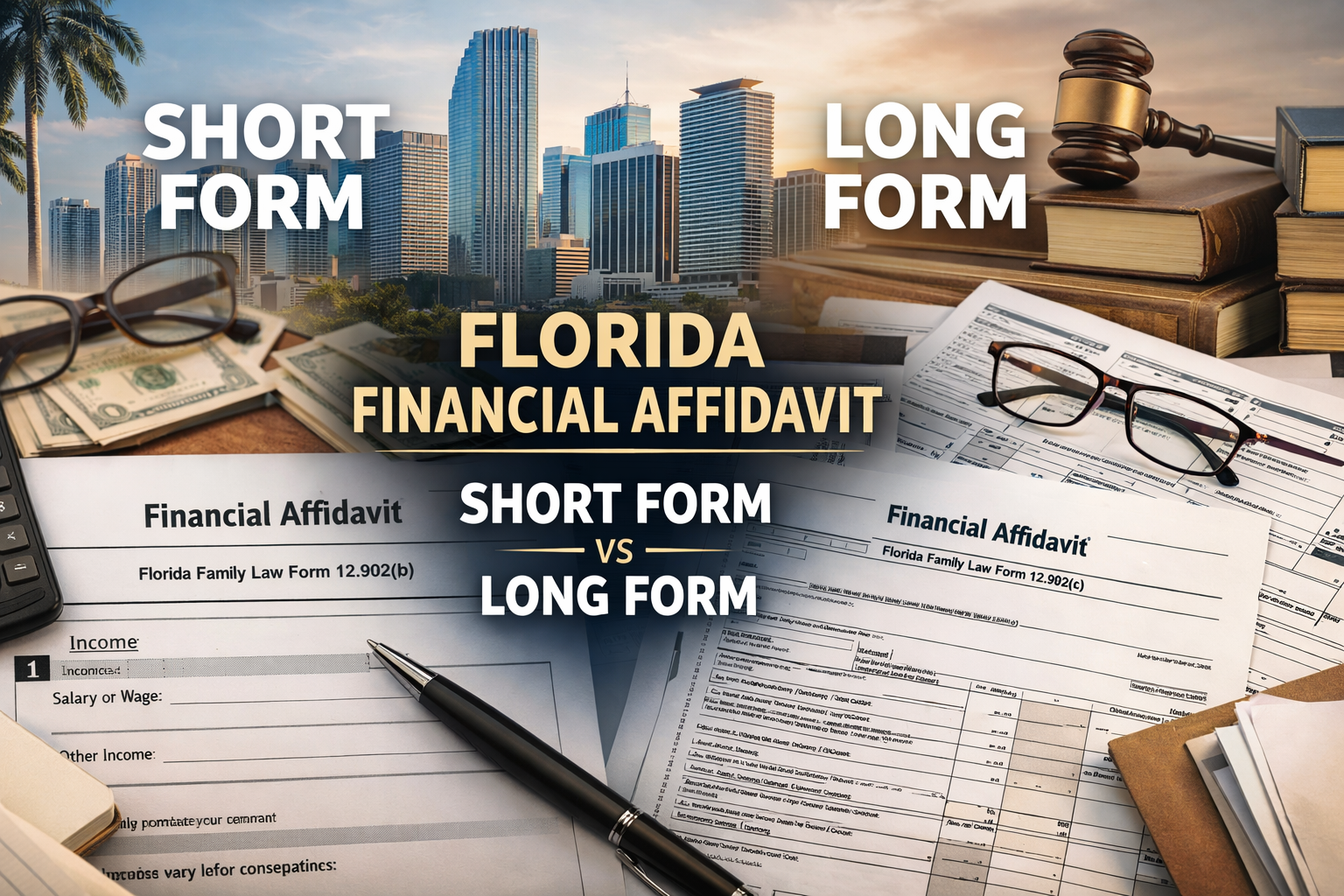
19 Nov Florida Financial Affidavit: Short Form vs Long Form
Summary
This guide explains the Florida financial affidavit short form vs long form and how the correct form is determined by a party’s gross annual income. It also outlines the mandatory disclosure rules in Florida family law and how financial affidavits affect divorce, child support, and alimony cases.
Mandatory Financial Disclosure in Florida Family Law
Florida family law cases operate under a system known as mandatory financial disclosure. This system requires each party to provide financial documentation and sworn statements regarding their financial condition. The requirement is governed primarily by Florida law and the Florida Family Law Rules of Procedure, including Fla. Fam. Law R. Proc. 12.285, which governs mandatory disclosure.
Mandatory financial disclosure is designed to ensure fairness in family law proceedings. Courts cannot determine issues such as alimony, child support, and equitable distribution without reliable financial information from both parties. The financial affidavit therefore becomes one of the central documents in a Florida family law case.
The affidavit is a sworn statement, meaning that it is signed under oath and carries the same legal consequences as testimony provided in court. Submitting inaccurate or misleading financial information can expose a party to penalties, including contempt of court or allegations of perjury. Because of these consequences, attorneys and litigants must carefully review financial affidavits before filing them with the court.
Financial affidavits must be served on the opposing party and filed with the court within the time limits established by the procedural rules. In many cases, the affidavit must be served within forty five days of the service of the initial pleading, although courts retain discretion to modify deadlines depending on the circumstances of the case.
Overview of the Florida Financial Affidavit
The financial affidavit is intended to provide a comprehensive overview of a party’s financial situation. It includes multiple categories of financial information that allow the court to evaluate a person’s financial capacity.
The affidavit requires disclosure of gross income from all sources. This includes wages, salary, bonuses, commissions, rental income, investment income, business income, disability benefits, retirement income, and other recurring payments. The affidavit also requires disclosure of deductions, including taxes and health insurance premiums, which allows the court to determine net income.
In addition to income, the affidavit requires disclosure of monthly living expenses. These expenses include housing costs, utilities, transportation, food, insurance, and other household expenditures. The court uses this information when evaluating alimony claims and determining the financial needs of each party.
Another critical section of the affidavit involves assets and liabilities. Parties must disclose bank accounts, retirement accounts, real estate, vehicles, business interests, and other assets. Debts such as mortgages, credit card balances, and personal loans must also be disclosed.
The purpose of requiring this information is to give the court a complete financial snapshot of both parties. Without accurate disclosure, the court cannot fairly divide marital assets or calculate child support obligations.
Short Form Financial Affidavit in Florida
The short form financial affidavit is used when a party’s gross annual income is less than fifty thousand dollars. The form is identified as Florida Family Law Form 12.902(b).
This version of the financial affidavit is designed to simplify financial disclosure for individuals with lower income levels. While the form still requires disclosure of income, expenses, assets, and liabilities, it contains fewer categories and requires less detailed information than the long form affidavit.
The purpose of the short form is to streamline the disclosure process in cases where financial complexity is limited. Many family law cases involve modest incomes and relatively simple financial situations. Requiring a lengthy and complex financial disclosure form in such cases would create unnecessary administrative burdens for litigants and the courts.
However, the short form affidavit still carries the same legal significance as the long form. It must be completed accurately, signed under oath, and served on the opposing party in compliance with the procedural rules.
Income Threshold for the Short Form
The determining factor for whether a party may use the short form affidavit is gross annual income. If a party’s gross annual income is less than fifty thousand dollars, the short form financial affidavit is generally appropriate.
The term gross income includes income from all sources, not simply employment wages. For example, income from investments, rental property, or business ownership must also be included when calculating the total annual income.
Courts evaluate income based on the party’s current financial circumstances. If income fluctuates significantly from year to year, the current year’s earnings typically guide the determination of which affidavit form is required.
Long Form Financial Affidavit in Florida
The long form financial affidavit is required when a party’s gross annual income is fifty thousand dollars or more. This affidavit is identified as Florida Family Law Form 12.902(c).
The long form requires substantially more detailed financial disclosure. It contains expanded sections for income sources, living expenses, assets, and liabilities. The goal is to provide a more detailed financial profile for individuals with higher income levels or more complex financial circumstances.
Many divorce cases in Miami involve business ownership, investment income, real estate holdings, or complex compensation structures. In these situations, the long form affidavit allows the court to better understand the financial realities of each party.
The long form affidavit also requires more extensive documentation. Parties may need to provide supporting records such as pay stubs, tax returns, bank statements, and investment account statements to verify the information disclosed in the affidavit.
When the Long Form May Be Required Despite Lower Income
Even if a party’s income is less than fifty thousand dollars, a court may require that party to complete the long form financial affidavit. This may occur when the financial circumstances of the case are complex or when the opposing party requests more detailed disclosure.
Requests for expanded financial disclosure may be made through discovery tools such as the Standard Family Law Interrogatories. Courts have broad discretion to require additional financial disclosure whenever necessary to ensure fairness in the proceedings.
Legal Authority Governing Financial Affidavits
The legal requirements for financial affidavits in Florida family law cases are primarily governed by the Florida Family Law Rules of Procedure. The most significant rule is Fla. Fam. Law R. Proc. 12.285, which establishes the mandatory disclosure requirements that apply to most family law cases.
Rule 12.285 requires parties to exchange financial information early in the litigation process. The rule specifies the documents that must be disclosed and establishes deadlines for compliance.
The Florida Supreme Court has periodically amended the family law rules to improve the mandatory disclosure system. For example, the Court addressed disclosure requirements in In re: Amendments to the Florida Family Law Rules of Procedure, 154 So. 3d 301 (Fla. 2014) and In re: Amendments to the Florida Family Law Rules of Procedure—2020 Regular-Cycle Report, 345 So. 3d 69 (Fla. 2020). These amendments refined procedural requirements and clarified the obligations of parties in family law cases.
The Court also addressed related procedural issues in In re Amendments to the Florida Rules of Civil Procedure, 344 So. 3d 940 (Fla. 2021), demonstrating the ongoing effort to maintain transparency and fairness in litigation.
Another relevant procedural rule is Fla. Fam. Law R. Proc. 12.015, which addresses general provisions governing family law procedure.
Exceptions to the Financial Affidavit Requirement
While financial affidavits are required in most Florida family law cases, limited exceptions exist. One such exception arises in simplified dissolution of marriage proceedings governed by Fla. Fam. Law R. Proc. 12.105. In simplified divorce cases, parties may agree to waive the filing of financial affidavits if they have resolved all financial issues and there are no minor children.
Another exception may occur when the court lacks jurisdiction to resolve financial matters. In such situations, a financial affidavit may not be required because financial issues are not before the court.
However, these exceptions are narrow. In the vast majority of family law cases in Miami and throughout Florida, financial affidavits remain mandatory.
Importance of Accuracy in Financial Affidavits
Because financial affidavits are sworn statements, accuracy is critically important. Courts rely heavily on these affidavits when making decisions regarding support obligations and property division.
If a party intentionally omits assets, understates income, or exaggerates expenses, the consequences can be severe. Courts may impose sanctions, award attorney fees to the opposing party, or draw adverse inferences against the party who provided inaccurate information.
Florida courts have consistently emphasized the importance of full financial disclosure in family law proceedings. Transparency promotes fairness and helps prevent manipulation of the legal process.
Financial Affidavits in Miami Divorce Cases
In Miami-Dade County, financial affidavits play a central role in divorce litigation. Judges rely on these documents when determining alimony, calculating child support under the Florida Child Support Guidelines, and dividing marital assets.
Miami family law cases often involve complex financial situations due to the diverse economic landscape of South Florida. Business ownership, international assets, and fluctuating income streams are common in Miami divorce cases. As a result, courts frequently require detailed financial disclosure through the long form affidavit.
Attorneys practicing in Miami family courts routinely advise clients to carefully document their financial circumstances before completing their affidavits. Accurate documentation reduces the risk of disputes and promotes efficient resolution of the case.
Consequences of Failing to File the Proper Affidavit
Failure to file the correct financial affidavit can create procedural complications. Courts may require parties to amend or supplement their affidavits, which can delay hearings and increase litigation costs.
In some cases, judges may impose sanctions for failure to comply with mandatory disclosure requirements. Sanctions may include attorney fees, court costs, or other penalties designed to enforce compliance with the procedural rules.
For this reason, determining whether the short form or long form affidavit applies is one of the earliest and most important decisions in a Florida family law case.
Conclusion
The distinction between the Florida financial affidavit short form vs long form is a fundamental procedural issue in Florida family law. The short form affidavit applies to individuals whose gross annual income is less than fifty thousand dollars, while the long form affidavit is required for those earning fifty thousand dollars or more. These affidavits serve as the foundation for financial transparency in family law cases, allowing courts to make fair decisions regarding child support, alimony, and property division.
Florida’s mandatory disclosure system, governed primarily by Fla. Fam. Law R. Proc. 12.285 and related procedural rules, ensures that both parties provide accurate financial information early in the litigation process. Courts in Miami and throughout Florida rely heavily on financial affidavits when resolving family law disputes.
Anyone involved in a Florida divorce or family law case should take the preparation of their financial affidavit seriously. Accuracy, completeness, and compliance with procedural rules are essential to protecting one’s rights and ensuring a fair outcome.
If you are involved in a divorce or family law matter in Miami-Dade County, consulting an experienced Florida family law attorney can help ensure that your financial disclosures comply with the rules and accurately reflect your financial circumstances.
TLDR: The Florida financial affidavit short form vs long form depends on a party’s gross annual income. Individuals earning under $50,000 typically file the short form financial affidavit, while those earning $50,000 or more must file the long form. Both forms are required under Florida Family Law Rule of Procedure 12.285 as part of mandatory financial disclosure in divorce and family law cases.
What is a Florida financial affidavit?
A Florida financial affidavit is a sworn statement that discloses a party’s income, expenses, assets, and liabilities in a family law case.
When must a financial affidavit be filed in Florida?
Financial affidavits must generally be served within forty five days of the service of the initial pleading under Fla. Fam. Law R. Proc. 12.285.
What is the difference between the short form and long form affidavit?
The short form is used when gross annual income is below fifty thousand dollars, while the long form is required when income is fifty thousand dollars or higher.
Can the court require a long form affidavit even if income is below $50,000?
Yes. Courts have discretion to require more detailed financial disclosure when necessary.
Are financial affidavits required in every Florida divorce?
Most divorce cases require financial affidavits unless the case qualifies for a simplified dissolution under Fla. Fam. Law R. Proc. 12.105.