

Miami Child Support Attorney
Child support in Florida is a legal obligation that both parents share, and it arises from the state’s codification of the fundamental duty that every parent owes to their minor children: the duty to provide financial support for the children’s basic needs until they reach the age of majority. Under Florida law, the obligation to pay child support exists independently of the parents’ marital status, the nature of their relationship, and any private agreement the parents may have reached between themselves. The Law Firm of Jeffrey Alan Aenlle, PLLC represents parents throughout Miami-Dade County in all aspects of child support proceedings before the Eleventh Judicial Circuit Family Division, including initial support determinations, post-judgment modifications, and enforcement actions.
Whether you are seeking to establish child support for the first time, pursuing a modification of an existing support order, or defending against an enforcement action, the child support framework under Florida law is highly structured and governed by detailed statutory guidelines that leave limited room for deviation without specific written judicial findings. Understanding how the guidelines work, what factors the court considers, and when a modification or departure from the guidelines is warranted is essential to presenting an effective case before the Eleventh Judicial Circuit Family Division.
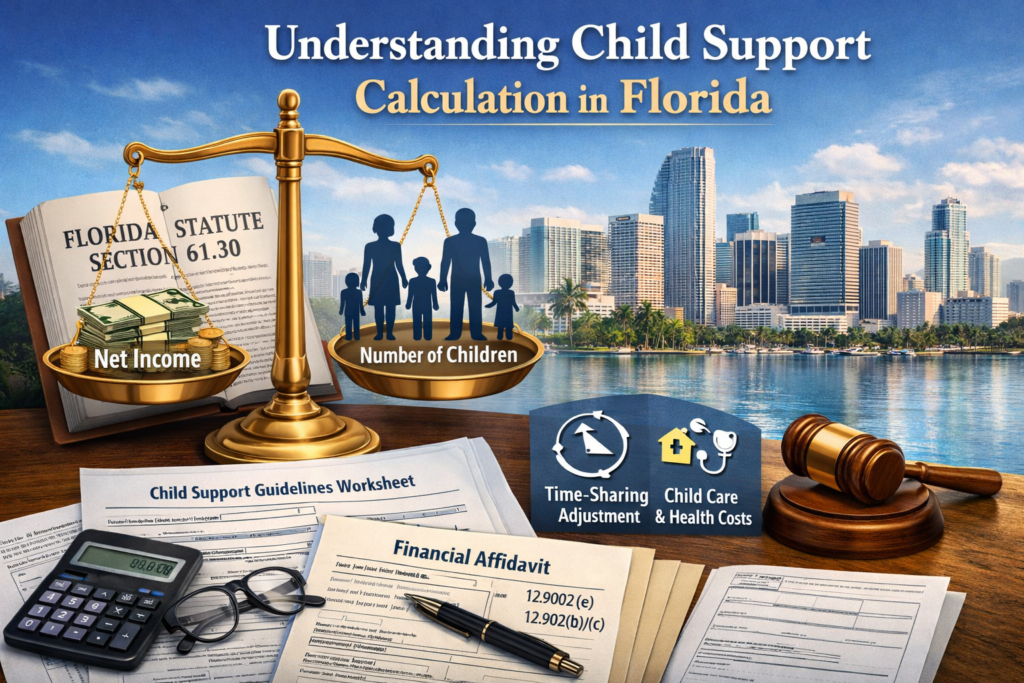
How Florida Calculates Child Support
Additional Components of Florida Child Support
The basic child support obligation calculated under the Fla. Stat. § 61.30 guidelines does not represent the entirety of the parents’ support obligation. Florida law requires that health insurance costs for the minor children be addressed in every child support order. Under Fla. Stat. § 61.30(8), the cost of health insurance for the children is added to the basic support obligation and allocated between the parents in proportion to their respective net incomes. If neither parent has access to reasonably priced health insurance through an employer, the court addresses the cost of obtaining coverage as part of the support determination.
Childcare costs that are reasonably necessary to allow either parent to work, attend school, or conduct a job search are also added to the basic support obligation under Fla. Stat. § 61.30(7) and allocated between the parents proportionately. Noncovered medical, dental, and prescription expenses for the minor children are addressed either through the child support order itself or through a separate provision requiring each parent to contribute to those expenses in proportion to their respective incomes. In Miami-Dade County, where the cost of private school tuition, extracurricular activities, and healthcare can be substantial, the allocation of these additional expenses is frequently a contested issue in child support proceedings.
The Impact of Timesharing on Child Support in Florida
The timesharing schedule established in the parenting plan has a direct and significant impact on the child support calculation under Fla. Stat. § 61.30. Florida law provides for a substantial timesharing adjustment when a parent exercises timesharing for at least twenty percent of the overnights in a calendar year, which equates to seventy-three or more overnights annually. Where this threshold is met, the standard child support calculation is adjusted to account for the additional expenses each parent incurs during their respective timesharing periods, which generally results in a reduction of the support obligation of the parent with the greater income.
In proceedings where the proposed timesharing schedule is contested, the child support implications of different timesharing outcomes can be significant. A change in the timesharing schedule that moves a parent above or below the twenty percent threshold can materially affect the support obligation. For this reason, the timesharing determination and the child support calculation are closely connected in Miami-Dade County family law proceedings, and both issues must be addressed together in the context of the overall parenting plan and financial presentation.
Child Support Modification in Florida
A child support order entered by the Eleventh Judicial Circuit Family Division may be modified upon a showing of a substantial change in circumstances that is material, permanent, and unanticipated at the time the existing order was entered. Under Fla. Stat. § 61.30(11)(c), a difference of at least fifteen percent or twenty-five dollars per month between the existing support order and the amount that would be calculated under the current guidelines, whichever is greater, is deemed a substantial change in circumstances sufficient to support a modification. This provision creates a clear, quantifiable threshold that simplifies the modification analysis when one or both parents have experienced a meaningful change in income.
Common grounds for child support modification in Miami-Dade County proceedings include a significant involuntary reduction in one parent’s income, a substantial increase in one parent’s income, a change in the timesharing schedule that affects the guideline calculation, a change in the children’s healthcare or childcare costs, or a change in either parent’s financial circumstances that affects their ability to pay or the children’s need for support. A parent who experiences a material change in financial circumstances should file a supplemental petition for modification promptly, as Florida courts generally do not award retroactive modification of child support to a date prior to the filing of the modification petition.
Child Support Enforcement in Florida
The failure to pay court-ordered child support in Florida carries serious legal consequences. A parent who willfully fails to pay child support as ordered by the Eleventh Judicial Circuit Family Division may be held in contempt of court under Fla. Stat. § 61.29, which can result in incarceration, fines, and the imposition of attorneys’ fees and costs. Florida law also authorizes a range of administrative enforcement remedies for child support delinquency, including income withholding under Fla. Stat. § 61.1301, suspension of the delinquent parent’s driver’s license and professional licenses, interception of state and federal tax refunds, and liens against the delinquent parent’s real and personal property.
The Law Firm of Jeffrey Alan Aenlle, PLLC represents both parents seeking to enforce unpaid child support obligations and parents facing enforcement actions who have encountered genuine financial hardship. A parent who is unable to meet their current support obligation due to a change in financial circumstances should seek a formal modification of the support order rather than simply stopping payment, as arrears that accrue under an existing court order cannot be retroactively reduced or forgiven by the court except under very limited circumstances.
Child Support Attorney Serving Miami-Dade County
Frequently Asked Questions
How is child support calculated in Florida?
Florida calculates child support under the Income Shares guidelines established by Fla. Stat. § 61.29 and Fla. Stat. § 61.30. The guidelines use both parents’ combined monthly net income and the timesharing schedule to determine a presumptive support obligation, which is then allocated between the parents proportionately. The court must order support in the guideline amount unless specific written findings support a departure. Health insurance costs and childcare expenses attributable to employment are added to the basic guideline amount and allocated between the parents in proportion to their respective net incomes.
Can child support be modified in Florida?
Yes. A child support order may be modified upon a showing of a substantial change in circumstances that is material, permanent, and unanticipated. Under Fla. Stat. § 61.30(11)(c), a difference of at least fifteen percent or twenty-five dollars per month between the existing order and the current guideline amount is deemed a substantial change. Common grounds for modification include a significant change in either parent’s income, a change in the timesharing schedule, or a change in the children’s healthcare or childcare costs.
Does timesharing affect child support in Florida?
Yes. The timesharing schedule has a direct impact on the child support calculation under Fla. Stat. § 61.30. When a parent exercises timesharing for at least twenty percent of the overnights in a calendar year, meaning seventy-three or more overnights, a substantial timesharing adjustment applies that reduces the support obligation of the higher-earning parent. Changes to the timesharing schedule that move a parent above or below this threshold can materially affect the support amount.
What happens if a parent does not pay child support in Florida?
A parent who willfully fails to pay court-ordered child support in Florida may be held in contempt of court under Fla. Stat. § 61.29, which can result in incarceration, fines, and an award of attorneys’ fees and costs to the other parent. Additional enforcement remedies include income withholding under Fla. Stat. § 61.1301, suspension of driver’s and professional licenses, interception of tax refunds, and property liens. Child support arrears that accrue under an existing court order cannot be retroactively reduced or forgiven except in very limited circumstances.
Until what age is child support paid in Florida?
Under Florida law, the obligation to pay child support continues until the child reaches the age of majority, which is eighteen years of age under Fla. Stat. § 743.07. However, if the child is still in high school and is between the ages of eighteen and nineteen, support continues until the child graduates from high school or turns nineteen, whichever occurs first. Support may also continue beyond the age of majority for a child who has a mental or physical incapacity that began before the age of eighteen and requires continued parental support.
Can parents agree to a child support amount different from the Florida guidelines?
Parents may agree to a child support amount that differs from the statutory guidelines, but the court must approve any such agreement and may not approve a deviation that is not in the best interests of the children. Under Fla. Stat. § 61.30(1)(a), any deviation from the guideline amount requires specific written findings by the court explaining why the guideline amount would be unjust or inappropriate under the circumstances. A private agreement between the parents to waive or reduce child support below the guideline amount is not enforceable unless it is approved by the court.
What is income withholding in Florida child support cases?
Income withholding is a mandatory enforcement mechanism under Fla. Stat. § 61.1301 that requires child support payments to be automatically deducted from the paying parent’s wages or other income and remitted directly to the Florida State Disbursement Unit for distribution to the receiving parent. Income withholding is required in all new child support orders entered in Florida unless both parties agree in writing to an alternative payment arrangement and the court approves that arrangement. Income withholding is one of the most effective tools for ensuring consistent payment of child support and is standard practice in Miami-Dade County Family Division proceedings.
The Law Firm of Jeffrey Alan Aenlle, PLLC handles child support matters at every stage of litigation in Miami-Dade County, including initial guideline calculations in dissolution of marriage and paternity proceedings, contested support hearings, post-judgment modification petitions, and enforcement and contempt proceedings before the Eleventh Judicial Circuit Family Division. Attorney Jeffrey Alan Aenlle has practiced Florida family law exclusively since his admission to the Florida Bar in 2011 and serves clients throughout Miami-Dade County, including Brickell, Coral Gables, Coconut Grove, Miami Beach, Aventura, Kendall, Doral, Hialeah, and the surrounding communities.
If you have questions about child support in Miami-Dade County, contact the Law Firm of Jeffrey Alan Aenlle, PLLC to schedule a free consultation at our Brickell office at 1221 Brickell Avenue, Suite 900, Miami, Florida 33131. Call us at +1 (786) 309-8588 or use the button below to schedule online. Schedule a Free Consultation