
15 Sep Mental Illness and Child Custody in Florida Divorce
Summary
This article explains how mental illness custody Florida cases are analyzed under Florida law, including the impact of psychiatric diagnoses on parenting plans, custody, and alimony. It also examines psychotherapist patient privilege, discovery limits, and key Florida appellate cases that guide divorce mental health litigation in Miami.
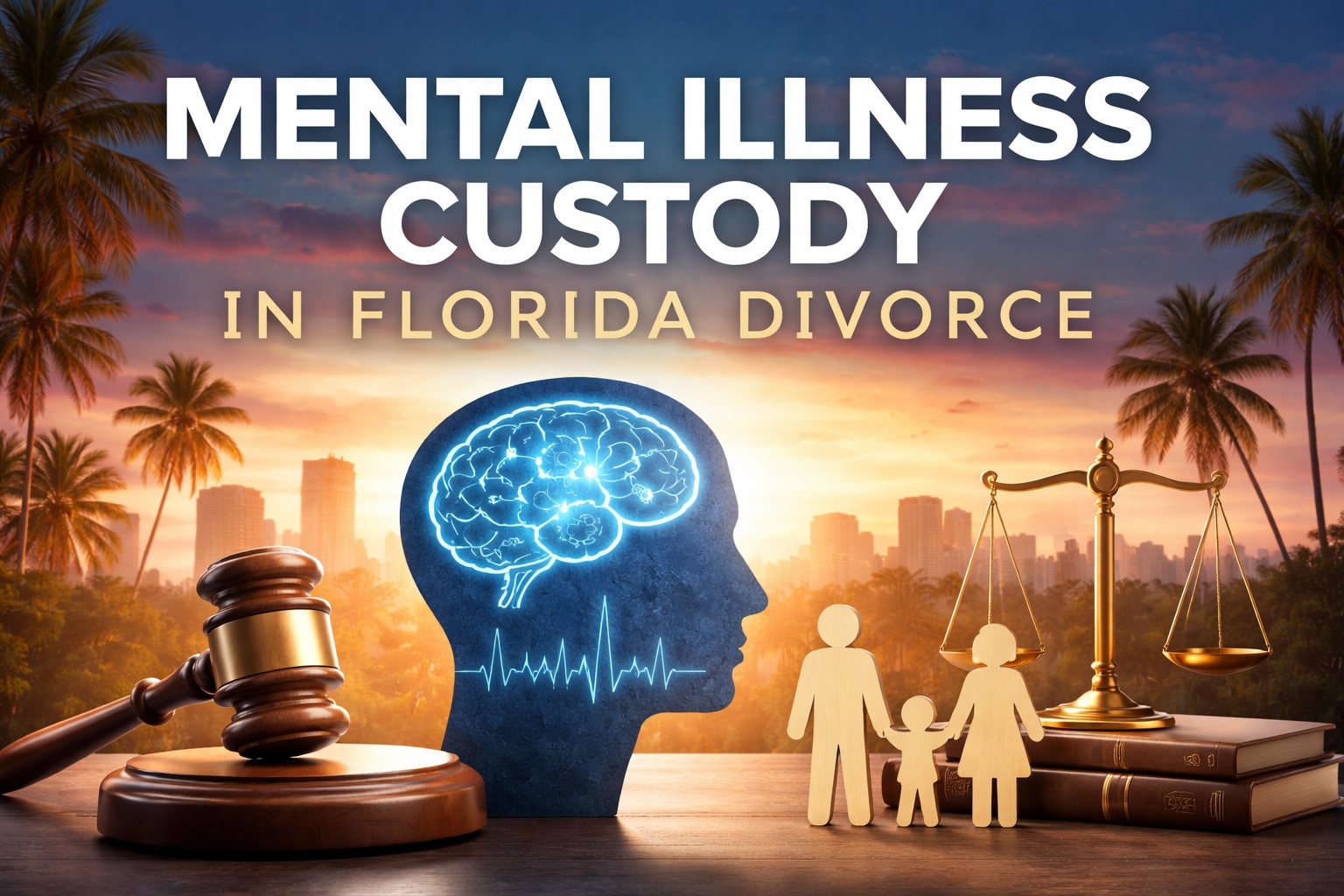
Mental illness custody cases frequently raise complex legal and evidentiary questions. In mental health litigation in divorce matters, courts must balance parental privacy, the psychotherapist patient privilege, and the best interests of the child. A mental health diagnosis alone does not determine parental fitness. However, when a psychiatric disorder parenting plan Florida dispute arises, courts carefully evaluate whether a parent’s mental health condition affects their ability to provide a safe, stable, and nurturing environment for a child. Florida statutes and appellate decisions provide a clear framework for determining how mental illness, psychiatric diagnoses, and psychological treatment impact divorce proceedings in Miami and throughout the state.
Mental Illness Custody Florida Cases and the Best Interests Standard
Florida family courts determine parenting arrangements under the best interests of the child standard. The governing statute is Florida Statutes §61.13, which directs courts to evaluate numerous factors when determining parental responsibility and timesharing. One of the most important considerations is the mental and physical health of the parents.
In mental illness custody Florida disputes, judges analyze whether a parent’s mental health condition interferes with parenting abilities. The focus is not on the diagnosis itself. Instead, the court evaluates the practical effect of the condition on the child’s welfare. A parent with depression, anxiety, bipolar disorder, or another psychiatric diagnosis may still be fully capable of exercising parental responsibility if the condition is managed and does not impair parenting.
Florida appellate courts have repeatedly emphasized that the central inquiry is the impact on the child rather than the existence of treatment or diagnosis. Courts consider whether the parent can provide stability, emotional support, and safe supervision. Evidence often includes medical records, testimony from treating professionals, and expert psychological evaluations.
How Courts Evaluate Mental Health Evidence in Divorce Mental Health Miami Litigation
Divorce mental health Miami cases often involve contested allegations regarding psychiatric conditions. When evaluating these claims, courts rely on statutory factors and established case law.
The Third District Court of Appeal has long recognized that mental health can be relevant to custody determinations. In Mohammad v. Mohammad, 358 So.2d 610 (Fla. 3d DCA 1978), the court acknowledged that a parent’s psychological stability may affect parental fitness. The decision confirmed that a parent’s mental health history can be examined when it directly relates to their ability to care for a child.
However, Florida courts also caution against assuming that mental illness automatically disqualifies a parent. The law requires proof that the condition actually affects parenting ability. This principle was reinforced in Roper v. Roper, 336 So.2d 654 (Fla. 4th DCA 1976). In that case the court held that merely seeking custody does not place a parent’s mental health at issue.
The distinction is crucial in high conflict divorce mental health Miami cases. Parties often attempt to weaponize allegations of mental illness during litigation. Florida courts therefore require credible evidence before allowing invasive discovery into psychiatric records.
Psychotherapist Patient Privilege in Florida Divorce Cases
A central issue in many mental health diagnosis divorce Miami disputes is the psychotherapist patient privilege. Florida recognizes strong protections for confidential communications between patients and mental health professionals.
The governing statute is Florida Statutes §90.503. This statute establishes that communications between a patient and psychotherapist are privileged and generally cannot be disclosed in court.
The purpose of the privilege is to encourage candid communication between patients and mental health providers. Without this protection, individuals might avoid seeking treatment or withhold important information during therapy.
However, the privilege is not absolute. Florida courts may allow disclosure when a party places their mental condition in controversy or when good cause exists to order a psychological evaluation.
When Mental Health Becomes “In Controversy”
In many psychiatric disorder parenting plan Florida cases, litigants dispute whether a parent’s mental health has been placed in controversy. Florida appellate courts have established specific standards governing this issue.
In Quinney v. Quinney, 890 So.2d 407 (Fla. 5th DCA 2004), the court held that the party seeking access to mental health records bears the burden of demonstrating that the mental condition is directly relevant to the litigation. Mere speculation or allegations are insufficient.
The principle protects litigants from unnecessary invasions of privacy. Courts require concrete evidence showing that the mental health condition may affect the outcome of the custody or support determination.
Similarly, in Swift v. Swift, 617 So.2d 834 (Fla. 4th DCA 1993), the court ruled that requesting alimony does not automatically place mental health in controversy. A spouse seeking financial support does not waive psychotherapist patient privilege unless they rely on their mental condition as a basis for their claim.
Good Cause for Psychological Evaluations
In mental illness custody Florida litigation, courts sometimes order psychological evaluations of parents. These evaluations are typically performed by court appointed experts.
The Florida appellate courts require a showing of good cause before ordering such an evaluation. The standard was addressed in Oldham v. Greene, 263 So.3d 807 (Fla. 1st DCA 2018). The court held that good cause requires evidence suggesting that the parent’s mental condition may pose a risk to the child’s wellbeing.
This standard prevents fishing expeditions into psychiatric history. Courts must ensure that psychological evaluations are justified by credible evidence rather than litigation strategy.
Calamitous Events and Mental Health Evidence
Florida courts have recognized limited circumstances where mental health records may become discoverable even if the privilege has not been expressly waived.
One example is the “calamitous event” doctrine discussed in O’Neill v. O’Neill, 823 So.2d 837 (Fla. 5th DCA 2002). In that case the court allowed discovery of psychiatric records after a parent attempted suicide. The court reasoned that such an event directly impacted the child’s safety and the custody determination.
The decision illustrates how Florida courts balance privacy rights with the need to protect children. When a parent’s mental health condition creates a potential danger to the child, the court may allow disclosure of otherwise privileged information.
Mental Health and Alimony in Florida Divorce
Mental health diagnosis divorce Miami litigation also affects financial issues such as alimony. Florida law requires courts to evaluate the economic circumstances of both spouses when determining support obligations.
The governing statute is Florida Statutes §61.08. This statute directs courts to consider numerous factors when determining alimony awards, including the mental and emotional condition of each party.
A spouse suffering from a severe psychiatric disorder may have limited earning capacity. Courts may consider whether the condition is temporary or permanent and whether it prevents the spouse from achieving self support.
For example, a spouse with bipolar disorder, severe depression, or another mental illness may require ongoing treatment that affects employment prospects. Florida courts may take these factors into account when determining both the amount and duration of alimony.
Waiver of Privilege in Alimony Disputes
Although mental health is relevant to alimony determinations, the psychotherapist patient privilege still applies. A party does not waive this privilege simply by requesting financial support.
The distinction was highlighted in Swift v. Swift, where the court held that mental health records remain protected unless the spouse relies on their psychological condition as the basis for their claim.
However, the privilege may be waived if a party repeatedly relies on mental health issues to justify financial relief. In Hakim v. Hakim, 368 So.3d 1070 (Fla. 4th DCA 2023), the court held that a spouse who repeatedly cited mental and physical health issues to support alimony claims placed those conditions in controversy.
As a result, the opposing party was permitted to obtain discovery regarding the spouse’s medical and psychological records.
Balancing Privacy and Child Welfare
Family courts must carefully balance competing interests in divorce mental health Miami cases. On one hand, litigants have a legitimate privacy interest in confidential therapy records. On the other hand, courts must ensure that parenting arrangements protect the child’s wellbeing.
Florida appellate decisions consistently emphasize that mental illness alone does not determine custody outcomes. The key question is whether the condition affects parenting ability or poses a risk to the child.
This balanced approach reflects modern understanding of mental health treatment. Many individuals with psychiatric diagnoses function successfully as parents, professionals, and community members.
Expert Testimony in Psychiatric Disorder Parenting Plan Florida Cases
Expert testimony often plays a significant role in mental illness custody Florida disputes. Psychologists and psychiatrists may provide evaluations addressing parenting capacity, emotional stability, and potential risks to the child.
Courts may rely on these evaluations to determine appropriate timesharing arrangements. In some cases judges order supervised visitation, therapy requirements, or parenting coordination to address mental health concerns.
These measures allow courts to protect the child while maintaining the parent child relationship whenever possible.
Mental Health Issues in High Conflict Divorce
High conflict divorce cases frequently involve allegations of mental illness. Unfortunately, these allegations are sometimes exaggerated or unsupported by evidence.
Florida courts therefore require credible proof before allowing intrusive discovery or psychological testing. The legal framework protects both parental rights and the integrity of mental health treatment.
Judges must distinguish between legitimate mental health concerns and tactical accusations made during litigation.
Mental Health and Parenting Plans in Miami
In Miami family courts, parenting plans often address mental health issues directly. Courts may include provisions requiring ongoing therapy, medication compliance, or periodic psychological evaluations.
These provisions allow parents with mental health conditions to remain involved in their children’s lives while ensuring that appropriate safeguards are in place.
The ultimate goal is to promote stability, safety, and emotional wellbeing for the child.
Conclusion
Mental illness custody Florida disputes present complex legal and evidentiary challenges. Florida law recognizes that mental health conditions can affect parenting ability and financial circumstances, yet it also protects the confidentiality of therapy records through the psychotherapist patient privilege. Courts must carefully balance parental privacy with the best interests of the child.
In divorce mental health Miami litigation, the key issue is not the existence of a diagnosis but the impact of the condition on parenting and financial capacity. Appellate decisions such as Mohammad v. Mohammad, Roper v. Roper, Swift v. Swift, Hakim v. Hakim, Oldham v. Greene, O’Neill v. O’Neill, and Quinney v. Quinney provide important guidance for courts navigating these issues.
Individuals facing divorce involving mental health concerns should seek experienced legal counsel familiar with Florida family law and the evidentiary rules governing psychiatric information. With proper legal guidance, courts can craft parenting plans and financial arrangements that protect both parental rights and the wellbeing of children.
If you are facing a divorce involving mental health issues, custody disputes, or complex parenting plan questions in Miami or Miami Dade County, consulting an experienced Florida family law attorney can help you protect your rights and your child’s future.
TLDR: In Florida divorce cases, a spouse’s mental health diagnosis may affect child custody, parenting plans, and alimony only when the condition impacts parenting ability or financial capacity. Courts apply the best interests of the child standard under Florida Statutes §61.13 and protect therapy records through the psychotherapist patient privilege in §90.503 unless the mental condition is placed in controversy or a court finds good cause for disclosure.
Does mental illness affect child custody in Florida?
A mental health diagnosis alone does not determine custody. Courts evaluate whether the condition affects parenting ability under Florida Statutes §61.13.
Can therapy records be used in a Florida divorce?
Therapy records are generally protected under Florida Statutes §90.503 unless the mental condition is placed in controversy or a court finds good cause.
Can bipolar disorder affect a parenting plan?
Yes, but only if the condition interferes with parenting ability or child safety. Courts evaluate evidence and expert testimony before modifying parenting arrangements.
Does mental illness affect alimony in Florida?
Courts may consider mental health when determining alimony under Florida Statutes §61.08, particularly if the condition affects earning capacity.
When can a court order a psychological evaluation?
Courts may order evaluations when good cause exists, such as evidence suggesting a parent’s mental health condition may affect the child’s wellbeing.