
02 Sep The Need for Parental Consent for the Passport of a Minor
Summary
This article explains the legal requirement of parental consent for a minor passport in Florida, including federal regulations and Florida court authority over passport disputes. It also examines Miami family law cases where courts authorize or restrict passport issuance to protect children from international abduction.
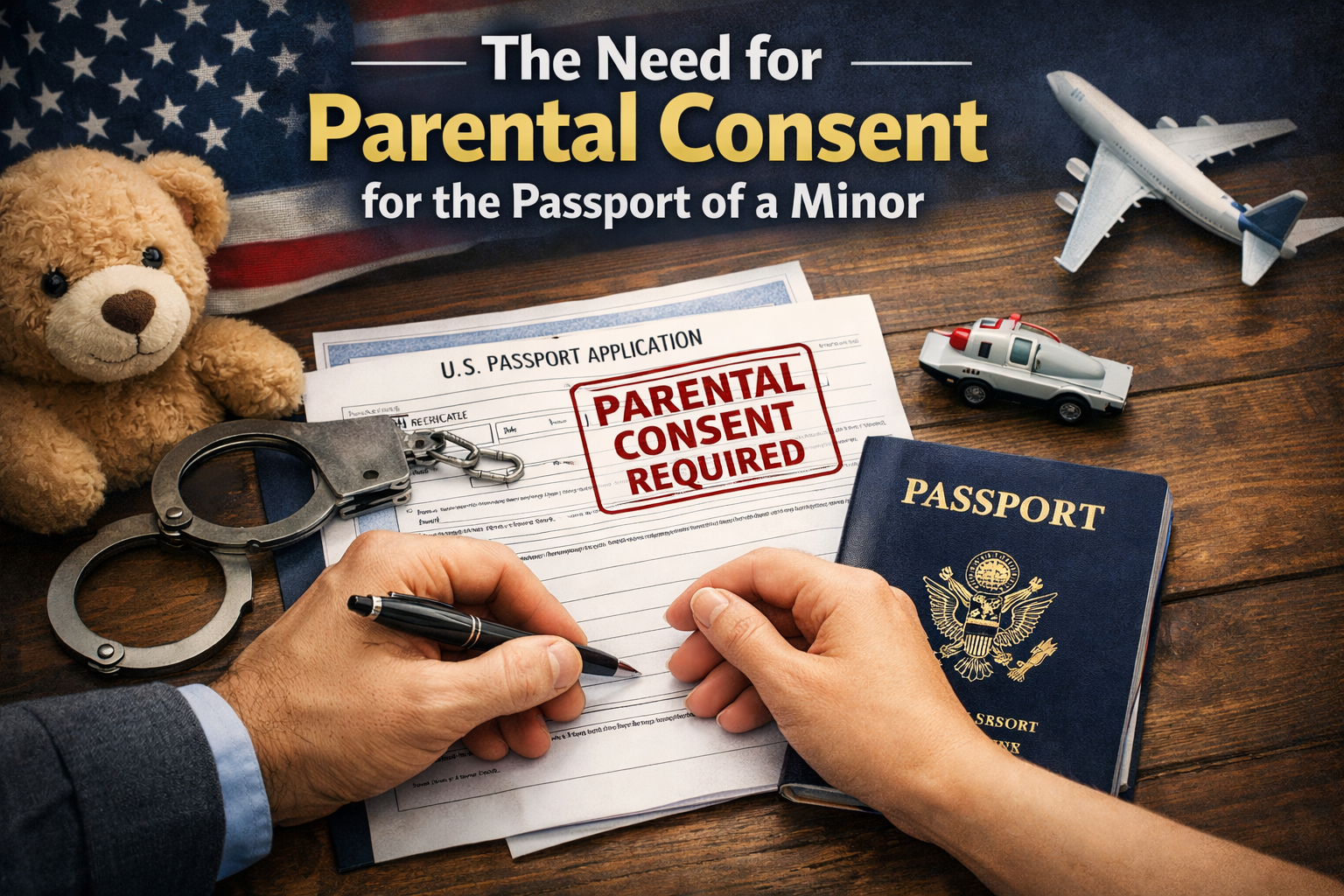
Obtaining a passport for a child involves strict legal safeguards designed to protect parental rights and prevent international child abduction. In Florida family law disputes, the requirement of parental consent for a minor’s passport is frequently litigated when parents disagree about travel, relocation, or custody rights. Federal regulations governing the issuance of passports for minors require the consent of both parents in most circumstances, while Florida courts retain authority to restrict or authorize passport issuance depending on the child’s best interests and the parents’ custodial rights. Understanding these legal requirements is essential for parents in Miami and throughout Florida who need to obtain a passport for a child or who wish to prevent unauthorized international travel.
Federal Law Governing Passports for Minors
The United States Department of State regulates the issuance of passports through federal regulations. One of the most important provisions governing children’s passports is 22 C.F.R. § 51.28, which establishes the general rule that both parents or legal guardians must consent to the issuance of a passport for a child under the age of sixteen. This requirement reflects longstanding federal efforts to reduce international parental child abduction and to ensure that both parents retain equal authority over major decisions affecting a child’s international travel.
Under this federal rule, the passport application for a minor must normally be executed by both parents or legal guardians. The Department of State requires either the physical presence of both parents at the time of application or the submission of a notarized statement of consent from the non-appearing parent. If both parents cannot appear together, the applying parent must provide a properly executed Form DS-3053 or other documentary proof of consent.
The policy behind the two-parent consent requirement is rooted in the recognition that international travel creates a significant risk of parental abduction. Once a child leaves the United States, recovering custody through international legal channels can be difficult, costly, and time-consuming. Federal law therefore treats the issuance of a passport as a significant decision requiring participation from both parents whenever possible.
Federal regulations also recognize limited exceptions to the two-parent consent rule. Under 22 C.F.R. § 51.28, one parent may apply alone if they present evidence demonstrating sole legal custody, a court order specifically authorizing passport issuance, or documentation showing that the other parent is unavailable. Examples include certified court orders awarding sole parental responsibility, birth certificates listing only one parent, or judicial findings terminating the other parent’s parental rights.
Another exception arises in situations involving exigent or special family circumstances. Federal regulations recognize that certain emergency situations may justify the issuance of a passport without the consent of both parents. Exigent circumstances typically involve time-sensitive conditions in which delaying passport issuance could jeopardize the health, safety, or welfare of the child. Special family circumstances may also arise where a parent cannot be located despite reasonable efforts or where humanitarian concerns make the issuance of a passport appropriate.
These federal safeguards form the foundation of the legal framework governing passports for minors. However, the federal passport process frequently intersects with state family law disputes, particularly in Florida divorce and custody cases where parents disagree about international travel.
Florida Family Law and Minor Passport Consent
Florida family law emphasizes the protection of parental rights and the best interests of the child when addressing disputes involving travel or relocation. Florida courts frequently address passport issues within the context of parenting plans and timesharing orders. Judges may impose restrictions designed to prevent international abduction while still allowing reasonable travel opportunities.
Florida law provides courts with authority to implement safeguards that prevent the unauthorized removal of a child from the jurisdiction. One commonly cited legal authority addressing preventative measures is Fla. Stat. § 71.04, which allows courts to impose restrictions designed to prevent child abduction or unauthorized international travel.
Under Florida law, courts may require both parents to provide written permission before a child travels internationally. In many Miami-Dade parenting plans, judges include provisions stating that a child may not leave the United States without the notarized consent of the other parent or a specific court order authorizing the travel. These provisions function as an additional safeguard that complements the federal passport consent requirement.
Florida courts may also require the surrender of a child’s passport to the court or to one parent as a condition of the parenting plan. Such restrictions are often imposed in cases involving high conflict custody disputes, international family connections, or prior allegations of attempted abduction.
The legal authority of Florida courts to regulate passport issues arises from their broad jurisdiction over parental responsibility and timesharing under Chapter 61 of the Florida Statutes. Judges must evaluate whether international travel poses a risk to the child’s welfare or the other parent’s custodial rights.
Judicial Interpretation in Florida Case Law
Florida courts have addressed passport disputes in several significant cases that illustrate how judges balance parental rights with the need to protect children from abduction. One frequently cited decision is Stone v. Suzuki, 308 So. 3d 1100 (Fla. 2d DCA 2020). In that case, the court emphasized that the issuance of a passport for a minor typically requires the consent of both parents unless one parent can demonstrate legal authority to act alone.
The decision in Stone v. Suzuki highlighted the interplay between federal passport regulations and state custody orders. The court recognized that federal law requires the consent of both parents under most circumstances but also acknowledged that Florida courts may issue orders authorizing passport issuance when one parent unreasonably withholds consent.
Section 61.13, Florida Statutes, gives the court authority to allocate decision-making on passport applications, and a court may authorize one parent to obtain a passport where the other parent’s refusal is unreasonable and the travel serves the child’s best interests. In that case, a Florida court authorized one parent to obtain a passport for a child without the other parent’s signature after determining that the refusal of consent was unreasonable. The court concluded that the child’s travel was legitimate and that the non-consenting parent’s objections were not supported by credible concerns about abduction or safety.
The Rodriguez decision illustrates the ability of Florida courts to intervene when one parent attempts to use the passport consent requirement as a tool of obstruction rather than a legitimate safeguard. Courts remain focused on whether the proposed travel serves the child’s best interests and whether appropriate protections exist to prevent abduction.
Courts routinely condition international travel on detailed itineraries, travel documentation, and contact information under the parenting plan authority in Section 61.13(2)(c), Florida Statutes. Such requirements are common in Miami-Dade family law cases involving international travel. Such requirements are common in Miami-Dade family law cases involving international travel.
Preventing International Child Abduction
International parental child abduction remains a significant concern in family law disputes involving foreign travel. The United States Department of State reports hundreds of international child abduction cases each year involving children taken abroad by one parent without the consent of the other.
The two-parent consent rule for minor passports is one of the most important preventative measures designed to reduce these incidents. By requiring the participation of both parents in the passport process, federal law ensures that a parent cannot easily obtain travel documents without the knowledge of the other parent.
Florida courts supplement these federal safeguards by imposing travel restrictions when appropriate. Judges may order that a child’s passport be held by the court clerk, require travel bonds, or mandate advance written consent before international travel occurs. These preventative measures are particularly common in cases involving international families or parents with strong ties to foreign countries.
Florida courts also have authority to order the delivery of existing passports as part of their jurisdiction over family law procedures. The Florida Supreme Court recognized the authority of family courts to implement procedural safeguards in In re Family Law Rules of Procedure, 663 So. 2d 1047 (Fla. 1995). Subsequent administrative updates, including In re Amendments to the Florida Supreme Court Approved Family Law Forms, 59 So. 3d 792 (Fla. 2010), reinforced the procedural framework governing family law orders.
These procedural authorities allow Florida judges to craft customized orders addressing passport possession, international travel notification, and consent requirements tailored to the specific circumstances of each case.
Miami Family Law Courts and Passport Disputes
In Miami-Dade County, passport disputes frequently arise in international families where parents maintain strong connections to other countries. South Florida’s diverse population and global travel patterns make international travel issues particularly common in local custody cases.
Miami family law judges routinely address requests for passports when parents seek permission to travel abroad for vacations, family visits, or cultural events. Courts must balance the child’s opportunity to experience international travel with the need to protect parental rights and prevent abduction.
Judges often require detailed travel information before approving international trips. Typical requirements include providing the travel itinerary, addresses where the child will stay, airline information, and emergency contact numbers. These safeguards allow the non-traveling parent to remain informed about the child’s location while abroad.
Miami courts also consider whether the destination country is a signatory to the Hague Convention on the Civil Aspects of International Child Abduction. Countries that participate in the Hague Convention provide legal mechanisms for returning abducted children to their home country. When travel involves a country that is not a Hague Convention participant, courts may impose stricter safeguards or deny travel altogether.
Resolving Passport Consent Disputes
When parents cannot agree about obtaining a passport for their child, the dispute typically must be resolved through the family court. The parent seeking the passport may file a motion requesting judicial authorization to obtain the passport without the other parent’s consent.
Florida courts evaluate several factors when deciding these disputes. Judges consider the legitimacy of the proposed travel, the risk of international abduction, the child’s relationship with both parents, and the existence of safeguards ensuring the child’s return.
Courts may also examine whether the refusing parent has legitimate concerns or whether the refusal is motivated by hostility or attempts to control the other parent. When the court determines that a parent is unreasonably withholding consent, the judge may authorize the passport application without that parent’s signature.
This judicial authority ensures that the passport consent requirement cannot be misused as a tool of harassment or obstruction in high conflict custody cases.
Practical Considerations for Parents
Parents seeking to obtain a passport for a child should carefully review both federal requirements and any existing Florida court orders governing travel. Failure to comply with a court order regarding passports or international travel can result in contempt proceedings or other sanctions.
It is also important for parents to maintain clear communication regarding travel plans. Providing advance notice and detailed travel information can reduce conflict and increase the likelihood that both parents will consent to the passport application.
When disputes arise, legal guidance from a Florida family law attorney can help parents navigate the intersection of federal passport regulations and state custody orders. Attorneys frequently assist clients with preparing consent forms, filing motions for judicial authorization, and negotiating travel agreements that protect both parents’ rights.
Conclusion
The requirement of parental consent for the issuance of a minor’s passport reflects a careful balance between facilitating international travel and protecting children from the risk of abduction. Federal law, particularly 22 C.F.R. § 51.28, establishes the general rule that both parents must participate in the passport application process. Florida courts supplement these safeguards by issuing orders regulating international travel, passport possession, and parental consent.
Through decisions such as Stone v. Suzuki, In re Rodriguez, and Miedes v. Ideses, Florida courts have demonstrated their willingness to intervene when passport disputes arise between parents. Judges strive to protect the child’s welfare while ensuring that neither parent abuses the consent requirement.
For families in Miami and throughout Florida, understanding the legal framework governing passports for minors is essential. Parents should be aware that obtaining a passport for a child is not merely an administrative process but a legal matter that may involve both federal regulations and family court oversight.
Speak With a Miami Family Law Attorney
Passport disputes involving children can quickly escalate into complex legal conflicts, particularly when international travel or relocation is involved. Parents facing disagreements about a child’s passport or international travel should seek legal advice to protect their rights and ensure compliance with both federal regulations and Florida court orders.
An experienced Miami family law attorney can assist with obtaining court authorization for a passport, enforcing travel restrictions, or modifying a parenting plan to address international travel concerns. Early legal guidance can help prevent costly litigation while safeguarding the child’s best interests.
TLDR: Under federal law, both parents must normally consent before a passport is issued to a child under sixteen. Florida courts, including those in Miami-Dade County, may enforce this rule, restrict international travel, or authorize passport issuance when one parent unreasonably refuses consent, ensuring that the child’s welfare and both parents’ custodial rights remain protected.
Can one parent get a passport for a child without the other parent in Florida?
Generally no. Federal law requires the consent of both parents under 22 C.F.R. § 51.28 unless one parent has sole custody or obtains a court order authorizing the passport.
What happens if a parent refuses to sign a passport application?
The other parent may file a motion in family court requesting judicial authorization to obtain the passport without the other parent’s signature.
Can a Florida court prevent a child from obtaining a passport?
Yes. Courts may impose restrictions under Fla. Stat. § 71.04 and related family law authority to prevent international abduction or unauthorized travel.
Can a judge require both parents to approve international travel?
Yes. Many Florida parenting plans require notarized written consent from the other parent before a child can travel outside the United States.
Do courts consider the risk of international abduction?
Yes. Courts frequently evaluate whether the destination country participates in the Hague Convention and whether safeguards exist ensuring the child’s return.