
18 Jun How to Request a Psychological Evaluation in a Custody Case
Summary
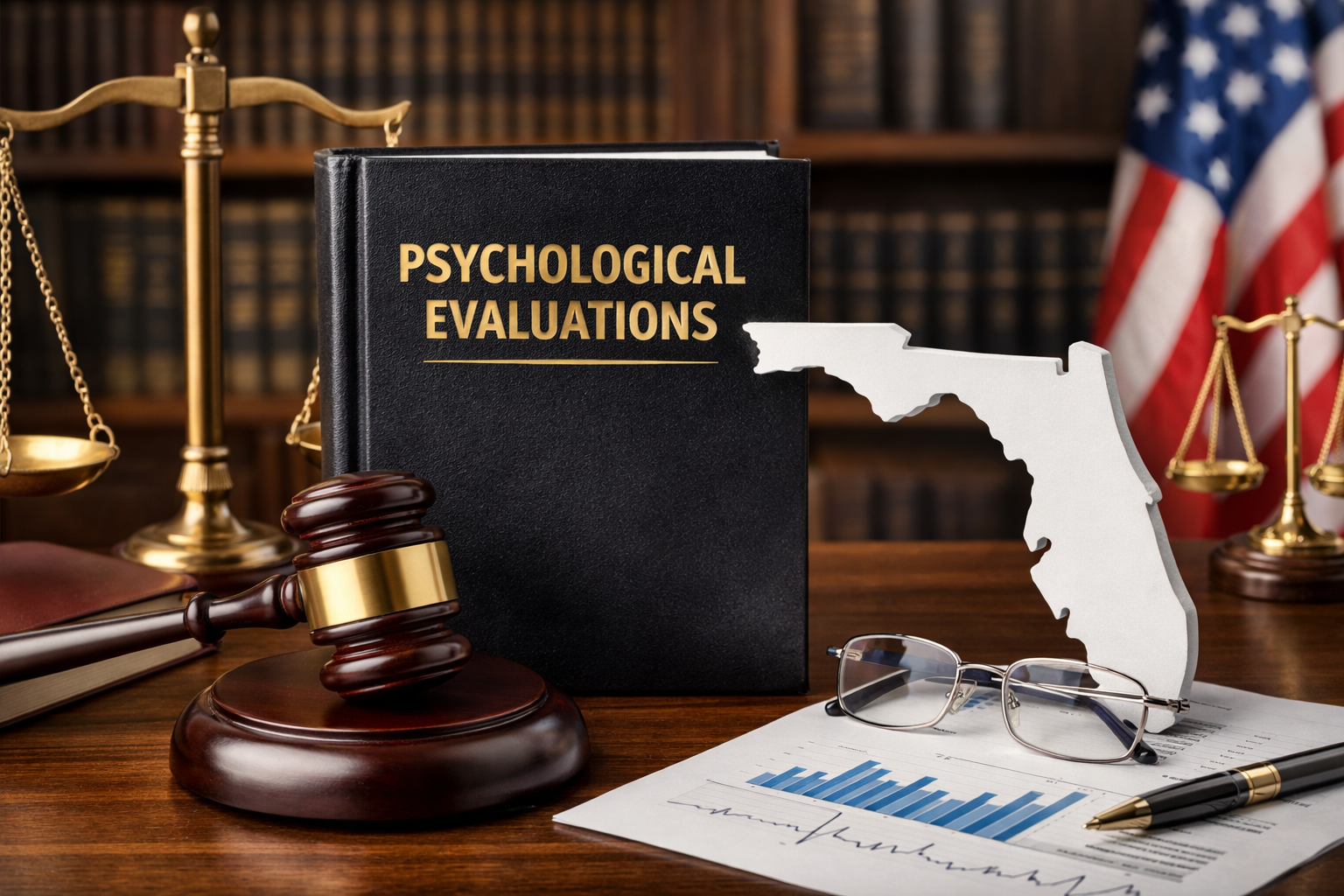
Psychological evaluations in Florida custody cases are governed by strict legal standards that require proof that a parent’s mental condition is in controversy and that good cause exists for the examination. Miami family courts rely on these evaluations carefully because Florida law protects parental privacy while ensuring judges have reliable information when determining the best interests of a child.
Psychological evaluation in Florida child custody cases are governed by strict statutory and procedural rules designed to balance parental privacy with the court’s duty to protect the best interests of children. In Miami family law courts and throughout Florida, judges may order psychological examinations when a parent’s mental condition is genuinely relevant to determining parental responsibility, time sharing, or child welfare. The legal standards for these evaluations arise primarily from Florida Family Law Rule of Procedure 12.360, Florida Rule of Civil Procedure 1.360, and Florida Statute § 61.20. Together these authorities establish when evaluations may be ordered, the procedural safeguards required, and the evidentiary purpose they serve in family law litigation.
The Role of Psychological Evaluations in Florida Custody Litigation
Psychological evaluations often become relevant in Florida custody litigation when the mental health of a parent is alleged to affect the welfare of a child. Family courts in Miami-Dade County and across Florida must determine parenting plans according to the best interests of the child. When allegations of mental health instability, personality disorders, substance abuse, or emotional impairment arise, courts may consider expert evaluation as a tool to obtain reliable psychological information.
However, psychological examinations are intrusive and implicate fundamental privacy rights. Florida appellate courts consistently emphasize that such evaluations cannot be ordered casually. Instead, trial courts must strictly comply with procedural safeguards before compelling a party to submit to psychological testing or interviews. Failure to follow these safeguards constitutes a departure from the essential requirements of law and may justify appellate relief.
Florida Family Law Rule of Procedure 12.360
The principal procedural mechanism governing psychological evaluations in Florida family law cases is Florida Family Law Rule of Procedure 12.360. This rule allows a court to order a party to submit to a mental examination conducted by a qualified professional when the party’s mental condition is in controversy and good cause exists for the evaluation.
The rule mirrors the language of Florida Rule of Civil Procedure 1.360, which governs similar examinations in general civil litigation. Florida courts have repeatedly recognized that Rule 12.360 incorporates the requirements and analytical framework of Rule 1.360 when psychological examinations are requested in family law matters. Manubens v. Manubens, 198 So. 3d 1072 (Fla. 4th DCA 2016).
In practice, Rule 12.360 creates a high evidentiary threshold before courts may compel psychological testing. The requesting party must demonstrate two independent elements: first, that the mental condition of the opposing party is genuinely in controversy; and second, that good cause exists for the examination.
The “In Controversy” Requirement
The “in controversy” requirement ensures that psychological evaluations are limited to situations where a party’s mental condition directly relates to the issues before the court. Allegations that merely speculate about emotional instability or make generalized claims of psychological concerns are insufficient.
Florida appellate courts consistently reject orders compelling psychological evaluations when the record lacks specific factual allegations demonstrating that a parent’s mental condition is relevant to custody determinations. In Pearson v. Pearson, 332 So. 3d 53 (Fla. 2d DCA 2021), the court quashed an order requiring psychological examinations because the pleadings did not place either party’s mental condition in controversy. The decision reinforced the principle that conclusory accusations do not justify intrusive examinations.
Similarly, in Delgado v. Miller, 264 So. 3d 1040 (Fla. 2d DCA 2019), the appellate court held that vague allegations regarding mental health concerns failed to meet the “in controversy” threshold required by Rule 12.360. Courts require detailed factual allegations demonstrating how the mental condition affects parenting ability or child safety.
The “Good Cause” Requirement
The second requirement under Rule 12.360 is the showing of good cause. Even when a mental condition is in controversy, courts must determine whether the requested evaluation is necessary to resolve the dispute. The requesting party must demonstrate that the examination is essential and that the relevant information cannot be obtained through less intrusive means.
In Manubens v. Manubens, 198 So. 3d 1072 (Fla. 4th DCA 2016), the court emphasized that psychological examinations should not be used as strategic litigation tools. Instead, they must be supported by evidence demonstrating a genuine need for expert psychological assessment.
Florida courts also caution against using psychological evaluations as retaliatory tactics between litigating parents. In Reno v. Reno, 282 So. 3d 163 (Fla. 5th DCA 2019), the court recognized that psychological examinations implicate significant privacy interests and must therefore be justified by compelling circumstances.
Procedural Safeguards Required in Evaluation Orders
When a court determines that both elements of Rule 12.360 have been satisfied, the order compelling the evaluation must contain specific information regarding the examination. The rule requires that the order identify the time, place, manner, conditions, and scope of the examination as well as the identity of the examiner.
Failure to include these details renders the order legally deficient. Florida appellate courts frequently grant petitions for writ of certiorari when trial courts enter open ended orders that fail to specify the parameters of the evaluation.
In Childs v. Cruz-Childs, 353 So. 3d 119 (Fla. 3d DCA 2022), the Third District Court of Appeal quashed an order requiring psychological evaluation because the trial court failed to specify the scope and conditions of the examination. The appellate court emphasized that strict compliance with Rule 12.360 is necessary to protect litigants’ due process rights.
Likewise, Ludwigsen v. Ludwigsen, 313 So. 3d 709 (Fla. 4th DCA 2020), held that an order lacking detailed examination parameters constituted a departure from the essential requirements of law. The case reaffirmed that courts must clearly define the boundaries of any compelled psychological examination.
Florida Statute § 61.20 and Social Investigations
Psychological evaluations may also arise in family law proceedings through a different legal mechanism. Florida Statute § 61.20 authorizes courts to order social investigations when parenting plans are at issue. These investigations may include psychological components as part of a broader inquiry into the child’s best interests.
Unlike Rule 12.360, Section 61.20 does not explicitly require findings that a party’s mental condition is in controversy or that good cause exists for a psychological evaluation. Instead, the statute provides the court with discretionary authority to order investigative reports addressing family dynamics, parental conduct, and the child’s living environment.
Nevertheless, Florida courts require clarity regarding the authority under which the evaluation is ordered. Parties must be informed whether the court is proceeding under Rule 12.360 or Section 61.20 because the procedural requirements differ.
The Florida Supreme Court addressed this distinction in Russenberger v. Russenberger, 639 So. 2d 963 (Fla. 1994). The court held that litigants are entitled to know which legal framework governs the ordered evaluation so that they may assert the appropriate procedural protections.
Later decisions reinforced the importance of this distinction. In Oldham v. Greene, 263 So. 3d 807 (Fla. 2d DCA 2018), the court emphasized that trial courts must clearly identify the authority for psychological evaluations in family law cases.
Psychological Evaluations and the Best Interests of the Child
The ultimate purpose of psychological evaluations in Florida custody disputes is to assist the court in determining the best interests of the child. Mental health professionals may evaluate parental personality traits, emotional stability, parenting capacity, and the psychological relationship between parent and child.
Judges in Miami family courts frequently rely on expert psychological testimony when determining parental responsibility and time sharing. Evaluations may include standardized psychological testing, clinical interviews, collateral interviews with teachers or family members, and review of medical records.
Despite their importance, psychological evaluations remain only one piece of the evidentiary puzzle. Courts evaluate expert opinions alongside other evidence such as witness testimony, school records, and parental conduct.
Privacy Rights and Due Process Considerations
Florida courts carefully balance the need for psychological information with the constitutional privacy rights of litigants. Mental health records and psychological testing results contain deeply personal information. As a result, courts require strict procedural compliance before compelling disclosure.
Appellate decisions consistently warn trial courts against entering overly broad evaluation orders. Because psychological examinations involve compelled disclosure of private mental health information, courts must narrowly tailor orders to the specific issues in dispute.
This approach protects litigants from unnecessary intrusion while allowing courts to obtain critical information when genuine mental health concerns affect child welfare.
Practical Implications for Family Law Attorneys
Attorneys practicing family law in Miami and throughout Florida must approach psychological evaluations with careful strategic planning. Motions requesting evaluations must contain detailed factual allegations demonstrating both the “in controversy” and “good cause” requirements. Vague allegations risk denial of the motion and potential appellate reversal.
Similarly, attorneys opposing such motions should evaluate whether the requesting party has met the stringent legal standards established by Rule 12.360 and Florida case law. Procedural deficiencies in evaluation orders often provide grounds for appellate relief through petitions for writ of certiorari.
Psychological Evaluations in Miami Family Courts
In Miami-Dade County family courts, psychological evaluations often arise in high conflict custody disputes involving allegations of domestic violence, parental alienation, substance abuse, or mental illness. Judges rely on mental health experts to provide professional insight into family dynamics and potential risks to children.
Because Miami family courts handle a high volume of custody disputes, psychological evaluations frequently serve as critical tools for resolving complex parenting conflicts. However, local practitioners recognize that courts strictly enforce the procedural safeguards required by Florida law.
Strategic Considerations for Litigants
Parties involved in custody litigation should understand that psychological evaluations can significantly influence the outcome of their case. A well conducted evaluation may shape judicial perceptions of parental fitness and influence the structure of the final parenting plan.
At the same time, litigants must recognize that courts will not authorize psychological testing without compelling legal justification. Requests must satisfy strict statutory and case law requirements designed to protect privacy and due process.
Conclusion
Psychological evaluations in Florida child custody cases are governed by a complex legal framework that balances the need for expert mental health analysis with the privacy rights of parents. Florida Family Law Rule of Procedure 12.360 establishes rigorous requirements that a party’s mental condition be in controversy and that good cause exist before an examination may be ordered. Courts must also specify detailed parameters governing the evaluation.
Alternatively, courts may order investigations under Florida Statute § 61.20 when determining parenting plans, but parties must be informed which authority governs the evaluation. Florida appellate decisions including Manubens v. Manubens, Pearson v. Pearson, Delgado v. Miller, Childs v. Cruz-Childs, Ludwigsen v. Ludwigsen, Oldham v. Greene, and Russenberger v. Russenberger emphasize strict adherence to procedural safeguards.
For parents involved in custody litigation in Miami and throughout Florida, understanding these legal standards is essential. Psychological evaluations can provide valuable insights into family dynamics, but courts will only authorize them when justified by law and supported by specific evidence.
If you are facing a custody dispute where psychological evaluations may become an issue, consulting an experienced Miami family law attorney can help protect your rights and ensure that any evaluation is conducted in compliance with Florida law.
TLDR: Florida courts may order psychological evaluations in child custody cases only when strict legal standards are met. Under Florida Family Law Rule of Procedure 12.360, the requesting party must prove that a parent’s mental condition is in controversy and that good cause exists for the examination. Alternatively, courts may order investigations under Florida Statute § 61.20. Appellate decisions consistently require detailed court orders and procedural safeguards to protect privacy rights while allowing judges to evaluate the best interests of the child.
What is a psychological evaluation in a Florida custody case?
A psychological evaluation is a mental health assessment ordered by a court to evaluate a parent’s emotional stability, parenting capacity, or psychological condition when determining custody or parenting plans.
When can a Florida court order a psychological evaluation?
Courts may order evaluations when a party’s mental condition is in controversy and good cause exists under Florida Family Law Rule of Procedure 12.360.
What is the difference between Rule 12.360 and Florida Statute § 61.20?
Rule 12.360 requires proof that a mental condition is in controversy and that good cause exists. Section 61.20 allows courts to order social investigations relating to parenting plans.
Can psychological evaluation orders be challenged?
Yes. Florida appellate courts often quash orders that fail to meet procedural requirements or lack sufficient evidence.
Are psychological evaluations common in Miami custody cases?
They are not routine but may occur in high conflict custody disputes involving allegations that a parent’s mental health affects the welfare of a child.