
03 Feb Sheltering a Runaway Minor in Florida – Is it Legal?
Summary
This article explains the legal risks and statutory requirements surrounding sheltering a runaway minor in Florida law, including criminal liability under section 787.035 and authorized placements under Chapters 984 and 39. It also analyzes parental notification duties, the meaning of good faith effort, and how Miami courts apply these rules in dependency and juvenile proceedings.
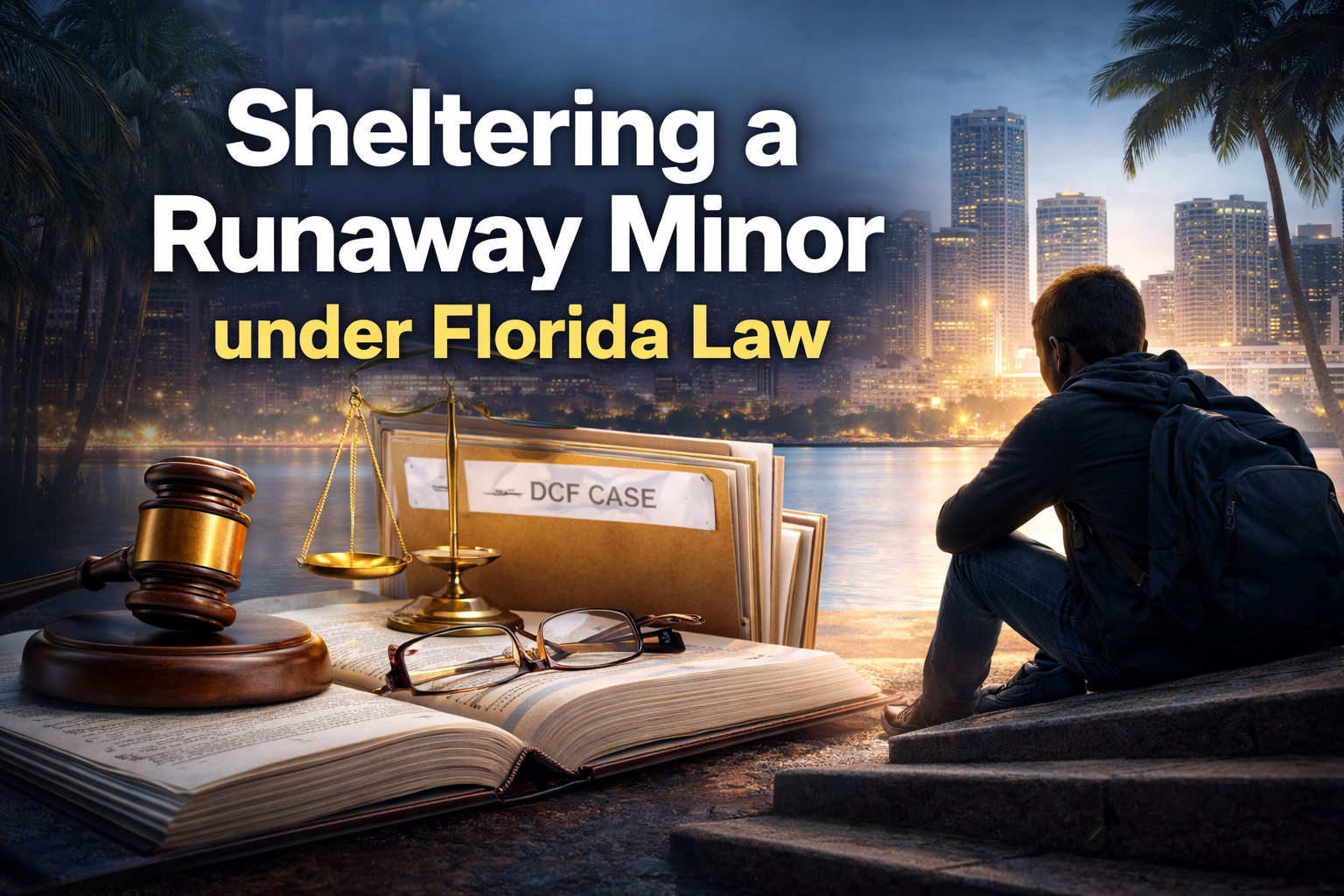
Sheltering a runaway minor in Florida is a legally sensitive issue that carries potential criminal consequences and significant child welfare implications. In Miami and throughout Florida, individuals who provide temporary housing to a minor without parental consent must understand the statutory framework that governs runaway children, parental notification, and authorized shelter placement. Florida law balances child safety with parental rights, and the legal consequences for noncompliance can include misdemeanor prosecution, suppression of evidence in juvenile proceedings, and judicial scrutiny of custody decisions.
Runaway incidents in densely populated areas such as Miami Dade County often involve complex family dynamics, allegations of abuse, or immediate safety concerns. Florida’s statutory scheme therefore addresses both unauthorized private sheltering and the lawful placement of children in department approved shelters under the supervision of the Department of Children and Families. The governing provisions appear primarily in sections 787.035, 984.13, 984.14, 985.101, and 39.402, Florida Statutes, along with Florida Administrative Code Rule 65C-46.016 and controlling appellate case law.
Criminal Prohibition Under Section 787.035 Florida Statutes
Florida’s primary criminal prohibition appears in section 787.035, Florida Statutes. This statute makes it unlawful for a person who is not an authorized agent of the Department of Children and Families to knowingly shelter an unmarried minor for more than twenty four hours without the consent of the minor’s parent or legal guardian or without notifying law enforcement. Section 787.035, Florida Statutes, further prohibits aiding a runaway by assisting in obtaining shelter unless proper notification occurs. Violation constitutes a first degree misdemeanor punishable under Florida law.
In M.J.R. v. State, 715 So. 2d 1103 (Fla. 4th DCA 1998), the court examined the statutory elements required to sustain a conviction under section 787.035 and emphasized that knowledge and failure to comply with notification requirements are central components. The decision underscores that individuals who provide shelter without taking steps to notify authorities risk criminal exposure, even if their subjective motivation is protective.
Authorized Shelter Placement Under Chapter 984
Chapter 984, Florida Statutes, governs children and families in need of services and includes provisions addressing runaway children. Section 984.13, Florida Statutes, authorizes law enforcement officers to take a runaway child into custody when reasonable grounds exist to believe the child has run away from a parent, guardian, or legal custodian. The officer may release the child to a parent or deliver the child to a shelter when appropriate.
Section 984.13, Florida Statutes, further allows placement in a shelter when the parent is unavailable, when the child voluntarily requests placement, when a court order directs shelter placement, or when both child and parent agree that temporary placement is necessary. In D.O. v. State, 77 So. 3d 787 (Fla. 3d DCA 2011), the Third District addressed law enforcement authority under Chapter 984 and clarified the legal basis for taking a runaway into custody in Miami Dade County. The decision confirms that custody of a runaway child must comply strictly with statutory authority.
Section 984.14, Florida Statutes, imposes immediate parental notification requirements on shelters receiving a runaway child. The shelter must attempt to notify the parent, guardian, or custodian promptly and determine whether safe return home is possible. This statutory obligation reflects Florida’s strong policy favoring parental involvement in decisions affecting a child’s welfare.
Florida Administrative Code Rule 65C-46.016
Florida Administrative Code Rule 65C-46.016 establishes standards for runaway shelters. The rule requires twenty four hour supervision, separation of adults from minors, and immediate efforts to notify parents or guardians unless allegations of abuse or neglect exist. In cases involving suspected abuse, shelters must contact the Department of Children and Families rather than immediately notifying the parent, thereby protecting children from potential harm.
Compliance with Rule 65C-46.016 is mandatory for department approved shelters operating in Miami and throughout Florida. Private individuals who provide shelter outside this regulatory structure do not benefit from these statutory protections and may fall within the criminal scope of section 787.035, Florida Statutes.
Shelter Hearings Under Section 39.402 Florida Statutes
When a child is taken into custody under dependency authority, section 39.402, Florida Statutes, governs shelter hearings. The statute requires a judicial determination of probable cause within twenty four hours of removal. Continued placement is permissible only if the court finds probable cause to believe the child has been abused, neglected, abandoned, or is in imminent danger and that no less restrictive alternative can ensure safety.
In Department of Children and Families v. H.M.R., 161 So. 3d 477 (Fla. 2d DCA 2014), the court held that strict compliance with section 39.402 is essential and that shelter placement requires specific factual findings. In Department of Children and Families v. D.H.C., 360 So. 3d 454 (Fla. 5th DCA 2023), the appellate court reiterated that continued shelter must be supported by evidence demonstrating necessity. Most recently, Guardian ad Litem v. L.W., 2025 Fla. App. LEXIS 2082 (Fla. 2d DCA 2025), further clarified that courts must carefully evaluate statutory criteria before authorizing ongoing placement.
Section 39.402, Florida Statutes, also addresses notice requirements and provides that failure to notify a parent does not invalidate a shelter order if the petitioner demonstrates a good faith effort to provide notice. This statutory language introduces the concept of good faith effort within the dependency context.
Defining Good Faith Effort in Parental Notification
Florida law does not provide a single statutory definition of good faith effort, yet several provisions outline the required conduct. Section 985.101, Florida Statutes, requires the person taking a child into custody to attempt to notify the parent immediately and to continue such attempts until notification occurs or custody transfers to the appropriate department. This persistent obligation reflects legislative intent to ensure parental awareness.
In Ramirez v. State, 739 So. 2d 568 (Fla. 1999), the Florida Supreme Court emphasized the importance of continuous attempts to notify parents when a juvenile is taken into custody. In State v. Cartwright, 448 So. 2d 1049 (Fla. 1984), the court discussed reasonable efforts in the context of juvenile detention. These cases suggest that good faith requires immediate, repeated, and reasonable attempts using available contact information.
Within the runaway shelter context, section 984.14, Florida Statutes, and Rule 65C-46.016 require immediate notification attempts unless abuse allegations are present. Collectively, these authorities indicate that good faith involves diligence, persistence, and documentation of notification efforts.
Consequences of Failing to Make a Good Faith Effort
Failure to comply with notification requirements can have multiple legal consequences. In the criminal context, section 787.035, Florida Statutes, exposes private individuals to misdemeanor liability for unauthorized sheltering. In the juvenile interrogation context, Dowst v. State, 336 So. 2d 375 (Fla. 1976), held that denying a juvenile’s request to speak with a parent may render a confession inadmissible. Similarly, Brookins v. State, 704 So. 2d 576 (Fla. 1st DCA 1997), recognized that parental notification bears upon voluntariness analysis.
Within dependency proceedings, failure to demonstrate good faith notice may result in judicial scrutiny, evidentiary challenges, or reversal on appeal if statutory requirements are not satisfied. Miami dependency courts in the Eleventh Judicial Circuit routinely examine compliance with section 39.402, Florida Statutes, during shelter hearings.
Miami Specific Considerations
In Miami Dade County, runaway cases frequently intersect with high density housing, multicultural households, and complex custody arrangements. Law enforcement officers operating under section 984.13, Florida Statutes, must navigate both state statutes and local administrative procedures. The Eleventh Judicial Circuit applies binding precedent from the Third District Court of Appeal, including D.O. v. State, 77 So. 3d 787 (Fla. 3d DCA 2011).
Parents in Miami who discover that a third party has sheltered their child without consent may pursue criminal complaints under section 787.035, Florida Statutes, and may also raise concerns in family court proceedings involving parental responsibility and timesharing. Judges may consider such conduct when evaluating the best interests of the child under section 61.13, Florida Statutes, where relevant.
Conclusion
Sheltering a runaway minor in Florida involves strict statutory duties, mandatory parental notification, and potential criminal exposure for unauthorized individuals. Sections 787.035, 984.13, 984.14, 985.101, and 39.402, Florida Statutes, along with Rule 65C-46.016 and controlling appellate decisions, create a comprehensive legal framework that prioritizes child safety while protecting parental rights. Individuals in Miami and throughout Florida should exercise extreme caution before providing shelter to a runaway minor without lawful authority or immediate notification to law enforcement or the Department of Children and Families.
If you are facing a situation involving a runaway child, alleged unauthorized sheltering, or a pending dependency or criminal matter in Miami Dade County, timely legal guidance is essential. Understanding your rights and obligations under Florida law can prevent criminal charges and protect your family’s interests.
TLDR: Sheltering a runaway minor in Florida is generally illegal if done without parental consent or law enforcement notification for more than twenty four hours under section 787.035, Florida Statutes. Authorized shelters and DCF placements are permitted under Chapters 984 and 39, but strict parental notification and judicial review requirements apply.
FAQ
Is it illegal to let a runaway minor stay at my house in Florida?
Yes. Under section 787.035, Florida Statutes, knowingly sheltering a runaway minor for more than twenty four hours without parental consent or notifying law enforcement is a first degree misdemeanor.
What must a shelter do when a runaway arrives?
Section 984.14, Florida Statutes, and Rule 65C-46.016 require immediate attempts to notify parents unless abuse is alleged, in which case DCF must be contacted.
What is a good faith effort to notify parents?
Florida courts interpret good faith effort to mean immediate and continuous reasonable attempts to notify parents, consistent with section 985.101, Florida Statutes, and cases such as Ramirez v. State, 739 So. 2d 568 (Fla. 1999).
Can failure to notify affect a criminal case?
Yes. Cases such as Dowst v. State, 336 So. 2d 375 (Fla. 1976), show that failure to notify parents may impact admissibility of juvenile statements.