

11 Jun Temporary Relief Hearings in Miami Family Court
A temporary relief hearing in Miami family court is a short, expedited proceeding under Chapter 61, Florida Statutes, and Florida Family Law Rule of Procedure 12.610 and 12.285, where the court enters temporary orders on timesharing, child support, alimony, exclusive use of the marital home, and attorney’s fees while the divorce or paternity case is pending.
Temporary relief hearings in Miami family court play a critical role in stabilizing families during divorce and paternity litigation. In high conflict cases filed in the Eleventh Judicial Circuit in and for Miami-Dade County, parties often cannot wait months for a final trial. Florida law therefore authorizes trial courts to enter temporary orders addressing timesharing, child support, alimony, and exclusive use of the marital residence while the case proceeds.
Under Chapter 61, Florida Statutes, and the Florida Family Law Rules of Procedure, courts have broad discretion to fashion equitable temporary relief. Appellate courts consistently emphasize that temporary relief is designed to preserve stability and protect children, not to prejudge the final outcome. See Saenz v. Sanchez, 390 So. 3d 71 (Fla. 3d DCA 2023); Miller v. Gordon, 365 So. 3d 1247 (Fla. 1st DCA 2023); Nishman v. Stein, 292 So. 3d 1277 (Fla. 4th DCA 2020).
Legal Foundation for Temporary Relief in Florida
Temporary relief in dissolution of marriage and paternity actions derives from the court’s equitable authority under Chapter 61, Florida Statutes. Section 61.08 governs alimony. Section 61.13 governs parental responsibility and timesharing. Section 61.16 authorizes temporary attorney’s fees. Section 61.30 governs child support. Section 61.13001 addresses temporary relocation relief.
Florida Family Law Rule of Procedure 12.285 requires mandatory financial disclosure prior to temporary financial hearings. Rule 12.610 governs injunctions for protection. Rule 12.615 governs civil contempt enforcement proceedings that may arise from temporary orders.
In Mullins v. Mullins, 799 So. 2d 450 (Fla. 4th DCA 2001), the court reiterated that temporary support orders are reviewed for abuse of discretion and appellate courts rarely disturb them absent clear error. More recently, Saenz and Miller confirm that temporary orders are not final determinations and may be modified at final judgment based on full evidentiary development.
Purpose and Scope of a Temporary Relief Hearing
A temporary relief hearing is not a mini trial. Florida appellate courts consistently explain that these hearings are intended to be expedited and focused. See Nishman v. Stein, 292 So. 3d 1277 (Fla. 4th DCA 2020). The purpose is to maintain financial stability and protect children during litigation.
Miami judges often limit temporary hearings to thirty or sixty minutes per side. Evidence is typically presented through financial affidavits, limited testimony, and documentary exhibits. Because time is limited, strategic preparation is essential.
Temporary Timesharing and Parental Responsibility
Temporary timesharing determinations are governed by section 61.13, Florida Statutes. Florida public policy favors frequent and continuing contact with both parents. Section 61.13(2)(c)1 establishes a rebuttable presumption that equal timesharing is in the child’s best interest unless otherwise agreed.
However, appellate courts clarify that detailed written findings required for final judgments are not always mandatory at the temporary stage. See Miller v. Gordon, 365 So. 3d 1247 (Fla. 1st DCA 2023).
In Merlihan v. Skinner, 382 So. 3d 735 (Fla. 4th DCA 2024), the Fourth District held that a trial court may not delegate its statutory responsibility for timesharing to a guardian ad litem. The court must independently evaluate the statutory best interest factors under section 61.13(3).
In Bahl v. Bahl, 220 So. 3d 1214 (Fla. 2d DCA 2016), the Second District reversed an emergency temporary modification where the court relied on an unsworn guardian ad litem report without proper testimony. This case underscores the importance of sworn evidence even in temporary proceedings.
Temporary Child Support
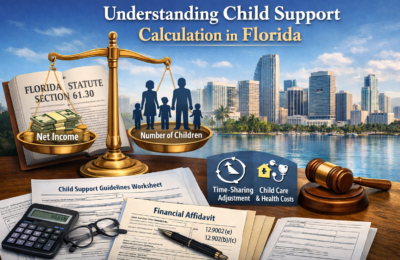
Temporary child support in Miami family court must comply with section 61.30, Florida Statutes. The statutory guidelines apply equally at the temporary stage. Courts calculate support based on net income, not gross income.
In Parker v. Parker, 2024 WL 171898 (Fla. 2d DCA Jan. 17, 2024), the Second District reversed an alimony calculation based on gross income rather than net income. Although Parker involved alimony, the principle applies equally to support calculations. Florida courts require accurate net income findings.
Miami-Dade judges require strict compliance with Rule 12.285 financial disclosure before temporary support hearings. Failure to exchange mandatory disclosure can result in continuance or sanctions.
Temporary Alimony
Section 61.08 governs temporary alimony. The 2023 statutory amendments eliminated permanent alimony and created durational limitations tied to the length of marriage. Even at the temporary stage, courts must analyze need and ability to pay.
Alimony calculations must rely on net income. See Parker v. Parker, supra. Courts may award bridge the gap or temporary support to maintain the status quo pending trial.
Exclusive Use and Possession of the Marital Home
Miami courts may grant exclusive use and possession of the marital residence when necessary to protect children or prevent irreparable harm. The requesting party must demonstrate special circumstances. Exclusive possession is often tied to primary temporary timesharing.
Temporary Attorney’s Fees and Costs
Section 61.16 authorizes temporary attorney’s fees based on need and ability to pay. The purpose is to ensure both parties have similar access to competent legal representation. Miami courts frequently award interim retainers where income disparity exists.
Relocation and Emergency Temporary Relief
Section 61.13001 governs temporary relocation. If a parent seeks temporary relocation, the court must hold a hearing within thirty days absent good cause. Strict compliance is required.
Emergency temporary relief requires competent substantial evidence of imminent harm. Courts must avoid reliance on unsworn allegations. See Bahl v. Bahl, supra.
Procedure in Miami-Dade County
Temporary relief hearings in Miami are scheduled through the Unified Family Court divisions of the Eleventh Judicial Circuit. Administrative orders require compliance with mandatory disclosure and mediation before final trial. Many divisions require submission of proposed orders in advance.
Parties must file a Notice of Hearing and coordinate with judicial assistants. Failure to comply with local procedures can delay relief.
Common Mistakes at Temporary Relief Hearings
One common mistake is failing to present updated financial affidavits. Another is misunderstanding that temporary orders can influence final outcomes. Although not binding, temporary arrangements often create practical status quo arguments.
Another frequent error is assuming the court will adopt a guardian ad litem recommendation without independent analysis. Merlihan makes clear that courts must exercise independent judgment.
What Miami Judges Evaluate
Judges evaluate credibility, financial documentation, statutory compliance, and the best interests of the child. They consider whether the requested relief preserves stability and fairness.
In high income Miami cases involving business owners or international assets, courts scrutinize income determination closely. Net income findings must be supported by competent evidence.
Strategic Considerations in Miami Temporary Relief Litigation
Given Miami’s diverse population and frequent international issues, temporary hearings may involve jurisdictional disputes under the Uniform Child Custody Jurisdiction and Enforcement Act codified in Chapter 61, Part II. Jurisdiction must be established before temporary custody relief is entered.
Attorneys must prepare focused testimony and anticipate objections under the Florida Evidence Code, Chapter 90.
Conclusion
Temporary relief hearings in Miami family court shape the trajectory of your case. Whether you are seeking temporary timesharing, child support, alimony, or exclusive possession of your home, early strategic action matters.
At our Miami family law firm, we prepare every temporary relief hearing as if it will influence the final outcome. We ensure compliance with Chapter 61, Florida Statutes, and the latest appellate decisions including Saenz, Miller, Parker, and Merlihan. If you need immediate temporary relief in Miami-Dade County, contact our office to schedule a confidential consultation.
Temporary relief hearings provide essential interim protections in Florida dissolution and paternity actions. Governed by Chapter 61, the Florida Family Law Rules of Procedure, and evolving appellate case law, these hearings require careful preparation and statutory compliance. Miami litigants must understand both the expedited nature of these proceedings and their practical impact on final judgment outcomes.
Frequently Asked Questions
How quickly can I get a temporary relief hearing in Miami?
Timing depends on judicial availability, but courts prioritize issues involving children and support. Relocation hearings under section 61.13001 must occur within thirty days absent good cause.
Do temporary orders become permanent?
No. Temporary orders remain in effect until modified or replaced by final judgment. However, courts often consider the temporary status quo at trial.
Can a guardian ad litem decide timesharing?
No. Under Merlihan v. Skinner, the court may not delegate its statutory responsibility to determine timesharing to a guardian ad litem.
Is net income required for temporary alimony?
Yes. As clarified in Parker v. Parker, alimony must be calculated based on net income, not gross income.
Can I request attorney’s fees at a temporary hearing?
Yes. Section 61.16 authorizes temporary attorney’s fees based on financial disparity.