
23 Oct What Happens If You Lie in a Florida Divorce Deposition?
Summary
This article explains the legal consequences of lying in a Florida divorce deposition, including potential perjury charges, discovery sanctions, and credibility damage in family court. It also examines how false testimony can lead to reopening a divorce judgment under Florida law, especially when financial disclosures are fraudulent.
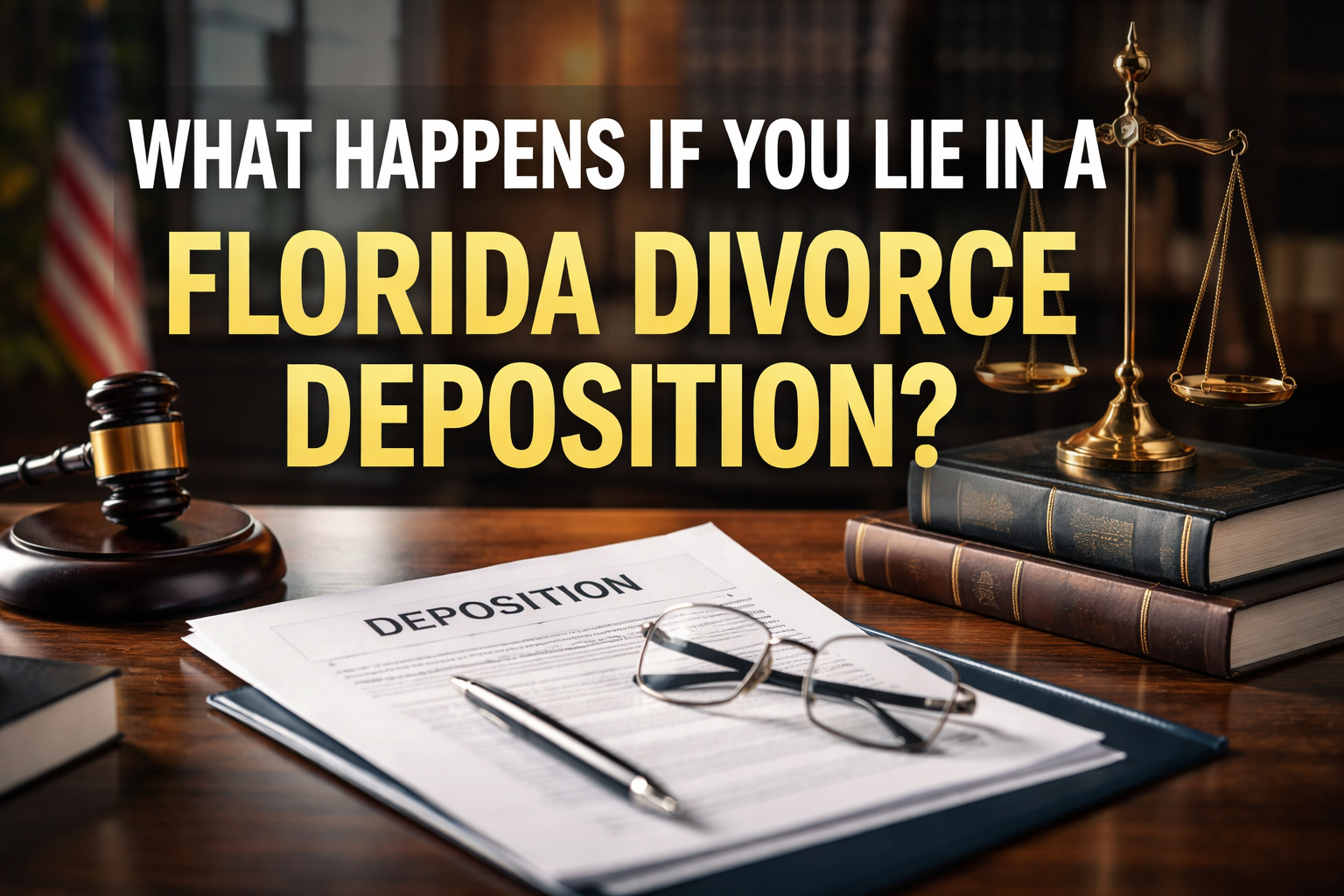
Lying in a Florida divorce deposition can create serious legal consequences that extend far beyond the deposition room. Because depositions are sworn testimony, false statements made during a family law deposition may expose a witness to criminal perjury charges, severe litigation sanctions, and even the reopening of a finalized divorce judgment. In Miami and throughout Florida, courts treat sworn testimony with particular seriousness because the truthfulness of discovery directly affects the fairness of judicial proceedings.
In Florida family law litigation, depositions are a central discovery tool. Attorneys frequently take depositions to clarify financial disclosures, verify testimony regarding marital assets and liabilities, and evaluate credibility prior to trial. When a witness knowingly provides false testimony under oath during a deposition, the misconduct can undermine the integrity of the judicial process and lead to multiple layers of legal consequences. These consequences may include criminal exposure, procedural sanctions within the divorce case itself, and long term post judgment remedies if the lie affects the outcome of the litigation.
The legal risks of false deposition testimony are particularly significant in high conflict divorce cases involving financial disputes, hidden assets, or contested parenting issues. Florida law recognizes several mechanisms that allow courts to address dishonesty during discovery, including perjury statutes, procedural rules governing sanctions, and post judgment relief for fraud. The combination of these legal frameworks demonstrates that honesty during a deposition is not merely an ethical obligation but a legal requirement with substantial consequences for those who violate it.
The Legal Significance of a Deposition in Florida Divorce Litigation
A deposition is a formal question and answer session conducted under oath outside the courtroom but within the context of ongoing litigation. The testimony is typically recorded by a court reporter and may be used later in court proceedings. Because the witness is sworn in before answering questions, deposition testimony carries the same legal obligation of truthfulness that applies to testimony given at trial.
In Florida divorce cases, depositions often focus on issues such as marital assets, income sources, business interests, parenting conduct, and financial disclosures. The information obtained during depositions can influence settlement negotiations, trial strategy, and the credibility determinations made by the judge.
Florida courts rely heavily on truthful discovery to ensure that equitable distribution, alimony determinations, and parenting decisions are based on accurate information. When a party lies during a deposition, the deception can distort the factual record and interfere with the court’s ability to administer justice.
For this reason, Florida law provides multiple remedies when false testimony occurs during discovery. These remedies reflect the legal system’s interest in deterring dishonesty and preserving the integrity of judicial proceedings.
Criminal Consequences: Perjury Under Florida Law
One of the most serious consequences of lying in a Florida divorce deposition is potential criminal prosecution for perjury. Florida law prohibits knowingly making false statements under oath regarding material matters. The relevant statutory framework includes Fla. Stat. § 837.012 and Fla. Stat. § 837.02.
Under Fla. Stat. § 837.012, a person commits perjury if they knowingly make a false statement under oath regarding a material matter when the statement is not believed to be true. The statute clarifies that the person’s belief about whether the statement is material does not serve as a defense. Therefore, even if a witness believes that a particular question is unimportant, intentionally giving a false answer may still satisfy the elements of perjury.
Florida law also distinguishes between perjury committed in an official proceeding and perjury committed outside an official proceeding. Perjury in an official proceeding is treated more severely and may be charged as a felony under Fla. Stat. § 837.02. By contrast, false statements under oath that are not made in an official proceeding may be prosecuted as a first degree misdemeanor under Fla. Stat. § 837.012.
Courts analyzing perjury cases frequently focus on whether the statement relates to a material matter in the litigation. In State v. Diaz, 785 So. 2d 744 (Fla. 3d DCA 2001), the court explained that materiality exists when a false statement is germane to the inquiry or capable of influencing the factfinder. The purpose of the perjury statute is to deter false testimony that could mislead the judicial process and obstruct the search for truth.
Another Florida appellate decision illustrates how sworn statements may fall within different perjury provisions depending on their connection to an official proceeding. In State v. Adkins, 553 So. 2d 294 (Fla. 5th DCA 1989), the court discussed how sworn statements administered by notaries may or may not occur within the context of official proceedings. This distinction can influence the classification of the offense.
Although criminal prosecutions for deposition lies are relatively uncommon in divorce cases, the legal exposure remains real. A knowingly false answer regarding financial assets, income sources, or other material matters could theoretically trigger a perjury investigation if the misconduct is severe or clearly intentional.
Civil Consequences: Discovery Sanctions in Divorce Cases
Even when criminal prosecution does not occur, lying in a Florida divorce deposition can lead to serious civil consequences within the divorce case itself. Florida procedural rules authorize trial courts to impose sanctions when a party engages in discovery misconduct.
Florida Rule of Civil Procedure 1.380 provides courts with broad authority to address discovery violations. Available sanctions include orders compelling compliance, striking pleadings, dismissing claims, entering default judgments, or prohibiting the introduction of certain evidence.
In family law cases, Florida Family Law Rule of Procedure 12.380 allows a party to file a motion to compel when a deponent refuses to answer questions or fails to comply with discovery obligations. The rule requires certification that the moving party attempted to resolve the dispute through good faith communication before seeking court intervention.
While discovery sanctions often arise when a party refuses to answer questions or fails to produce documents, courts may also impose sanctions when testimony is intentionally false or misleading. Dishonesty during discovery undermines the fairness of the litigation process and may justify strong judicial responses.
In Schmitz v. Schmitz, 401 So. 3d 416 (Fla. 5th DCA 2024), the appellate court discussed the authority of trial courts to impose sanctions when parties violate discovery orders. The court recognized that judges may deem certain facts established or impose other sanctions when discovery misconduct occurs. At the same time, the court emphasized that sanctions must comply with due process and should only be imposed after providing notice and an opportunity to be heard.
Another case demonstrates how severe sanctions may become when dishonesty affects the litigation process. In Long v. Swofford, 805 So. 2d 882 (Fla. 3d DCA 2001), the court recognized that dismissal of claims may be appropriate when a party commits fraud during discovery. Although dismissal is considered an extreme remedy, Florida courts have acknowledged that it may be necessary in cases involving deliberate deception.
In practical terms, if a judge concludes that a party lied during a deposition about key issues such as income, assets, or parenting conduct, the court may respond in several ways. The judge may draw adverse inferences against the dishonest party, limit the presentation of evidence, or impose monetary sanctions. In more severe cases, the court could strike pleadings or grant other case altering remedies.
Impact on Credibility and Case Outcomes
Beyond formal sanctions, lying in a deposition can severely damage a party’s credibility in a divorce case. Credibility plays a critical role in family law proceedings because judges frequently must decide between conflicting testimony.
If a judge determines that a party intentionally lied under oath during discovery, that finding may influence how the court evaluates the party’s testimony on other issues. For example, credibility concerns could affect determinations related to equitable distribution, alimony, or parenting disputes.
Judges often consider honesty and transparency when evaluating the conduct of parties in divorce litigation. When one party is caught providing false testimony, the court may be more inclined to accept the testimony of the opposing party or draw negative inferences about the dishonest witness.
Therefore, the strategic damage caused by deposition dishonesty can be significant even when no formal sanctions are imposed. A credibility finding can shape the outcome of a divorce case in ways that are difficult to reverse.
Fraud and the Risk of Reopening a Divorce Judgment
Lying in a deposition may also create long term consequences if the false testimony influences the final outcome of the divorce case. Florida courts allow litigants to seek relief from final judgments when fraud or misconduct affected the proceedings.
Florida Family Law Rule of Procedure 12.540 authorizes courts to set aside final orders based on fraud, misrepresentation, or other misconduct by an adverse party. Florida appellate courts have recognized this rule as an important safeguard against judgments obtained through dishonest conduct.
In Corrigan v. Vargas, 277 So. 3d 642 (Fla. 2d DCA 2019), the court confirmed that Rule 12.540 allows litigants to seek relief from final judgments when fraud or misrepresentation occurs. Similarly, in Duke v. Duke, 360 So. 3d 1163 (Fla. 5th DCA 2023), the court reiterated that fraudulent conduct may justify setting aside a final order in family law proceedings.
The rule has particular significance in cases involving financial disclosures. Florida courts require parties in divorce proceedings to file sworn financial affidavits detailing their income, assets, and liabilities. If a party provides false financial information during discovery or deposition testimony, the misconduct may later serve as grounds to reopen the case.
Florida case law further recognizes that fraudulent financial affidavits can lead to long lasting exposure to post judgment litigation. In Romero v. Romero, 959 So. 2d 333 (Fla. 3d DCA 2007), the court explained that the Florida Supreme Court removed the one year time limitation for claims involving fraudulent financial affidavits in marital cases. As a result, parties may challenge a judgment based on fraudulent financial disclosures without the typical time restrictions.
This rule reflects the policy that divorce judgments should not be allowed to stand when they are based on deliberately false financial information. Consequently, a lie during deposition testimony that conceals assets or income may lead to litigation years after the divorce judgment is entered.
Practical Risks in Miami Divorce Litigation
In Miami and throughout South Florida, divorce litigation frequently involves complex financial issues, including business ownership, international assets, and high value property. Depositions are often used to investigate these financial matters and clarify inconsistencies in financial affidavits.
Because Miami divorce cases often involve detailed financial discovery, false deposition testimony about assets, bank accounts, or income sources may be particularly dangerous. Opposing counsel frequently reviews bank records, tax returns, and other documents that may reveal inconsistencies with deposition testimony.
When such inconsistencies appear, attorneys may seek sanctions, file motions to compel additional discovery, or request evidentiary hearings regarding fraud or misconduct. The resulting litigation can significantly increase costs and prolong the divorce process.
Moreover, Miami family court judges regularly encounter complex discovery disputes and are familiar with the legal remedies available when parties attempt to conceal information. Courts are therefore equipped to respond aggressively when dishonesty during discovery threatens the fairness of the proceedings.
Why Truthful Testimony Matters in Divorce Depositions
Truthful testimony during depositions serves several critical functions within the Florida family law system. First, it allows attorneys to evaluate the strengths and weaknesses of each party’s claims. Second, it helps courts make informed decisions regarding property division, support obligations, and parenting arrangements.
When parties provide honest answers during discovery, cases are more likely to settle efficiently because both sides understand the relevant facts. Conversely, dishonesty can prolong litigation, increase legal fees, and create additional disputes that require court intervention.
The legal framework discussed above demonstrates that Florida law strongly discourages false testimony. Criminal statutes, procedural rules, and fraud based remedies all work together to deter dishonesty during litigation.
Conclusion
Lying in a Florida divorce deposition can trigger a chain of serious legal consequences that extend well beyond the deposition itself. False testimony under oath may expose a witness to criminal perjury liability under Florida law, particularly when the statement concerns a material matter in the litigation. Even when criminal prosecution does not occur, courts have broad authority to impose discovery sanctions, strike pleadings, or draw adverse inferences against parties who provide dishonest testimony.
Additionally, false deposition testimony that influences the outcome of a divorce case may later support efforts to reopen or set aside a final judgment. Florida procedural rules allow courts to grant relief when fraud or misrepresentation affects the fairness of the proceedings, and fraudulent financial disclosures may be challenged without traditional time limits.
For individuals involved in divorce litigation in Miami or elsewhere in Florida, the safest and most effective strategy is simple. Provide truthful answers during depositions and ensure that financial disclosures are accurate and complete. The risks associated with dishonesty during discovery are substantial, and the long term consequences can far outweigh any perceived short term advantage.
If you believe that false testimony or hidden assets have affected your divorce case, consulting an experienced Florida family law attorney can help you evaluate potential remedies under the applicable statutes, procedural rules, and case law. Careful legal analysis is often necessary to determine whether sanctions, fraud claims, or post judgment relief may be available.
TLDR: Lying in a Florida divorce deposition can lead to criminal perjury charges, severe discovery sanctions, and even reopening of the divorce judgment if the lie involves fraud or financial disclosure. Courts in Miami and throughout Florida treat sworn deposition testimony as legally binding and dishonest answers can seriously damage credibility, case outcomes, and long term financial settlements.
Can lying in a deposition lead to criminal charges in Florida?
Yes. If a person knowingly provides false testimony under oath about a material matter, they may face perjury charges under Florida law depending on the circumstances of the proceeding.
Can a divorce case be dismissed because someone lied in a deposition?
In extreme cases involving fraud or serious discovery misconduct, Florida courts may impose severe sanctions including dismissal of claims or striking pleadings.
Can a divorce judgment be reopened if someone lied during discovery?
Yes. Florida Family Law Rule of Procedure 12.540 allows courts to set aside judgments obtained through fraud or misrepresentation, including dishonest financial disclosures.
Does lying in a deposition affect credibility in court?
Absolutely. Judges often rely heavily on credibility determinations, and proven dishonesty can significantly influence how the court evaluates testimony and evidence.
What should you do if you discover a spouse lied in a deposition?
You should consult a Florida family law attorney immediately to evaluate potential sanctions, fraud claims, or motions for relief from judgment based on the misconduct.