
15 Aug What is Durational Alimony under Florida Law?
Summary
This article explains Durational Alimony Florida under Fla. Stat. § 61.08, including statutory duration limits based on the length of the marriage, the thirty five percent net income differential cap, and how courts determine reasonable need and ability to pay. It analyzes controlling Florida appellate decisions such as Lostaglio, Pricher, Beck, Edman, Abbott, Jimenez, Wabeke, Frazier, Grable, Keyser, Woodlief, and Loconto. The article also addresses modification under Fla. Stat. § 61.14, termination rules, and how Miami courts apply durational alimony standards in divorce proceedings.
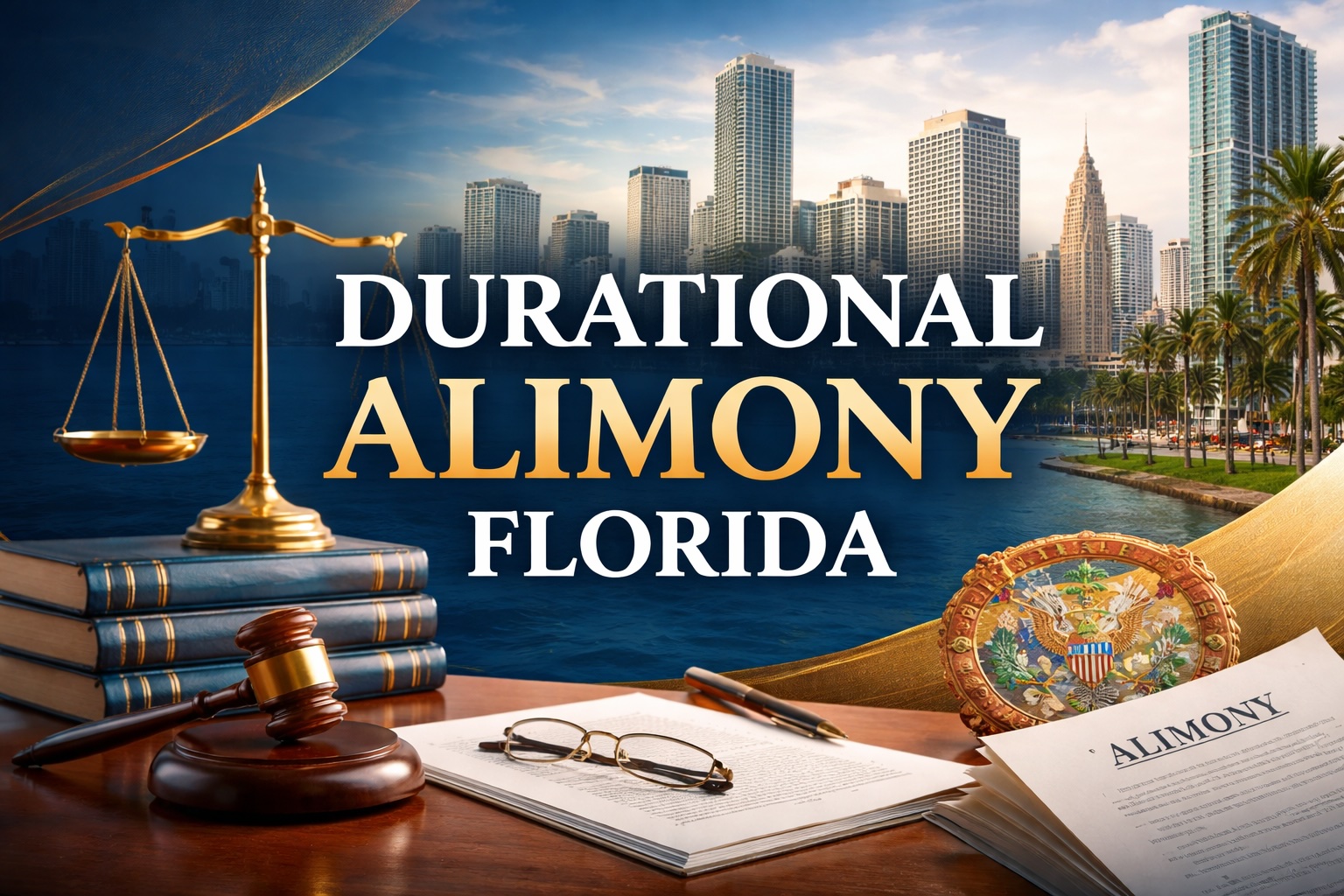
Durational Alimony Florida law is governed primarily by Fla. Stat. § 61.08 and establishes a structured framework for awarding time-limited spousal support in Florida dissolution proceedings. In Miami and throughout Florida, durational alimony provides economic assistance to a former spouse for a defined period following divorce. Since Senate Bill 1416 took effect on July 1, 2023, section 61.08(1)(a), Florida Statutes, authorizes only temporary, bridge the gap, rehabilitative, and durational alimony, so durational alimony is now the principal vehicle for ongoing periodic support. This article provides an analysis of durational alimony under Florida law, including statutory caps, calculation methodology, reasonable need determinations, modification standards, and controlling appellate authority.
Statutory Framework of Durational Alimony Florida
Durational alimony is codified in Fla. Stat. § 61.08. The statute defines durational alimony as support awarded to provide economic assistance for a set period following dissolution of marriage. It is available in marriages of short, moderate, or long duration, subject to the statutory bar on any durational award following a marriage lasting less than 3 years. Decisions issued before July 1, 2023 describe durational alimony as an alternative to permanent support. See Lostaglio v. Lostaglio, 199 So. 3d 560 (Fla. 5th DCA 2016), and Pricher v. Pricher, 300 So. 3d 1258 (Fla. 5th DCA 2020). That framing reflects the pre-reform statute. Permanent alimony has since been abolished, and under section 61.08(11), Florida Statutes, the current statute governs every initial petition pending on or filed on or after July 1, 2023.
Florida law classifies marriages as short term, moderate term, or long term based on statutory definitions contained within Fla. Stat. § 61.08. These classifications directly impact the maximum permissible duration of durational alimony.
Duration Limits Under Fla. Stat. § 61.08
The statute imposes strict caps on the length of durational alimony. For short term marriages, defined as less than ten years, the award may not exceed fifty percent of the length of the marriage. For moderate term marriages between ten and twenty years, the award may not exceed sixty percent of the length of the marriage. For long term marriages of twenty years or more, the award may not exceed seventy five percent of the length of the marriage. These limitations are mandatory unless exceptional circumstances are proven by clear and convincing evidence.
The strict enforcement of these duration caps was emphasized in Beck v. Tamas-Beck, 426 So. 3d 503 (Fla. 4th DCA 2025), where the appellate court corrected a miscalculation of marriage length that affected the alimony term. Similarly, Edman v. Edman, 407 So. 3d 452 (Fla. 4th DCA 2025), clarified that any extension beyond statutory limits requires specific findings supported by clear and convincing evidence.
Calculation of Durational Alimony Florida
The amount of Durational Alimony Florida is determined by statutory formula. Pursuant to Fla. Stat. § 61.08, the award must be the lesser of the obligee’s reasonable need or thirty five percent of the difference between the parties’ net incomes. Net income is calculated in accordance with Fla. Stat. § 61.30(2) and (3), excluding court ordered spousal support paid in the same action.
This statutory cap represents a legislative effort to create predictability and reduce inconsistent alimony awards across Florida courts, including the Eleventh Judicial Circuit in Miami-Dade County.
Threshold Determination of Need and Ability to Pay
Before awarding durational alimony, the trial court must make express findings that the obligee has a genuine need for support and that the obligor has the ability to pay. This two step inquiry is mandatory under Fla. Stat. § 61.08(2). Failure to make these findings constitutes reversible error.
Florida courts have repeatedly reversed alimony awards where these findings were absent. See Frazier v. Dodd, 406 So. 3d 1034 (Fla. 5th DCA 2025); Grable v. Grable, 432 So. 3d 1154 (Fla. 1st DCA 2026); Keyser v. Keyser, 204 So. 3d 159 (Fla. 5th DCA 2016); and Woodlief v. Woodlief, 415 So. 3d 1208 (Fla. 5th DCA 2025).
Determining Reasonable Need in Durational Alimony Florida
The concept of reasonable need is central to Durational Alimony Florida. Courts evaluate the obligee’s actual post dissolution financial requirements in light of the marital standard of living and statutory factors listed in Fla. Stat. § 61.08(3).
In Abbott v. Abbott, 187 So. 3d 326 (Fla. 2d DCA 2016), and Jimenez v. Jimenez, 211 So. 3d 76 (Fla. 4th DCA 2017), the courts emphasized that reasonable need must be supported by competent, substantial evidence and tied to specific statutory considerations. The court in Wabeke v. Wabeke, 31 So. 3d 793 (Fla. 2d DCA 2009), further clarified that employability and potential self sufficiency are central to evaluating ongoing need.
Under Fla. Stat. § 61.08(3), courts consider duration of the marriage, standard of living established during the marriage, age and health of each party, financial resources including marital and nonmarital assets, earning capacities, vocational skills, employability, contributions to the marriage, responsibilities for minor children, tax consequences, and all other factors necessary to do equity and justice.
In Loconto v. Loconto, 415 So. 3d 696 (Fla. 3d DCA 2025), the court applied the statutory thirty five percent cap and reinforced that the amount must be the lesser of calculated need or the statutory income differential percentage.
Modification of Durational Alimony Florida
Durational alimony is modifiable in amount upon a substantial change in circumstances pursuant to Fla. Stat. § 61.14. However, the length of the award is generally nonmodifiable absent exceptional circumstances. This distinction is crucial in Miami divorce practice, where post judgment modification litigation is common.
Durational alimony terminates upon the death of either party or the remarriage of the obligee unless otherwise agreed in a marital settlement agreement, consistent with Fla. Stat. § 61.08.
Exceptional Circumstances and Extensions
Exceptional circumstances must be proven by clear and convincing evidence before extending durational alimony beyond statutory limits. In Edman v. Edman, 407 So. 3d 452 (Fla. 4th DCA 2025), the court required detailed factual findings addressing age, employability, disability, financial resources, and caregiving responsibilities.
This heightened evidentiary burden reflects legislative intent to limit long term financial entanglement between former spouses while preserving equitable discretion in extraordinary cases.
Miami Specific Considerations in Durational Alimony Florida
In Miami-Dade County, where income disparities are often significant due to concentrated professional and entrepreneurial earnings, durational alimony litigation frequently involves disputes regarding income calculation under Fla. Stat. § 61.30. High asset divorces may involve complex compensation structures requiring forensic accounting analysis to determine net income for purposes of the thirty five percent statutory cap.
The Eleventh Judicial Circuit strictly enforces statutory requirements for written findings under Fla. Stat. § 61.08, and appellate review from the Third District Court of Appeal continues to shape durational alimony jurisprudence in South Florida.
Conclusion
Durational Alimony Florida is a structured, formula driven form of spousal support designed to provide economic assistance for a defined period following dissolution of marriage. Governed by Fla. Stat. § 61.08 and interpreted through controlling appellate decisions including Lostaglio, Pricher, Beck, Edman, Abbott, Jimenez, Wabeke, Frazier, Grable, Keyser, Woodlief, and Loconto, durational alimony reflects legislative intent to balance fairness with predictability.
Courts must determine need and ability to pay, apply the thirty five percent net income differential cap, adhere to strict duration limits, and make detailed factual findings. Exceptional circumstances require clear and convincing evidence. Modification is limited to changes in amount absent extraordinary proof.
For Miami residents navigating divorce, understanding Durational Alimony Florida is essential to protecting financial stability and ensuring compliance with statutory mandates.
TLDR: Durational Alimony Florida is time limited spousal support awarded under Fla. Stat. § 61.08 to provide economic assistance after divorce. The amount is capped at the lesser of the recipient’s reasonable need or thirty five percent of the difference between the parties’ net incomes, and the duration cannot exceed statutory percentage limits based on the length of the marriage unless exceptional circumstances are proven by clear and convincing evidence.
Frequently Asked Questions
How long can durational alimony last in Florida?
Durational alimony cannot exceed fifty percent of a short term marriage, sixty percent of a moderate term marriage, or seventy five percent of a long term marriage under Fla. Stat. § 61.08 unless exceptional circumstances are proven.
How is durational alimony calculated in Florida?
The award equals the lesser of the obligee’s reasonable need or thirty five percent of the difference between the parties’ net incomes calculated under Fla. Stat. § 61.30.
Can durational alimony be modified?
The amount may be modified upon a substantial change in circumstances under Fla. Stat. § 61.14. The length is generally not modifiable absent exceptional circumstances.
Does durational alimony end at remarriage?
Yes. Durational alimony terminates upon the remarriage of the obligee or death of either party unless otherwise agreed.
Speak With a Miami Divorce Attorney
If you are facing divorce in Miami and need guidance on Durational Alimony Florida, consult experienced counsel to evaluate statutory limits, income calculations, and potential modification issues. Careful legal strategy at the trial level is critical because appellate courts strictly enforce compliance with Fla. Stat. § 61.08. Early legal planning can protect your financial future and prevent costly post judgment litigation.