
20 Mar Almost Divorced: Will I be Held Responsible if My Ex Defaults on a New Loan?
Summary
This article explains whether a person can be held responsible if their ex-spouse defaults on a new loan in Florida. It analyzes Florida statutes and case law governing credit agreements, equitable distribution, and post-divorce financial liability.
In Florida family law and consumer finance law, one common question arises after divorce: can someone be held liable if an ex-spouse defaults on a new loan? The issue of ex-spouse obtaining a new loan and subsequently defaulting is especially relevant for divorced individuals who worry that a former spouse’s financial decisions may unexpectedly affect their own credit or legal exposure. Understanding how Florida law treats liability for credit agreements is essential for protecting financial independence after dissolution of marriage.
Florida law generally provides strong protections against liability for debts that a person did not personally agree to in writing. Courts consistently emphasize that credit obligations cannot be imposed merely because two individuals were previously married. Instead, the law requires a written credit agreement that clearly identifies the responsible borrower. When an ex-spouse independently takes out a loan after divorce, the other former spouse will typically not be legally responsible for repayment unless that person signed the loan or otherwise agreed to be liable.
This article provides an examination of the legal framework governing liability for an ex-spouse’s new loan in Florida. It analyzes statutory law, appellate case law, and principles of equitable distribution in divorce proceedings. It also addresses practical issues frequently encountered by family law attorneys in Miami-Dade County and throughout South Florida, including credit agreements, jointly owned property, and post-divorce financial obligations.
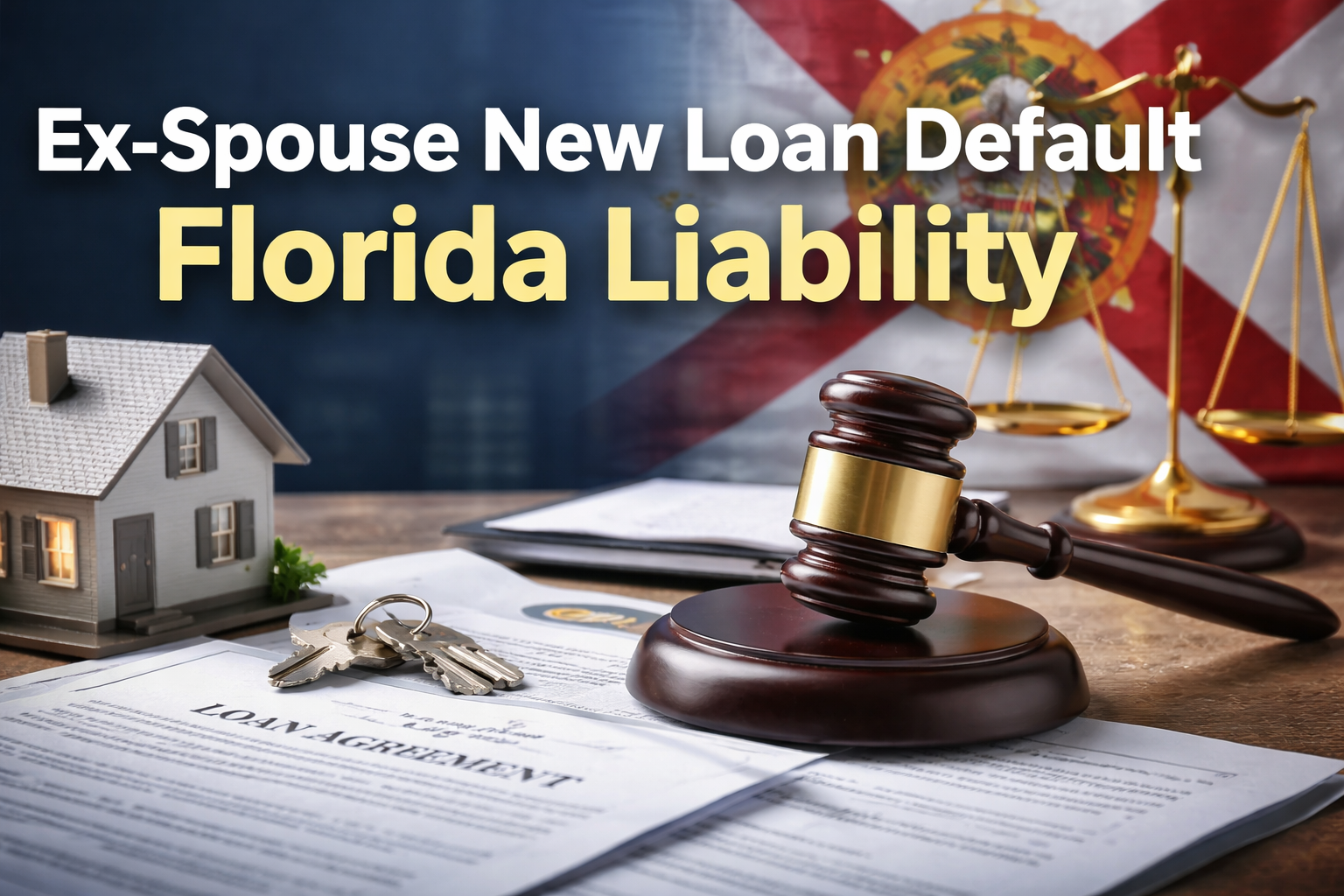
Understanding Ex-Spouse New Loan Default Florida Liability
The question of ex-spouse liability for a new loan is primarily governed by contract law principles and specific Florida statutes regulating credit agreements. In simple terms, liability generally depends on whether the person signed the loan or otherwise agreed in writing to assume responsibility.
Florida courts routinely reaffirm that debt obligations arise from contract, not from the existence of a prior marital relationship. This distinction is crucial because divorce legally separates the financial lives of former spouses unless they intentionally choose to share a debt.
For individuals living in Miami, Coral Gables, Brickell, or other parts of Miami-Dade County, this rule provides reassurance that a former spouse’s independent borrowing activity does not automatically create financial exposure.
Florida Statutory Requirement of a Written Credit Agreement
The most important statute governing this issue is Florida Statute § 687.0304, often referred to as the Florida Credit Agreement Statute. The statute establishes strict requirements for enforcing credit agreements.
Under this statute, a debtor may not maintain an action on a credit agreement unless the agreement is in writing, expresses consideration, sets forth the relevant terms and conditions, and is signed by both the creditor and the debtor. The statute further prohibits courts from implying a credit agreement based on the relationship between the parties.
This statutory framework directly addresses the concern of ex-spouse liability for a new loan. Because the statute requires a signed written agreement, a person who did not sign the loan documents generally cannot be held responsible for repayment.
Importantly, the statute also prevents creditors from arguing that liability should exist simply because two individuals were married at some point. Even a fiduciary relationship does not create liability without a written credit agreement.
Case Law Confirming Liability Requires a Signature
Florida appellate courts have repeatedly reinforced the statutory requirement that liability for a loan depends on the existence of a written and signed credit agreement.
In Frederick v. Frederick, 257 So. 3d 1105 (Fla. 2d DCA 2018), the court addressed the scope of liability associated with mortgage documents and loan notes. The case emphasized that a party who signs a mortgage but does not sign the accompanying promissory note may not be personally liable for the underlying debt. Instead, the party’s exposure may be limited to their interest in the property that secures the loan.
The case illustrates a broader legal principle: personal liability arises from the promissory note or credit agreement itself, not from collateral documents or related property interests.
Florida courts have also examined situations where individuals attempt to impose liability on someone who did not sign the loan at all. In ROSL, Inc. v. Des Jardins, cited in Frederick, the court concluded that a third party who did not sign the note could not be held responsible for the debt. The decision reinforces the requirement that liability must be expressly assumed in writing.
These cases demonstrate that Florida courts apply a strict contractual approach to debt obligations. Without a signature on the loan agreement, a creditor generally cannot establish liability.
When Property Ownership May Require a Signature
Although a person is generally not liable for an ex-spouse’s new loan, certain circumstances may require a signature even when the borrower is only one party.
This issue often arises when a loan is secured by property that is jointly owned. A lender may require the signature of all property owners to ensure that the collateral can be foreclosed if the borrower defaults.
The Florida case Richardson v. Everbank, 152 So. 3d 1282 (Fla. 1st DCA 2015), illustrates this situation. The court discussed the distinction between signing a mortgage to allow foreclosure on property and signing a promissory note that creates personal liability for repayment.
In such cases, a person who signs only the mortgage document may grant the lender rights against the property but does not necessarily become personally responsible for the debt.
This distinction frequently arises in Miami real estate transactions involving marital homes or investment properties acquired during marriage.
Equitable Distribution and Marital Liabilities
Another legal principle relevant to ex-spouse new loan default Florida liability is the doctrine of equitable distribution in divorce proceedings.
Under Florida law, marital assets and liabilities are divided according to equitable distribution principles. The governing statute is Florida Statute § 61.075, which directs courts to identify marital assets and marital liabilities and distribute them equitably between the parties.
The statute provides that debts incurred during the marriage may be classified as marital liabilities and allocated between the spouses in the final judgment of dissolution.
However, debts incurred after separation or after the final judgment of divorce are typically considered nonmarital liabilities belonging solely to the party who incurred them.
Florida appellate decisions illustrate this principle. In Raphael v. Raphael, 221 So. 3d 687 (Fla. 4th DCA 2017), the court addressed the classification of debts in the context of equitable distribution. The case confirmed that debts incurred outside the marital period are generally treated as individual obligations.
Similarly, in Ortiz v. Ortiz, 315 So. 3d 149 (Fla. 4th DCA 2021), the court examined the allocation of liabilities between spouses during divorce proceedings. The decision emphasized that marital debts must be identified and allocated as part of equitable distribution.
These cases highlight an important distinction. A debt created after divorce is not a marital liability and therefore cannot be imposed on the former spouse through equitable distribution.
Post-Divorce Loans and Financial Independence
Once a divorce is finalized, former spouses generally regain complete financial independence from each other. Each individual becomes solely responsible for debts that they personally incur. This principle is particularly important in metropolitan areas such as Miami, where individuals frequently obtain personal loans, credit cards, car loans, and mortgages after divorce.
Creditors may evaluate a borrower’s income, credit history, and financial stability, but they cannot automatically pursue the borrower’s former spouse for repayment unless that person signed the credit agreement. This rule protects divorced individuals from financial liability arising from a former partner’s independent financial decisions.
Common Situations That Create Confusion
Although the legal rule appears straightforward, several practical situations can create confusion about liability for an ex-spouse’s debt.
One common scenario involves jointly held credit cards that remain open after divorce. If both parties originally signed the credit agreement, both may remain liable for charges even if the divorce judgment assigns responsibility to only one party.
Another situation involves refinancing of a marital home. If one spouse refinances a mortgage after divorce and the other spouse does not sign the new loan documents, the non-signing spouse is generally not responsible for the new debt.
A third situation occurs when lenders mistakenly attempt to collect from a former spouse due to outdated credit records. In these cases, documentation showing the absence of a signed credit agreement usually resolves the dispute.
Credit Reporting and Financial Protection
Even though the law generally protects individuals from liability for an ex-spouse’s new loan, it is still important to monitor credit reports after divorce. Former spouses in Miami and across Florida should periodically review their credit reports to confirm that no unauthorized accounts have been opened in their name. Promptly disputing inaccurate credit reporting can prevent unnecessary damage to credit scores and financial reputation.
Practical Guidance for Divorced Individuals in Miami
Divorced individuals in Miami-Dade County can take several practical steps to avoid potential liability issues related to former spouses.
Closing joint accounts during the divorce process is one of the most effective ways to prevent future disputes. Ensuring that all marital debts are addressed in the final judgment of dissolution also helps clarify responsibility.
When purchasing property or obtaining credit after divorce, individuals should carefully review all loan documents to confirm that they are not inadvertently assuming liability for another person’s obligations.
Family law attorneys in Miami frequently advise clients to retain copies of divorce judgments and loan agreements to demonstrate their financial independence if questions arise later.
Conclusion
Florida law strongly protects individuals from being held responsible for an ex-spouse’s new loan. Liability for debt arises from a written credit agreement signed by the borrower, not from a prior marital relationship. The Florida Credit Agreement Statute and related case law make it clear that courts will not impose liability without a signed agreement establishing responsibility.
Appellate decisions such as Frederick v. Frederick, Richardson v. Everbank, Ortiz v. Ortiz, and Raphael v. Raphael reinforce the principle that debt obligations must be expressly assumed in writing. In the absence of such an agreement, a person generally cannot be held liable for a loan obtained solely by a former spouse.
For individuals in Miami and throughout Florida, this rule provides an important safeguard that protects financial independence after divorce. Understanding the legal framework governing credit agreements and marital liabilities can help former spouses avoid unnecessary financial risk and respond effectively if a creditor attempts to pursue repayment.
If you are facing questions about liability for a former spouse’s debt or other financial issues following divorce, consulting an experienced Florida family law attorney can provide clarity and protection. Legal guidance can ensure that your rights are preserved and that creditors comply with the strict requirements imposed by Florida law.
TLDR: Under Florida law, a person is generally not liable for an ex-spouse’s new loan unless they signed the credit agreement. Florida Statute § 687.0304 requires a written and signed credit agreement to establish liability, and Florida appellate courts consistently hold that a former spouse cannot be responsible for a debt they did not agree to in writing.
What happens if my ex-spouse defaults on a loan they took after our divorce?
If you did not sign the loan agreement or otherwise agree in writing to be responsible, Florida law generally prevents creditors from holding you liable for the debt.
Can a lender pursue me because we were married when the loan was taken?
Marriage alone does not create liability for a credit agreement. A creditor must show that you signed the agreement or otherwise agreed in writing to be responsible.
What if the loan is secured by property that I co-own?
A lender may require your signature on a mortgage to secure the property. However, signing a mortgage does not necessarily create personal liability for repayment of the loan.
Are debts incurred after divorce considered marital liabilities?
No. Debts incurred after the dissolution of marriage are generally treated as nonmarital liabilities belonging to the person who incurred them.
What should I do if a creditor contacts me about my ex-spouse’s loan?
You should request documentation showing that you signed the credit agreement. If no signed agreement exists, you may dispute the claim and consult a Florida attorney for assistance.