
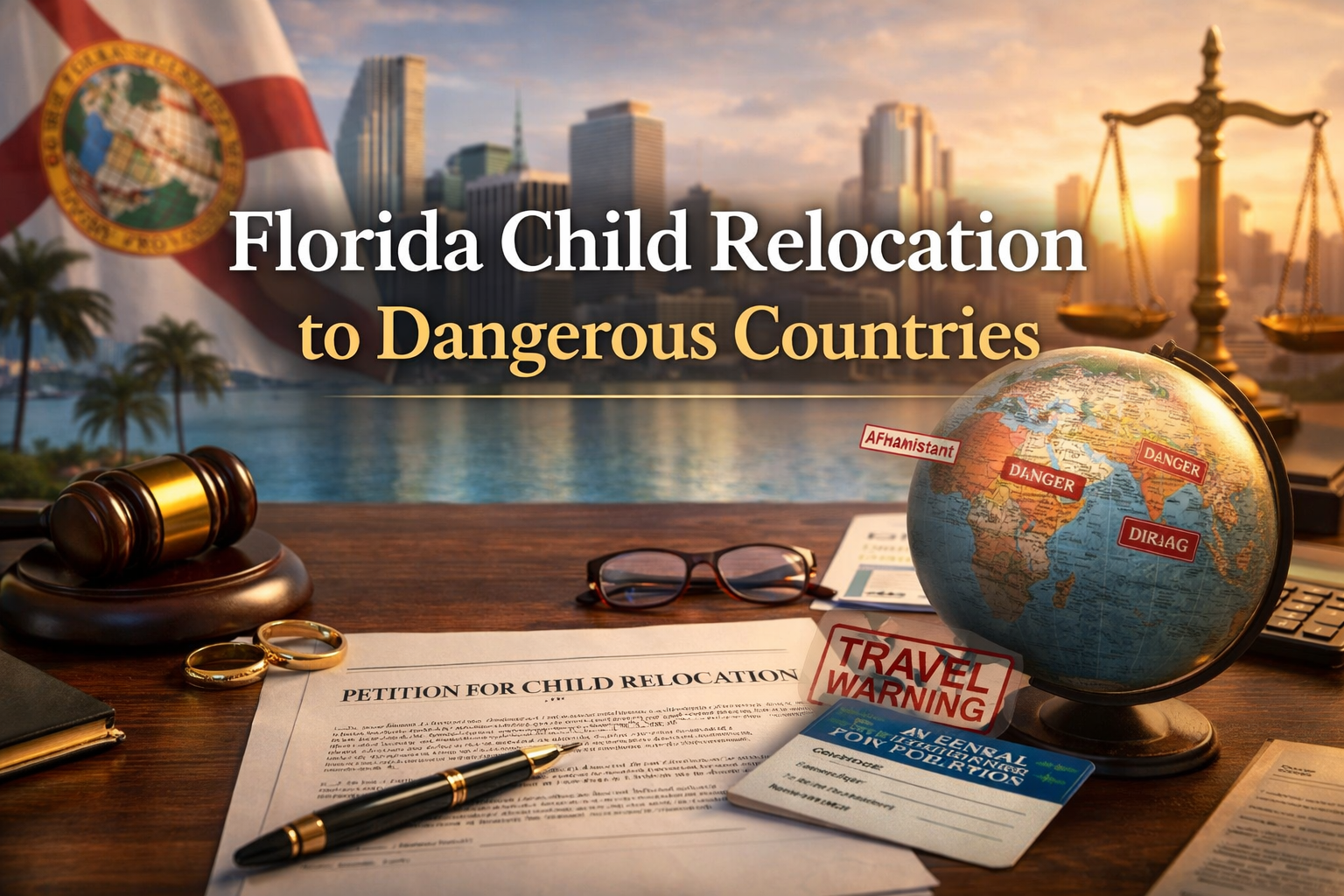
17 Apr Florida Child Relocation to Dangerous Countries
Summary
Florida courts apply strict legal scrutiny when a parent seeks to relocate a child to a politically unstable or travel advisory country. Judges analyze safety risks, international child abduction concerns, and the child’s best interests under Florida relocation law.
When one parent asks a court to permit a child to move to a politically unstable or travel advisory country, Florida courts must carefully balance parental rights with the overriding legal principle that the best interest of the child controls every custody decision. In Miami and throughout Florida, judges examine statutory relocation law, international abduction risks, travel safety concerns, and the ability of the child to maintain a meaningful relationship with the non relocating parent. Because international relocation can dramatically alter a parenting plan and may place the child beyond the practical reach of United States courts, judges apply heightened scrutiny to these requests.
Florida Law Governing Child Relocation
Florida law governing relocation disputes is primarily contained in Fla. Stat. § 61.13001. This statute establishes the legal procedure when a parent seeks to move a child more than fifty miles away for sixty consecutive days or more. The statute applies whether the relocation is within Florida, elsewhere in the United States, or outside the country. However, international relocation cases often raise additional safety and jurisdictional concerns that significantly influence the court’s analysis.
Under Florida law, a parent who seeks relocation must file a petition to relocate that includes detailed factual allegations supporting the request. The relocating parent carries the initial burden of proving by a preponderance of the evidence that the proposed relocation is in the best interest of the child. If that burden is met, the burden shifts to the non relocating parent to demonstrate that the relocation is not in the best interest of the child.
Florida appellate courts have repeatedly emphasized that relocation disputes must be decided using a fact specific analysis. In Sanabria v. Sanabria, 271 So. 3d 1101 (Fla. 3d DCA 2019), the court reaffirmed that relocation decisions require substantial competent evidence demonstrating that the move will benefit the child rather than merely benefiting the relocating parent. Similarly, in C.G. v. M.M., 310 So. 3d 977 (Fla. 2d DCA 2020), the court explained that relocation cases must carefully evaluate all statutory factors before altering an existing parenting arrangement.
Best Interest of the Child Standard
The controlling legal principle in any Florida custody dispute is the best interest of the child. Florida courts evaluate relocation requests using numerous statutory considerations that address the child’s emotional development, stability, and long term welfare. Although the relocation statute contains specific factors, courts often analyze them within the broader framework of the child’s well being and the preservation of meaningful family relationships.
When the proposed relocation involves a country experiencing political instability, civil conflict, or a United States travel advisory, the court’s analysis becomes particularly rigorous. Judges must consider whether the relocation will expose the child to safety risks, disrupt the child’s education, or interfere with the ability of the other parent to maintain a relationship with the child.
Florida appellate decisions illustrate how courts apply the best interest standard. In Rossman v. Profera, 67 So. 3d 363 (Fla. 4th DCA 2011), the court emphasized that the preservation of the child’s relationship with both parents is a critical factor in relocation decisions. Likewise, in Orta v. Suarez, 66 So. 3d 988 (Fla. 3d DCA 2011), the court held that relocation determinations must focus on the overall welfare of the child rather than the preferences of either parent.
International Relocation and Political Instability
When a parent seeks to relocate a child to a politically unstable country, Florida courts must evaluate the practical risks associated with that environment. Political instability may involve armed conflict, government collapse, widespread civil unrest, or limited access to infrastructure such as healthcare, transportation, and education. Courts may also consider United States State Department travel advisories when assessing the safety of a destination country.
Although Florida courts do not automatically deny relocation requests involving unstable regions, the presence of political instability raises serious concerns regarding the safety and welfare of the child. Judges may examine whether the proposed destination provides stable housing, educational opportunities, and access to medical care. If the relocating parent cannot demonstrate that the child will have a safe and supportive environment, the relocation request may fail.
Risk of International Child Abduction
One of the most significant concerns in international relocation cases is the possibility of parental child abduction. If a child is taken to another country and the relocating parent refuses to return the child, enforcing a Florida custody order may become extremely difficult.
Florida law specifically addresses international abduction risks in Fla. Stat. § 61.45, which provides courts with authority to implement safeguards when a child may face a credible risk of abduction. The statute allows courts to consider factors such as prior threats to remove the child from the United States, attempts to obtain travel documents without the other parent’s consent, or evidence that the parent intends to permanently relocate the child beyond the reach of Florida courts.
If the destination country is not a participant in the Hague Convention on the Civil Aspects of International Child Abduction, the risk of permanent loss of jurisdiction becomes particularly significant. Without international treaty enforcement mechanisms, recovering an abducted child may be extraordinarily difficult.
Impact on the Child’s Development
Florida courts also examine the developmental impact of relocation. The court must determine whether the move will enhance the child’s quality of life or whether it will disrupt the child’s emotional stability and educational progress.
In Buschor v. Buschor, 252 So. 3d 833 (Fla. 5th DCA 2018), the court reiterated that relocation decisions must evaluate the practical consequences of the move on the child’s daily life. This includes the availability of schools, extracurricular opportunities, healthcare access, and emotional support networks.
For children living in Miami or elsewhere in South Florida, relocation to a politically unstable country may involve drastic cultural, linguistic, and social adjustments. Courts consider whether the child will have access to reliable schools and whether the child will remain connected to extended family members.
Preserving the Parent Child Relationship
Another key consideration in relocation cases is the feasibility of preserving the child’s relationship with the non relocating parent. Florida courts recognize that frequent contact between a child and both parents promotes emotional stability and healthy development.
If relocation would significantly reduce contact between the child and the other parent, the court may conclude that the move is not in the child’s best interest. International travel expenses, visa requirements, and safety conditions can make regular visitation impractical.
Although modern technology such as video communication can supplement personal contact, courts generally view virtual communication as an imperfect substitute for in person interaction.
Domestic Violence and Safety Concerns
Florida courts must also consider whether the relocating parent has a history of domestic violence or criminal conduct. The safety of the child remains the paramount concern.
Under Fla. Stat. § 61.13, courts must consider evidence of domestic violence, abuse, neglect, or abandonment when determining parental responsibility and time sharing. If the relocating parent has engaged in abusive conduct or criminal activity, the court may determine that relocation would place the child at risk.
Safeguards Courts May Impose
Even if a Florida court approves an international relocation, judges often impose safeguards designed to protect the child and preserve the authority of the court.
Courts may require the relocating parent to post a financial bond to ensure compliance with the parenting plan. The bond may be forfeited if the parent fails to return the child to the United States for scheduled visitation.
Judges may also require detailed travel itineraries, contact information, and proof that the child’s passport will remain accessible to both parents. In some cases, courts require that the custody order be registered or recognized in the destination country.
Miami Specific Considerations
Miami family courts frequently encounter international relocation disputes due to the region’s diverse population and global connections. Many families in Miami maintain close ties to countries in Latin America, Europe, and the Middle East. As a result, relocation requests involving international travel arise regularly in the Eleventh Judicial Circuit.
Miami judges apply Florida relocation law while also considering practical issues unique to international travel. These may include immigration restrictions, travel advisories issued by the United States government, and the availability of diplomatic assistance if legal disputes arise abroad.
Because Miami serves as a major international gateway, courts in this jurisdiction often require detailed evidence about the conditions in the destination country, including safety data and access to essential services.
Conclusion
Florida child relocation to dangerous countries requires careful judicial analysis grounded in statutory law and appellate precedent. Courts evaluate relocation requests using the best interest of the child standard while considering safety risks, international abduction concerns, and the preservation of the parent child relationship.
When the proposed relocation involves a politically unstable or travel advisory country, Florida courts apply heightened scrutiny. Judges examine the stability of the destination, the child’s developmental needs, and the practical ability of the non relocating parent to maintain meaningful contact with the child.
Ultimately, the court’s responsibility is to protect the welfare of the child while balancing the legitimate interests of both parents. In many cases, the risks associated with political instability or international jurisdiction may outweigh the potential benefits of relocation.
Speak With a Miami Child Relocation Lawyer
International relocation cases can permanently reshape a family’s future. If you are involved in a Florida custody dispute involving international travel or relocation to a politically unstable country, it is critical to obtain experienced legal guidance. A Miami family law attorney can evaluate the risks, present evidence regarding the child’s best interests, and advocate for safeguards that protect both the child and the parent child relationship.
Legal strategy in these cases often involves expert testimony, international law analysis, and detailed evidence regarding the proposed destination. Early legal intervention can make the difference between preserving a parenting relationship and losing meaningful contact with a child.
TLDR: Florida courts analyze relocation requests involving politically unstable countries under the best interest of the child standard in Fla. Stat. § 61.13001. Judges examine safety conditions, international abduction risks, the Hague Convention status of the destination country, and the ability to maintain the parent child relationship. If risks outweigh benefits, courts may deny relocation or impose strict safeguards under Florida law.
Can a parent move a child to another country after a Florida divorce?
No parent may relocate a child more than fifty miles for sixty consecutive days without court approval or written consent from the other parent under Florida relocation law.
Do Florida courts allow relocation to dangerous countries?
Courts may deny relocation if political instability or safety risks threaten the child’s welfare or prevent the other parent from maintaining a meaningful relationship with the child.
What if the destination country is not part of the Hague Convention?
Courts often treat non Hague countries as higher risk because enforcing custody orders and recovering abducted children may be extremely difficult.
What evidence helps support a relocation request?
Evidence may include housing plans, school enrollment information, safety reports, employment documentation, and proof that the child’s quality of life will improve.
Can a judge require safeguards if relocation is approved?
Yes. Courts may require financial bonds, travel documentation, custody order registration abroad, or other safeguards to ensure compliance with the parenting plan.