
22 Sep Gambling Problems in Florida Divorce Cases
Summary
This article explains how Florida courts handle divorce cases involving a spouse with a gambling problem. It analyzes equitable distribution, alimony, and financial disclosure rules under Florida law and relevant case authority.
Understanding Gambling Addiction in Florida Divorce Litigation
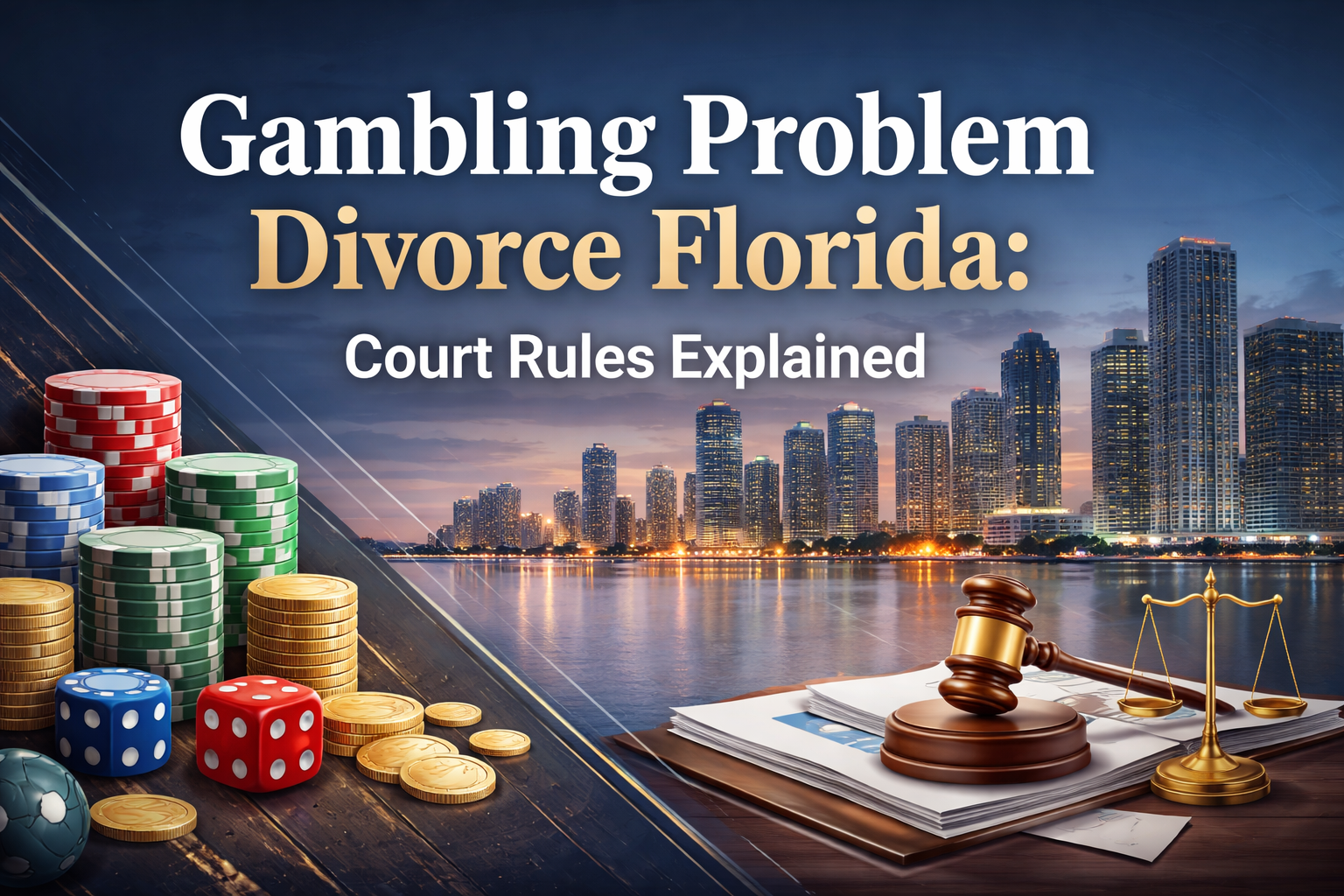
Problem gambling is increasingly recognized as a financial and psychological issue that can profoundly affect family stability. Within divorce litigation, gambling becomes relevant when it impacts marital assets or financial security. In South Florida cities such as Miami, Brickell, and Miami Beach, where casinos, online gaming, and international financial transactions are common, courts regularly confront cases where one spouse alleges that the other dissipated marital funds through gambling.
Florida courts do not punish gambling behavior itself. Instead, the legal inquiry focuses on whether the gambling resulted in financial misconduct that harmed the marital estate. Judges must determine whether funds were intentionally wasted, concealed, or diverted for nonmarital purposes. This inquiry often requires forensic accounting, banking analysis, and a detailed examination of spending patterns over time.
When gambling losses are substantial, the non gambling spouse may argue that those losses constitute dissipation of marital assets. If proven, courts may compensate the innocent spouse through unequal distribution of property. This legal framework ensures that one spouse cannot recklessly destroy marital wealth without consequences in the final judgment of dissolution.
Equitable Distribution and Gambling Losses in Florida
The Legal Framework Under Florida Law
Equitable distribution is governed by Florida Statute § 61.075. The statute requires courts to begin with the presumption that marital assets and liabilities should be divided equally between the spouses. However, the court may deviate from equal distribution if there is justification based on statutory factors.
One of the most significant factors in a gambling problem divorce Florida case is whether a spouse intentionally dissipated marital assets. Dissipation occurs when marital funds are used for a purpose unrelated to the marriage and the conduct results in financial harm to the marital estate.
Florida courts require clear evidence that the dissipation was the result of intentional misconduct rather than poor financial judgment. If gambling losses were simply the result of risky or irresponsible spending during the marriage, courts may be reluctant to treat those losses as intentional destruction of marital assets. However, when evidence demonstrates that a spouse knowingly squandered marital funds through compulsive gambling, courts may adjust the distribution to restore fairness.
Case Law Addressing Intentional Misconduct
Florida courts have emphasized the need for specific factual findings before allocating dissipated assets. In Corrales v. Int’l Collision Repair Center, 2019 Fla. Cir. LEXIS 16051 (Fla. Cir. Ct. 2019), the court explained that dissipated assets may only be included in equitable distribution if the evidence demonstrates intentional misconduct. Courts must identify the misconduct and quantify the financial impact on the marital estate.
Other Florida decisions have similarly required trial courts to make detailed findings when concluding that marital funds were dissipated. The requirement protects both parties by ensuring that unequal distribution is supported by evidence rather than speculation.
For example, if a spouse withdrew large amounts of money from joint accounts and used those funds exclusively for gambling activities without the knowledge of the other spouse, a court may treat those funds as dissipated assets. The court may then allocate a larger share of the remaining marital estate to the innocent spouse.
Alimony Implications of a Spouse’s Gambling Problem
Florida Alimony Law
Alimony determinations in Florida divorce proceedings are governed by Florida Statute § 61.08. The statute requires courts to evaluate the financial needs of one spouse and the ability of the other spouse to pay support. Judges must also consider numerous economic factors including the standard of living during the marriage, the duration of the marriage, the earning capacities of the parties, and the contributions each spouse made to the marital partnership.
When gambling has caused financial instability, courts may examine how those losses affected the parties’ economic circumstances. A spouse who depleted marital savings through gambling may face reduced credibility when arguing inability to pay support.
Economic Impact of Gambling on Alimony Awards
In many gambling related divorces, the financial consequences of gambling directly affect alimony calculations. If one spouse lost substantial marital funds through gambling, the court may determine that the innocent spouse requires additional financial support to maintain economic stability following the divorce.
Conversely, courts may consider whether the gambling spouse’s financial difficulties reduce their ability to pay alimony. Judges must balance fairness with economic reality. If gambling losses significantly reduced available resources, the court must assess whether those losses were voluntary misconduct or unavoidable financial circumstances.
Florida law also permits courts to consider misconduct when it has economic consequences for the marriage. If gambling caused substantial depletion of marital assets, courts may factor that economic harm into alimony determinations.
Mandatory Financial Disclosure in Gambling Related Divorce Cases
Transparency Requirements Under Florida Family Law Rules
Financial transparency is essential in any divorce case involving allegations of hidden gambling losses. Florida Family Law Rule of Procedure 12.285 requires both parties to provide mandatory financial disclosures during dissolution proceedings.
The rule requires disclosure of income, bank statements, tax returns, credit card statements, retirement accounts, and other financial records. In gambling related divorce cases, these documents often reveal patterns of financial activity that help courts determine whether marital funds were dissipated.
Under Rule 12.285, parties must also disclose statements for accounts involving virtual currency transactions, brokerage accounts, and retirement investments. These requirements are particularly relevant in modern gambling cases where online betting platforms and cryptocurrency transactions may conceal financial losses.
Consequences of Failure to Disclose Gambling Activity
Failure to comply with mandatory disclosure obligations can result in significant legal consequences. Courts may impose sanctions, draw adverse inferences, or reopen financial determinations if undisclosed gambling transactions are discovered.
In Miami divorce litigation, attorneys frequently subpoena casinos, financial institutions, and online betting platforms to uncover hidden financial activity. Bank statements, credit card records, and wire transfer data often reveal gambling patterns that were not initially disclosed.
The mandatory disclosure rule promotes transparency and ensures that judges have accurate financial information when dividing assets and determining support obligations.
Mediation and Settlement in Gambling Related Divorce Cases
Most Florida divorce cases require mediation before trial. Mediation provides an opportunity for spouses to negotiate financial issues and resolve disputes without prolonged litigation.
Administrative orders governing mediation often require parties to participate in mediation unless there are exceptional circumstances such as domestic violence. For example, administrative directives like Fla. 10th Jud. Cir. AO 5-51.0 illustrate how Florida courts encourage alternative dispute resolution.
In gambling related divorce disputes, mediation can help spouses address issues such as repayment of gambling losses, allocation of remaining assets, and support arrangements. Negotiated settlements may allow spouses to reach practical solutions that avoid the uncertainty of trial.
Evidence Used to Prove Gambling Dissipation
Proving dissipation of marital assets requires substantial evidence. Courts often examine bank statements, casino transaction records, credit card charges, wire transfers, and loan documents. Forensic accountants may analyze financial data to determine how much money was lost and when the losses occurred.
Evidence must demonstrate both the amount of money lost and the intentional nature of the conduct. Courts distinguish between occasional gambling during the marriage and compulsive gambling that destroys marital finances.
In Miami high asset divorce cases, attorneys frequently uncover gambling losses through subpoenaed casino player records or online gambling accounts. These records may show repeated withdrawals, large cash advances, or transfers to gambling platforms.
How Miami Courts Evaluate Gambling in Divorce
Judges in Miami-Dade County frequently handle complex financial divorce cases involving international assets, offshore accounts, and high value properties. When gambling is involved, courts conduct detailed financial analysis to determine whether marital funds were misused.
South Florida’s proximity to major casinos and the widespread availability of online gambling platforms make these issues increasingly common in divorce litigation. Courts must ensure that equitable distribution reflects the true financial circumstances of the marriage.
Miami divorce attorneys often work with financial experts to reconstruct the marital estate and determine whether gambling losses should affect property distribution.
Conclusion
Individuals facing divorce in Miami where gambling has affected marital finances should seek legal guidance as early as possible. Gambling related financial issues can dramatically influence property division, alimony, and overall case strategy.
Early investigation of financial records is essential. Identifying hidden gambling losses or unauthorized withdrawals can significantly impact equitable distribution outcomes. Experienced family law counsel can coordinate forensic accounting, subpoena financial records, and present clear evidence to the court.
For spouses who have been financially harmed by a partner’s gambling addiction, Florida law provides tools to pursue fair compensation during divorce proceedings. Proper legal representation ensures that marital assets are accurately accounted for and that the innocent spouse is protected from unfair financial consequences.
Divorce cases involving gambling problems require careful legal analysis and detailed financial investigation. Florida courts examine whether gambling losses constitute intentional dissipation of marital assets under Florida Statute § 61.075, whether the financial consequences influence alimony under Florida Statute § 61.08, and whether the parties complied with mandatory disclosure requirements under Florida Family Law Rule of Procedure 12.285.
When supported by credible evidence, gambling related financial misconduct may lead to unequal distribution of assets or adjustments in support obligations. Courts aim to ensure that one spouse does not unfairly benefit from reckless destruction of marital property.
For Miami residents facing a gambling problem divorce Florida case, understanding how courts analyze these issues is essential. Legal strategy, financial transparency, and strong evidentiary support play critical roles in achieving a fair outcome.
TLDR: In a gambling problem divorce Florida case, courts analyze whether gambling losses intentionally dissipated marital assets, affected alimony obligations, or violated mandatory financial disclosure rules. Evidence of intentional misconduct can justify unequal distribution of marital property and influence support awards under Florida law.
What happens if a spouse gambles away marital money in Florida?
Florida courts may treat gambling losses as dissipation of marital assets if there is evidence of intentional misconduct. If proven, the court may award a larger share of remaining marital assets to the innocent spouse.
Can gambling affect alimony in Florida divorce?
Yes. Courts may consider the financial impact of gambling when determining alimony under Florida Statute § 61.08, particularly if gambling caused economic harm to the marriage.
Do spouses have to disclose gambling transactions in divorce?
Yes. Florida Family Law Rule of Procedure 12.285 requires disclosure of financial records including bank statements, credit card statements, and other financial transactions that may reveal gambling activity.
How can gambling losses be proven in divorce court?
Evidence may include bank records, casino statements, online betting accounts, and forensic accounting analysis showing the amount and timing of financial losses.
Should I hire a lawyer if my spouse has a gambling problem during divorce?
Yes. Gambling related financial misconduct can significantly affect equitable distribution and alimony. Legal counsel can help investigate financial records and present evidence to protect your interests.