
15 Jan Guarding Against Parental Child Abduction in Florida
Summary
This article explains how Florida law prevents parental child abduction through the UCCJEA, injunctive relief standards, statutory risk factors, and Hague Convention return procedures. It focuses on protecting children in Miami custody cases involving interstate and international removal risks.
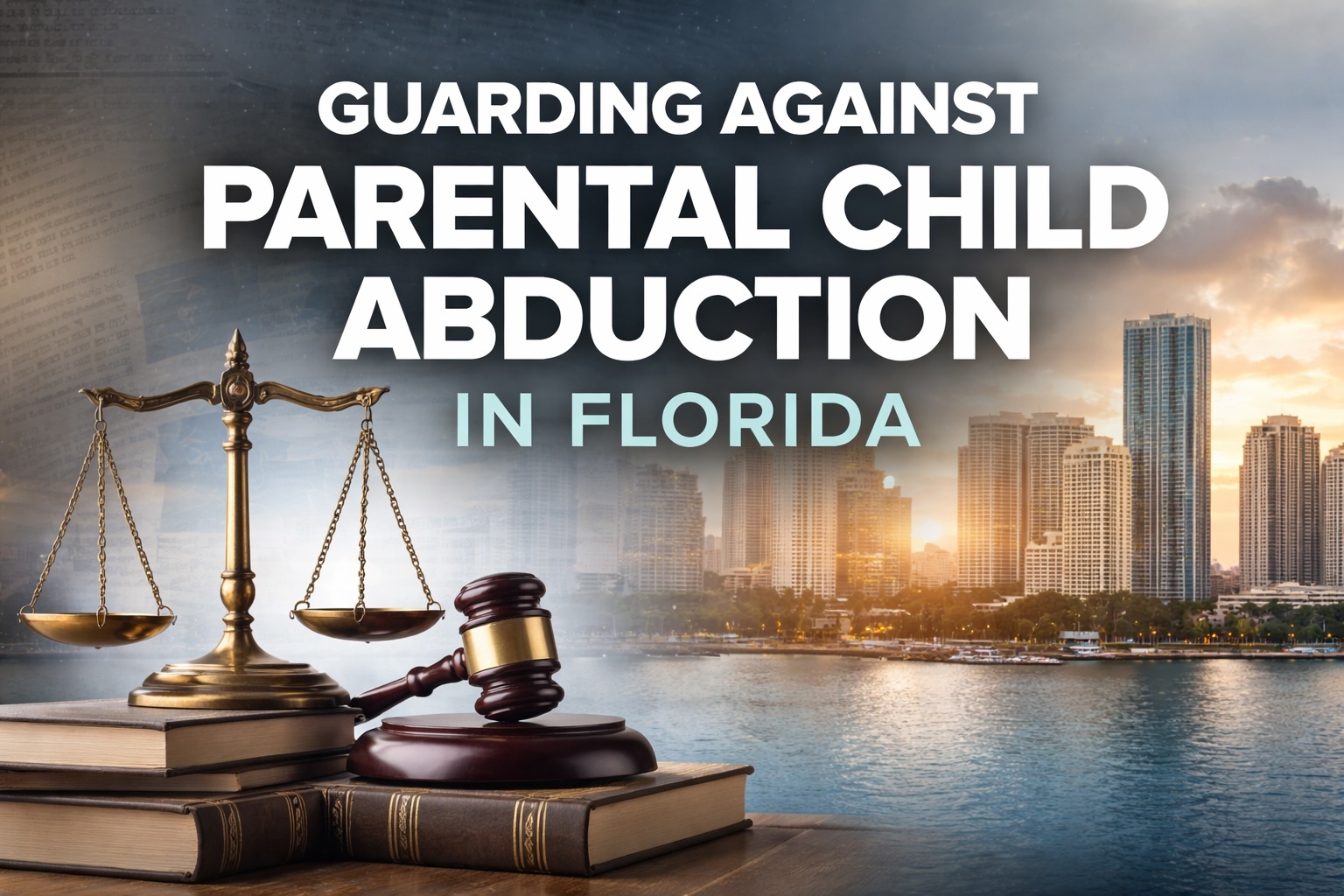
Guarding Against Parental Child Abduction in Florida is a critical concern in high conflict custody and time sharing disputes, particularly in Miami and throughout South Florida where interstate and international travel is frequent. Florida law provides a structured jurisdictional framework, injunctive remedies, statutory risk factors, and international return procedures designed to deter unilateral removals and protect children from wrongful retention or concealment. This analysis examines the Uniform Child Custody Jurisdiction and Enforcement Act, Florida’s public policy against child snatching, evidentiary standards for injunctive relief, statutory abduction risk factors, prosecutorial enforcement authority, and the Hague Convention return mechanism as applied in Florida courts.
Florida’s Jurisdictional Framework Under the UCCJEA
Florida determines subject matter jurisdiction in interstate custody disputes under the Uniform Child Custody Jurisdiction and Enforcement Act codified at sections 61.501 through 61.542, Florida Statutes. See Hindle v. Fuith, 33 So. 3d 782 (Fla. 5th DCA 2010). The statute establishes uniform rules designed to eliminate jurisdictional competition, prevent conflicting custody orders, and deter the use of interstate relocation to obtain tactical advantages.
The stated purposes of the UCCJEA include avoiding jurisdictional conflict, discouraging continuing custody controversies, and deterring abductions and unilateral removals undertaken to obtain custody awards. Fla. Stat. § 61.502. This legislative purpose is central to guarding against parental child abduction in Florida because it reflects express statutory recognition that interstate removal has historically been used to manipulate custody outcomes.
Section 61.514(1), Florida Statutes, provides the exclusive jurisdictional basis for an initial child custody determination in Florida and establishes home state jurisdiction as the primary ground. Fla. Stat. § 61.514. In Burgos v. Vargas, 395 So. 3d 683 (Fla. 3d DCA 2024), Florida appellate authority reaffirmed the necessity of strict adherence to UCCJEA jurisdictional predicates before exercising authority in interstate disputes.
Establishing clear jurisdiction is a foundational preventive measure. When Miami courts enter valid, enforceable custody determinations grounded in section 61.514, those determinations become entitled to interstate enforcement. Jurisdictional clarity reduces incentives for unilateral removal because other states must respect properly entered Florida custody orders.
Florida Public Policy Against Child Snatching
Florida appellate courts have repeatedly recognized a strong public policy against parental child snatching. In Zuccaro v. Zuccaro, 407 So. 2d 389 (Fla. 3d DCA 1981), the court identified deterrence of child snatching as a primary reason for adoption of uniform custody jurisdiction legislation. The court emphasized that preventing unilateral removal is integral to the statutory framework.
Similarly, Pace v. Pace, 510 So. 2d 1031 (Fla. 2d DCA 1987), acknowledged that uniform custody statutes serve to discourage interstate manipulation and promote stability. This policy backdrop supports trial courts in Miami and throughout Florida when fashioning protective provisions within parenting plans that address credible abduction risk.
Public policy alone does not substitute for evidentiary proof. However, when credible indicators of removal or concealment are present, courts interpret statutory authority consistently with Florida’s expressed legislative goal of deterring unilateral removals.
Protective Authority of Florida Trial Courts
Florida trial courts retain broad continuing jurisdiction in custody cases to protect children and address matters affecting their well being. In Richardson v. Richardson, 766 So. 2d 1036 (Fla. 2000), the court recognized that trial courts possess authority to invoke protective mechanisms, including Chapter 39 proceedings, when immediate protection becomes apparent.
In the context of guarding against parental child abduction in Florida, this continuing jurisdiction permits expedited hearings and protective intervention when credible threats of removal arise. Miami courts frequently confront international mobility concerns given the region’s global connections, and judicial authority to act promptly can be decisive.
Standards for Injunctive Relief to Prevent Removal
Injunctive relief is prospective in nature and cannot prevent conduct that has already occurred. Yerex v. Durzo (In re Estate of Yerex), 651 So. 2d 220 (Fla. 4th DCA 1995). The threatened injury must be more than speculative. It must be imminent and probable.
When seeking an injunction to prevent removal of a child from Florida, a parent must demonstrate that the anticipated removal is sufficiently imminent to justify preventive action. Mere suspicion or generalized fear will not satisfy the standard articulated in Yerex. Evidence such as confirmed travel arrangements, recent passport applications, termination of employment, sale of property, or explicit threats strengthens the showing of imminence.
Section 61.11, Florida Statutes, authorizes courts to issue injunctions or other orders to secure compliance when a party is about to remove himself or property from the state. In P.T.S. Trading Corp. v. Habie, 673 So. 2d 498 (Fla. 3d DCA 1996), the court recognized broad equitable authority in appropriate circumstances. While section 61.11 frequently arises in support contexts, its principles reinforce judicial authority to restrain imminent conduct that would frustrate court jurisdiction.
Statutory Abduction Risk Factors and Security Measures
Section 61.45, Florida Statutes, identifies factors relevant to assessing risk that a parent may remove or conceal a child in violation of a parenting plan. Fla. Stat. § 61.45. These factors include prior violations, threats of removal, strong ties to another jurisdiction, dual citizenship, financial incentives to relocate, and conduct consistent with planning departure such as closing accounts or applying for travel documents.
The statute also highlights international considerations, including whether the destination country is not a signatory to the Hague Convention or lacks effective enforcement mechanisms. Fla. Stat. § 61.45. In Miami, where international travel to non Hague jurisdictions is common, these considerations are particularly relevant.
Courts may impose security or bond requirements when justified by the statutory factors. Security mechanisms serve as deterrents by increasing the financial and legal consequences of noncompliance. When supported by record evidence, such conditions align with Florida’s public policy against child snatching as recognized in Zuccaro.
State Attorney Authority and Enforcement
Section 61.538, Florida Statutes, authorizes state attorney involvement in UCCJEA or Hague related matters under specified circumstances, including when there is an existing custody determination or a reasonable belief that a child was wrongfully removed or retained in violation of the Hague Convention. Fla. Stat. § 61.538.
This enforcement authority strengthens the protective framework by enabling coordinated action to locate and return a child. In Miami Dade County, collaboration between family courts and prosecutorial authorities may expedite recovery efforts in urgent cases.
International Abduction and the Hague Convention
The Hague Convention on the Civil Aspects of International Child Abduction establishes procedures for prompt return of children wrongfully removed or retained. In De la Melena v. Panez, 397 So. 3d 253 (Fla. 3d DCA 2024), the court described the return remedy as the central operating feature of Hague proceedings.
Florida courts emphasize that Hague proceedings determine the appropriate forum for custody adjudication rather than the ultimate merits of custody. De Carvalho v. Pereira, 308 So. 3d 1078 (Fla. 3d DCA 2020). This distinction is critical. A successful Hague petition restores the child to the proper jurisdiction, after which substantive custody determinations proceed under domestic law.
For Miami families with international ties, early strategic planning is essential. Identifying destination countries’ Hague status and compliance history informs risk assessment under section 61.45 and supports targeted preventive relief.
Practical Application in Miami Custody Litigation
Guarding Against Parental Child Abduction in Florida requires a coordinated approach. Counsel should establish jurisdiction under section 61.514, seek precise parenting plan language, monitor statutory risk indicators under section 61.45, and pursue injunctive relief when evidence satisfies the imminence standard articulated in Yerex. In international contexts, counsel must evaluate Hague remedies promptly and coordinate with authorities under section 61.538 when appropriate.
Miami’s unique geographic position as a gateway to Latin America and Europe heightens abduction risk in certain cases. Courts in the Eleventh Judicial Circuit regularly confront cross border mobility concerns, making statutory literacy and evidentiary precision indispensable.
Conclusion
Guarding Against Parental Child Abduction in Florida depends upon jurisdictional clarity under the UCCJEA, adherence to statutory risk factors in section 61.45, application of the imminence standard for injunctive relief, and strategic use of Hague Convention return procedures. Florida appellate authority underscores a strong public policy against child snatching, and statutory enforcement mechanisms reinforce that policy. When properly invoked and supported by evidence, these tools collectively deter unilateral removal and protect the stability of children subject to custody litigation.
TLDR: Guarding Against Parental Child Abduction in Florida involves using the UCCJEA jurisdictional framework under sections 61.501 through 61.542, applying statutory risk factors in section 61.45, seeking injunctive relief when removal is imminent under Yerex v. Durzo, and pursuing Hague Convention return remedies as recognized in De la Melena v. Panez. Florida courts prioritize deterrence of child snatching and enforce custody orders to prevent interstate and international abduction.
FAQ
What is the legal basis for preventing parental child abduction in Florida?
Florida relies on the UCCJEA codified at sections 61.501 through 61.542, Florida Statutes, along with statutory risk factors in section 61.45 and equitable injunctive authority recognized in Florida case law.
What must be shown to obtain an injunction preventing removal of a child?
The movant must demonstrate a prospective injury that is imminent and probable, not speculative, as required by Yerex v. Durzo, 651 So. 2d 220 (Fla. 4th DCA 1995).
How does the Hague Convention function in Florida courts?
Hague proceedings focus on prompt return of a wrongfully removed or retained child to the proper jurisdiction, as explained in De la Melena v. Panez, 397 So. 3d 253 (Fla. 3d DCA 2024), and do not determine ultimate custody merits.
Can Florida authorities assist in locating a wrongfully removed child?
Yes. Section 61.538, Florida Statutes, authorizes state attorney involvement under specified conditions in UCCJEA and Hague related matters.
Protect Your Child in Miami Custody Litigation
If you are concerned about the risk of interstate or international removal, early legal intervention is critical. Miami parents should seek counsel experienced in UCCJEA litigation, injunctive practice, and Hague Convention proceedings to implement proactive safeguards. A carefully structured parenting plan, supported by statutory authority and enforceable across jurisdictions, remains the most effective defense against parental child abduction in Florida.