


21 Dec Tax Implications of Alimony in Florida Divorce
Summary
Guide to the tax implications of alimony in Florida divorce, analyzing Fla. Stat. § 61.08, federal tax law changes after 2018, key appellate cases, and how Miami courts structure equitable spousal support awards.
The tax implications of alimony in Florida divorce changed twice in the space of six years, and both changes cut against the assumptions most people still carry into a dissolution case. Federal law stopped treating alimony as deductible to the payor and taxable to the recipient for instruments executed after December 31, 2018. Then, in 2023, the Florida Legislature deleted tax treatment from the list of factors a court must weigh when setting alimony under section 61.08, Florida Statutes.
The practical result is counterintuitive. Taxes matter more than ever to what a spouse actually keeps, and less than ever as a formal item on the court’s checklist. This article explains the current federal rule, the date that determines which rule applies to a given case, what Florida law does and does not require a judge to consider after the 2023 reform, and where tax treatment still drives the number even though it is no longer a named statutory factor.
One caveat at the outset. This is a family law discussion, not tax advice. Anyone structuring a settlement with meaningful dollars at stake should have a CPA or tax attorney run the actual numbers alongside counsel.
The Federal Rule After the Tax Cuts and Jobs Act
For decades, alimony that met the federal definition was deductible by the paying spouse under 26 U.S.C. section 215 and includable in the receiving spouse’s gross income under 26 U.S.C. section 71. That arrangement created real value to divide. A payor in a high bracket deducted at a high rate while the recipient reported the income at a lower one, and the spread between the two brackets was money the couple could allocate between them in negotiation.
Section 11051 of the Tax Cuts and Jobs Act of 2017, Pub. L. No. 115-97, repealed both provisions. Under current federal law, for a divorce or separation instrument executed after December 31, 2018:
- The paying spouse cannot deduct alimony payments.
- The receiving spouse does not include alimony in gross income.
Alimony is now treated, for federal tax purposes, much like any other after-tax transfer between former spouses. The bracket arbitrage that used to subsidize settlements is gone, which means the same dollar figure that worked in a 2017 marital settlement agreement costs the payor substantially more today and is worth correspondingly more to the recipient.
A Florida Court Cannot Order Post-2018 Alimony Taxable
This is not merely a federal filing question. A Florida trial court that writes the old treatment into a final judgment commits reversible error. In Duhamel v. Duhamel, 385 So. 3d 209 (Fla. 2d DCA 2024), the Second District held that a trial court erred in ordering that the former wife’s alimony be treated as taxable income where the final judgment of dissolution was entered after December 31, 2018.
Duhamel is worth reading closely if you are dealing with a judgment that recites tax treatment, because it confirms that the federal change is not something the parties or the court can simply opt out of by drafting.
The Date That Decides Which Rule Applies
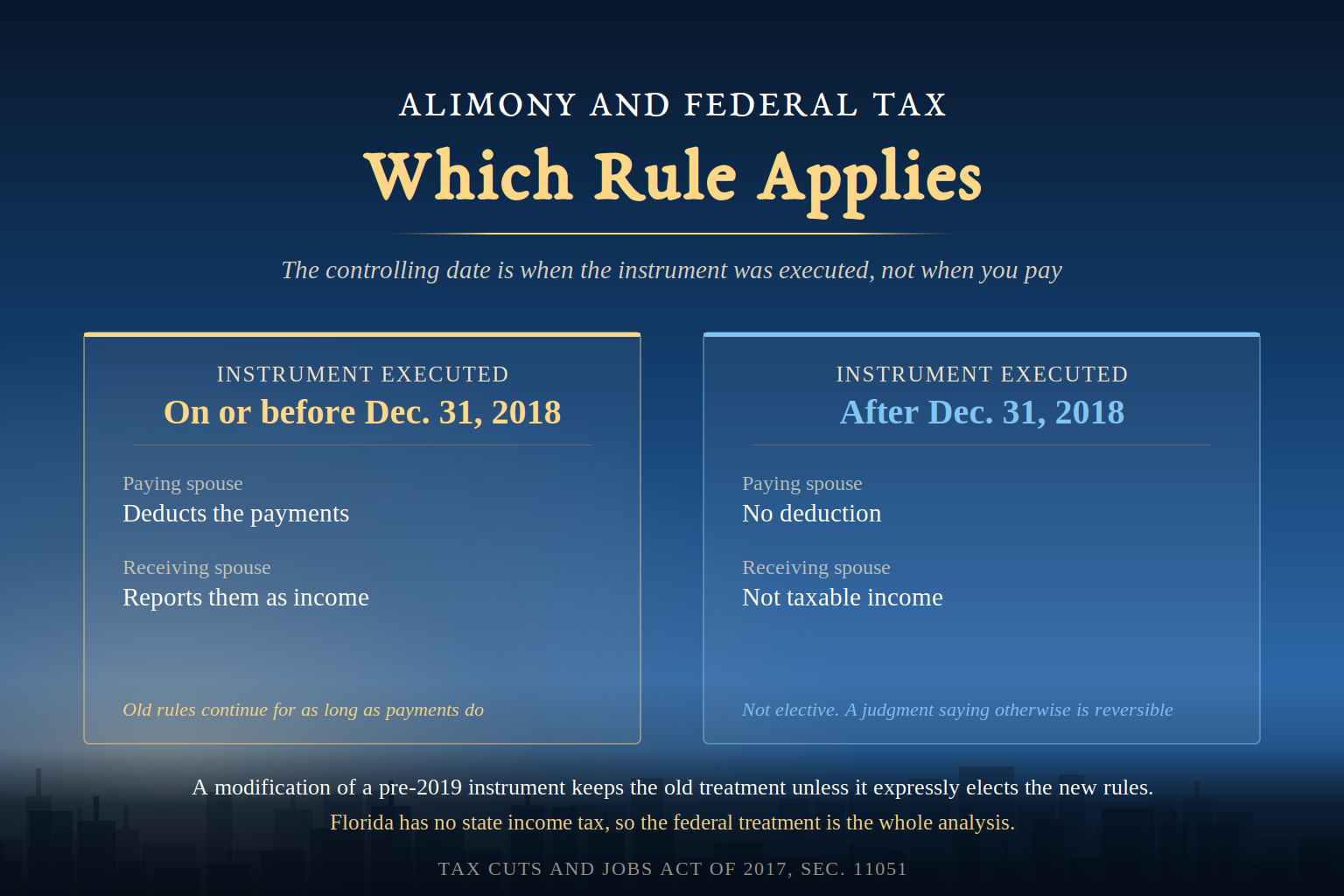
The single most important question in any alimony tax analysis is a date question, and it is not the date of payment. It is the date the divorce or separation instrument was executed.
Instruments Executed After December 31, 2018
The current rule applies. No deduction for the payor, no inclusion for the recipient. Nothing in the agreement can change that, and as Duhamel shows, a judgment that purports to change it is vulnerable on appeal.
Grandfathered Pre-2019 Instruments
A divorce or separation instrument executed on or before December 31, 2018 keeps the old treatment. The payor continues to deduct and the recipient continues to report the income, indefinitely, for as long as payments continue under that instrument. This is a meaningful population of South Florida cases, and it is why the older rules still have to be understood rather than discarded.
The Modification Trap
Here is where grandfathered cases go wrong. A modification of a pre-2019 instrument does not automatically move it to the new regime. The new rules apply to a modified pre-2019 instrument only if the modification expressly provides that the Tax Cuts and Jobs Act amendments apply to it.
That cuts in both directions and makes drafting decisive. A payor who benefits from the deduction can lose it by signing a modification containing that election, often without appreciating what the clause does. A recipient who would rather stop reporting the income has to negotiate for the election affirmatively, because silence preserves the old treatment. Anyone heading into a modification of a pre-2019 order should treat this clause as a negotiated term with a dollar value, not boilerplate. The general standard for modifying alimony is covered in our article on whether alimony can be modified in Miami.
What Florida Law Now Says About Taxes
Until 2023, section 61.08 contained an express tax factor. The pre-reform statute, at section 61.08(2)(h), required a court to consider “the tax treatment and consequences to both parties of any alimony award, including the designation of all or a portion of the payment as a nontaxable, nondeductible payment.” Florida appellate courts enforced it, and failing to make tax findings when the evidence was in the record was reversible.
That factor no longer exists. Senate Bill 1416, enacted as chapter 2023-315, Laws of Florida, removed it. The current version of section 61.08, Florida Statutes contains no reference to tax, taxes, taxable, deductible, or nondeductible anywhere in its text. The eight factors now listed at section 61.08(3) say nothing about tax treatment.
This matters because a great deal of the material available online, including material written by lawyers, still cites section 61.08(2)(h) as though it were current law. It is not, and a litigant who walks into a Miami-Dade courtroom arguing that the judge is statutorily required to make tax findings under that subsection is arguing from a repealed provision.
Where Tax Consideration Now Lives
Removing the named factor did not make tax consequences irrelevant. Section 61.08(3) directs the court to consider the listed factors “including, but not limited to,” and the final factor, section 61.08(3)(h), is a catch-all: “Any other factor necessary for equity and justice between the parties, which shall be specifically identified in the written findings of fact.”
Tax treatment fits squarely within that catch-all. The difference is one of posture. Under the old statute, tax consideration was mandatory and its omission was error. Under the current statute, it is discretionary, and the burden sits with the party who wants the court to account for it to put the evidence in the record and ask for a specific finding under paragraph (h).
The Older Tax Cases, Handled Honestly
A line of Florida decisions reversed alimony awards for failure to make tax findings: Rosaler v. Rosaler, 219 So. 3d 840 (Fla. 4th DCA 2017), Persaud v. Persaud, 244 So. 3d 410 (Fla. 2d DCA 2018), and Tarkow v. Tarkow, 128 So. 3d 82 (Fla. 2d DCA 2013), which held that a trial court erred in approving an alimony reduction that failed to account for the recipient’s federal and state income tax expense.
Each of those decisions construed the enumerated factor that the 2023 Legislature repealed. They are no longer authority for the proposition that a court must consider a specific statutory tax factor. They remain useful as reasoning on why after-tax reality bears on an equitable award, which is exactly the argument that now has to be made under paragraph (h) instead. Citing them as though the mandate survived is the error to avoid.
Where Taxes Still Drive the Number
The strongest point in a modern Florida alimony case is not that taxes are a listed factor. It is that the statute’s arithmetic runs on net income, and net income is a tax concept.
Need and Ability to Pay
Section 61.08(2)(a) requires the court to make a specific factual determination that the party seeking support has an actual need and that the other party has the ability to pay. Neither determination can be made from gross figures. What a recipient actually needs and what a payor can actually afford are both post-tax questions, whatever the factor list says.
The 35 Percent Cap on Durational Alimony
This is the clearest example. Section 61.08(8)(c) caps durational alimony at the recipient’s reasonable need or “an amount not to exceed 35 percent of the difference between the parties’ net incomes, whichever amount is less.” The statutory ceiling is computed on the difference in net incomes, and the statute goes further by fixing how that figure is derived: net income “shall be calculated in conformity with s. 61.30(2) and (3), excluding spousal support paid pursuant to a court order in the action between the parties.” Section 61.30(2) and (3) is the child support guidelines machinery for gross income and allowable deductions, and those deductions are tax items. So the alimony ceiling is, by express statutory cross-reference, a tax-adjusted number. Get the tax treatment wrong and the cap itself is wrong. Our article on durational alimony in Florida works through that calculation, and the broader framework appears in our discussion of Florida alimony after the 2023 reform.
The Net Income Floor for the Payor
Section 61.08(9) provides that an award “may not leave the payor with significantly less net income than the net income of the recipient unless there are written findings of exceptional circumstances.” Again, net. Because post-2018 alimony is paid with after-tax dollars and received tax-free, the same nominal award moves the parties’ relative net positions further than an identical award would have before 2019.
Findings Still Have to Show the Work
In Ogle v. Ogle, 334 So. 3d 699 (Fla. 1st DCA 2022), the First District remanded for specific factual findings and net income calculations demonstrating how those figures were used to determine the support obligations. That requirement is entirely independent of the repealed tax factor, and it is the practical hook for getting tax-adjusted numbers into a judgment.
The Designation Power and Whether It Still Matters
Before the Tax Cuts and Jobs Act, Florida courts had authority to structure an award so that it fell outside the federal deduction and inclusion rules. In Rykiel v. Rykiel, 838 So. 2d 508 (Fla. 2003), the Florida Supreme Court held that a trial court may order that alimony payments be excluded from the payee’s gross income and not deducted by the payor, provided the designation is clearly stated. Almodovar v. Almodovar, 754 So. 2d 861 (Fla. 3d DCA 2000), had addressed related structuring, and it was reviewed in the line of authority leading to Rykiel.
For instruments executed after 2018 this power is largely spent, because federal law already produces the nondeductible and nontaxable result automatically. The designation authority retains practical significance mainly for grandfathered pre-2019 instruments and for drafting clarity where a judgment might otherwise be ambiguous about the character of a payment.
Structuring Around the Loss of Deductibility
High-asset Miami cases have responded to the loss of the deduction in fairly predictable ways. None of these is a loophole, and each has consequences beyond tax that belong in the analysis.
- Shifting value into equitable distribution. A transfer of property incident to divorce is generally not a taxable event between the spouses, so allocating more property and less periodic support can be efficient. The tradeoff is that property division is final and not modifiable, while support may be modifiable.
- Lump sum alimony. A lump sum award behaves more like a property award: it is generally not modifiable and does not terminate on death or remarriage the way periodic support does. Classification therefore still matters a great deal for enforcement and termination even though it no longer changes the federal tax result for post-2018 instruments.
- Retirement asset transfers. Dividing a qualified plan by a qualified domestic relations order moves value without triggering immediate tax, though the receiving spouse takes the deferred tax liability with it. A pre-tax dollar in a retirement account is not worth the same as a post-tax dollar in a bank account, and a settlement that treats them as equivalent has quietly favored one side.
The general tax landscape of a Florida divorce is covered in our article on how divorce affects your taxes in Florida, and the dependency exemption question in who claims children on taxes after divorce. Note that child support has never been deductible or taxable, before or after the 2017 Act.
Miami-Dade Considerations
Florida has no state income tax, so the federal treatment is effectively the whole analysis. That simplifies one thing and sharpens another: because there is no state layer to argue about, the accuracy of the federal net income figures carries the entire weight of the ability-to-pay determination.
Miami practice complicates those figures in specific ways. Self-employed spouses, closely held businesses, distributions that are not salary, real estate income, and assets or income sources outside the United States all make “net income” a contested expert question rather than a line on a W-2. In the Family Division of the Eleventh Judicial Circuit, alimony cases of any size routinely turn on whose tax-adjusted numbers the court accepts, which is a discovery and expert problem before it is a legal one.
Conclusion
Three points carry most of the weight. First, for any divorce or separation instrument executed after December 31, 2018, alimony is neither deductible by the payor nor taxable to the recipient, and a Florida judgment saying otherwise is reversible under Duhamel. Second, pre-2019 instruments keep the old treatment unless a modification expressly elects into the new rules, which makes that clause a negotiated term worth real money. Third, Florida’s express statutory tax factor was repealed in 2023, so tax consequences now enter through the catch-all at section 61.08(3)(h) and, more powerfully, through the net income figures that drive need, ability to pay, the 35 percent cap, and the payor’s net income floor.
Anyone still working from the pre-2019 deduction assumption, or from a citation to the repealed section 61.08(2)(h), is working from a framework that no longer exists.
Speak With a Miami Alimony Lawyer
If you are negotiating or litigating alimony in Miami-Dade or Broward County, the after-tax number is the only one that matters to your household, and it is rarely the number on the face of the agreement. An experienced Miami alimony attorney can build the net income record the statute actually runs on, structure a settlement that accounts for the loss of deductibility, and make sure a modification of an older order does not give away a tax position by accident. Learn more about our approach to alimony and spousal support matters.
Frequently Asked Questions
Is alimony taxable in Florida?
Florida has no state income tax, so the question is entirely federal. For a divorce or separation instrument executed after December 31, 2018, alimony is not deductible by the payor and not included in the recipient’s gross income. For instruments executed on or before that date, the older deductible and taxable treatment continues to apply.
Which date controls, the date I pay or the date of the divorce?
Neither. The controlling date is when the divorce or separation instrument was executed. Payments made today under a 2016 agreement still follow the pre-2019 rules.
If I modify an old alimony order, do the new tax rules kick in?
Not automatically. A modification of a pre-2019 instrument moves it to the current rules only if the modification expressly provides that the Tax Cuts and Jobs Act amendments apply. Silence preserves the old treatment, so the clause should be a deliberate decision on both sides.
Does a Florida judge have to consider tax consequences when setting alimony?
Not as a named statutory factor any more. The 2023 reform removed the tax factor formerly at section 61.08(2)(h). A court may still consider tax consequences under section 61.08(3)(h), the catch-all for any other factor necessary for equity and justice, but the party who wants that consideration has to put the evidence in and ask for the finding.
Then why do taxes still matter to my alimony number?
Because the statute’s math runs on net income. Need and ability to pay are post-tax questions, the durational alimony ceiling is capped at 35 percent of the difference between the parties’ net incomes, and section 61.08(9) bars an award that leaves the payor with significantly less net income than the recipient absent written findings of exceptional circumstances.
Can we just agree that the payor gets the deduction?
No. For post-2018 instruments the federal treatment is not elective. A judgment purporting to make post-2018 alimony taxable to the recipient was reversed in Duhamel v. Duhamel, 385 So. 3d 209 (Fla. 2d DCA 2024).
Is child support treated the same way?
No, and it never was. Child support has always been neither deductible by the payor nor taxable to the recipient, independent of the 2017 Act.
Does the loss of the deduction justify modifying my alimony?
A change in tax law is not itself a substantial change in circumstances, and a pre-2019 order keeps its old treatment regardless. Where after-tax reality has genuinely shifted a party’s need or ability to pay, that financial change, rather than the tax law, is what supports a modification petition.