
07 Jan Who Qualifies for Alimony in Florida?
Summary
Florida alimony is awarded only when one spouse demonstrates a financial need for support and the other spouse has the ability to pay under Florida Statutes § 61.08. Miami courts evaluate factors such as the length of the marriage, the standard of living during the marriage, each spouse’s earning capacity, and recent legal reforms that eliminated permanent alimony when determining eligibility for spousal support.
The question of who qualifies for alimony in Florida is one of the most heavily litigated issues in Miami-Dade divorce practice, and one of the most widely misunderstood. Spousal support is not a default consequence of divorce. It is not a percentage of the payor’s income, it is not an automatic reward for a long marriage, and it is not an entitlement that attaches because one spouse earns more than the other. Under Florida Statutes section 61.08, alimony is available only when the party asking for it proves two specific things, and then only in the forms and for the durations the Legislature has authorized.
This article works through the eligibility rules in detail: the threshold test of need and ability to pay, who carries the burden of proving each element, which version of the statute governs a given case, how the length of the marriage operates as a gateway rather than merely a measurement, the statutory factors the court must weigh, and the separate eligibility requirements attached to each of the four surviving forms of alimony. The 2023 reform legislation changed a great deal of this, and a spouse still working from pre-2023 assumptions about permanent support is reasoning from a framework that no longer exists.
The Statutory Framework Governing Who Qualifies for Alimony in Florida
Section 61.08 is the controlling statute. It authorizes a court, in a proceeding for dissolution of marriage, to award “temporary, bridge-the-gap, rehabilitative, or durational alimony, as is equitable.” Permanent alimony is absent from that list, and its absence is deliberate. The 2023 amendments removed permanent periodic alimony as an available remedy in Florida. The background to that legislation is covered in our discussion of Florida alimony after the 2023 reform.
The practical consequence is significant. A spouse married for thirty years who would, under the prior statute, have had a strong claim to permanent support is now limited to durational alimony, subject to the caps discussed below. The Fourth District Court of Appeal applied this directly in Edman v. Edman, 407 So. 3d 452 (Fla. 4th DCA 2025), reversing a permanent alimony award because permanent alimony was not an authorized remedy under the governing version of the statute. That holding matters for eligibility in a specific way: a claim framed around a form of support the statute no longer authorizes fails regardless of how sympathetic the underlying facts are.
Edman also illustrates the findings requirement. Section 61.08(2)(b) directs that the court “shall include written findings of fact relative to the factors provided in subsection (3) supporting an award or denial” of alimony. In Edman, the trial court’s judgment lacked the required determinations, and the appellate court said so. A final judgment that grants or denies support without those findings is vulnerable, which is why the evidentiary record built during the case matters as much as the argument made at trial.
Which Version of the Statute Applies to Your Case
Before anything else, a Florida court has to decide which alimony statute governs. Section 61.08(11) supplies the rule: “The court shall apply this section to all initial petitions for dissolution of marriage or support unconnected with dissolution of marriage pending or filed on or after July 1, 2023.”
For a case filed after July 1, 2023, this is straightforward. For older cases it is not, and the Florida district courts of appeal are currently split on what “pending” means. The Second District has held that an initial petition remains pending through final disposition on appeal, so that a case still in the appellate pipeline after July 1, 2023 is governed by the amended statute. See Woodward v. Woodward, 400 So. 3d 861 (Fla. 2d DCA 2025), and Morgan v. Morgan, 427 So. 3d 599 (Fla. 2d DCA 2026). The Fifth District has taken the opposite view, holding that an initial petition stops being pending once the trial court renders its written final judgment, whether or not an appeal follows, and certifying express and direct conflict with the Second District on the point. See Hawryluk v. Hawryluk, 433 So. 3d 893 (Fla. 5th DCA 2026).
This is not an academic distinction. It determines whether permanent alimony is still on the table in an older case, and whether the durational caps and the 35 percent limit discussed below apply at all. Anyone litigating an alimony issue arising from a pre-July 2023 petition, or returning to court on remand in such a case, should treat the applicable version of section 61.08 as a live question rather than an assumption.
The Threshold Test: Actual Need and Ability to Pay
Before a Florida court reaches the statutory factors, the type of alimony, or the amount, it must clear a threshold. Section 61.08(2)(a) provides that in determining whether to award alimony, “the court shall first make a specific, factual determination as to whether the party seeking support, maintenance, or alimony has an actual need for it and whether the other party has the ability to pay.”
Both elements are required. Need without ability to pay produces no award. Ability to pay without demonstrated need produces no award either. This is the single most important concept in understanding who qualifies for alimony in Florida, and it is where most contested alimony claims are actually won or lost.
Proving Actual Need
Need is not a general sense of financial strain, and it is not the gap between two incomes. It is a documented shortfall between a spouse’s reasonable monthly expenses and that spouse’s own income and resources. Courts look to financial affidavits, testimony about household expenses, bank and credit card records, and evidence of the standard of living established during the marriage.
The marital standard of living is a reference point, not a guarantee. The statute directs the court to consider it, but Florida law does not promise either party that the marital lifestyle survives the divorce intact. In most cases the same income that supported one household now supports two, and both spouses absorb some reduction.
The Fourth District’s decision in Wallace v. Wallace, 418 So. 3d 148 (Fla. 4th DCA 2025), shows how a need claim fails. The trial court had awarded durational alimony to the former husband, and the appellate court reversed. Two of the errors bear directly on eligibility. First, the trial court calculated the husband’s income using a part-time hourly rate with no evidence supporting his inability to work full time, despite record evidence that he had previously held two full-time jobs. Second, and more fundamentally, the husband presented no evidence of actual monthly needs beyond his financial affidavits, which showed minimal or no deficit. A financial affidavit that does not show a shortfall is affirmative evidence against the claim.
The same opinion disposes of the most common lay assumption about alimony. Trial courts are not required to equalize the financial positions of the parties. Income disparity is not need. A spouse earning $50,000 opposite a spouse earning $200,000 does not qualify for alimony on that arithmetic alone. That spouse qualifies only by proving that $50,000 does not cover reasonable expenses.
Proving Ability to Pay
The second element looks to the other spouse’s net income, assets, liabilities, and reasonable living expenses. The analysis runs on net income rather than gross, a distinction appellate courts enforce. In Woodward v. Woodward, 400 So. 3d 861 (Fla. 2d DCA 2025), the Second District reversed in part because the trial court had calculated ability to pay using gross rather than net income, and remanded for recalculation.
Woodward also confirms a ceiling that operates independently of the payor’s wealth: an award of alimony that exceeds the recipient spouse’s need is an abuse of discretion. A high-earning spouse’s capacity to pay does not enlarge the other spouse’s entitlement. Need sets the maximum; ability to pay determines whether that maximum is attainable. (Woodward is the Second District decision involved in the certified conflict described above, but that conflict concerns only the meaning of “pending” in section 61.08(11). It does not disturb the need ceiling, which Florida appellate courts apply consistently.)
Section 61.08(9) adds a further limit that functions as a practical constraint at the margins: an award “may not leave the payor with significantly less net income than the net income of the recipient unless there are written findings of exceptional circumstances.”
Who Carries the Burden
The statute allocates the burden explicitly. Section 61.08(2)(a) provides that the party seeking support “has the burden of proving his or her need for support, maintenance, or alimony and the other party’s ability to pay.” That allocation is why a well-documented case routinely beats a sympathetic one. The requesting spouse must prove both halves of the test, including the other side’s finances, which is why mandatory disclosure, written discovery, and where necessary the deposition of the opposing spouse are central to an alimony claim rather than peripheral to it. Where one spouse controls a business or the household financial records, assembling that proof is often the most demanding part of the case. Related problems arise where assets have been moved or concealed, which we address in our discussion of financial circumstances at the time of divorce.
Voluntary Unemployment and Imputed Income
A spouse cannot manufacture need, and a spouse cannot manufacture an inability to pay. Where a party is voluntarily unemployed or voluntarily underemployed, Florida courts may impute income, meaning the court treats that party as earning what he or she is capable of earning rather than what the party actually reports. Courts look to the standards developed under section 61.30 in making that determination, examining recent work history, occupational qualifications, and prevailing earnings in the community.
Imputation cuts both ways and frequently decides eligibility outright. An imputed figure can erase a claimed shortfall, defeating the need element, as the income findings in Wallace illustrate. It can equally establish an ability to pay that a payor’s reported income appears to rule out. Our article on imputed income in Florida alimony cases covers the proof required.
Length of the Marriage Is an Eligibility Gateway, Not Just a Measurement
Length of marriage is listed among the statutory factors, but under the current statute it does more than inform the court’s discretion. It determines which forms of alimony are available at all, and it caps how long support can run.
How Florida Classifies Marriages
Section 61.08(5) establishes a rebuttable presumption classifying marriages into three categories:
- Short-term marriage: a duration of less than 10 years.
- Moderate-term marriage: a duration between 10 and 20 years.
- Long-term marriage: a duration of 20 years or longer.
The word “presumption” is doing real work here. These classifications are the starting point, not a fixed rule, and a party who can show why the presumed classification does not fit the marriage may argue for a different one. That argument is worth making, because the category selected determines the duration cap discussed below.
Duration is measured from the date of the marriage to the date of filing of the action for dissolution, not to the date of separation and not to the date of final judgment. Spouses who separated years before either of them filed are frequently surprised by this. A marriage that felt finished in year nine but was not the subject of a petition until year eleven is a moderate-term marriage. Where the marriage is on the shorter side, the analysis narrows considerably, and we cover it separately in our article on alimony after a short marriage in Florida.
The Three-Year Bar
Section 61.08(8)(a) contains a hard eligibility rule with no equivalent in the pre-2023 statute: “Durational alimony may not be awarded following a marriage lasting less than 3 years.”
This is not a factor to be weighed. It is a bar. A spouse whose marriage lasted two years and ten months as of the filing date cannot receive durational alimony no matter how severe the need, no matter how substantial the other spouse’s income, and no matter how the statutory factors otherwise line up. That spouse may still be eligible for temporary support during the case, and potentially for bridge-the-gap alimony, but the durational door is closed.
The Statutory Factors
Once the threshold determination is made, section 61.08(3) requires the court to consider, and to make written findings on, the following factors in setting the type and amount of support:
- The duration of the marriage.
- The standard of living established during the marriage, and the anticipated needs and necessities of life for each party after the divorce.
- The age and the physical, mental, and emotional condition of each party, including whether either party is disabled and the resulting impact on that party’s ability to be self-supporting.
- The resources and income of each party, including the marital and nonmarital assets and liabilities distributed to each.
- The earning capacities, educational levels, vocational skills, and employability of the parties, and when applicable, the time necessary for either party to acquire sufficient education or training to find appropriate employment.
- The contribution of each party to the marriage, including homemaking, child care, education, and career building of the other party.
- The responsibilities each party will have with regard to any minor children.
- Any other factor necessary for equity and justice between the parties, which must be specifically identified in the written findings.
Two of these deserve particular attention in eligibility disputes. The fourth factor ties alimony to property division: a spouse who receives substantial income-producing assets in equitable distribution may have correspondingly less need, and opposing counsel will make that argument. The fifth factor is where imputed income is litigated, for the reasons described above.
Eligibility for Each Form of Alimony
Clearing the threshold test establishes that some form of support is appropriate. It does not establish which one. Each of the four forms carries its own requirements and its own statutory limits.
Temporary Alimony
Temporary alimony, often called pendente lite alimony, supports a spouse during the pendency of the case. Its function is to preserve financial stability and rough parity of resources while the divorce proceeds, and it terminates at final judgment. Because it is measured against present circumstances rather than a long-term plan, it is frequently the first relief sought where one spouse controls the income or has cut off access to marital accounts. An award of temporary support says nothing definitive about what, if anything, will be awarded at the end of the case.
Bridge-the-Gap Alimony
Bridge-the-gap alimony assists a spouse in making the transition from married to single life by meeting identifiable short-term needs. The familiar examples are the first several months of rent on a new residence, a security deposit, or a vehicle for a spouse who relied on a shared car.
Two limits define eligibility. Under section 61.08(6), an award of bridge-the-gap alimony may not exceed 2 years, and it is not modifiable in either amount or duration. The non-modifiability cuts both ways: the recipient cannot return to court for more, and the payor cannot come back seeking a reduction after a job loss. It terminates on the death of either party or on the remarriage of the recipient. A fuller treatment appears in our article on who qualifies for bridge-the-gap alimony in Florida.
Rehabilitative Alimony
Rehabilitative alimony funds a spouse’s return to self-support through education, training, or the redevelopment of previously held credentials. Eligibility here carries a documentary requirement the other forms do not: the award must be supported by a specific and defined rehabilitative plan. A general statement that a spouse intends to go back to school is insufficient. The plan needs to identify the program, the cost, and the timeline.
Section 61.08(7)(c) caps the length of a rehabilitative award at 5 years. This form is most often appropriate for a spouse who left the workforce to raise children or to support the other spouse’s career and who has a realistic path back to employment. Our discussion of rehabilitative alimony in Miami covers the plan requirement in depth.
Durational Alimony
Durational alimony provides support for a set period following a marriage of three years or more, where neither bridge-the-gap nor rehabilitative alimony is appropriate. It is the form most heavily litigated after the 2023 reform, because it is what replaced permanent alimony for long marriages. Section 61.08(8) constrains it in three ways.
The three-year bar, section 61.08(8)(a). Durational alimony may not be awarded following a marriage lasting less than 3 years.
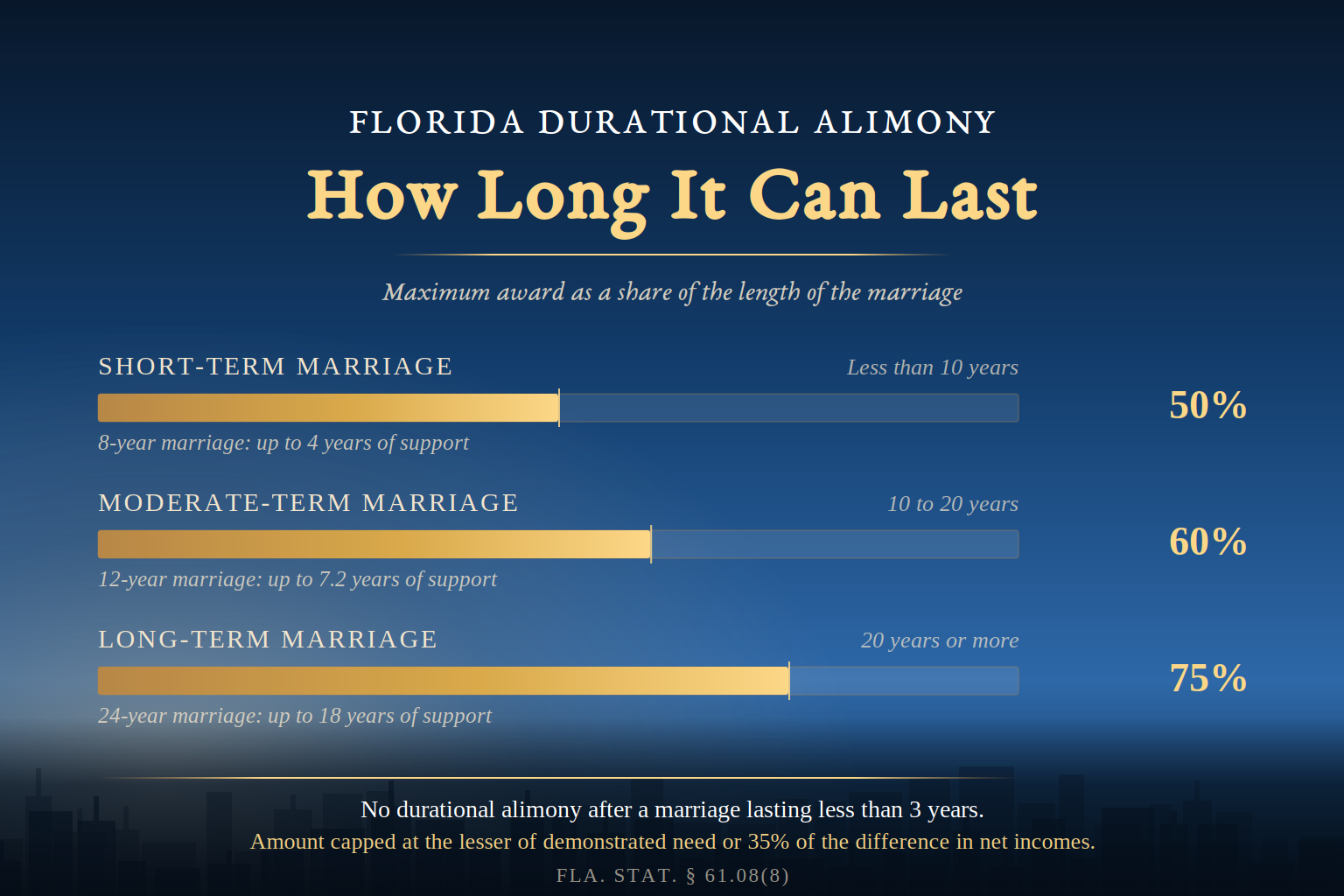
The duration caps, section 61.08(8)(b). An award may not exceed 50 percent of the length of a short-term marriage, 60 percent of the length of a moderate-term marriage, or 75 percent of the length of a long-term marriage. A 24-year marriage therefore supports a durational award of up to 18 years, not 24. A 12-year marriage supports up to 7.2 years. A 6-year marriage supports up to 3 years. The statute permits a court to extend an award beyond these limits under limited circumstances, but the extension requires clear and convincing evidence and specific written findings, and it is the exception rather than the norm.
The amount cap, section 61.08(8)(c). The amount of durational alimony is the recipient’s reasonable need, or an amount not to exceed 35 percent of the difference between the parties’ net incomes, whichever amount is less. Both halves of that formula bind. A spouse with a proven need of $3,000 per month does not receive $3,000 if 35 percent of the net income difference is $2,200. The statute also fixes how that figure is derived: net income “shall be calculated in conformity with s. 61.30(2) and (3), excluding spousal support paid pursuant to a court order in the action between the parties.”
Our article on durational alimony in Florida works through the calculation in more detail.
What Reduces, Bars, or Ends Eligibility
Adultery
Florida is a no-fault state, and marital misconduct does not by itself create or destroy entitlement to support. Section 61.08(1)(b) permits the court to consider “the adultery of either spouse and the circumstances thereof in determining the amount of alimony, if any, to be awarded.” In practice the consideration is almost always economic: marital funds spent on an affair are the version of this argument that gains traction, because it is a depletion of marital assets rather than a moral claim. We address the distinction in our article on adultery and alimony in Florida.
Supportive Relationships
Under section 61.14(1)(b), alimony may be reduced or terminated where the recipient is in a supportive relationship with a person to whom the recipient is not related by consanguinity or affinity. The statute lists the circumstances the court examines, including whether the parties hold themselves out as a married couple, the extent to which they have pooled assets or income, and the length of time they have resided together. The obligor carries the initial burden of proving that the relationship exists or existed within the preceding year. This issue is covered in our article on alimony and cohabitation.
Nominal Awards Where There Is No Present Ability to Pay
Where a spouse establishes entitlement but the other spouse genuinely cannot pay at present, a court may award a nominal sum and retain jurisdiction, preserving the ability to revisit the award if circumstances change. The Fourth District took that approach in Atkinson v. Atkinson, 429 So. 3d 526 (Fla. 4th DCA 2026), where the evidence showed the former husband’s finances would likely improve after the sale of the marital home and the elimination of the associated expenses. Atkinson reasons in terms of permanent periodic alimony and therefore arises from a case governed by the pre-2023 statute, but the underlying principle, that a present inability to pay need not permanently foreclose a meritorious claim, remains instructive.
Later Changes
Eligibility determined at final judgment is not always permanent. Durational and rehabilitative awards may be modified on a showing of a substantial, material, involuntary, and unanticipated change in circumstances; bridge-the-gap awards may not. Our article on whether alimony can be modified addresses the standard.
How Miami-Dade Courts Apply These Rules
Alimony cases in Miami-Dade County are heard in the Family Division of the Eleventh Judicial Circuit. The statutory framework is identical statewide, but the evidentiary reality in Miami is distinctive in ways that affect both halves of the threshold test.
Housing costs drive the need analysis. A monthly expense figure that would look inflated elsewhere in the state can be entirely reasonable in Miami-Dade. The reverse is also true: a spouse who builds a need claim on a Brickell or Coral Gables lifestyle that the marital income never actually supported should expect those numbers to be challenged line by line.
Income proof is frequently contested. Miami practice involves a high proportion of self-employed spouses, closely held businesses, cash-intensive operations, real estate holdings, and assets or income sources located outside the United States. Where income cannot be established from a W-2, ability to pay becomes a forensic question rather than an arithmetic one, often requiring business records, tax returns, a lifestyle analysis, and in some cases a forensic accountant. A spouse seeking support in that setting should expect the case to turn on discovery.
Conclusion
Who qualifies for alimony in Florida comes down to proof. The requesting spouse must establish an actual need and the other spouse’s ability to pay, and carries the burden on both. The court must then make written findings on the statutory factors and select a form of support the Legislature still authorizes, within the limits it has set: two years for bridge-the-gap, five years for rehabilitative, and for durational alimony a three-year minimum marriage, a duration capped at 50, 60, or 75 percent of the length of the marriage, and an amount capped at the lesser of demonstrated need or 35 percent of the difference in net incomes. Permanent alimony is not among the options for cases governed by the current statute, and for older cases, which statute governs is itself a contested question on which the district courts of appeal are split.
None of this is resolved by a formula. It is resolved by the quality of the financial record each side builds, which is why outcomes so often track the preparation rather than the equities.
Speak With a Miami Alimony Lawyer
If you are contemplating a divorce in Miami-Dade or Broward County and need to understand whether you qualify for alimony, or whether you are exposed to paying it, the analysis begins with your financial picture and your spouse’s. An experienced Miami alimony attorney can evaluate your circumstances under section 61.08, identify what the record will need to show, and advocate for an outcome that reflects it. Learn more about our approach to alimony and spousal support matters.
Frequently Asked Questions
Is alimony automatic in a Florida divorce?
No. Under section 61.08(2)(a), a Florida court awards alimony only after making a specific factual determination that the requesting spouse has an actual need for support and that the other spouse has the ability to pay. The requesting spouse bears the burden of proving both.
Does a higher income automatically mean my spouse qualifies for alimony?
No. Florida courts are not required to equalize the parties’ financial positions, as the Fourth District confirmed in Wallace v. Wallace, 418 So. 3d 148 (Fla. 4th DCA 2025). Income disparity by itself does not establish need. The spouse requesting support must show an actual shortfall between reasonable expenses and available income and resources.
What types of alimony exist in Florida?
Four: temporary, bridge-the-gap, rehabilitative, and durational. Permanent alimony was eliminated by the 2023 amendments, which section 61.08(11) applies to initial petitions pending or filed on or after July 1, 2023.
How long does a marriage have to last to qualify for alimony?
There is no minimum for temporary or bridge-the-gap alimony. Durational alimony, however, may not be awarded following a marriage lasting less than three years. Marriage length is measured from the date of marriage to the date the dissolution petition is filed.
How long can durational alimony last?
Under section 61.08(8)(b) it may not exceed 50 percent of the length of a short-term marriage (under 10 years), 60 percent of a moderate-term marriage (10 to 20 years), or 75 percent of a long-term marriage (20 years or more), subject to a narrow exception requiring clear and convincing evidence. Those categories are rebuttable presumptions under section 61.08(5) rather than fixed definitions.
Is there a cap on the amount of alimony?
Yes, for durational alimony. The amount is the recipient’s reasonable need or 35 percent of the difference between the parties’ net incomes, whichever is less. Separately, section 61.08(9) provides that an award may not leave the paying spouse with significantly less net income than the recipient absent written findings of exceptional circumstances.
Can the court use income I am not actually earning?
Yes. Where a spouse is voluntarily unemployed or voluntarily underemployed, a Florida court may impute income based on recent work history, qualifications, and prevailing earnings in the community. Imputation can defeat a need claim or establish an ability to pay that reported income appears to rule out.
Does adultery affect who qualifies for alimony?
Adultery does not create or defeat entitlement. Section 61.08(1)(b) allows the court to consider adultery and the circumstances surrounding it in determining the amount of alimony, and the argument carries the most weight where marital funds were spent on the affair.
Can alimony be modified or terminated later?
Durational and rehabilitative alimony may be modified on a showing of a substantial, material, involuntary, and unanticipated change in circumstances. Bridge-the-gap alimony is not modifiable. Alimony may also be reduced or terminated if the recipient enters a supportive relationship under section 61.14(1)(b).