
25 Mar When Can Child Support Be Reduced in Florida?
Summary
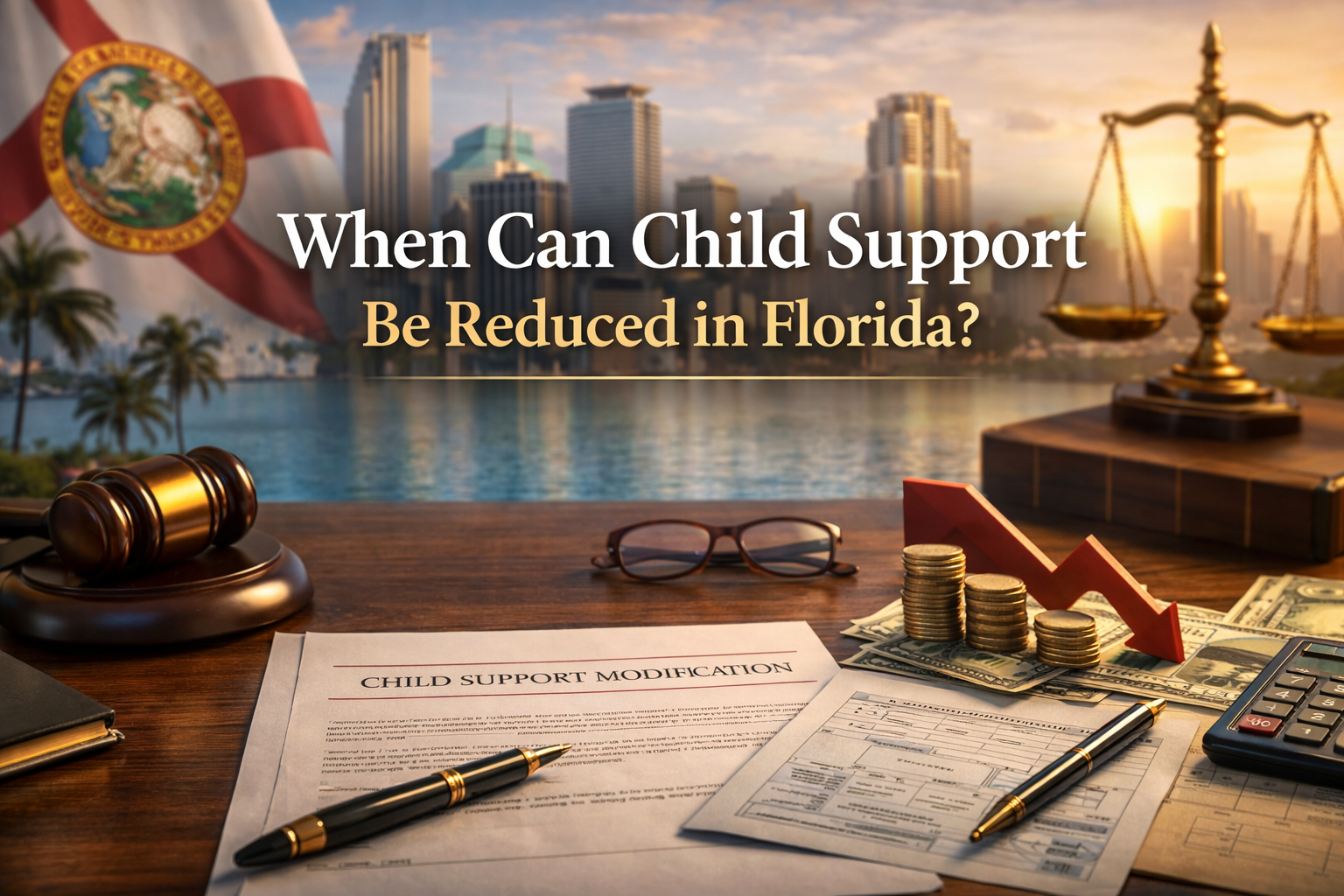
Florida courts may reduce child support only when the requesting party demonstrates a substantial, involuntary, and permanent change in circumstances under Fla. Stat. §§ 61.13 and 61.14. Families in South Florida facing changed financial conditions should consult a Florida family law attorney to evaluate their modification options.
For parents navigating the Florida family court system, understanding when and how to reduce child support in Florida is one of the most consequential questions they may face. Child support orders are not permanent fixtures; rather, they are intended to reflect the financial realities of both parents and the ongoing needs of the child. When those realities change materially, the law provides a pathway to revisit and, where justified, to reduce the existing obligation. That said, the legal standards governing modification are exacting, and courts do not grant reductions lightly. This article examines the statutory framework, the case law interpreting it, the procedural requirements that apply in Miami-Dade County and throughout Florida, and the specific circumstances that courts have found sufficient to warrant a downward modification of child support.
Families in Miami and across South Florida often encounter dramatic shifts in economic circumstances, whether due to job loss, illness, business failure, or changes in timesharing arrangements. When such changes occur, it is essential to act promptly and to understand the precise legal requirements that must be satisfied before a court will agree to reduce a support obligation. The analysis begins with the foundational statutes that govern modification proceedings in this state.
The Statutory Framework for Reducing Child Support in Florida
Florida law establishes a clear, though demanding, statutory basis for modifying child support. Under Fla. Stat. § 61.13, a court possesses the authority to modify a child support order whenever there is a substantial change in the circumstances of the parties or the minor child. This provision is the primary mechanism through which a paying parent seeks to reduce child support in Florida, and it reflects the legislature’s recognition that financial circumstances can shift in ways that make strict enforcement of an original order inequitable.
Complementing this provision is Fla. Stat. § 61.14, which governs the enforcement and modification of support agreements and orders generally. Section 61.14 authorizes either party to apply to the court for an upward or downward modification of a support order as equity requires, provided the change in circumstances justifies the requested relief. Together, sections 61.13 and 61.14 form the legislative architecture within which all modification proceedings are conducted, and they make clear that neither parent holds a unilateral right to alter a court-ordered obligation simply because circumstances have become inconvenient. A formal judicial proceeding is required, and the burden rests squarely on the petitioning party.
Beyond modification, the guidelines themselves are addressed in Fla. Stat. § 61.30, which establishes the formula courts use to calculate presumptive child support amounts based on the combined net incomes of both parents and the percentage of overnights each parent exercises. Any deviation from the guideline amount, whether upward or downward, must be supported by written findings. It is within this statutory architecture that courts evaluate all petitions to reduce child support in Florida, and any attorney or self-represented litigant who overlooks the interplay among these three statutes is likely to encounter significant obstacles in court.
What Qualifies as a Substantial Change in Circumstances
The threshold requirement for any effort to reduce child support in Florida is proof of a substantial change in circumstances. However, not every financial setback, career transition, or lifestyle adjustment will satisfy this standard. Florida courts have consistently applied a three-part test, articulated most recently by the First District Court of Appeal in Arrington v. Arrington, 316 So. 3d 417 (Fla. 1st DCA 2021), which requires the petitioning party to demonstrate that: (1) a substantial change has occurred; (2) the change was not contemplated at the time the original order was entered; and (3) the change is sufficient, material, involuntary, and permanent in nature.
Each of these three prongs must be established independently. Satisfying one or two is insufficient. A court reviewing a petition to reduce child support will scrutinize the evidence carefully to determine whether all three criteria are met before it exercises its equitable power to grant relief. Because this conjunctive test is demanding by design, petitioners must approach modification proceedings with comprehensive financial documentation, credible testimony, and a clear factual narrative that addresses each element directly.
Common triggering events that courts have recognized as potentially qualifying include the involuntary loss of employment, a medically documented disability that prevents full-time work, a permanent reduction in earning capacity following illness or injury, or a material increase in the child’s timesharing with the paying parent. Conversely, temporary fluctuations in income, short-term unemployment, or self-imposed financial decisions that reduce earnings are not typically sufficient. The law draws a sharp distinction between changes that are genuinely beyond a parent’s control and those that reflect a voluntary choice to earn less, and that distinction is central to whether a court will reduce child support in Florida.
The Critical Distinction: Voluntary Versus Involuntary Income Changes
Perhaps no issue generates more contested litigation in modification proceedings than the question of whether a reduction in the paying parent’s income was truly involuntary. Florida courts draw an emphatic and consequential line between involuntary income reduction and voluntary underemployment or unemployment. This distinction is codified in Fla. Stat. § 61.30(2)(b), which expressly authorizes courts to impute income to a parent who is voluntarily unemployed or underemployed, absent a demonstrated physical or mental incapacity or other genuinely uncontrollable circumstances.
The Florida Supreme Court addressed this precise issue in Overbey v. Overbey, 698 So. 2d 811 (Fla. 1997). In that landmark decision, the Court held that a reduction in income must be involuntary to justify a modification of child support, and it underscored that courts will not permit a parent to avoid support obligations by deliberately choosing to earn less. The Overbey standard remains the controlling authority on this question, and it has been applied consistently in subsequent proceedings throughout Florida. A parent who quits a stable position, refuses to accept comparable employment, or restructures a business in ways that suppress income without legitimate justification will find that courts attribute earning capacity based on prior income levels rather than accepting the reduced figure at face value.
The First District Court of Appeal reinforced this principle in Burdette v. Burdette, 681 So. 2d 862 (Fla. 1st DCA 1996), where the court affirmed that the availability of income imputation serves as a powerful safeguard against attempts to manufacture a substantial change in circumstances by voluntarily reducing income. Under the imputation doctrine, a court will calculate child support based on what the parent could earn given their education, employment history, and the prevailing job market in their community, rather than what they actually earn at the time of the petition. For parents in Miami, where the labor market is robust and diverse, this standard can be particularly significant, as courts will consider both local employment data and the parent’s demonstrated capabilities in evaluating whether imputation is warranted.
The Permanency Requirement in Florida Child Support Modification
A critical and frequently misunderstood element of the standard for reducing child support in Florida is the permanency requirement. The change in circumstances must not merely be substantial and involuntary; it must also be permanent in character. A temporary hardship, however genuine, will not satisfy this prong unless the petitioner can demonstrate that the changed conditions are likely to persist for an extended period rather than resolving in the near term.
The Third District Court of Appeal examined the permanency requirement in Freeman v. Freeman, 615 So. 2d 225 (Fla. 3d DCA 1993). The Freeman court clarified that while permanency does not literally require proof of a change that will last forever, it does require proof that the condition is not merely transient or temporary. A parent who experiences a layoff but who has strong prospects for re-employment in their field within a few months, for instance, may find that a court declines to reduce the support obligation, on the grounds that the change does not satisfy the permanency standard. In contrast, a parent who suffers a permanent disability that eliminates their ability to perform the work for which they were trained, or who exits an industry in terminal decline with no realistic path to comparable income, presents a much stronger case for satisfying this element.
Practically speaking, petitioners seeking to reduce child support in Florida should be prepared to present medical records, vocational expert testimony, labor market analyses, and other objective evidence that supports the conclusion that the changed circumstances are durable. Mere assertions that things are unlikely to improve are not sufficient; courts expect documentation, and in competitive South Florida markets where counsel regularly presents expert witnesses, unprepared litigants are at a significant disadvantage.
Burden of Proof and the Role of Prior Agreements
The burden of proof in a proceeding to reduce child support in Florida rests entirely on the party seeking modification. This allocation is not merely a procedural technicality; it is a substantive feature of Florida family law that reflects the strong public policy in favor of protecting children from disruption in their financial support. In practice, it means that the petitioning parent must affirmatively establish each element of the substantial change test by a preponderance of the evidence, and that the respondent is not obligated to disprove the petitioner’s case.
The First District addressed the evidentiary demands of this burden in Arrington v. Arrington, 316 So. 3d 417 (Fla. 1st DCA 2021), confirming that the petitioner bears the full weight of demonstrating that the change is substantial, involuntary, permanent, and not contemplated at the time the original order was entered. This requirement is applied strictly, and courts have affirmed the denial of petitions that were supported by little more than the petitioner’s own testimony about changed income without corroborating documentation.
The burden is further elevated when the original child support amount was established by agreement between the parties rather than by contested judicial determination. As the Second District recognized in Newnum v. Weber, 715 So. 2d 306 (Fla. 2d DCA 1998), when parents have negotiated a support figure, courts require clear and convincing evidence of the statutory elements before they will disturb the agreed-upon amount. This heightened standard reflects the judiciary’s respect for contractual arrangements between litigants and the public interest in encouraging parties to resolve disputes through negotiated settlements rather than prolonged litigation. For Miami-Dade litigants who entered into marital settlement agreements or consent orders containing child support provisions, this principle deserves careful attention when evaluating whether a modification petition is likely to succeed.
Imputing Income to Parents Seeking to Reduce Child Support in Florida
The doctrine of income imputation operates as both a sword and a shield in child support modification proceedings. On one hand, it prevents a parent from reducing their support obligation by voluntarily accepting lesser employment or by structuring their financial affairs to suppress reportable income. On the other hand, the same doctrine may be used by a petitioner to argue that the other parent’s income has increased, warranting an upward rather than downward modification. Understanding how imputation functions is therefore essential to any assessment of modification strategy.
Under Fla. Stat. § 61.30(2)(b), income shall be imputed to a voluntarily unemployed or underemployed parent based on their recent work history, occupational qualifications, and the prevailing earnings level in the community for similar work. The statute further provides that imputation is inappropriate where the parent suffers from a physical or mental incapacity that prevents employment or where other circumstances beyond the parent’s control make full-time employment impracticable. The burden of establishing these exceptions falls on the parent claiming them.
Florida appellate courts, including the First District in Burdette v. Burdette, 681 So. 2d 862 (Fla. 1st DCA 1996), and the Florida Supreme Court in Overbey v. Overbey, 698 So. 2d 811 (Fla. 1997), have both affirmed trial court decisions that imputed income to parents who could not demonstrate either a genuine incapacity or an objective barrier to employment. In Miami-Dade County, where the labor market supports a wide range of professional, skilled, and service-sector employment, trial courts have broad latitude to determine an appropriate imputed income figure, and successful modification petitions must often address and rebut imputation arguments before they can establish the necessary substantial change.
Retroactive Limitations: What Dates Apply When You Reduce Child Support in Florida
One of the most critical and often misunderstood aspects of child support modification in Florida concerns retroactivity. Florida law is unambiguous on this point: a court may not reduce child support obligations retroactively to a date prior to the filing of the petition for modification. Any arrears that accrued before the petition was filed are treated as a vested right of the payee parent and cannot be erased or reduced by a subsequent modification order.
This principle was reaffirmed by the Third District Court of Appeal in Department of Revenue v. Fucien, 429 So. 3d 1085 (Fla. 3d DCA 2026), one of the most recent appellate decisions addressing the temporal scope of modification orders. The Fucien court confirmed that retroactive reduction of support is impermissible and that any modification can only take effect prospectively from the date of the petition. This ruling aligns with the long-standing precedent established by the Florida Supreme Court in Department of Revenue v. Jackson, 846 So. 2d 486 (Fla. 2003), which addressed the same retroactivity prohibition in the context of Department of Revenue enforcement proceedings.
The retroactivity rule has a profound practical implication: it places a premium on acting quickly. A parent who experiences a qualifying change in circumstances but delays filing a petition for modification continues to accumulate an obligation at the original rate, and no court can relieve that parent of liability for the amounts that accrued during the period of delay. Section 61.14 confirms that prospective modification from the date of filing is the appropriate remedy, and attorneys representing clients in Miami-Dade and throughout Florida consistently advise that the petition should be filed as soon as the qualifying change occurs rather than waiting to see whether the situation stabilizes. Every month of delay is a month of support that cannot be recovered through a subsequent order.
Judicial Discretion and the Child Support Guideline Framework
Even where a petitioner successfully establishes a substantial, involuntary, and permanent change in circumstances, the resulting modification is not an automatic recalculation at the new income level. Florida courts retain meaningful discretion to determine the appropriate amount of child support within the framework established by Fla. Stat. § 61.30, and the exercise of that discretion is reviewed for abuse on appeal. The guideline amount is presumptively correct, and any deviation must be supported by specific written findings that explain why the guideline result would be unjust or inappropriate.
The Florida Supreme Court addressed the relationship between judicial discretion and the guideline framework in Department of Revenue v. Jackson, 846 So. 2d 486 (Fla. 2003), affirming that while the guidelines provide the starting point for any calculation, courts may deviate from the presumptive amount by up to five percent without specific written findings, and by any greater amount with adequate written justification. Factors that courts have considered in exercising this discretion include the particular needs of the child, the standard of living to which the child has become accustomed, the financial resources of both parents, the age and health of the child, and any other equitable considerations that are relevant to the child’s welfare.
The Florida Supreme Court’s administrative order in In re Amendments to the Florida Supreme Court Approved Family Law Forms, 173 So. 3d 19 (Fla. 2015), further illustrates the Court’s ongoing attention to the procedural integrity of child support proceedings, including modification petitions. That order reflects the Court’s commitment to ensuring that the forms and procedures used in family law cases are calibrated to produce accurate, fair, and legally sound outcomes. For practitioners in Miami-Dade County, where the Eleventh Judicial Circuit processes a substantial volume of family law modifications each year, adherence to the current court-approved forms is a procedural prerequisite that should not be overlooked.
How to File a Petition to Reduce Child Support in Florida
Filing a petition to reduce child support in Florida requires careful attention to procedure, documentation, and timing. The process begins with the preparation and filing of a Supplemental Petition for Modification of Child Support using the Florida Supreme Court-approved form, which must be filed in the circuit court that entered the original order. In Miami-Dade County, this means filing in the Eleventh Judicial Circuit Court, Family Division. The petition must allege the specific facts constituting the claimed substantial change in circumstances, and it must be served on the other party in accordance with the Florida Rules of Family Law Procedure.
Mandatory financial disclosure is a fundamental component of any modification proceeding. Pursuant to Florida Family Law Rule of Procedure 12.285, both parties are required to produce a current Financial Affidavit along with supporting documentation including tax returns, pay stubs, bank statements, and other financial records. The Financial Affidavit provides the court with a comprehensive snapshot of each parent’s income, assets, expenses, and liabilities, and it forms the evidentiary foundation for the guideline calculation under Fla. Stat. § 61.30. Failure to comply with mandatory disclosure requirements can result in sanctions, adverse inferences, or dismissal of the petition.
Beyond the mandatory disclosure requirements, petitioners should also consider whether expert testimony or vocational evaluations are warranted. In cases where income imputation is at issue, a vocational rehabilitation expert can provide testimony regarding the parent’s employability and earning potential in the current job market. In Miami-Dade, where courts are accustomed to complex financial presentations and experienced opposing counsel, robust evidentiary preparation is often the difference between a successful and an unsuccessful modification.
Child Support Reduction in Miami: Local Considerations for Families
Miami-Dade County presents a unique set of considerations for parents seeking to reduce child support in Florida. The county is home to one of the most economically diverse and dynamic metropolitan areas in the United States, and family court judges in the Eleventh Judicial Circuit bring a sophisticated understanding of local labor markets, business structures, and the economic realities faced by Miami families. This context shapes the way courts evaluate income claims, assess imputation arguments, and exercise discretion in determining appropriate support modifications.
The multilingual, multinational character of Miami’s professional and business community means that income documentation often involves foreign-currency transactions, international business interests, self-employment through closely held entities, and other structures that require specialized analysis. Parents who operate businesses with complex revenue streams or who maintain financial interests in multiple jurisdictions face heightened scrutiny in modification proceedings, and the courts’ experience with such matters means that attempts to obscure income through creative structuring are unlikely to succeed. Counsel familiar with the Eleventh Judicial Circuit’s practices and the expectations of its family division judges can be invaluable in navigating these complexities.
Additionally, Miami-Dade County’s Unified Family Court model, which consolidates related family matters before a single judge where possible, means that modification petitions may be heard alongside other pending matters involving the same family. Parents should be aware that inconsistent positions taken across different proceedings in the same case may be used against them, and that the judge assigned to the modification petition may have familiarity with prior rulings, stipulations, and representations made in earlier proceedings. Consistency, credibility, and transparency are therefore not merely ethical obligations but strategic imperatives.
Common Mistakes When Attempting to Reduce Child Support in Florida
The modification process is one of the most misunderstood areas of Florida family law, and certain mistakes recur with sufficient frequency that they deserve explicit attention. The first and most consequential mistake is delay. As discussed above, the prohibition on retroactive modification means that every month a petitioner waits to file is a month of liability that cannot be undone. Parents who wait to “see how things go” before filing a petition may find themselves burdened with arrears that significantly exceed what they would have owed had they acted promptly.
A second common error is assuming that an informal agreement with the other parent eliminates the need for a court order. Verbal or written agreements between the parties to accept reduced payments are not enforceable against the child, who is a statutory beneficiary of the support obligation, and they do not prevent the payee parent from later seeking enforcement of the original order for the full unpaid amount. Only a court-approved modification order provides the paying parent with legal protection against future enforcement of the original obligation.
A third frequent mistake involves inadequate financial documentation. Petitions that are unsupported by current tax returns, bank statements, business financial statements, and other objective financial records are unlikely to persuade a court that the claimed income reduction is genuine and substantial. The preparation of a compelling, well-documented petition is not merely an exercise in legal formality; it is the practical foundation on which a successful modification rests.
When Courts Deny Petitions to Reduce Child Support in Florida
Understanding the circumstances under which courts deny modification petitions is as important as understanding the grounds for granting them. Courts in Florida have consistently denied petitions to reduce child support in a wide range of circumstances that, while financially difficult, do not satisfy the applicable legal standard. A temporary reduction in business revenue that is likely to rebound, a voluntary career change to a lower-paying but more personally satisfying occupation, or a self-imposed reduction in working hours to pursue other interests are all examples of changes that courts have declined to recognize as substantial, involuntary, and permanent within the meaning of the statute and case law.
Courts have also denied petitions where the petitioner failed to demonstrate that the changed circumstances were not contemplated at the time the original order was entered. For instance, if the parties negotiated a support amount at a time when both were aware of significant market risks affecting the paying parent’s industry, and a subsequent downturn materializes, a court might find that the risk was foreseeable and therefore does not constitute an unanticipated change. This “contemplated at the time” element is often determinative in cases involving self-employed parents, commission-based earners, or professionals in volatile industries, and it is an argument that opposing counsel regularly raises in modification proceedings.
Finally, courts will deny or limit relief where the petitioner has failed to comply with mandatory disclosure requirements. In the Eleventh Judicial Circuit, as throughout Florida, judges take financial disclosure obligations seriously, and a petitioner who appears in court without current financial affidavits, supporting documentation, and full compliance with Rule 12.285 faces the risk of dismissal, sanctions, or an unfavorable inference regarding their financial situation. Procedural compliance is not a peripheral concern; it is a threshold requirement for obtaining any substantive relief.
Conclusion
The ability to reduce child support in Florida is a carefully circumscribed right, designed to accommodate genuine changes in circumstance while protecting children from the consequences of a parent’s voluntary or strategic decisions. The legal standard requires proof that the change is substantial, involuntary, permanent, and not contemplated at the time of the original order, and the burden of establishing each element rests entirely on the party seeking relief. Florida courts, guided by Fla. Stat. §§ 61.13, 61.14, and 61.30, and informed by a robust body of appellate precedent including Arrington v. Arrington, Overbey v. Overbey, Burdette v. Burdette, Freeman v. Freeman, Newnum v. Weber, the Department of Revenue decisions in Fucien and Jackson, and the Florida Supreme Court’s administrative guidance in In re Amendments to Family Law Forms, apply these principles with rigor and consistency.
For parents in Miami and throughout South Florida, the modification process demands prompt action, comprehensive financial documentation, and a clear-eyed understanding of both the legal standards and the procedural requirements that apply in the Eleventh Judicial Circuit. Voluntary or temporary changes in income will not satisfy the governing standard, and informal agreements with the other parent provide no legal protection. Where a qualifying change genuinely exists, however, Florida law does provide a meaningful avenue for relief, and a well-prepared petition, filed promptly and supported by credible evidence, stands a reasonable prospect of success. Given the complexity of the modification process and the significant financial stakes involved, consulting with an experienced Florida family law attorney is the most important first step any parent can take.
TLDR: Florida courts may reduce child support when the paying parent proves a substantial, involuntary, and permanent change in circumstances that was not anticipated at the time of the original order; voluntary income reductions will not qualify, imputed income may be used in their place, and any modification applies only prospectively from the date the petition is filed, never retroactively.
What is the legal standard to reduce child support in Florida?
To reduce child support in Florida, the requesting parent must prove under Fla. Stat. § 61.13 that there has been a substantial, involuntary, and permanent change in circumstances that was not contemplated at the time the original support order was entered. All three elements must be demonstrated, and the burden of proof rests on the parent seeking the modification.
How far back can a child support reduction go in Florida?
A child support reduction in Florida cannot be applied retroactively to a date before the modification petition was filed. Consistent with the Florida Supreme Court’s ruling in Department of Revenue v. Jackson, 846 So. 2d 486 (Fla. 2003), and reaffirmed in Department of Revenue v. Fucien, 429 So. 3d 1085 (Fla. 3d DCA 2026), any modification applies only prospectively from the date of filing. All accrued arrears remain owed and enforceable.
Does losing my job automatically qualify me to reduce child support in Florida?
Job loss does not automatically reduce child support in Florida. The court must find that the loss was involuntary, that it produced a substantial and permanent change in circumstances, and that it was not anticipated when the original order was entered. Additionally, under Fla. Stat. § 61.30(2)(b), a court may impute income to a parent who is found to be voluntarily unemployed or underemployed, using the parent’s prior earnings history and local market data to calculate a notional income figure.
What happens if my ex and I agree to lower payments without going to court?
An informal private agreement to reduce child support is not enforceable and does not modify the existing court order. The payee parent may later seek enforcement of the full original amount for any period during which reduced payments were made, and the child’s statutory rights to the ordered support cannot be waived by private agreement. Only a court-approved modification order legally changes the obligation.
Can my child support be reduced if my timesharing increased?
Yes. An increase in the paying parent’s overnights with the child can constitute a substantial change in circumstances that supports a reduction in child support, because timesharing percentage directly affects the guideline calculation under Fla. Stat. § 61.30. The petitioner must formally establish the new timesharing pattern and present an updated guideline calculation showing the effect on the presumptive support amount.
How does the court calculate imputed income in a Florida modification?
When a Florida court finds that a parent is voluntarily underemployed or unemployed, it imputes income based on the parent’s recent work history, educational background, occupational qualifications, and the prevailing wage for comparable positions in the community, pursuant to Fla. Stat. § 61.30(2)(b). Expert vocational testimony and labor market data are commonly presented to assist the court in setting an appropriate imputed income figure.
Do I need an attorney to file a petition to reduce child support in Florida?
While Florida law permits self-representation in family court proceedings, the modification process involves complex evidentiary, procedural, and strategic considerations that make experienced legal representation strongly advisable. In Miami-Dade County, where family division judges apply rigorous standards and opposing parties are often represented by skilled counsel, an attorney familiar with the Eleventh Judicial Circuit can substantially improve a petitioner’s prospects for a successful outcome.
Speak With a Miami Child Support Attorney Today
If you are considering a petition to reduce child support in Florida, or if you have received notice that the other parent is seeking a modification of your existing order, the Law Firm of Jeffrey Alan Aenlle, PLLC is prepared to assist you. Our firm concentrates exclusively in Florida family law, with particular depth in child support modification proceedings in South Florida. We understand the exacting standards that Florida courts apply, and we have the experience to build the factual and legal record that a successful petition demands.
Every modification case is different. The facts that drive the analysis, the documentation required to support or oppose a petition, and the strategic decisions that determine whether to litigate or negotiate all depend on the specific circumstances of your family. The sooner you obtain legal guidance, the better positioned you will be to protect your rights and your relationship with your child.
To schedule a confidential consultation, please contact our office using any of the methods below. We serve clients throughout South Florida, including Miami-Dade, Broward Counties and are available to discuss your situation at your convenience.