
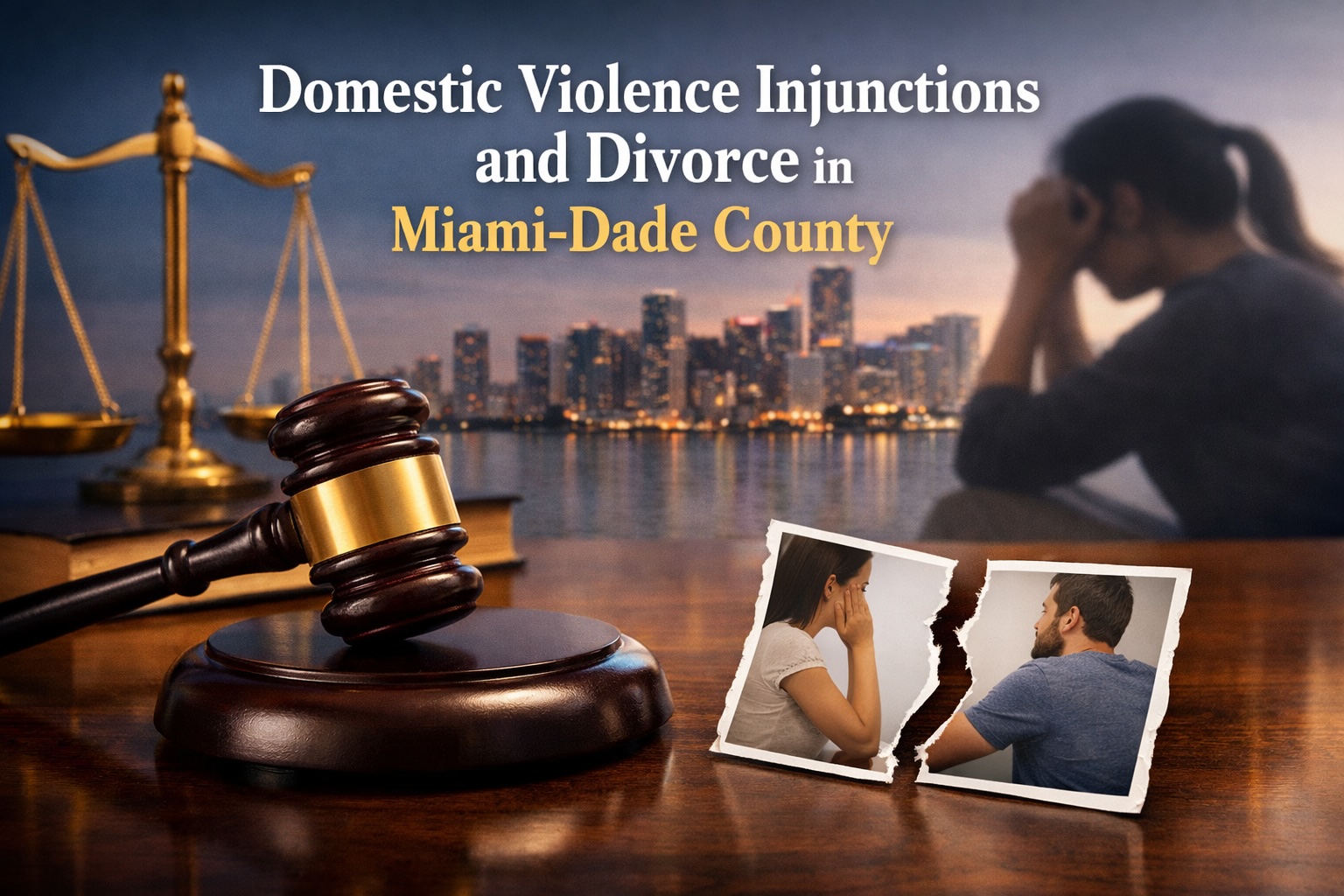
04 Aug Domestic Violence Injunctions and Divorce in Miami-Dade County
Summary
This article explains how domestic violence injunctions interact with divorce proceedings in Miami-Dade County under Florida law. It examines the statutory framework, relevant case law, and how courts balance victim protection with family law issues such as custody, housing, and parental rights.
Domestic violence injunctions and divorce in Miami-Dade County frequently intersect within Florida’s family law system. When allegations of domestic violence arise between spouses or former partners, the legal consequences often extend beyond criminal law and into family court proceedings that determine divorce, child custody, parenting plans, and property rights. Florida courts treat domestic violence allegations with significant seriousness because the safety of victims and children is a paramount concern under state law.
In Miami-Dade County, the Eleventh Judicial Circuit regularly handles cases where a petition for protection against domestic violence is filed simultaneously with or shortly before a dissolution of marriage proceeding. These situations create complex legal questions involving jurisdiction, temporary relief, parenting time restrictions, and exclusive possession of marital residences. Florida law provides a structured statutory framework that governs how courts issue and enforce domestic violence injunctions, primarily through Chapter 741 of the Florida Statutes, while divorce proceedings fall under Chapter 61.
Understanding the interaction between domestic violence injunctions and divorce in Miami-Dade County is essential for anyone navigating family litigation in South Florida. Courts must balance the protection of victims with due process rights for respondents while ensuring that temporary injunction orders do not improperly interfere with broader divorce issues that must ultimately be resolved within a dissolution proceeding.
Florida’s Legal Definition of Domestic Violence
Florida law defines domestic violence broadly to include a variety of criminal acts committed by one family or household member against another. Under Florida Statutes §741.28, domestic violence encompasses offenses such as assault, aggravated assault, battery, aggravated battery, stalking, aggravated stalking, kidnapping, false imprisonment, and any criminal offense that results in physical injury or death.
The statute also defines who qualifies as a “family or household member.” This category includes spouses, former spouses, persons related by blood or marriage, individuals currently residing together as a family, individuals who have resided together in the past as a family, and parents of a child in common. Except for parents of a child in common, the parties must have lived together in the same dwelling unit for the statute to apply.
This definition is critical when courts evaluate petitions for protection because only individuals who meet these statutory requirements may obtain a domestic violence injunction under Florida law. In Miami-Dade County divorce cases, spouses or former spouses almost always qualify as family or household members, meaning allegations of abuse can immediately trigger injunction proceedings alongside divorce litigation.
Filing for a Domestic Violence Injunction in Miami-Dade County
The procedure for obtaining a domestic violence injunction is governed by Florida Statutes §741.30. Any person who is the victim of domestic violence or who has reasonable cause to believe that they are in imminent danger of becoming a victim may file a verified petition for protection in the circuit court.
In Miami-Dade County, these petitions are typically filed through the Domestic Violence Division of the Eleventh Judicial Circuit. Petitioners may file electronically or in person at designated courthouse locations. The petition must contain sworn allegations describing the acts of violence or threats that justify the request for court protection.
Once the petition is filed, a judge reviews the allegations to determine whether an immediate threat exists. If the court finds an immediate and present danger of domestic violence, the judge may issue a temporary injunction without first hearing from the respondent. This ex parte temporary injunction provides immediate legal protection until a full hearing can occur.
Florida law requires that a full evidentiary hearing be held within fifteen days after the issuance of a temporary injunction. During this hearing, both parties may present testimony, evidence, and witnesses. The court then determines whether to dismiss the petition or issue a final injunction for protection against domestic violence. The importance of this hearing was emphasized in Sanchez v. Saenz, 320 So. 3d 926 (Fla. 3d DCA 2021), where the appellate court reinforced procedural safeguards and the requirement that courts evaluate credible evidence before granting long-term relief.
Relief Available Through Domestic Violence Injunctions
Courts issuing domestic violence injunctions possess broad authority to craft orders that protect victims while addressing immediate family law concerns. Florida courts may grant a wide range of remedies depending on the circumstances of the case.
One of the most significant forms of relief involves temporary exclusive use and possession of a shared residence. In Castillo v. Aldahondo, 416 So. 3d 362 (Fla. 3d DCA 2025), the appellate court recognized that circuit courts have the authority to remove a respondent from the marital home when necessary to ensure the safety of the petitioner.
Injunction orders may also address child custody and parenting issues on a temporary basis. Courts frequently issue temporary parenting plans or timesharing schedules as part of an injunction order when minor children are involved. The authority for courts to implement such measures was examined in Hunter v. Booker, 133 So. 3d 623 (Fla. 1st DCA 2014), which acknowledged the court’s responsibility to safeguard children while litigation is pending.
In addition, courts may require respondents to participate in batterers’ intervention programs, prohibit contact with the petitioner, establish distance requirements from residences or workplaces, and mandate the surrender of firearms. These remedies are designed to prevent future acts of violence while the parties address longer term family law matters.
Service and Enforcement of Injunctions in Miami-Dade County
Once a domestic violence injunction is issued, it must be personally served on the respondent before it becomes enforceable. Service ensures that the respondent has notice of the court’s order and understands the restrictions imposed by the injunction.
In Miami-Dade County, law enforcement agencies are authorized to serve injunctions within their jurisdiction. Administrative procedures within the Eleventh Judicial Circuit govern how service is documented and recorded. Administrative Order 98-2 of the Eleventh Judicial Circuit establishes procedures requiring law enforcement officers to document service details and provide electronic confirmation to the clerk of court.
Once served, the injunction becomes immediately enforceable. Violations of injunction orders may result in criminal charges, arrest, and additional legal penalties. Law enforcement officers throughout Miami-Dade County are authorized to arrest individuals who violate domestic violence injunctions.
Jurisdiction of Florida Circuit Courts
Florida circuit courts possess exclusive jurisdiction over domestic violence injunction proceedings. This jurisdiction includes the authority to issue temporary injunctions, conduct evidentiary hearings, modify injunction terms, and dissolve injunctions when circumstances change.
The scope of this jurisdiction was discussed in Castillo v. Aldahondo, where the court emphasized that circuit courts may address temporary housing and protective measures even when a related divorce case exists or may later be filed.
However, while injunction courts can address temporary matters, they generally avoid making permanent determinations about marital property, long term child custody arrangements, or financial support obligations. Those issues are typically reserved for dissolution of marriage proceedings governed by Chapter 61 of the Florida Statutes.
The Relationship Between Domestic Violence Injunctions and Divorce Proceedings
Domestic violence injunctions and divorce in Miami-Dade County often occur simultaneously. A spouse who files for a domestic violence injunction may later initiate divorce proceedings, or the injunction may arise during an already pending dissolution case.
When both actions exist, Florida courts attempt to coordinate the proceedings so that conflicting orders do not arise. The relationship between these legal processes was examined in Spano v. B.B., 947 So. 2d 635 (Fla. 4th DCA 2007), where the court acknowledged that injunction proceedings provide temporary protective measures while broader family law disputes are addressed in divorce litigation.
For example, an injunction court may temporarily restrict a parent’s contact with a child for safety reasons. However, the ultimate determination of parental responsibility and long term timesharing schedules typically occurs in the divorce case.
In Miami-Dade County family courts, judges frequently review existing injunction orders when determining temporary relief in divorce proceedings. Evidence presented during injunction hearings may also influence decisions regarding temporary support, custody arrangements, and use of marital property.
Modification or Dissolution of Domestic Violence Injunctions
Domestic violence injunctions are not necessarily permanent. Either party may file a motion requesting modification or dissolution of an injunction when circumstances change.
Florida appellate courts have repeatedly held that injunctions should remain in place only when the petitioner continues to have a reasonable fear of imminent domestic violence. In Larios v. Larios, 359 So. 3d 1224 (Fla. 3d DCA 2023), the court emphasized that speculative concerns or subjective fears alone are insufficient to justify continuing an injunction.
Courts reviewing modification requests examine factors such as whether the respondent has complied with prior court orders, completed counseling programs, avoided contact with the petitioner, or demonstrated rehabilitation. If the petitioner can no longer establish a reasonable fear of violence, the injunction may be dissolved.
Voluntary Dismissal of Domestic Violence Petitions
In some situations, petitioners choose to voluntarily dismiss domestic violence injunction cases. Florida courts recognize that injunction petitions are civil actions initiated by private individuals rather than criminal prosecutions brought by the state.
The right to voluntary dismissal was discussed in Tobkin v. State, 777 So. 2d 1160 (Fla. 4th DCA 2001). Once a petitioner voluntarily dismisses the case, the court’s authority to continue exercising jurisdiction may be limited unless other legal proceedings are pending.
However, even when a petitioner dismisses an injunction request, allegations of domestic violence may still influence ongoing divorce litigation. Family courts remain obligated to consider any evidence of abuse when determining parenting plans or child safety measures.
Judicial Discretion in Miami-Dade County Domestic Violence Cases
Judges in the Eleventh Judicial Circuit possess significant discretion when crafting injunction orders. Each domestic violence case presents unique factual circumstances that require careful judicial evaluation.
Florida courts have repeatedly recognized this discretion. In Carroll v. Goll, 255 So. 3d 418 (Fla. 4th DCA 2018), the court noted that trial judges are best positioned to assess witness credibility, evaluate evidence, and determine whether protective relief is appropriate.
In Miami-Dade County divorce cases involving allegations of domestic violence, judges often consider multiple factors including the history of the relationship, the severity of alleged incidents, the presence of children, and the potential risk of future harm.
Practical Implications for Divorce Litigants in Miami-Dade County
Individuals involved in divorce proceedings must understand that domestic violence injunctions can significantly affect the outcome of their family law cases. An injunction may temporarily remove a spouse from the marital home, restrict communication, or limit contact with children.
These temporary orders can influence negotiations and court decisions throughout the divorce process. For example, if a court finds credible evidence of domestic violence, it may affect determinations regarding parental responsibility and timesharing under Florida family law principles.
Miami-Dade County courts prioritize the safety of victims and children when evaluating these issues. At the same time, courts must ensure that injunction proceedings are not misused as strategic tools in divorce litigation. Judges therefore carefully evaluate evidence before granting or extending injunctions.
Conclusion
Domestic violence injunctions and divorce in Miami-Dade County represent a complex intersection of protective legal measures and family law litigation. Florida law provides clear statutory authority allowing courts to issue injunctions that protect victims from immediate harm while preserving the ability of family courts to resolve broader marital disputes.
The legal framework governing these cases emphasizes both victim safety and procedural fairness. Circuit courts possess broad authority to issue temporary injunctions, provide protective relief, and address urgent family law issues such as housing and parenting arrangements. However, long term determinations regarding divorce, property division, and custody remain within the scope of dissolution proceedings.
For individuals navigating divorce in Miami-Dade County, understanding the role of domestic violence injunctions is essential. These protective orders can significantly affect legal rights, parental relationships, and the overall direction of family law litigation.
TLDR: Domestic violence injunctions in Miami-Dade County provide immediate legal protection for victims while divorce proceedings address long term family law issues such as custody, support, and property division. Florida courts coordinate these proceedings carefully, balancing victim safety with due process rights to ensure fair and lawful outcomes.
What is a domestic violence injunction in Miami-Dade County? A domestic violence injunction is a court order issued by a Florida circuit court that protects a victim from acts of domestic violence by restricting contact and imposing legal requirements on the respondent.
Can you file for divorce while a domestic violence injunction is pending? Yes. Many individuals file for divorce while a domestic violence injunction is active, and courts in Miami-Dade County frequently manage both proceedings simultaneously.
How long does a domestic violence injunction last in Florida? A temporary injunction usually lasts until the final hearing, which must occur within fifteen days. A final injunction may remain in effect indefinitely unless modified or dissolved by the court.
Can a domestic violence injunction affect child custody? Yes. Courts may issue temporary parenting plans or restrict timesharing if domestic violence allegations raise safety concerns for children.
Can an injunction be removed? Either party may request modification or dissolution if circumstances change and the petitioner no longer has a reasonable fear of imminent domestic violence.