
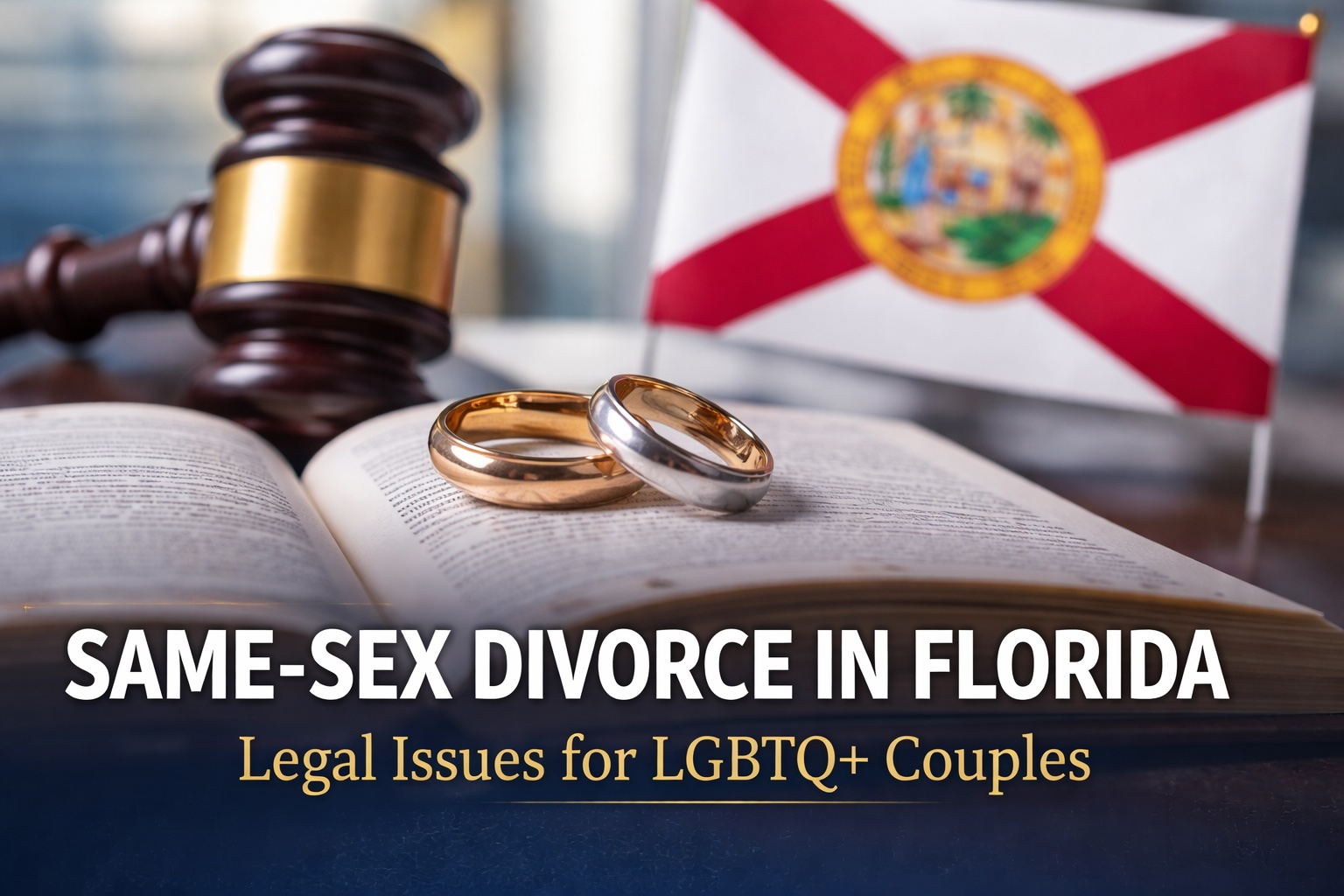
01 Sep Same-Sex Divorce in Florida: Property Division, Custody, and LGBTQ+ Legal Issues
Summary
This article explains how same-sex divorce in Florida works, including property division, custody issues, and the lasting legal effects of historical bans on same-sex marriage. It focuses on Florida statutes and case law while highlighting how Miami courts address the unique challenges faced by LGBTQ+ couples seeking divorce.
Same-sex divorce in Florida presents legal questions that differ in several meaningful ways from traditional divorce proceedings. Although marriage equality has been firmly established nationwide, the legacy of prior legal restrictions continues to affect how courts interpret property rights, parental status, and the duration of marital relationships for LGBTQ+ couples. These challenges are especially relevant in South Florida communities such as Miami, where diverse family structures frequently intersect with complex legal histories. Understanding how Florida courts address same-sex divorce requires examining the historical prohibition of same-sex marriage, the constitutional rulings that overturned those prohibitions, and the statutory framework that now governs the dissolution of marriage.
Florida family law provides the procedural and substantive rules for divorce proceedings through Chapter 61 of the Florida Statutes. These statutes apply equally to all married couples. However, because same-sex marriage was historically prohibited in Florida, many LGBTQ+ couples experienced periods in which their legally recognized relationships in other jurisdictions were not acknowledged by Florida courts. This historical gap in recognition can affect issues such as equitable distribution of marital property, the classification of marital assets, and parental rights in custody disputes. As a result, same-sex divorce in Florida often requires courts to reconcile statutory family law with constitutional mandates of equal protection and due process.
Historical Context of Same-Sex Marriage Prohibitions in Florida
To understand modern same-sex divorce in Florida, it is necessary to consider the legal framework that existed prior to marriage equality. For many years, Florida law explicitly prohibited the recognition of same-sex marriages. The statutory provision Florida Statutes § 741.212 declared that marriages between persons of the same sex were not recognized for any purpose within the state. The statute further specified that such unions, even if legally performed in another jurisdiction, could not be treated as marriages under Florida law.
This prohibition was reinforced by constitutional amendments adopted by Florida voters in 2008, which defined marriage exclusively as the union of one man and one woman. For several years, this statutory and constitutional framework prevented same-sex couples from marrying in Florida and also prevented Florida courts from recognizing same-sex marriages performed elsewhere. The consequences of these prohibitions extended beyond marriage itself and created practical barriers for couples seeking divorce or other legal remedies associated with marital relationships.
The legal landscape began to change in 2014 when federal courts ruled that Florida’s prohibition on same-sex marriage violated constitutional protections. Following these rulings, Florida began issuing marriage licenses to same-sex couples on January 6, 2015. The recognition of marriage equality transformed family law in the state and allowed same-sex couples to access the same legal institutions that had long been available to heterosexual couples. Despite these changes, however, disputes involving same-sex divorce continue to involve questions about how courts should treat relationships that existed before the state formally recognized such marriages.
Recognition of Same-Sex Marriages for Divorce Proceedings
One of the earliest legal issues surrounding same-sex divorce in Florida involved whether courts could dissolve marriages that the state previously refused to recognize. Before the constitutional rulings invalidating Florida’s marriage ban, some courts faced cases in which same-sex couples who had married in other states sought a divorce in Florida. Because Florida law declared those marriages void, courts struggled with whether they had jurisdiction to dissolve them.
The case of Oliver v. Stufflebeam, 155 So. 3d 395 (Fla. 2d DCA 2014), highlighted the tension between Florida’s statutory prohibition and the practical need for judicial remedies. In that case, the court addressed whether a same-sex couple legally married in another state could obtain a divorce in Florida despite the statutory ban. The decision demonstrated how the refusal to recognize a marriage could effectively trap individuals in legal relationships that they had no ability to dissolve within the state.
Another significant decision addressing these issues was Brandon-Thomas v. Brandon-Thomas, 163 So. 3d 644 (Fla. 4th DCA 2015). In this case, the court acknowledged the constitutional implications of denying same-sex couples access to divorce proceedings. The court emphasized that refusing to allow a dissolution action while simultaneously refusing to recognize the marriage placed couples in an untenable legal position. By preventing access to divorce, the state effectively treated same-sex couples differently from opposite-sex couples in violation of equal protection principles.
Similarly, Shaw v. Shaw, 177 So. 3d 977 (Fla. 4th DCA 2014), examined the difficulties faced by couples who were forced to travel or relocate to other states simply to dissolve their marriages. These cases underscored the broader constitutional concerns raised by denying same-sex couples access to the courts. Once federal courts invalidated Florida’s marriage ban and the United States Supreme Court recognized marriage equality nationwide, the path to divorce became clearer for LGBTQ+ couples within the state.
Equitable Distribution and Property Division in Same-Sex Divorce
Property division is one of the most significant aspects of any divorce proceeding, and same-sex divorce in Florida is governed by the same equitable distribution principles that apply to all divorcing couples. The controlling statute is Florida Statutes § 61.075, which establishes that marital assets and liabilities must be distributed fairly between the spouses. The statute defines marital assets as those acquired during the marriage and provides a presumption that such assets should be divided equitably unless circumstances justify a different allocation.
While the statute itself is neutral regarding the gender or sexual orientation of the spouses, the historical nonrecognition of same-sex marriages can complicate the determination of what constitutes marital property. Many same-sex couples were in long term relationships or legally married in other states years before Florida recognized their unions. When these couples divorce, disputes may arise about whether property acquired during those earlier periods should be treated as marital assets.
Florida appellate decisions such as Nelson v. Nelson, 206 So. 3d 818 (Fla. 5th DCA 2016), emphasize the importance of identifying and classifying marital property based on statutory definitions. Courts generally rely on the date of the legal marriage to determine when the marital estate begins. For same-sex couples whose relationships predated legal recognition in Florida, this rule can lead to disagreements about whether assets accumulated during earlier years of partnership should be included in the marital estate.
The case of Distefano v. Distefano, 253 So. 3d 1178 (Fla. 4th DCA 2018), further illustrates how courts approach equitable distribution disputes under Florida law. The decision reinforces the principle that marital property must be divided in a manner that is fair and consistent with statutory factors. In same-sex divorce cases, courts must apply these same principles while remaining mindful of the constitutional requirement that LGBTQ+ couples receive equal treatment under the law.
Child Custody and Parental Rights in Same-Sex Divorce
Child custody and parental responsibility disputes can present particularly complex issues in same-sex divorce in Florida. In many LGBTQ+ families, one partner may be the biological parent of a child while the other partner functions as a social or psychological parent. Prior to marriage equality, legal barriers sometimes prevented nonbiological parents from obtaining formal parental rights through adoption or other legal mechanisms.
When a same-sex couple divorces, questions may arise about whether both individuals have legally recognized parental rights. Florida courts determine parental responsibility and time sharing arrangements based on the best interests of the child. However, establishing legal standing to seek custody or visitation may require proof of legal parentage, which can be more difficult for nonbiological parents in certain circumstances.
Historically, Florida’s refusal to recognize same-sex marriages contributed to situations in which a nonbiological parent who had raised a child for many years lacked formal legal recognition. As courts increasingly confront these cases, they must balance the statutory framework governing parental responsibility with the realities of modern family structures. Ensuring that children maintain stable relationships with both parental figures is often a central consideration in these disputes.
In Miami and other metropolitan areas of Florida, family courts frequently encounter cases involving assisted reproductive technology, surrogacy arrangements, and adoption by same-sex couples. These evolving family structures require courts to interpret existing statutes in ways that protect the welfare of children while respecting the constitutional rights of LGBTQ+ parents.
Uneven Application of Legal Rights Prior to Marriage Equality
The legal challenges associated with same-sex divorce in Florida are partly rooted in the uneven application of legal rights before marriage equality became law. For decades, same-sex couples were excluded from the legal protections that accompany marriage. As a result, many couples entered into financial arrangements, property ownership structures, and parenting roles without the benefit of clear legal recognition.
When these relationships end, courts must sometimes untangle complex legal questions about property ownership and parental rights. The absence of formal marital recognition during earlier periods can make it more difficult to determine how assets should be divided or how parental responsibilities should be allocated. In some cases, couples may have relied on contractual agreements or informal understandings that now require judicial interpretation.
The shift toward marriage equality has significantly reduced these uncertainties for newer marriages. However, disputes involving relationships that began before 2015 continue to appear in Florida courts. Legal practitioners handling same-sex divorce in Miami and throughout the state must therefore understand both the historical legal context and the modern statutory framework governing divorce.
Constitutional Principles Governing Same-Sex Divorce
The constitutional foundation for same-sex divorce in Florida rests on principles of equal protection and due process under the United States Constitution. When courts previously refused to recognize same-sex marriages, they effectively denied couples access to the legal mechanisms necessary to dissolve those relationships. This denial raised serious constitutional concerns because it treated same-sex couples differently from opposite-sex couples who could freely obtain a divorce.
In Brandon-Thomas v. Brandon-Thomas, the court emphasized that access to divorce proceedings is an essential component of the right to marry. Preventing same-sex couples from dissolving their marriages created a situation in which individuals remained legally bound to relationships without any available legal remedy. Such unequal treatment was inconsistent with constitutional guarantees of fairness and equal protection.
The United States Supreme Court ultimately resolved these issues in Obergefell v. Hodges, which held that same-sex couples have the same fundamental right to marry as opposite-sex couples. Although this decision primarily addressed the right to marry, it also confirmed that same-sex couples are entitled to the full range of legal rights and responsibilities associated with marriage. This includes the right to seek a divorce under state law.
Florida courts are therefore required to apply family law statutes in a manner that treats same-sex couples equally. Any interpretation of the law that denies LGBTQ+ individuals access to divorce remedies or related legal protections would conflict with the constitutional principles articulated by the Supreme Court.
Same-Sex Divorce in Miami and South Florida
Miami and the broader South Florida region have become central locations for family law litigation involving diverse family structures. The region’s large LGBTQ+ population means that local courts frequently address issues related to same-sex divorce in Florida. Attorneys practicing in Miami must be prepared to handle cases involving interstate marriages, international couples, and complex property arrangements that developed before the recognition of marriage equality.
South Florida’s international character also introduces jurisdictional questions that may arise when couples were married abroad or lived in multiple states before seeking a divorce in Florida. Courts must determine residency requirements, jurisdictional authority, and the proper application of Florida law to marriages performed elsewhere. These issues can make same-sex divorce proceedings particularly complex for couples who have lived or married outside the state.
Despite these challenges, Florida’s family courts continue to adapt to evolving legal and social realities. Judges increasingly approach same-sex divorce cases with the same analytical framework applied to any dissolution proceeding, focusing on equitable outcomes that respect statutory law and constitutional protections.
Conclusion
Same-sex divorce in Florida reflects the intersection of evolving constitutional principles, historical legal restrictions, and modern family law statutes. While marriage equality has been firmly established, the legacy of earlier prohibitions continues to influence certain aspects of divorce proceedings for LGBTQ+ couples. Issues involving property division, parental rights, and recognition of marriages performed in other jurisdictions can require careful legal analysis.
Florida courts must ensure that all couples receive equal treatment under the law while applying the statutory framework governing divorce. For LGBTQ+ individuals in Miami and throughout the state, understanding these legal principles is essential when navigating the end of a marriage. As case law continues to develop, the legal system will likely refine its approach to addressing the unique challenges that arise in same-sex divorce cases.
TLDR: Same-sex divorce in Florida follows the same statutory framework as other divorces, but historical bans on same-sex marriage can create unique challenges involving property division, parental rights, and recognition of relationships formed before marriage equality. Florida courts must apply family law statutes in a way that ensures LGBTQ+ couples receive the same constitutional protections and access to divorce as any other married couple.
What is same-sex divorce in Florida? Same-sex divorce in Florida refers to the legal dissolution of a marriage between two spouses of the same sex under Florida’s family law statutes. Following the recognition of marriage equality, LGBTQ+ couples have the same right to seek divorce, property division, and parental determinations as any other married couple.
How are assets divided in a same-sex divorce in Florida? Asset division follows Florida’s equitable distribution law under Florida Statutes § 61.075. Courts classify property as marital or nonmarital and distribute marital assets fairly between the spouses based on statutory factors.
Can both partners seek custody of children in a same-sex divorce? Child custody decisions are determined based on the best interests of the child. If both spouses have legal parental status through birth, adoption, or other legal recognition, courts may award shared parental responsibility and time sharing.
Did past bans on same-sex marriage affect divorce cases? Yes. Because Florida did not recognize same-sex marriages before 2015, some couples encounter disputes about property acquired before legal recognition of their marriage or about parental rights established during earlier periods.
Do Miami courts treat same-sex divorces differently? Miami family courts apply the same Florida statutes to all divorce cases. However, judges may encounter unique issues related to interstate marriages, international couples, and property acquired before marriage equality became law.