
03 Mar Florida Child Support Enforcement in Miami: What Happens If You Do Not Pay
Summary
This article explains what happens in Florida, and specifically in Miami-Dade County, when a parent does not pay court ordered child support, including enforcement through wage withholding, contempt proceedings, license suspensions, liens, levies, tax intercepts, credit reporting, passport denial, and in serious cases incarceration under Chapters 61 and 409, Florida Statutes. It also explains why arrears generally cannot be erased retroactively, what Miami judges look for in enforcement hearings, and why the safest path is to seek a lawful modification under section 61.14 while continuing to pay what you can.
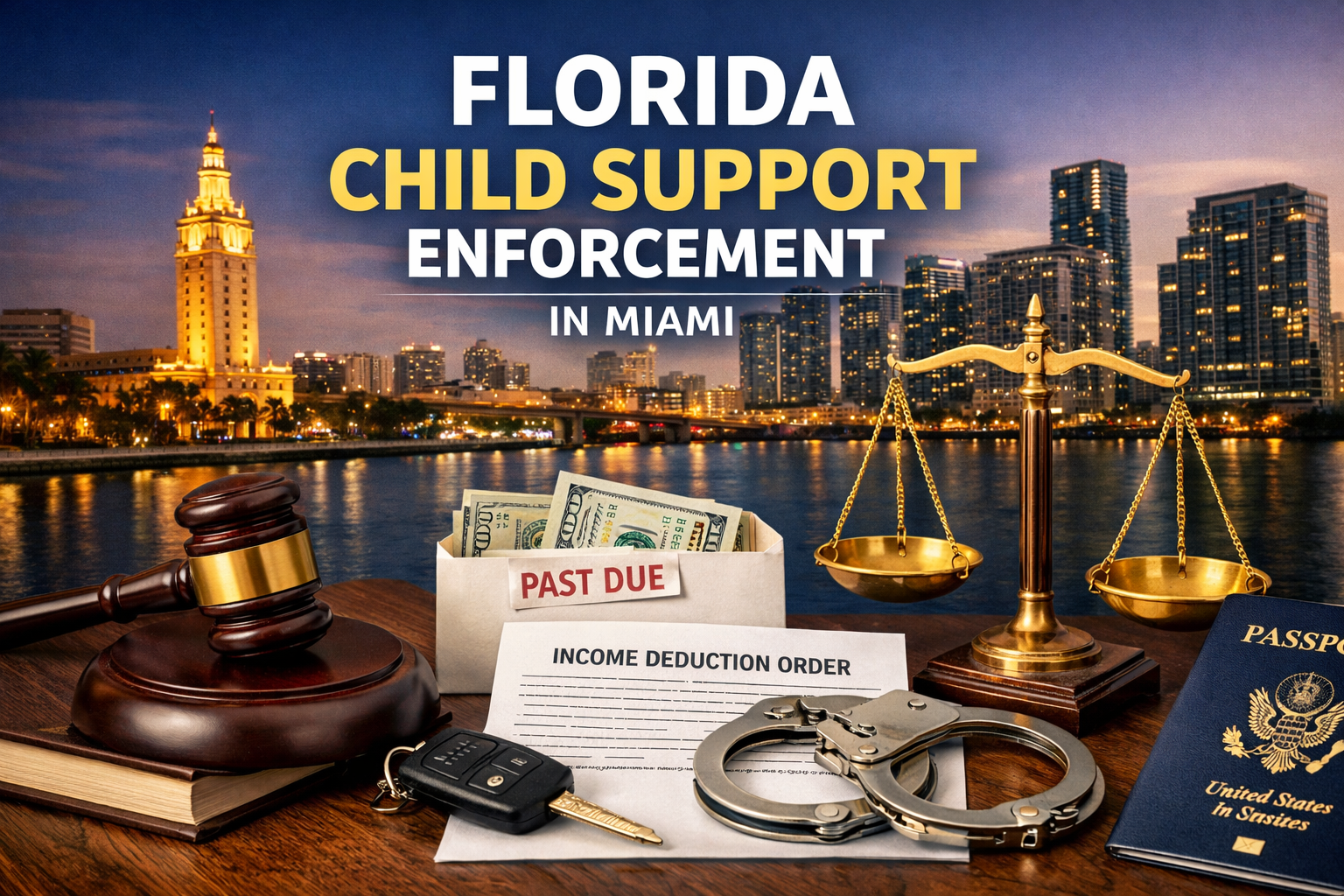
In Florida, if you do not pay child support required by a court order, the court and the Florida Department of Revenue can enforce the order through wage withholding, contempt proceedings, driver’s license suspension, professional license suspension, bank account seizure, property liens, credit reporting, tax refund intercepts, passport denial, and in serious cases incarceration. These remedies are authorized primarily under Chapters 61 and 409, Florida Statutes, and are frequently used in Miami-Dade County family law cases. See sections 61.14, 61.1301, 61.13016, 322.058, 409.2564, and 409.2598, Florida Statutes.
When a parent stops paying child support in Florida, the legal system treats the problem as an enforcement issue, not a negotiation. A child support order is a binding court order. In Miami, where the cost of living is high and parenting schedules can be complex, missed support payments quickly create financial pressure on the receiving parent and the child. Florida law responds with a broad set of enforcement tools designed to secure payment and deter noncompliance.
This article explains the legal consequences of nonpayment, the most common enforcement mechanisms, what the Miami-Dade courts and the Florida Department of Revenue actually do in practice, and what judges look for when deciding sanctions. It also explains the most important concept in Florida child support enforcement: you do not fix an unpaid support problem by simply stopping payments. You fix it by seeking a lawful modification while continuing to pay what you can.
Florida Child Support Orders Are Enforceable Court Orders
Florida child support usually arises in one of three ways. It can be ordered in a dissolution of marriage case, a paternity case, or a support case involving the Florida Department of Revenue. Regardless of the case type, the result is a legally enforceable order. Florida courts have continuing jurisdiction to enforce child support orders. Section 61.14(1)(a), Florida Statutes.
In Miami-Dade County, child support orders are commonly entered in the Eleventh Judicial Circuit Family Division. Parents may see the order referred to as a final judgment, a supplemental final judgment, or an order establishing child support. The label does not change the key point. Once entered, each payment becomes due on the date specified in the order and the obligation is enforceable by law.
A critical Florida rule is that child support is generally not retroactively reduced to forgive past due amounts simply because the paying parent later experiences hardship. While Florida law allows modification of support going forward after a substantial change in circumstances, past due support becomes fixed when it accrues. Section 61.14, Florida Statutes. Florida appellate courts frequently reiterate that trial courts cannot retroactively modify vested child support arrears except in limited circumstances authorized by statute. See Department of Revenue ex rel. Sherman v. Daly, 74 So. 3d 165 (Fla. 1st DCA 2011).
If you are in Miami and you believe you cannot afford your current child support, the correct legal approach is to file for modification promptly. Until the court modifies the order, the existing amount remains due and enforceable. Section 61.14, Florida Statutes.
How Enforcement Starts in Miami-Dade County
Enforcement can start in more than one way. The receiving parent may file a motion for contempt or a motion to enforce child support. The Florida Department of Revenue may initiate administrative enforcement in Title IV-D cases. In Miami-Dade, it is also common for enforcement activity to occur while other issues remain pending, such as time-sharing disputes, relocation disputes, or modification requests. Florida law permits enforcement while those other issues are being litigated, and judges frequently separate the issues to ensure support is not delayed.
Miami-Dade cases can move quickly because the system relies heavily on standardized notices, automated payment tracking, and established court and agency processes. When nonpayment is documented, the legal question often becomes not whether you owe, but what remedy is appropriate and whether your nonpayment was willful.
Income Withholding and Wage Garnishment
The most common and most immediate enforcement tool is income withholding. Florida requires that child support orders include an income deduction order in most cases. Section 61.1301(1)(a), Florida Statutes. Income withholding applies to wages and other sources of income and is designed to make payments consistent without relying on voluntary compliance.
In Miami, wage withholding is often established at the start of the case, especially when the paying parent is a W-2 employee. If arrears accrue, withholding can increase to collect both the current support and a portion of the arrears. Section 61.1301, Florida Statutes.
Employers must comply with valid withholding orders. Florida law provides enforcement consequences for employers who fail to honor withholding. Section 61.1301, Florida Statutes. If you change jobs, withholding can follow you. If you become self-employed, wage withholding may be less effective, and enforcement tends to shift toward bank levies, liens, and contempt proceedings.
Contempt of Court in Miami Family Court
When wage withholding is not enough, or when payments are missed despite withholding, the receiving parent or the Department of Revenue may seek contempt. Contempt is a court enforcement power that compels compliance and can impose sanctions for willful nonpayment. Section 61.14, Florida Statutes.
In a contempt proceeding, the court typically focuses on three questions. First, was there a valid support order. Second, did the paying parent fail to pay as ordered. Third, was the failure to pay willful, meaning the parent had the ability to pay and chose not to. Section 61.14, Florida Statutes.
Florida law creates strong enforcement leverage by authorizing incarceration as a contempt remedy when the court finds willful nonpayment and the contemnor has the present ability to purge the contempt by paying a specified amount. Section 61.14, Florida Statutes. The purpose is coercive rather than purely punitive. Miami judges frequently emphasize that the court must set a clear purge amount and must base ability-to-pay findings on evidence, including financial affidavits and testimony.
Nonpayment contempt proceedings can also result in orders requiring job search efforts. Florida law specifically authorizes job search orders in support enforcement. Section 61.14(1)(b), Florida Statutes. In Miami, judges may require proof of applications, interviews, and follow-up, especially when the paying parent claims unemployment or underemployment.
Civil Enforcement Remedies Beyond Contempt
Florida law allows the court to enter judgments for child support arrears. Once reduced to judgment, arrears can be enforced like other money judgments, including through execution and garnishment in appropriate circumstances. Section 61.14, Florida Statutes. This is significant because a judgment can create long-term collection options, including liens on property and certain levy mechanisms.
Florida also allows liens and other collection measures through administrative enforcement. Chapter 409, Florida Statutes. In practice, many Miami child support cases involve a combination of judicial and administrative enforcement, particularly when arrears become substantial.
Driver’s License Suspension and Vehicle Registration Consequences
License suspension is one of the most effective pressure points in Florida child support enforcement. Florida law authorizes driver’s license suspension and motor vehicle registration suspension when a parent is delinquent. Sections 61.13016 and 322.058, Florida Statutes.
In Miami, this consequence can be especially disruptive because many parents rely on driving for employment, school drop-offs, and co-parenting logistics. Once a suspension notice issues, the parent typically must take specific steps to avoid suspension or to reinstate. The statutes provide notice and an opportunity to contest in certain circumstances, and many cases are resolved through payment plans with the Department of Revenue. Sections 61.13016 and 322.058, Florida Statutes.
Parents should understand a practical reality. If your driver’s license is suspended, it can make it harder to earn income, which can worsen arrears. That is why early legal intervention matters. A Miami support enforcement attorney can often coordinate a structured resolution that addresses both compliance and reinstatement requirements under the statute.
Professional License Suspension in Florida
Florida law also permits suspension of professional licenses and occupational licenses for child support delinquency. Chapter 409 includes provisions authorizing the Department of Revenue to work with licensing authorities to suspend or deny licenses for delinquent obligors. Section 409.2598, Florida Statutes.
In Miami, professional license consequences can impact nurses, contractors, real estate professionals, health care providers, and other licensed workers. This tool is powerful because it targets the ability to work in regulated professions. When a paying parent faces professional license suspension, quick action to address delinquency or establish a compliant payment plan is often essential.
Liens, Levies, and Asset Seizure
When support is not paid, Florida law permits liens against property and financial accounts. The Department of Revenue has administrative authority to enforce support through liens and levies. Section 409.2564, Florida Statutes. These actions may include levies on bank accounts and certain financial assets when statutory requirements are satisfied.
Liens can attach to real property and certain personal property. Once a lien attaches, it can interfere with refinancing, sale, or transfer, which is common in Miami when families restructure finances after separation. For example, if a parent wants to sell a condo in Brickell, Coral Gables, Coconut Grove, or Miami Beach, unresolved child support liens can become a closing issue and can require payoff or negotiated release.
Florida law also allows the court to impose enforcement measures that reach assets indirectly, including through judgments and post-judgment collection tools. Section 61.14, Florida Statutes. The specific mechanism depends on the facts, the procedural posture, and whether the enforcement is proceeding in court, through the Department of Revenue, or both.
Credit Reporting and Long-Term Financial Consequences
Child support delinquency can be reported to credit bureaus through administrative processes. Federal law authorizes reporting of overdue support and related enforcement actions through Title IV-D programs, and Florida’s Department of Revenue operates within that framework. Chapter 409, Florida Statutes. For Miami residents, credit consequences can affect housing, car financing, and employment screening.
Credit reporting is sometimes underestimated because it does not create immediate court drama. However, for many parents, it becomes one of the most painful long-term consequences, especially when trying to rent or buy housing in Miami’s competitive market.
Tax Refund Intercepts and Federal Collection Tools
Florida child support enforcement can involve federal collection tools when arrears meet thresholds. One major tool is interception of tax refunds. Florida’s child support program participates in federal intercept processes for past due support in qualifying cases. Chapter 409, Florida Statutes. These intercepts can include federal tax refunds and, in some situations, other federal payments.
Parents who rely on tax refunds to stabilize finances often find the intercept process surprising because the refund is withheld before they can react. In Miami, this frequently impacts self-employed parents and gig workers who make estimated payments and expect refunds based on deductions and credits.
Passport Denial for Serious Arrears
When arrears become significant, passport denial can occur. Federal law authorizes passport denial for certain child support delinquencies, and Florida’s program can certify eligible cases through the Title IV-D process. 42 U.S.C. section 652(k). In an international city like Miami, this consequence is especially important. Parents may need passports for work, family travel, or international parenting plans.
Passport denial is not just about vacations. It can affect business travel, immigration planning, and international relocation issues. If a Miami parent anticipates travel, resolving arrears early may prevent a sudden travel disruption.
Interest on Child Support Arrears
Arrears can accrue interest. Florida law authorizes interest on support obligations that are reduced to judgment and provides for enforcement of that interest. Section 61.14, Florida Statutes. The practical effect is that delaying resolution can make the total amount grow substantially over time, particularly when arrears are large and persist for years.
In Miami-Dade County, where economic volatility and job shifts are common, many parents fall behind during transitions. The interest component is one reason early modification and structured compliance plans are often smarter than avoidance.
Criminal Consequences in Extreme Cases
Most child support enforcement in Florida is civil, meaning it is handled in family court or through administrative actions. However, extreme cases can trigger criminal exposure under certain circumstances. Florida’s enforcement system also coordinates with federal and interstate enforcement mechanisms when nonpayment becomes chronic and evasive, especially where a parent moves across state lines. Chapter 409, Florida Statutes.
In practice, criminal prosecution is not the typical first response in Miami. It is more likely in cases involving long-term intentional evasion, significant arrears, or conduct indicating an attempt to defeat enforcement mechanisms.
What Miami Judges Look For in Support Enforcement Hearings
Support enforcement in Miami family court is fact-driven. Judges often focus on financial ability, credibility, and whether the paying parent took reasonable steps to comply. Courts may evaluate employment history, job search efforts, assets, discretionary spending, and the parent’s overall financial picture.
Florida law provides that the court can consider evidence of ability to pay when determining contempt and remedies. Section 61.14, Florida Statutes. A parent who can demonstrate genuine inability to pay may avoid incarceration, but that does not erase the debt. The court may still enter judgments, establish payment plans, and order job search requirements. Section 61.14, Florida Statutes.
Miami judges also tend to pay close attention to documentation. In a busy docket, documented proof of income, expenses, employment efforts, and payments matters. Parents who show up with organized records often have a stronger position in negotiating realistic compliance terms.
Common Mistakes That Make Child Support Problems Worse
One common mistake is relying on informal agreements. Parents sometimes agree verbally to reduce support temporarily when the paying parent loses a job or takes on new expenses. Florida law generally treats the court order as controlling until modified. Section 61.14, Florida Statutes. Informal agreements do not reliably protect the paying parent from arrears, interest, or enforcement actions.
Another mistake is delaying a modification request. Florida law allows modification based on substantial change in circumstances, but the earlier the request is filed, the sooner the parent can potentially obtain a lawful change going forward. Section 61.14, Florida Statutes.
A third mistake is ignoring Department of Revenue notices. Administrative enforcement moves quickly. License suspension and other tools can proceed on a statutory timeline. Sections 61.13016, 322.058, 409.2564, and 409.2598, Florida Statutes. In Miami, where schedules are tight and work travel can be unpredictable, missing a deadline can lead to avoidable escalations.
Miami-Specific Realities: Co-Parenting Logistics and Court Expectations
Miami-Dade County has unique practical issues that often overlap with support enforcement. Traffic and commuting time can affect job search expectations, time-sharing compliance, and the ability to attend hearings. Miami also has a high percentage of international families, blended families, and multilingual households. These factors can create additional complexity, but they do not change the legal obligation to comply with a support order.
In some cases, support enforcement is tied to time-sharing conflicts. Florida law treats child support and time-sharing as separate issues. A parent cannot legally justify nonpayment by alleging the other parent interfered with time-sharing. Section 61.13, Florida Statutes. Likewise, a parent generally cannot withhold time-sharing solely because child support is late, absent a specific court order. Florida courts repeatedly treat these as separate obligations to protect the child from becoming leverage in parental disputes.
Because Miami family cases often involve high conflict and high stakes, it is common for judges to insist on clear compliance. That includes prompt payments, accurate disclosure, and timely responses to court directives. Section 61.14, Florida Statutes.
When and How Child Support Can Be Modified
Florida law allows child support modification when there is a substantial change in circumstances, the change is material, involuntary, and permanent enough to warrant adjustment under the statutory framework. Section 61.14, Florida Statutes. In many cases, the guideline calculation under section 61.30, Florida Statutes, becomes part of the analysis.
In Miami, common modification triggers include loss of employment, significant income reduction, disability, serious health issues, or changes in the child’s needs. Modification can also be influenced by changes in time-sharing, because the guideline calculation can depend on the number of overnights in some circumstances. Section 61.30, Florida Statutes.
Importantly, filing for modification does not automatically pause enforcement. Until the court enters a new order, the prior order remains in effect. Section 61.14, Florida Statutes. That is why paying what you can and showing good faith is often critical. Judges consider credibility and effort when determining enforcement remedies.
What to Do Right Now If You Are Facing Enforcement in Miami
If you are behind on child support in Miami-Dade County, the fastest way to reduce risk is to take controlled, legally correct steps before the problem escalates. Florida’s system is built to enforce support aggressively. Waiting for it to go away usually makes things worse because arrears increase, interest can accrue, and enforcement tools can compound.
If you are the paying parent and you have missed payments, start by gathering proof of income, job status, and expenses, then determine whether you need a modification petition under section 61.14, Florida Statutes. If enforcement has already started, you may need a strategic response to avoid findings of willfulness and to propose a realistic purge plan that you can actually meet.
If you are the receiving parent in Miami and support is not being paid, you have enforcement options that can move quickly. A properly filed motion to enforce or motion for contempt can lead to court orders, payment plans, and coercive remedies. Section 61.14, Florida Statutes. If the case is handled through the Department of Revenue, administrative tools such as license suspension and liens may be available. Sections 409.2564 and 409.2598, Florida Statutes.
Child support enforcement is not just about money. It is about stability for the child and accountability for parents. If you are dealing with arrears, a Miami child support attorney can help you choose the right pathway, court enforcement, administrative enforcement, or both, and can help you present your case in a way that aligns with what Miami judges expect under Florida law.
Frequently Asked Questions:
Can I go to jail for not paying child support in Florida?
Yes, in some cases. Florida courts may incarcerate a parent for civil contempt when the court finds willful nonpayment and the parent has the present ability to pay a purge amount. Section 61.14, Florida Statutes.
If I lost my job, can I stop paying child support until I get a new one?
No. The existing order remains enforceable until modified. You should file a modification petition as soon as possible and continue paying what you can while the case is pending. Section 61.14, Florida Statutes.
Can the other parent and I agree privately to reduce child support?
A private agreement does not reliably change the enforceability of the court order. The safest approach is a court-approved modification under Florida law. Section 61.14, Florida Statutes.
How does wage garnishment work for child support in Florida?
Florida generally requires income withholding in child support orders and authorizes withholding to collect ongoing support and arrears. Section 61.1301, Florida Statutes.
Can my driver’s license be suspended for unpaid child support?
Yes. Florida law authorizes driver’s license suspension and motor vehicle registration consequences for delinquent child support, following statutory notice and procedures. Sections 61.13016 and 322.058, Florida Statutes.
Can my professional license be suspended for unpaid child support in Florida?
Yes. Florida law authorizes professional and occupational license enforcement through the child support program, depending on statutory requirements and coordination with licensing authorities. Section 409.2598, Florida Statutes.
Can the Department of Revenue seize my bank account for child support arrears?
In qualifying cases, the Department of Revenue has administrative enforcement authority that can include liens and levies consistent with Florida law. Section 409.2564, Florida Statutes.
Can my tax refund be taken for child support arrears?
Yes. Florida participates in intercept programs for qualifying arrears, and tax refund intercepts may be used in appropriate cases. Chapter 409, Florida Statutes.
Can Florida deny my passport for unpaid child support?
Yes. Federal law authorizes passport denial for certain child support delinquencies, and Florida can certify eligible cases through the child support enforcement program. 42 U.S.C. section 652(k).
Does child support arrears go away when the child turns 18?
No. While the ongoing support obligation may end depending on the order and circumstances, arrears remain collectible and enforceable. Section 61.14, Florida Statutes.
What is the best first step if I am behind on child support in Miami?
The best first step is to get legal guidance quickly, gather financial documentation, and determine whether you need a modification, a negotiated arrears plan, or a defense to a contempt allegation. Courts focus on ability to pay, willfulness, and good faith efforts under Florida law. Section 61.14, Florida Statutes.