
14 Jan Child Support Under Florida Law Explained
Summary
Child Support under Florida Law is determined using statutory guidelines that allocate financial responsibility between parents based on income and the number of children involved. Florida courts may modify or enforce child support orders when circumstances change, always prioritizing the best interests of the child.
Child Support under Florida Law is governed by a comprehensive statutory framework designed to ensure that children receive financial support from both parents after separation, divorce, or the establishment of paternity. Florida courts follow specific statutory guidelines that determine how support is calculated, how long it lasts, and when it may be modified or enforced. In Miami and throughout Florida, child support cases are primarily governed by Chapter 61 of the Florida Statutes, particularly Florida Statute § 61.30, which establishes the child support guidelines used in virtually every family law case. These guidelines create a presumption of the appropriate support amount while allowing courts limited discretion to adjust the award when specific circumstances justify a deviation.
Public Policy Behind Child Support Under Florida Law
The legal foundation for child support in Florida is grounded in the principle that both parents share a continuing obligation to financially support their children. This obligation exists regardless of the parents’ marital status and continues even after divorce or separation. The Florida Legislature codified this policy in Florida Statute § 61.29, which establishes the public policy underlying the state’s child support guidelines.
The statute emphasizes that the guidelines exist to ensure fairness and predictability in family law proceedings. The Legislature recognized that children should receive the same level of financial support they would have received if their parents had remained together. By allocating financial responsibility proportionally between parents based on their incomes, the guidelines aim to replicate the economic reality of an intact household. The policy also encourages settlement between parents and seeks to minimize unnecessary litigation by providing a structured formula that courts can apply consistently.
In addition to statutory policy, courts frequently rely on parenting principles contained in Florida Statute § 61.13, which addresses parental responsibility and time sharing. Financial support obligations exist alongside the broader goal of protecting the best interests of the child, which remains the central guiding principle in Florida family law.
Calculation of Child Support Under Florida Law
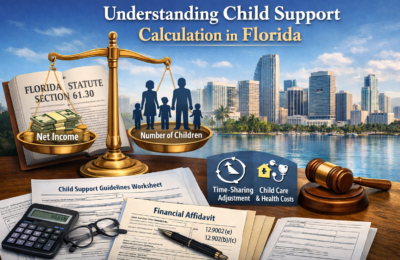
The calculation of child support in Florida is primarily governed by the statutory guidelines contained in Florida Statute § 61.30. These guidelines establish a presumptive support amount based on the combined net monthly income of both parents and the number of children involved in the case. Courts determine each parent’s proportionate share of the total obligation according to their percentage of the combined income.
The calculation process begins by determining each parent’s gross income. Gross income includes wages, salary, commissions, bonuses, business income, disability benefits, pension income, and various other forms of compensation. Certain deductions are then applied to determine each parent’s net monthly income. These deductions may include federal income taxes, mandatory retirement contributions, health insurance premiums for the child, and court ordered support obligations for other children.
Once each parent’s net income is determined, the court combines the figures and refers to the statutory child support guidelines schedule. The schedule provides the minimum child support obligation for families within specific income ranges. When the combined income exceeds the highest level in the schedule, the statute provides additional percentages that apply to the excess income.
The resulting figure represents the presumptive child support obligation. Each parent is responsible for a portion of this amount proportional to his or her share of the combined income. The parent who spends less time with the child generally pays support to the parent who exercises the majority of time sharing.
Florida courts treat the guideline amount as presumptively correct. However, courts may deviate from the guideline amount by up to five percent when appropriate circumstances exist. When a deviation greater than five percent occurs, the court must make written findings explaining why the guideline amount would be unjust or inappropriate.
Common factors that may justify deviation include extraordinary medical expenses, special educational needs of the child, seasonal variations in income, or the financial impact of significant time sharing arrangements. These adjustments allow courts to tailor support awards to the unique needs of each family while preserving the predictability of the statutory guidelines.
Retroactive Child Support in Florida
Florida courts may award retroactive child support when a parent has failed to provide adequate support before the filing of a legal action. Under Florida Statute § 61.30, retroactive support may generally extend up to twenty four months before the date the petition was filed.
In determining the amount of retroactive support, courts examine the obligor parent’s actual income during the retroactive period as well as any voluntary support payments already made. Courts may establish a payment schedule that allows the obligor to satisfy the retroactive obligation over time while also meeting ongoing support requirements.
Florida appellate courts have clarified the application of retroactive support in several cases. In Department of Revenue v. E.P., 373 So. 3d 395 (Fla. 2d DCA 2023), the court examined issues involving retroactive support calculations and the application of statutory guidelines. Similarly, Dart v. Dart, 429 So. 3d 2 (Fla. 4th DCA 2026), addressed the treatment of income and support obligations when determining retroactive awards.
These cases demonstrate that retroactive support determinations require careful analysis of financial records and equitable considerations. Courts aim to balance fairness to the obligor parent with the fundamental principle that children should receive consistent financial support.
Duration of Child Support Under Florida Law
In most cases, child support obligations continue until the child reaches eighteen years of age. However, Florida law recognizes several circumstances in which support may continue beyond that age.
If a child is between the ages of eighteen and nineteen, still enrolled in high school, and reasonably expected to graduate before turning nineteen, the court may order continued support. This provision reflects the Legislature’s recognition that many students remain financially dependent while completing their secondary education.
Florida law also provides for support of dependent adult children under Florida Statute § 61.1255. This statute allows courts to order support for adult children who are unable to support themselves due to mental or physical incapacity that began before the age of majority.
The Florida Supreme Court and district courts have recognized the importance of ensuring financial protection for dependent adult children. In Department of Revenue v. Vobroucek, 259 So. 3d 228 (Fla. 2d DCA 2018), the court addressed issues related to the continuation of support obligations and clarified the legal framework governing post majority support.
Modification of Child Support Orders
Child support orders are not necessarily permanent. Florida courts retain jurisdiction to modify child support when a substantial change in circumstances occurs. The party seeking modification must demonstrate that the change is material, substantial, and unanticipated at the time the original order was entered.
Common grounds for modification include significant increases or decreases in parental income, changes in the child’s needs, alterations in time sharing arrangements, or substantial medical expenses. Courts analyze these changes within the context of the statutory guidelines to determine whether a revised support amount is appropriate.
The case of Gonzalez v. Calles, 402 So. 3d 402 (Fla. 3d DCA 2024), illustrates the application of modification principles. In that case, the court concluded that a substantial increase in a parent’s income justified an upward modification of child support because the original award no longer reflected the parents’ financial circumstances.
Florida law also addresses the impact of subsequent children on child support calculations. While the existence of additional children may justify deviation in certain circumstances, it generally cannot be used as a basis to reduce an existing child support obligation unless the case involves an upward modification proceeding.
Enforcement of Child Support Orders in Florida
Florida provides several mechanisms to enforce child support obligations. Courts may enter income deduction orders requiring an employer to withhold child support payments directly from the obligor parent’s paycheck. These orders help ensure consistent and timely payments.
Additional enforcement tools include license suspension, tax refund intercepts, contempt proceedings, and liens against property. In cases involving public assistance, the Florida Department of Revenue may also pursue enforcement actions under federal Title IV D child support programs.
Another important enforcement issue involves credit for Social Security benefits paid on behalf of the child. When a child receives derivative Social Security benefits due to a parent’s disability or retirement, the obligor parent may seek credit toward the child support obligation. Courts examine the amount of the benefits and determine whether the payments satisfy or offset the support obligation.
Child Support Litigation in Miami and South Florida
In Miami and throughout South Florida, child support disputes frequently arise in divorce, paternity, and modification proceedings filed in the Eleventh Judicial Circuit of Florida. The court applies the same statutory framework described above but must also evaluate local economic conditions, employment patterns, and family dynamics.
Miami’s diverse economy often results in complex income calculations involving self employment income, international assets, commissions, and variable compensation structures. Accurate financial disclosure is essential in these cases because even small discrepancies in reported income can significantly affect the support calculation.
Family law practitioners in Miami must also address cases involving high net worth parents, international custody disputes, and fluctuating income streams common in industries such as real estate, hospitality, and international trade. These cases require careful application of Florida’s statutory guidelines to ensure that the resulting support award reflects the child‘s best interests.
Why Legal Guidance Matters in Child Support Cases
Although the statutory guidelines provide a structured framework, the calculation and enforcement of child support can become complex in practice. Issues such as self employment income, hidden assets, deviations from guideline amounts, and enforcement disputes frequently require careful legal analysis.
Parents involved in child support disputes often benefit from consulting a family law attorney familiar with Florida’s statutory framework and the procedures of local courts. Effective representation helps ensure that financial disclosures are accurate, guideline calculations are correct, and the resulting support order protects the child‘s interests.
Conclusion
Child Support under Florida Law reflects a carefully designed legal system intended to protect children and ensure that both parents share responsibility for their financial well being. Through statutory guidelines, judicial oversight, and enforcement mechanisms, Florida courts strive to create fair and predictable outcomes in family law cases.
The statutory framework established by Florida Statutes §§ 61.29 and 61.30 provides a structured approach to calculating child support while preserving judicial discretion to address unique circumstances. Appellate decisions such as Department of Revenue v. E.P., Dart v. Dart, Department of Revenue v. Vobroucek, and Gonzalez v. Calles further clarify the application of these statutes and guide courts in resolving disputes.
For parents navigating divorce, paternity, or modification proceedings in Miami or elsewhere in Florida, understanding the legal principles governing child support is essential. Proper application of these laws ensures that children receive the financial support necessary for their health, education, and overall development.
If you are facing a child support dispute in Miami, consulting an experienced Florida family law attorney can help you understand your rights, evaluate potential outcomes, and develop a strategy tailored to your family’s circumstances.
TLDR: Child Support under Florida Law is determined using statutory guidelines that allocate financial responsibility between parents based on their combined income and the number of children involved. Florida courts may modify or enforce child support orders when circumstances change, always prioritizing the best interests of the child.
What is child support under Florida law?
Child support under Florida law is a financial obligation requiring both parents to contribute to the expenses of raising their child. The amount is calculated using statutory guidelines found in Florida Statute § 61.30.
How is child support calculated in Florida?
Child support is calculated using the parents’ combined net income and the number of children involved. Each parent pays a proportionate share based on their income.
How long does child support last in Florida?
Child support usually continues until the child turns eighteen, but it may continue until age nineteen if the child is still in high school.
Can child support be modified in Florida?
Yes. A court may modify child support when a substantial change in circumstances occurs, such as a significant change in income or the child’s needs.
Can child support be enforced in Florida?
Yes. Courts may enforce child support through income deduction orders, contempt proceedings, and other enforcement mechanisms.