
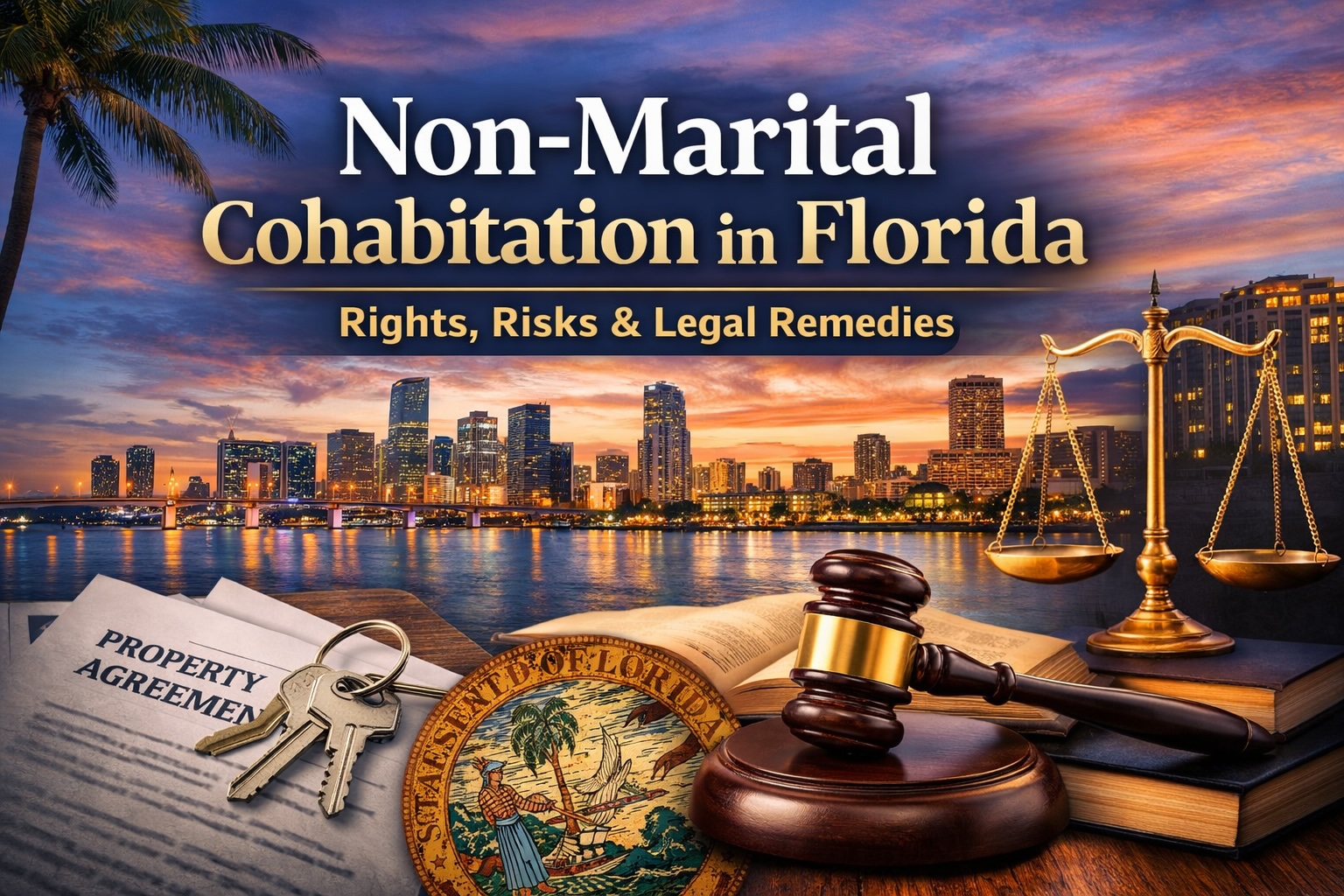
10 Jun Non-Marital Cohabitation in Florida: Rights, Risks, and Legal Remedies
Summary
This article explains Non-Marital Cohabitation in Florida, including property rights, contract enforcement, constructive trusts, supportive relationships under Fla. Stat. § 61.14, and key cases such as Armao v. McKenney and Stevens v. Muse, with Miami-specific legal considerations.
Non-Marital Cohabitation in Florida is a legally distinct relationship status that affects property rights, contract enforcement, and alimony modification. In Miami and throughout Florida, many couples live together without marriage, yet Florida law does not provide the same statutory protections afforded to spouses. Understanding how Non-Marital Cohabitation in Florida is treated under statutes and case law is essential for protecting financial interests and avoiding unintended legal consequences.
Definition of Non-Marital Cohabitation in Florida
Non-Marital Cohabitation in Florida describes a relationship in which two individuals reside together in a manner resembling marriage, often sharing expenses, property, and an intimate relationship, without entering into a legally valid marriage. Florida abolished common-law marriage effective January 1, 1968. Fla. Stat. § 741.211. Accordingly, couples who begin cohabiting after that date cannot create a marriage merely by living together or holding themselves out as spouses.
The statute preserves valid common-law marriages entered into before January 1, 1968 or those formed in jurisdictions where common-law marriage is recognized. Fla. Stat. § 741.211. However, modern Non-Marital Cohabitation in Florida does not confer marital status, regardless of duration or public presentation.
Florida courts have consistently distinguished cohabitation from marriage for purposes of property division and alimony. Without a valid marriage, equitable distribution under Chapter 61 does not apply. This distinction has significant implications for Miami residents who accumulate assets while living together outside of marriage.
Florida’s Abolition of Common Law Marriage
The legal framework for Non-Marital Cohabitation in Florida begins with Fla. Stat. § 741.211. This statute abolished common-law marriages entered into after January 1, 1968. The legislative intent was to require formal solemnization and licensing to create a valid marriage. Consequently, couples cannot obtain marital rights by implication, conduct, or duration of cohabitation alone.
For Miami couples who may believe that long-term cohabitation creates marital rights, this statute provides a clear legal boundary. Without compliance with Florida’s marriage statutes, no marital estate exists for purposes of equitable distribution under Chapter 61.
Property Rights in Non-Marital Cohabitation in Florida
One of the most misunderstood aspects of Non-Marital Cohabitation in Florida involves property rights. Married spouses benefit from equitable distribution under Chapter 61 of the Florida Statutes. Unmarried cohabitants do not. There is no statutory framework granting automatic rights to assets acquired during cohabitation.
Instead, disputes between cohabitants are governed by general civil law principles, including contract law and equitable remedies. Florida courts have recognized that unmarried partners may pursue claims based on express contracts, implied contracts, constructive trusts, resulting trusts, and quantum meruit where legally appropriate.
Express and Implied Contracts Between Cohabitants
Florida courts recognize that cohabitants may enter into enforceable agreements concerning property and financial arrangements, provided the agreement is supported by lawful consideration independent of sexual relations. In Stevens v. Muse, 562 So. 2d 852 (Fla. 5th DCA 1990), the court acknowledged that agreements between unmarried partners are not void per se, so long as they are not founded upon meretricious consideration.
More recently, Armao v. McKenney, 218 So. 3d 481 (Fla. 3d DCA 2017), reaffirmed that contracts between cohabitants are enforceable when based on valid consideration separate from the relationship itself. This decision is particularly relevant in Miami, as it originated from the Third District Court of Appeal, which has jurisdiction over Miami-Dade County.
Florida’s statute of frauds, Fla. Stat. § 725.01, requires certain agreements to be in writing, including those made upon consideration of marriage. However, the statute does not automatically invalidate all oral agreements between cohabitants. Where the agreement does not fall within the statute’s enumerated categories and is supported by lawful consideration, it may be enforceable.
Constructive Trusts and Resulting Trusts
When no formal contract exists, Florida courts may impose equitable remedies to prevent unjust enrichment. In Castetter v. Henderson, 113 So. 3d 153 (Fla. 1st DCA 2013), the court articulated the elements required to impose a constructive trust, including a promise, transfer of property in reliance on that promise, a confidential relationship, and unjust enrichment.
Constructive trusts are frequently litigated in cases of Non-Marital Cohabitation in Florida where one partner contributes financially to property titled solely in the other partner’s name. Miami courts apply these equitable principles carefully, requiring clear and convincing evidence to justify imposing such a remedy.
Quantum Meruit and Unjust Enrichment
Quantum meruit allows recovery for the reasonable value of services rendered when no enforceable contract exists. In the context of Non-Marital Cohabitation in Florida, this may arise when one partner provides substantial labor or financial contributions with the expectation of compensation. Florida courts analyze these claims under traditional equitable standards, focusing on benefit conferred and inequitable retention of that benefit.
Supportive Relationships and Alimony Modification
Although Non-Marital Cohabitation in Florida does not create marital rights, it may affect existing alimony obligations. Fla. Stat. § 61.14 authorizes modification or termination of alimony when the obligee enters into a supportive relationship. The statute directs courts to consider economic realities rather than the mere label of cohabitation.
In Linstroth v. Dorgan, 2 So. 3d 305 (Fla. 4th DCA 2008), the court emphasized that the focus is on financial interdependence and support. Similarly, Murphy v. Murphy, 201 So. 3d 18 (Fla. 4th DCA 2013), reinforced that a supportive relationship analysis requires evaluation of shared expenses, pooling of assets, and the extent to which the new relationship reduces the recipient’s need for alimony.
For Miami family law litigants, the presence of Non-Marital Cohabitation in Florida may therefore have significant consequences in post-judgment proceedings. Courts examine factors such as length of cohabitation, shared bank accounts, joint purchases, and financial support.
Statutory Framework Governing Non-Marital Cohabitation in Florida
Several key statutes govern the legal implications of Non-Marital Cohabitation in Florida. Fla. Stat. § 741.211 abolishes common-law marriage. Fla. Stat. § 725.01 addresses enforceability of certain agreements under the statute of frauds. Fla. Stat. § 61.14 governs alimony modification based on supportive relationships.
These statutes operate together to define the legal boundaries of cohabitation in Florida. While Chapter 61 provides comprehensive remedies for married parties, unmarried cohabitants must rely on contract and equity principles.
Public Policy and Modern Jurisprudence
Historically, courts were reluctant to enforce agreements between unmarried partners based on public policy concerns. Modern Florida jurisprudence has evolved. As recognized in Stevens v. Muse and Armao v. McKenney, agreements supported by lawful consideration are not automatically void. The focus is on the nature of consideration rather than moral judgments about the relationship.
This shift reflects changing societal norms in Miami and throughout Florida, where Non-Marital Cohabitation in Florida has become increasingly common. Nevertheless, the absence of statutory protections remains a critical distinction.
Miami-Specific Considerations
In Miami-Dade County, high property values and complex financial arrangements make Non-Marital Cohabitation in Florida particularly significant. Real estate ownership disputes frequently arise when unmarried couples purchase property together without written agreements. The Third District Court of Appeal decisions, including Armao v. McKenney, provide binding precedent for Miami courts.
Miami practitioners must carefully analyze title documents, contribution evidence, and contractual arrangements. Failure to formalize agreements can result in protracted litigation in the Eleventh Judicial Circuit.
Risk Management for Cohabitants
Given the absence of marital protections, individuals engaged in Non-Marital Cohabitation in Florida should consider written cohabitation agreements. Such agreements can clarify property ownership, expense allocation, and dispute resolution mechanisms. Proper drafting ensures compliance with Fla. Stat. § 725.01 where applicable and avoids ambiguity that could undermine enforceability.
Without proactive planning, cohabitants may face uncertain outcomes governed solely by equitable doctrines that require substantial evidentiary proof.
Conclusion
Non-Marital Cohabitation in Florida remains legally distinct from marriage. Florida abolished common-law marriage under Fla. Stat. § 741.211, limiting cohabitants’ access to equitable distribution and statutory protections. Property disputes are resolved through contract law, constructive trusts, resulting trusts, and quantum meruit principles as articulated in Stevens v. Muse, Armao v. McKenney, and Castetter v. Henderson. Alimony obligations may be modified under Fla. Stat. § 61.14 if a supportive relationship exists, as clarified in Linstroth v. Dorgan and Murphy v. Murphy.
For Miami residents, the financial stakes of Non-Marital Cohabitation in Florida are substantial. Clear agreements and informed legal guidance are essential to protect assets and avoid unintended liabilities.
Speak with a Miami Family Law Attorney
If you are living in a Non-Marital Cohabitation in Florida relationship or facing a property or alimony dispute in Miami, strategic legal advice is critical. Whether drafting a cohabitation agreement, defending a supportive relationship claim, or pursuing equitable remedies, experienced representation can protect your rights. Contact a Miami family law attorney to evaluate your situation and develop a proactive strategy tailored to Florida law.
TLDR: What Is Non-Marital Cohabitation in Florida? Non-Marital Cohabitation in Florida refers to two unmarried individuals living together in a marriage-like relationship without a valid legal marriage. Florida abolished common-law marriage after January 1, 1968 under Fla. Stat. § 741.211. As a result, cohabiting partners do not receive equitable distribution rights, spousal inheritance rights, or automatic financial protections. Disputes are resolved through contract principles, equitable remedies such as constructive trusts, and other civil claims recognized by Florida courts.
FAQ: Non-Marital Cohabitation in Florida
Does living together create a common-law marriage in Florida?
No. Fla. Stat. § 741.211 abolished common-law marriage after January 1, 1968. Cohabitation alone does not create marital rights.
Can unmarried partners divide property like married couples?
No. Equitable distribution applies only to valid marriages under Chapter 61. Unmarried partners must rely on contract and equitable claims.
Are cohabitation agreements enforceable in Florida?
Yes, if supported by lawful consideration independent of sexual relations, as recognized in Stevens v. Muse and Armao v. McKenney. Certain agreements may need to comply with Fla. Stat. § 725.01.
Can alimony be terminated if a former spouse cohabits?
Possibly. Under Fla. Stat. § 61.14, courts may modify or terminate alimony if a supportive relationship exists, considering financial interdependence and shared support.
What remedies are available if I contributed to property titled in my partner’s name?
Florida courts may impose a constructive trust or recognize equitable claims under Castetter v. Henderson if the legal elements are proven.