
10 Mar Can Child Support Be Paid Directly to the Child in Florida?
Summary
Florida law requires child support to be paid to the custodial parent or through designated state payment channels, not directly to the child, unless a court explicitly orders otherwise. Parents seeking to redirect payments must file a formal petition for modification in family court, as unauthorized arrangements risk noncompliance findings, arrears, and contempt sanctions.
Whether child support can be paid directly to the child in Florida is a question that arises with surprising frequency in Miami family law proceedings, particularly as children grow into their teenage years and parents begin to question whether the traditional framework still makes practical sense. Florida law, however, provides a clear structural answer that prioritizes judicial oversight, statutory compliance, and the preservation of a child’s fundamental right to financial support. Understanding how that framework operates, and why it exists, is essential for any parent or practitioner navigating a child support dispute in Miami-Dade County or anywhere else in the State of Florida.
At its core, Florida’s statutory scheme governing child support was designed to ensure that children receive consistent and enforceable financial support, and that neither parent can unilaterally alter the terms of a court-ordered support obligation without judicial sanction. Consequently, the question of whether child support can be paid directly to the child in Florida requires an examination of the governing statute, the relevant case law, and the practical realities of family court proceedings throughout South Florida.
This article explores the statutory framework established under section 61.13 of the Florida Statutes, the judicial interpretations developed through Florida appellate decisions, and the implications for Miami families who find themselves wondering whether a different payment arrangement might better serve the needs of their children. As will be demonstrated, Florida law does not recognize a general right to pay child support directly to the child, and any deviation from the court-ordered payment mechanism requires explicit judicial authorization.
The Statutory Framework for Child Support Payments in Florida
Florida’s statutory framework for child support begins with section 61.13 of the Florida Statutes, which serves as the primary legislative vehicle through which courts exercise authority over child support obligations. That statute grants Florida courts broad discretion to “order either or both parents” to pay support, and it frames that support as payable “to the other parent.” This language is not incidental. It reflects a deliberate legislative choice to route child support through the custodial parent rather than to the child directly, and it forms the foundation upon which Florida courts have consistently resisted efforts to circumvent the traditional payment structure.
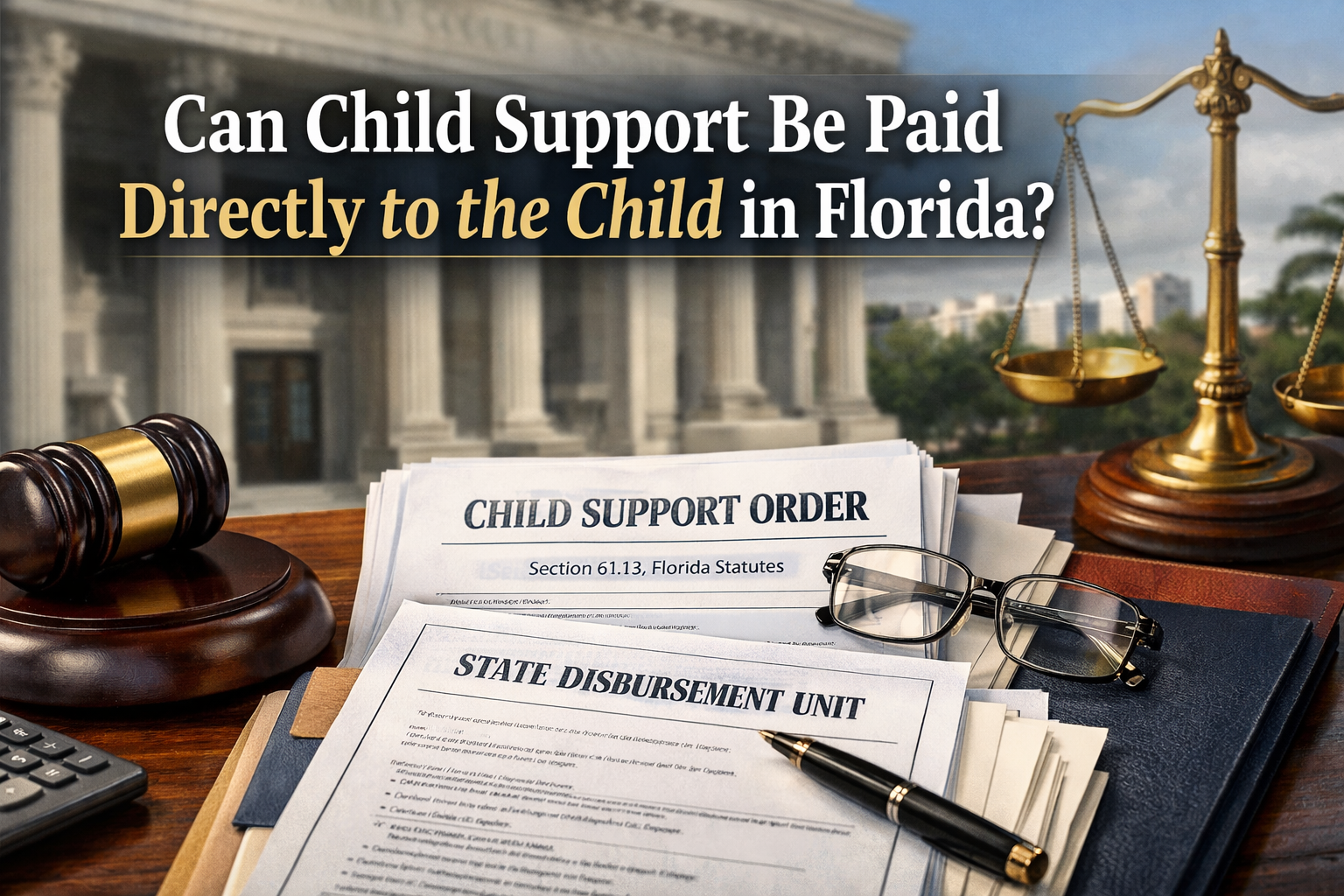
Additionally, section 61.13 addresses the specific mechanisms by which child support payments must be routed once a court order is in place. The statute contemplates three primary channels: payment through immediate income deduction to the State Disbursement Unit, payment directed through the depository, or, where both parties request it and the court finds it in the child’s best interest, payment made directly to the obligee. In each case, however, the statute is clear that the obligee, meaning the person to whom support is legally owed under the court’s order, is the recipient parent, not the child. This distinction carries significant consequences for any parent who believes that paying the child directly constitutes compliance with a child support order.
The State Disbursement Unit plays a particularly important role within this statutory framework. Florida law requires that when income deduction is ordered, payments flow through the State Disbursement Unit as a centralized collection and disbursement mechanism. This structure was implemented to enhance enforceability, provide a clear record of payments, and reduce disputes over whether support has actually been received. When parents attempt to bypass this structure by paying the child directly, they risk being found in noncompliance with the court’s order, regardless of whether the child actually received and benefited from those payments.
Understanding the Role of the Obligee in Florida Child Support Law
A precise understanding of the term “obligee” is essential to understanding why direct payment to the child is generally impermissible under Florida law. In the context of Florida’s child support statutes, the obligee is the party to whom the duty of support is owed under the existing court order. In the overwhelming majority of cases, that party is the custodial parent or the parent with primary timesharing, not the child. This legal distinction has important practical consequences, because it means that when a court order directs a payor parent to make support payments, the legal obligation runs to the obligee parent, not to the child as an individual.
The appellate decision in Amiot v. Olmstead, 321 So. 3d 305 (Fla. 1st DCA 2021), illustrates this principle clearly. In that case, the court reaffirmed that the authority to order child support is framed in terms of directing one parent to pay support to the other parent. The decision reinforces the statutory structure of section 61.13 and makes clear that the default legal framework does not contemplate the child as a direct payee of court-ordered support. For Miami families, this means that any informal arrangement in which the payor parent sends money directly to the child, rather than to the obligee parent, creates the very real risk of a noncompliance finding and potential contempt proceedings.
Can Parents Agree to Pay Child Support Directly to the Child in Florida?
One of the most common misconceptions among parents navigating Florida child support matters is the belief that a mutual agreement between the parents to redirect support payments directly to the child somehow resolves the legal problem. Parents often reason that because both adults consent to the arrangement, the child’s interests are adequately protected and no judicial involvement is necessary. Florida law, however, firmly rejects this reasoning, and the relevant case law makes clear that parental agreements regarding child support remain subject to ongoing court oversight regardless of the parties’ intentions.
The Florida appellate decision in Golson v. Golson, 207 So. 3d 321 (Fla. 5th DCA 2016), stands as one of the clearest judicial articulations of this principle. In Golson, the court reaffirmed that parents cannot contract away a child’s right to support, and that a custodial parent cannot waive the child‘s entitlement to support through acquiescence in nonpayment or through informal agreement. The child’s right to support, in other words, belongs to the child, not to the parents. As a result, neither parent has the unilateral authority to restructure the manner in which support is paid in a way that may diminish the child’s protected right to receive that support as mandated by court order.
This principle has profound implications for parents in Miami who believe they have reached an understanding with one another regarding direct payment to the child. Even if both parents agree that the arrangement is financially sensible, perhaps because the child is a teenager who is managing his or her own expenses, that private agreement does not constitute a modification of the court’s order. Absent a court-approved modification, the original order remains in full effect, and the payor parent remains legally obligated to comply with its terms. A payment made directly to the child, rather than to the obligee parent or through the designated payment mechanism, does not discharge the payor’s legal obligation under the existing order.
The Limits of Parental Autonomy in Florida Child Support Agreements
Florida courts have long recognized that parental autonomy in the realm of child support is significantly constrained by the state’s interest in protecting children’s welfare. Accordingly, even when parents reach a voluntary agreement regarding the modification of child support terms, that agreement is subject to court approval and remains modifiable upon a showing of changed circumstances. The Florida appellate decision in Zolonz v. Zolonz, 659 So. 2d 451 (Fla. 4th DCA 1995), addressed precisely this dynamic, confirming that agreements between parents regarding child support remain subject to the state’s power to control and regulate, and that courts retain the authority to modify those agreements when circumstances change.
The significance of Zolonz for the question of direct payment to the child is twofold. First, it establishes that parental agreements, even those that are voluntarily and thoughtfully negotiated, do not operate outside the court’s continuing jurisdiction over child support matters. Second, it confirms that the court’s power to revisit and modify support arrangements is not limited by what the parents themselves may have decided is best. For Miami parents considering a private arrangement to redirect child support payments, Zolonz serves as a cautionary reminder that such arrangements carry legal risk and may not be enforced as the parties intend.
Furthermore, the intersection of Golson and Zolonz creates a legal environment in which parents who attempt to circumvent the court-ordered payment structure through informal agreement may find themselves in a particularly difficult position. The paying parent cannot rely on the receiving parent’s acquiescence as a defense to a noncompliance finding, and the receiving parent cannot validly waive the child’s right to properly routed support. As a practical matter, then, any modification to the payment structure, including any arrangement to pay the child directly, must be formalized through the family court system.
Circumstances Where Direct Payment to the Child May Be Authorized in Florida
Although Florida law does not recognize a general or automatic right to pay child support directly to the child, it does not categorically prohibit such an arrangement under all circumstances. Rather, the existing legal framework suggests that direct payment to the child may be authorized, or at least accommodated, if the court itself explicitly structures the support order to permit or require such payment. The key distinction is between an unauthorized, informal redirection of payments made by one or both parents acting unilaterally, and a court-sanctioned modification that expressly designates the child as the payee.
Under section 61.13 of the Florida Statutes, the court’s authority over child support is broad and continuing. A court that finds it appropriate, given specific facts and circumstances, to direct support payments to the child rather than to the custodial parent retains the discretion to structure the order accordingly. This might arise, for example, in circumstances involving an older teenager who is financially independent, a situation in which the custodial parent has been found to misappropriate support funds, or a case in which the child is otherwise legally emancipated. In each of these situations, however, the authorization for direct payment must come from the court itself, not from the parents’ private agreement.
It is also worth noting that Florida’s child support framework contemplates the child’s best interest as the overriding standard in all support determinations. While that standard does not automatically translate into a right to receive support directly, it does provide the legal basis upon which a court might conclude, in an appropriate case, that direct payment to the child better serves the child’s interests than the traditional routing mechanism. Courts in Miami-Dade County and throughout South Florida have the inherent authority to fashion relief that serves the child’s welfare, provided that relief is consistent with the governing statute and the broader principles of Florida family law.
Emancipation and Its Effect on Child Support Obligations in Florida
The concept of emancipation is closely related to the question of direct child support payment, because emancipation fundamentally changes the child’s legal status and may affect how support is structured going forward. Under Florida law, a child who has been emancipated is no longer considered a minor for purposes of parental support obligations, and the traditional child support framework may no longer apply in the same way. However, it is important to recognize that emancipation does not automatically redirect child support to the child, nor does it excuse the paying parent from compliance with an existing order until that order has been formally modified by the court.
For Miami families navigating these issues, the practical takeaway is that even in cases involving older teenagers or circumstances that might seem to call for a different payment structure, the path to any legally recognized change runs through the family court. Filing a petition for modification of child support, seeking a formal order addressing the payment mechanism, or requesting a judicial determination that direct payment is appropriate in the circumstances are all proper avenues for addressing the concern. Acting unilaterally, by contrast, creates legal exposure that no family, and no attorney, should be willing to accept.
Child Support Enforcement and the Consequences of Unauthorized Payment Arrangements in Florida
Understanding the enforcement landscape is essential for any Miami parent who is considering, or who has already implemented, an informal arrangement to pay child support directly to a child. Florida’s child support enforcement mechanisms are robust and far-reaching, and a finding of noncompliance with a child support order can have serious consequences, including wage garnishment, license suspension, passport denial, contempt of court proceedings, and, in egregious cases, incarceration. These consequences do not disappear simply because the paying parent can demonstrate that money was transferred to the child rather than to the obligee parent.
The reason for this unforgiving enforcement posture is grounded in the same policy rationale that underlies the entire child support statutory scheme. Florida’s legislature and courts have determined that consistent, traceable, court-compliant payment of child support is essential to children’s welfare. When parents are allowed to self-help by redirecting payments outside the court-ordered channel, the enforcement system breaks down, records become unreliable, and children’s long-term financial security is placed at risk. For this reason, Florida courts have consistently held that payments made outside the court-ordered mechanism, including direct payments to the child, do not constitute credit against the paying parent’s legal obligation absent explicit court approval.
In practical terms, this means that a Miami parent who has been paying child support directly to a teenage child for months or years, believing in good faith that this arrangement serves the child’s interests, may nonetheless be found to be in arrears under the existing court order. The custodial parent’s acquiescence in the informal arrangement provides no defense, as established in Golson v. Golson, 207 So. 3d 321 (Fla. 5th DCA 2016), and the paying parent’s good intentions do not transform an unauthorized payment into a court-compliant one. This is a harsh result, but it reflects the legislature’s deliberate policy choice to prioritize enforcement integrity over informal flexibility.
Income Deduction Orders and the State Disbursement Unit
Florida’s income deduction system provides an additional layer of structural complexity that makes unauthorized payment arrangements particularly risky. When a court enters an income deduction order, the paying parent’s employer is directed to withhold the support obligation from the employee’s wages and transmit it directly to the State Disbursement Unit. In this context, any attempt by the paying parent to redirect support payments to the child would require either the modification of the income deduction order or the separate payment of additional funds to the child, with the income deduction continuing to operate in parallel.
The existence of an active income deduction order eliminates the practical option of simply redirecting payments without judicial involvement. Even a paying parent who genuinely believes that direct payment to the child is in everyone’s best interest has no lawful mechanism for accomplishing that goal without court intervention when an income deduction order is in place. This structural reality serves as a powerful reminder that the solution to concerns about payment routing is not self-help, but rather the formal invocation of the court’s continuing jurisdiction over child support matters.
Modifying a Child Support Order to Address Payment Routing in Miami, Florida
For Miami parents who have legitimate concerns about how child support payments are being used by the custodial parent, or who believe that direct payment to the child would better serve the child’s needs, the appropriate legal remedy is a petition for modification of the existing child support order. Florida’s modification framework, established under section 61.13, provides a pathway for parents to seek judicial relief when circumstances have changed sufficiently to warrant a different approach. The modification process, while more involved than an informal agreement, provides the legal certainty and enforceability that informal arrangements cannot.
To successfully petition for modification of a child support order in Florida, the moving party must generally demonstrate a substantial, material, and unanticipated change in circumstances since the entry of the existing order. The courts of Miami-Dade County and the broader South Florida region have applied this standard consistently, and they require more than a general sense that the current arrangement is impractical. However, where the moving party can demonstrate concrete evidence that the current payment mechanism is not serving the child’s best interest, the court has broad authority to craft an appropriate remedy, including, potentially, an order directing payment directly to the child.
The decision in Zolonz v. Zolonz, 659 So. 2d 451 (Fla. 4th DCA 1995), is again instructive here, because it confirms that the court’s power to modify child support arrangements is not foreclosed by the parties’ prior agreements or by the passage of time. Provided that the moving party can satisfy the requisite legal standard, the court’s continuing jurisdiction over child support matters gives it the authority to revisit and restructure the payment mechanism in a way that better serves the child’s current needs and circumstances. For Miami families, this means that the formal modification process is both available and potentially effective as a means of addressing legitimate concerns about payment routing.
How Miami Family Law Attorneys Can Help Navigate Child Support Payment Issues
Navigating the intersection of Florida’s child support statute, the relevant appellate case law, and the practical realities of family court proceedings in Miami requires experienced legal guidance. The legal landscape governing child support payment mechanisms is nuanced, and the consequences of missteps, including unauthorized payment arrangements, informal agreements that lack court approval, and unilateral modifications of the payment channel, can be severe and long-lasting. For this reason, Miami parents facing questions about direct payment to their children should consult with a knowledgeable Florida family law attorney before making any changes to their existing arrangements.
A skilled Miami family law attorney can assess the specific facts of the family’s situation, evaluate whether a formal modification petition is appropriate, and guide the client through the court process in a way that protects both the parent’s legal position and the child’s rights. Moreover, an experienced attorney can anticipate the arguments that the other side is likely to raise, advise the client on the strength of the available legal arguments, and help ensure that any resolution of the payment routing issue is properly documented and enforceable going forward.
Miami-Specific Considerations for Child Support Disputes
Miami and Miami-Dade County present a unique set of circumstances that can affect the handling of child support disputes. The area’s diverse population, the prevalence of multi-jurisdictional families, the frequency of international travel and international financial arrangements, and the complexity of Miami’s local court system all contribute to a legal environment that requires specialized knowledge and experience. For families in Miami who are grappling with questions about child support payment routing, understanding how these local factors interact with Florida’s statutory framework is essential.
Miami-Dade County’s Unified Family Court operates under administrative orders that govern the processing of family law matters, and practitioners who regularly appear in that court develop familiarity with local practices, judicial preferences, and procedural requirements that can significantly affect the outcome of child support disputes. Additionally, Miami’s proximity to international financial centers and the prevalence of foreign currency transactions mean that issues of payment compliance and documentation are often more complex than they might be in other parts of Florida.
For Miami parents who are paying or receiving child support in circumstances that involve any international dimension, including payments from abroad, bank accounts in foreign jurisdictions, or parties who travel frequently outside the United States, the importance of ensuring that child support payments flow through court-compliant channels is even greater. The enforcement mechanisms available to Florida courts, including passport denial and the interception of federal benefits, are particularly relevant in these contexts, and the risk of a noncompliance finding is correspondingly higher when payment records are complicated by international transactions.
Furthermore, the cost of living in Miami means that child support amounts in Miami-Dade County are often substantial, and the financial stakes of a noncompliance finding are correspondingly high. Parents in Miami who find themselves in a dispute over payment routing should recognize that the potential consequences extend well beyond the immediate question of where support payments are directed. Arrears, interest, attorney’s fees, and the potential for contempt sanctions all compound the financial exposure that arises from unauthorized payment arrangements, making professional legal guidance all the more important.
Conclusion
Florida law is clear that child support cannot generally be paid directly to the child in the absence of an explicit court order authorizing that arrangement. The statutory framework established under section 61.13 of the Florida Statutes directs child support payments to the obligee parent, not to the child, and the appellate decisions in Amiot v. Olmstead, 321 So. 3d 305 (Fla. 1st DCA 2021), Golson v. Golson, 207 So. 3d 321 (Fla. 5th DCA 2016), and Zolonz v. Zolonz, 659 So. 2d 451 (Fla. 4th DCA 1995) collectively establish a body of case law that strongly supports the primacy of court-ordered payment mechanisms over informal parental agreements.
For Miami families navigating these issues, the message is straightforward: any desire to redirect child support payments, whether to the child directly or through a different payment channel, must be addressed through the family court system. Informal agreements, however well-intentioned, do not constitute a valid modification of a court order, and payments made outside the court-ordered mechanism do not discharge the paying parent’s legal obligation. The solution is not self-help, but rather the formal invocation of the court’s continuing jurisdiction through a properly filed petition for modification.
Ultimately, the legal framework governing child support payment in Florida reflects a considered policy judgment that children’s financial security is best protected by a system that emphasizes judicial oversight, statutory compliance, and enforceable payment mechanisms. That framework may sometimes feel inflexible from the perspective of individual families, but it serves a vital function in ensuring that every child in Florida receives the support to which he or she is legally entitled, on the terms and through the channels that the court has determined to be appropriate.
Contact a Miami Child Support Attorney Today
If you have questions about child support paid directly to the child in Florida, or if you are facing a child support dispute anywhere in Miami-Dade County or South Florida, the Law Firm of Jeffrey Alan Aenlle, PLLC is ready to help. With a focused practice in Florida Family Law and deep familiarity with the courts and procedures of Miami-Dade County, Attorney Aenlle provides clients with the knowledgeable, strategic, and compassionate representation they need to protect their rights and their children’s futures.
Whether you need to file a petition for modification, defend against a contempt action, or simply understand your rights and obligations under an existing child support order, experienced legal guidance makes all the difference. Florida’s child support framework is complex, and the consequences of missteps can be severe and long-lasting. Do not navigate these issues alone.
Contact us today to schedule a consultation and take the first step toward resolving your child support matter with confidence and clarity. Serving clients throughout Miami, Miami-Dade County, and the greater South Florida region.
TLDR: In Florida, child support generally cannot be paid directly to the child. Under section 61.13, Florida Statutes, support is payable to the other parent or through designated payment mechanisms such as the State Disbursement Unit or the court depository. Florida courts, as confirmed in Amiot v. Olmstead, 321 So. 3d 305 (Fla. 1st DCA 2021), Golson v. Golson, 207 So. 3d 321 (Fla. 5th DCA 2016), and Zolonz v. Zolonz, 659 So. 2d 451 (Fla. 4th DCA 1995), do not recognize parental agreements that redirect support payments as valid modifications of court orders. Any change to the payment structure, including direct payment to the child, requires explicit court approval through a properly filed petition for modification.
Can I pay child support directly to my child instead of to my ex-spouse in Florida?
No. Under section 61.13, Florida Statutes, child support is payable to the other parent, not to the child. Making payments directly to your child, without a court order authorizing that arrangement, does not constitute compliance with your existing support obligation and may expose you to contempt proceedings and arrears.
What happens if both parents agree to redirect child support payments to the child in Florida?
Even if both parents agree, a private agreement to redirect child support payments does not modify the existing court order. As established in Golson v. Golson, 207 So. 3d 321 (Fla. 5th DCA 2016), parents cannot contract away a child’s right to support, and the custodial parent cannot waive compliance with the court-ordered payment mechanism through acquiescence or informal agreement.
Is there any way to legally pay child support directly to the child in Florida?
Yes, but only with explicit court authorization. If a court finds, based on specific facts and circumstances, that direct payment to the child better serves the child’s best interest, it may enter an order directing such payment. The appropriate mechanism for seeking this relief is a petition for modification of the existing child support order filed in the family court.
What are the risks of paying child support directly to my child without court approval in Florida?
Paying child support directly to your child without court approval carries significant legal risk. Florida’s enforcement mechanisms may treat such payments as noncompliant, meaning you could be found in arrears even if your child received the money. Potential consequences include contempt sanctions, wage garnishment, license suspension, and passport denial.
How does the State Disbursement Unit affect child support payments in Florida?
Florida’s State Disbursement Unit serves as a centralized collection and disbursement mechanism for child support payments when an income deduction order is in place. Payments that bypass this mechanism, including direct payments to the child, may be treated as noncompliant with the court order regardless of the payor’s good faith. Any modification of the payment routing mechanism requires court approval.
Can child support be modified to reflect direct payment to the child as they approach adulthood in Florida?
A parent may petition the family court for modification of the existing child support order based on a substantial, material, and unanticipated change in circumstances. If the court finds that such a change exists and that direct payment to the child would serve the child’s best interest, it has the authority to modify the payment structure accordingly. This inquiry is governed by section 61.13, Florida Statutes, and the guiding principles established in Zolonz v. Zolonz, 659 So. 2d 451 (Fla. 4th DCA 1995).
What should I do if I am a Miami parent concerned about how the other parent is using child support payments?
If you are a Miami parent who believes that child support payments are not being used for the benefit of your child, the appropriate course of action is to consult with an experienced Florida family law attorney. Options may include petitioning the court for modification of the existing order, requesting judicial oversight of how support funds are applied, or, in appropriate circumstances, seeking a court order directing payment through a different channel. Acting unilaterally by redirecting payments to the child without court approval is not a legally recognized solution.