

30 Jun How Long Does a Divorce Take?
Summary
A divorce in Florida can take as little as about 90 days for an uncontested case, but contested divorces involving disputes over property, support, or children often take 180 days or longer depending on complexity and court scheduling. The timeline is influenced by statutory requirements such as residency under Fla. Stat. § 61.021, the 20-day waiting period under Fla. Stat. § 61.19, compliance with procedural rules, and judicial discretion recognized in cases such as Walker v. Walker, 719 So. 2d 977 (Fla. 1998).
How long does a divorce take in Florida is one of the most common questions asked by individuals considering the dissolution of marriage. The timeline for divorce proceedings in Florida varies depending on several factors, including statutory requirements, court procedures, whether the case is contested or uncontested, and the complexity of financial or parenting issues. Florida law establishes certain mandatory prerequisites that must be satisfied before a final judgment of dissolution of marriage may be entered. However, practical realities within the court system, particularly in large jurisdictions such as Miami-Dade County, often influence the total duration of the case.
Florida family courts operate under a unified system designed to resolve domestic disputes efficiently while protecting the interests of spouses and children. Divorce proceedings are governed primarily by Chapter 61 of the Florida Statutes and the Florida Family Law Rules of Procedure. These legal frameworks establish jurisdictional requirements, procedural obligations, and substantive rules governing property division, parental responsibility, and financial support.
While many divorces are resolved quickly when spouses cooperate and reach agreements, contested divorces involving complex assets, child custody disputes, or alimony claims may take substantially longer. Understanding the statutory framework and procedural steps involved can provide valuable insight into why some divorces are finalized within months while others extend for a year or more.
Statutory Framework Governing Divorce in Florida
Residency Requirement for Filing a Divorce
Florida law requires that at least one spouse must reside in the state for six months before filing a petition for dissolution of marriage. This residency requirement is codified in section 61.021 of the Florida Statutes and serves as a jurisdictional prerequisite for the court to hear the case. If the residency requirement is not satisfied, the court lacks authority to enter a final judgment dissolving the marriage. Residency may be proven through testimony, a Florida driver license, voter registration records, or other competent evidence demonstrating that the party has lived in Florida for the required period.
In practice, the residency requirement rarely creates significant delays because most couples seeking divorce already meet this threshold. However, in situations where a spouse recently moved to Florida, the individual may need to wait until the six month residency period is satisfied before filing.
Statutory Waiting Period Before Final Judgment
Even after the petition for dissolution of marriage is filed, Florida law imposes a statutory waiting period before a final judgment may be entered. Section 61.19 of the Florida Statutes provides that a court may not enter a final judgment of dissolution of marriage until at least twenty days have passed since the filing of the original petition. The purpose of this provision is to provide a brief cooling off period that allows the parties to reconsider reconciliation or negotiate settlement.
Although the statute establishes a twenty day minimum waiting period, courts retain discretion to waive the waiting period when delay would result in injustice. In practice, most cases exceed this minimum period because the parties must complete several procedural requirements before a final hearing can occur.
Legal Grounds for Dissolution of Marriage
Florida is a no fault divorce state. Under section 61.052 of the Florida Statutes, a court may grant a dissolution of marriage when the marriage is irretrievably broken or when one spouse has been adjudicated mentally incapacitated for a period of at least three years. Because fault is not required, the focus of most divorce proceedings centers on resolving financial matters and determining appropriate parenting arrangements.
If a court determines that the marriage is not irretrievably broken, the statute authorizes the court to take certain remedial steps, including ordering counseling, continuing the proceedings for up to three months, or taking other actions designed to promote reconciliation. Although such circumstances are relatively rare, they illustrate the discretion courts possess when evaluating the viability of the marital relationship.
Procedural Timeline of Divorce Proceedings
Initiating the Divorce Case
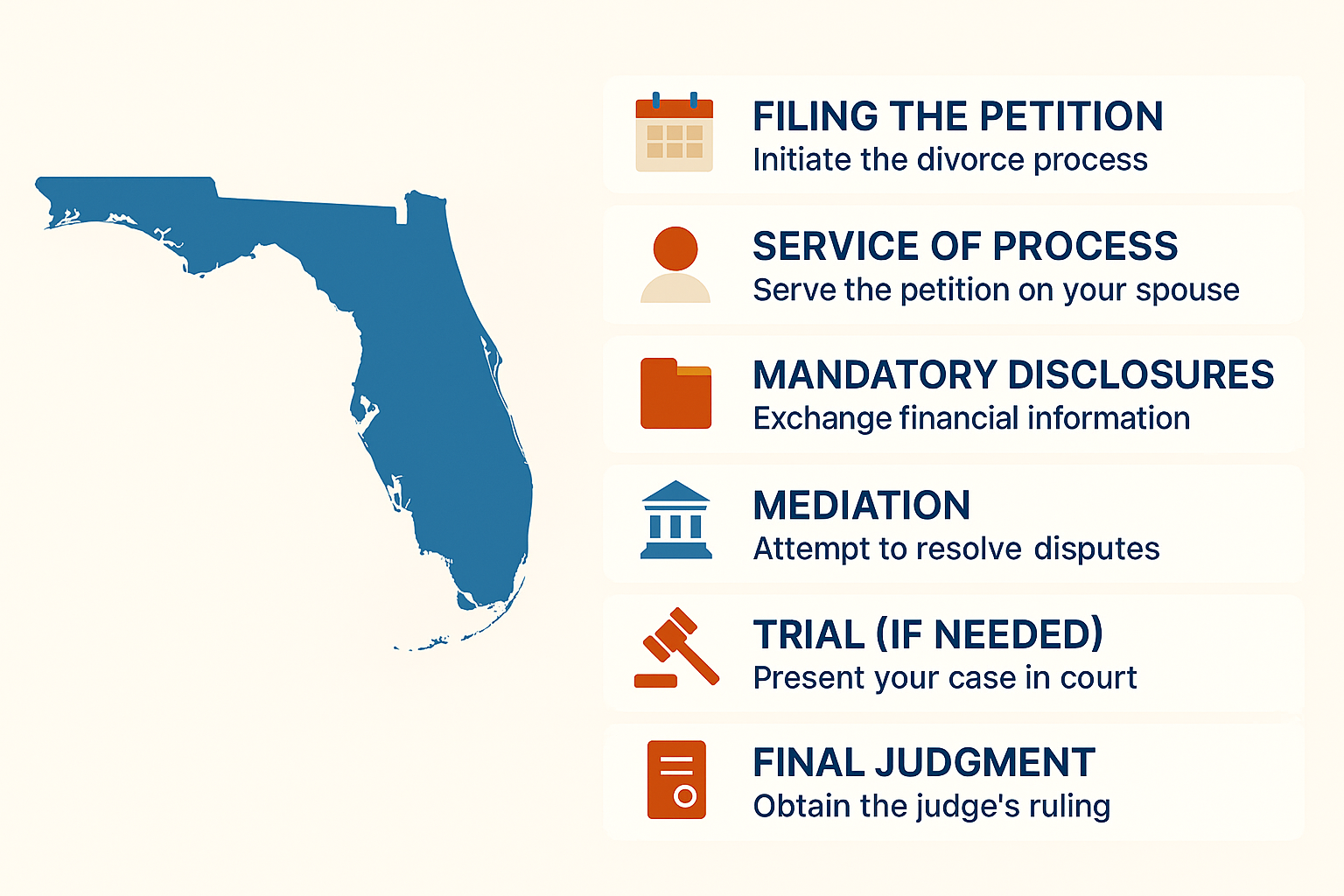
The divorce process begins when one spouse files a petition for dissolution of marriage in the circuit court of the county where either party resides. In Miami-Dade County, divorce cases are heard within the Eleventh Judicial Circuit Unified Family Court division. Once the petition is filed, the other spouse must be formally served with the legal documents unless service is waived.
After service of process, the responding spouse typically has twenty days to file an answer or responsive pleading. The filing of the answer marks the beginning of the litigation phase, during which both parties exchange information and address any contested issues.
Mandatory Financial Disclosure Requirements
Florida family law procedure requires both parties to exchange financial information early in the divorce process. Financial disclosure includes sworn financial affidavits, tax returns, pay stubs, bank records, and other documents identifying income, assets, and liabilities. Administrative orders in several Florida circuits require that these disclosures be completed within forty five days after service of the petition, including provisions contained in Fla. 9th Jud. Cir. AO 2004-05-05.
Failure to comply with mandatory disclosure requirements can result in sanctions, court orders compelling production, and delays in the progress of the case. Because financial transparency is essential for determining equitable distribution and support obligations, courts often refuse to schedule final hearings until disclosure obligations are satisfied.
Parent Education and Family Stabilization Course
When minor children are involved, Florida courts require both parents to complete a Parent Education and Family Stabilization Course. Administrative orders such as Fla. 9th Jud. Cir. AO 2004-05-05 require completion of this course within forty five days after filing or service of the petition. The course is designed to educate parents about the emotional impact of divorce on children and to promote cooperative parenting following the dissolution of marriage.
Courts typically require proof of course completion before entering a final judgment involving minor children unless the requirement is waived for good cause.
Uncontested Divorce Timeline in Florida
An uncontested divorce occurs when both spouses agree on all issues, including property division, parenting plans, child support, and alimony. Because there are no disputes requiring judicial intervention, uncontested divorces generally proceed quickly through the court system.
Florida judicial administration standards provide guidance regarding expected timeframes for case resolution. Administrative orders such as Fla. 5th Jud. Cir. AO S-2008-22 establish a general time standard of approximately ninety days from filing to final disposition for uncontested cases. These standards were developed in connection with statewide administrative reforms recognized in The Florida Bar Re Amendment to Rules of Judicial Admin. etc., 493 So. 2d 423 (Fla. 1986).
In many cases, once the statutory waiting period has passed and the parties have completed mandatory disclosures, the court may schedule a brief final hearing to approve the settlement agreement and enter the final judgment.
Contested Divorce Timeline in Florida
Contested divorces arise when spouses disagree about significant issues such as equitable distribution of assets, spousal support, child custody, or parenting time. These disputes require additional procedural steps that extend the duration of the case.
Contested cases frequently involve discovery, depositions, expert witnesses, and pretrial motions. Courts often require mediation before a final hearing can be scheduled. Administrative orders such as Fla. 5th Jud. Cir. AO M-2010-23-E emphasize the importance of mediation and case management procedures designed to promote settlement.
Under statewide administrative guidelines, contested family law cases are expected to be resolved within approximately one hundred eighty days from filing. However, the complexity of the issues and the parties’ willingness to cooperate can significantly influence whether this timeframe is achieved.
Judicial Discretion and Case Complexity
The time required to finalize a divorce ultimately depends on the circumstances of the particular case. Florida appellate courts have recognized that the definition of a reasonable timeframe for concluding divorce proceedings must be evaluated in context. In Walker v. Walker, 719 So. 2d 977 (Fla. 5th DCA 1998), the court emphasized that the determination of what constitutes a reasonable time for entry of a final judgment depends upon the facts and procedural posture of the case.
Judges possess broad discretion to manage their dockets and schedule hearings in a manner that ensures fairness and due process. When complex financial matters, contested parenting issues, or evidentiary disputes arise, additional hearings and discovery may be necessary.
Appellate decisions addressing procedural issues also influence divorce timelines. For example, the Florida Supreme Court addressed privacy considerations affecting court records in In re Implementation of Committee on Privacy and Court Records Recommendations Amendments to the Florida Rules of Civil Procedure, 78 So. 3d 1045 (Fla. 2011). These reforms required courts and litigants to follow specific procedures when handling sensitive information in court filings, which can affect document preparation and case management.
Miami Specific Considerations in Divorce Cases
Divorce cases filed in Miami-Dade County are handled by the Eleventh Judicial Circuit Unified Family Court. Miami is one of the largest metropolitan jurisdictions in Florida, and the family court division manages a substantial volume of cases each year. As a result, scheduling hearings and trial dates may take longer than in smaller counties.
Miami divorce cases frequently involve complex financial issues, including international assets, family businesses, investment properties, and retirement accounts. The presence of substantial assets often requires forensic accounting analysis, valuation experts, and additional discovery, which can extend the timeline of the case.
Miami courts also prioritize the protection of children involved in divorce proceedings. Parenting plans must address timesharing schedules, decision making authority, and the child’s best interests. Judges carefully review these arrangements before approving a final judgment.
Factors That May Delay Divorce Proceedings
Several factors commonly contribute to delays in divorce cases. Noncompliance with financial disclosure requirements is a frequent source of delay. When parties fail to produce required financial records, courts may need to issue orders compelling production or impose sanctions.
Disputes involving child custody or parental responsibility can also extend the timeline. Courts may require psychological evaluations, guardian ad litem investigations, or additional hearings before determining an appropriate parenting plan.
Litigation strategy may also affect the timeline. When parties engage in extensive discovery or file multiple motions, the case may remain pending longer than average.
Why Legal Representation Matters in Miami Divorce Cases
Navigating the Florida divorce process can be challenging without experienced legal guidance. Divorce involves complex procedural rules, financial disclosure requirements, and negotiation strategies that can significantly affect the outcome of the case.
An experienced Miami divorce lawyer can help clients comply with statutory requirements, prepare accurate financial disclosures, and negotiate settlement agreements that reduce the need for prolonged litigation. Early legal representation often leads to more efficient resolution and fewer court appearances.
Conclusion
The question of how long does a divorce take in Florida depends on several legal and practical considerations. Statutory requirements such as residency under section 61.021, the twenty day waiting period under section 61.19, and the grounds for dissolution under section 61.052 establish the legal foundation for divorce proceedings. Procedural obligations including mandatory financial disclosure, parenting education courses, and mediation further shape the timeline.
Uncontested divorces may be finalized within approximately ninety days under administrative time standards recognized in Fla. 5th Jud. Cir. AO S-2008-22 and The Florida Bar Re Amendment to Rules of Judicial Admin. etc., 493 So. 2d 423 (Fla. 1986). Contested divorces often require more time due to discovery, mediation, and court hearings, with general expectations of around one hundred eighty days. However, as recognized in Walker v. Walker, 719 So. 2d 977 (Fla. 5th DCA 1998), the reasonable timeframe for resolving a divorce ultimately depends on the unique circumstances of each case.
Individuals seeking divorce in Miami-Dade County should understand that the complexity of their case, compliance with procedural requirements, and the court’s scheduling availability all influence how quickly a final judgment may be entered.
TLDR: How long does a divorce take in Florida depends on whether the case is contested or uncontested. Uncontested divorces may be completed in about ninety days once statutory requirements such as residency, waiting periods, and financial disclosure are satisfied. Contested divorces typically take about one hundred eighty days or longer depending on disputes involving property division, alimony, or parenting issues and the court’s schedule.
What is the minimum time required for a divorce in Florida
The minimum time for a divorce in Florida is generally slightly longer than twenty days because section 61.19 requires at least twenty days to pass after filing before a final judgment can be entered. In practice most cases take longer because parties must complete disclosures and schedule a final hearing.
How long does an uncontested divorce take in Florida
Uncontested divorces often take approximately ninety days from filing to final judgment according to administrative time standards recognized in Fla. 5th Jud. Cir. AO S-2008-22 and The Florida Bar Re Amendment to Rules of Judicial Admin. etc., 493 So. 2d 423 (Fla. 1986).
How long does a contested divorce take in Florida
Contested divorces may take around one hundred eighty days or longer depending on the complexity of the issues involved and whether mediation or trial is required.
What factors delay divorce cases in Florida
Delays often occur due to incomplete financial disclosures, disputes regarding child custody or property division, or procedural issues addressed by courts in decisions such as Walker v. Walker, 719 So. 2d 977 (Fla. 5th DCA 1998).
Do Miami divorce cases take longer than other counties
In some cases divorce proceedings in Miami-Dade County may take longer because the Eleventh Judicial Circuit handles a large volume of family law cases and frequently addresses complex financial matters.